Nanjing
Template:Short descriptionScript error: No such module "other uses".Script error: No such module "Distinguish". Script error: No such module "Unsubst". Script error: No such module "Unsubst". Script error: No such module "Settlement short description".Script error: No such module "Infobox".Script error: No such module "Check for unknown parameters".Script error: No such module "Check for conflicting parameters".Expression error: Unexpected < operator
NanjingTemplate:Efn is the capital of Jiangsu, East China. The city, which is located in the southwestern corner of the province, has 11 districts, an administrative area of Script error: No such module "convert"., and as of 2021[update]Script error: No such module "Check for unknown parameters". a population of 9,423,400.[1] Situated in the Yangtze River Delta, Nanjing has a prominent place in Chinese history and culture, having served as the capital of various Chinese dynasties, kingdoms and republican governments dating from the 3rd century to 1949,[2] and has thus long been a major center of culture, education, research, politics, economy, transport networks and tourism, being the home to one of the world's largest inland ports. The city is also one of the fifteen sub-provincial cities in the People's Republic of China's administrative structure,[3] enjoying jurisdictional and economic autonomy only slightly less than that of a province.[4] It has also been awarded the title of 2008 Habitat Scroll of Honor of China, Special UN Habitat Scroll of Honor Award and National Civilized City.[5] Nanjing is also considered a Beta (global second-tier) city classification, together with Chongqing, Hangzhou and Tianjin by the Globalization and World Cities Research Network,[6] and ranked as one of the world's top 100 cities in the Global Financial Centres Index.[7]
As of 2021, Nanjing has 68 institutions of higher learning,[8][9] including 13 double-first-class universities, ten 111-plan universities, eight 211 universities, and 97 academies.[10] Nanjing University, which has a long history, is among the world's top 10 universities ranked by the Nature Index.[11] The ratio of college students to the total population ranks No.1 among large cities nationwide. Nanjing has the fifth-largest scientific research output of any city in the world.[12] As of 2024, it has been ranked as the world's second most prolific scientific research center in earth and environmental sciences and the world's third most prolific scientific research center in chemistry and physical sciences, according to the Nature Index.[13][14][15][16]
Nanjing, one of the nation's most important cities for over a thousand years, is recognized as one of the Four Great Ancient Capitals of China. It has been one of the world's largest cities, enjoying peace and prosperity despite various wars and disasters.[17][18][19][20] Nanjing served as the capital of Eastern Wu (229–280), one of the three major states in the Three Kingdoms period; the Eastern Jin and each of the Southern dynasties (Liu Song, Southern Qi, Liang and Chen), which successively ruled southern China from 317 to 589; the Southern Tang (937–75), one of the Ten Kingdoms; the Ming dynasty when, for the first time, all of China was ruled from a city, one city (1368–1421);[21] and the Republic of China (1927–37, 1946–49), serving as the internationally recognized capital of China and the seat of the central government of China under the Kuomintang, until the government's relocation to Taipei at the conclusion of the Chinese Civil War. The city also served as the seat of the rebel Taiping Heavenly Kingdom (1853–64) and the Japanese-installed collaborationist regime of Wang Jingwei (1940–45) during the Second Sino-Japanese War. It suffered devastating atrocities in both conflicts, most notably the Nanjing Massacre of 1937–38.[22][23]
Nanjing became the capital city of Jiangsu province in 1952, after serving as a Direct-administered Municipality from 1949 to 1952 following the establishment of the People's Republic of China. It has many important heritage sites, including the Presidential Palace, Sun Yat-sen Mausoleum and Ming Xiaoling Mausoleum. Nanjing is famous for human historical landscapes, mountains and waters such as Fuzimiao, Ming Palace, Chaotian Palace, Porcelain Tower, Drum Tower, Stone City, City Wall, Qinhuai River, Xuanwu Lake and Purple Mountain. Key cultural facilities include Nanjing Library, Nanjing Museum and Jiangsu Art Museum.
Script error: No such module "anchor".
Names
Script error: No such module "Redirect hatnote". Script error: No such module "infobox".
Nanjing
The name "Nanjing" (literally "Southern Capital") was formally established to designate the modern-day city in 1368, the first year of the Ming dynasty. Upon establishing his capital there, the Hongwu Emperor officially named it "Southern Capital" to distinguish it from the "Northern Capital" at Kaifeng. The name later served as a counterpart to the Northern Capital, Beijing.[24]
Nanjing, formerly romanized as Nanqim,[25] Nankin,[26] and Nanking,[27][28] was also transcribed in the Wade–Giles system as Nan-ching.
Jinling
There was a yi (settlement) known as Jinling (Script error: No such module "Lang-zh".) around the 4th century BCE in the area—mentioning the specific metal that later lore insisted must have been buried by the Chu monarch, before it was renamed Moling (Script error: No such module "Lang-zh".) after Qin's unification.[29] Between 624 and 626, the name "Jinling" was briefly restored as a county designation. By the early 10th century, the Yang Wu regime once again designated this area as Jinling. In the early Republican era, Jinling Circuit was established to administer Nanjing and its surrounding counties.[24]
Jiangning and Shangyuan
At the turn of the 4th century, Jiangning (Script error: No such module "Lang-zh".) county was established to the southwest of the former Eastern Wu capital,[24][29] with its seat located in what is now Jiangning Subdistrict. Following the Sui dynasty's destruction of Jiankang, several counties within the former metropolitan area were annexed into Jiangning, and this remained the primary designation for the county until the mid-Tang period.[24][30]
In 761, Emperor Suzong of Tang renamed the area Shangyuan (Script error: No such module "Lang-zh".), after his regnal era. In 917, Jiangning county was partitioned from the southern territories; since then, both county seats came to be located within the same walled city.[24][30] Subsequently, during the periods of 937–975, 1018–1129, and 1645–1911, the Nanjing region was designated as Jiangning Prefecture, with Shangyuan long serving as the prefectural seat.[24]
History
Script error: No such module "Labelled list hatnote". Script error: No such module "anchor".
Pre-imperial and early imperial eras

Human habitation in the Nanjing region dates to the Neolithic period. Sites near the modern urban core, including the type-site of the Beiyinyangying (Script error: No such module "Lang".) culture, contained a cemetery with 225 burials and grave goods such as polished stone tools, and jade and agate ornaments, indicating close connections with the Lake Tai region.[31] Incised pictorial marks on wide-mouthed zun pottery vessels have also been reported from Beiyinyangying and several other sites with late Dawenkou-period or related deposits.[32]
The lower strata of the Dianjiangtai (Script error: No such module "Lang".) site in Pukou are broadly contemporaneous with the Erlitou period and predate the later Hushu (Script error: No such module "Lang".) culture, named after a town in Jiangning.[33][34] During the second millennium BCE, the region was characterized by the Hushu culture, a Bronze Age archaeological complex localized to the Ning–Zhen (Nanjing–Zhenjiang) area.[34]
Archaeological excavations at the Xijie (Script error: No such module "Lang".) site on the south bank of the Qinhuai River have identified a fortified settlement with multiple concentric ditches and wall foundations dating to the Shang–Zhou transition. The remains include ring trenches, wall foundations, ash pits, postholes, wells, and tombs. Although the precise relationship between Xijie and later historically recorded cities remains uncertain, the site suggests the presence of an organized settlement in the Qinhuai River area earlier than the named urban foundations described in transmitted texts.[35]
Historical records attribute early named urban foundations in the area to the 5th century BCE: Yuecheng, reportedly built by Fan Li of Yue, and Yecheng, associated in later accounts with metallurgical activity and attributed to King Fuchai of Wu. However, their precise locations and chronologies remain subjects of academic debate. Under Chu rule, the area was known as Jinling, before being renamed Moling following the Qin unification.[29]
Capital of the Six Dynasties
Throughout the Six Dynasties period, the successive regimes based in the southeast maintained their administrative center at Jiankang (originally named Jianye) in the lower Yangtze, except for brief intervals in 221–229, 265–267, and 552–554, when the seat of government was temporarily relocated to the middle Yangtze.[36]
In 211, the warlord Sun Quan moved his headquarters from Dantu to Moling. The following year, he fortified Shitou Hill in the north of the county, constructed the Stone City, and renamed the settlement Jianye (Script error: No such module "Lang"., meaning "establishing the imperial enterprise").[37] After proclaiming himself emperor in 229, Sun Quan established his capital at Jianye and constructed the Taichu (Script error: No such module "Lang".) Palace. In 267, the larger-scale Zhaoming (Script error: No such module "Lang".) Palace was erected to its east as a new imperial residence. These early structures were largely destroyed during the Western Jin conquest and the subsequent civil wars of the early 4th century.Script error: No such module "Footnotes".Script error: No such module "Check for unknown parameters".
In 305, the local warlord Chen Min seized Jianye and reportedly repaired the ruins of the Taichu Palace, only to be ousted two years later by Sima Rui, the Prince of Langye. Sima Rui subsequently relocated his headquarters from the north of the Yangtze to the city. To avoid the naming taboo of the newly enthroned Emperor Min of Jin, the city was renamed Jiankang in 313. Following the fall of Northern China to non-Han regimes, Sima Rui formally established Jiankang as the capital in 317 and was enthroned there the following year as the founding emperor of the Eastern Jin.Script error: No such module "Footnotes".Script error: No such module "Check for unknown parameters".
During the Su Jun Rebellion (327–329), the imperial palaces were burnt to the ground, prompting a comprehensive reconstruction of the city between 330 and 332. This established the fundamental spatial layout of Jiankang for the remainder of the Southern Dynasties.Script error: No such module "Footnotes".Script error: No such module "Check for unknown parameters". Uniquely, the capital initially lacked brick walls, relying instead on natural topography and a bamboo stockade. When this stockade was expanded in 332, orange trees were planted along its exterior; formal brick walls were not constructed until around 480.[38]
While residential areas had historically concentrated south of the Qinhuai River, the expansion of the city—which grew from a single southern gate to six gates—facilitated urban development in other directions. In particular, the addition of new eastern gates encouraged the growth of the eastern suburbs, where high-ranking officials began constructing extensive estates. The formal central parklands of the city were repurposed as the primary imperial residence, commonly referred to as Taicheng (Script error: No such module "Lang"., "Terrace City").Script error: No such module "Footnotes".Script error: No such module "Check for unknown parameters".
As the political center consolidated through the late 4th century, the city's spatial layout began to reflect the intensifying factional rivalries of the court. In the 390s, a grand residence was constructed on the east side of the imperial avenue for the prince Sima Daozi, the de facto head of the Eastern Jin court. This estate was named Dongfu (Script error: No such module "Lang"., "Eastern Mansion"). Directly opposite lay Xizhoucheng (Script error: No such module "Lang"., "Western Province City"), the administrative seat of Yangzhou. In 414, to defend against rebel forces and political rivals, the Dongfu precinct was formally fortified with walls and moats, functioning as a secondary military and political center. During the subsequent Southern Dynasties, the Dongfu typically served as the headquarters for chancellors and powerful provincial governors, while the Xizhou precinct became a frequent residence for imperial princes.Script error: No such module "Footnotes".Script error: No such module "Check for unknown parameters".
After Liu Song attempts to reconquer northern China failed, the southern court increasingly presented Jiankang as a permanent and legitimate imperial capital. Since the 450s, Emperor Xiaowu undertook a series of ritual reforms to institutionalize this legitimacy. He relocated the Southern Suburbs (Script error: No such module "Lang"., the imperial altar for heaven worship) from an eccentric southeastern location to a site precisely aligned with the city's primary north–south meridian to conform with traditional cosmological canons of an imperial capital.[39]
Canals linked Jiankang to regional centers such as Yangzhou, Suzhou, and Shaoxing, making it a hub of trade. Only the imperial palaces were walled; aristocratic mansions, temples, markets, workshops, and common dwellings spread openly across the surrounding area, where princes and elites often engaged in commerce and moneylending through clients and retainers. Commercial activity centered on four large walled markets, along with smaller neighborhood markets and specialized ones for grain, raw silk, fodder, and livestock.[40]

The capital also emerged as a major cultural center. The local vernacular lyrics of the Jiankang region, collected by the southern court during the fourth and fifth centuries, were codified into the Yuefu (Music Bureau) corpus as "Songs of Wu" (Script error: No such module "Lang"., Wusheng ge).[42] By the late fifth century, local sites such as Wuyi Lane (Script error: No such module "Lang"., Black Robe Lane) and the Western Residence (Script error: No such module "Lang"., Xidi) of Xiao Ziliang, the Prince of Jingling, had become prominent gathering places for influential literary circles, most notably the "Eight Friends of Jingling" (Script error: No such module "Lang".).Script error: No such module "Footnotes".Script error: No such module "Check for unknown parameters".
Jiankang was also a center of East Asian Buddhism; by the Liang dynasty, the city reportedly housed over 500 monasteries.[43] Notably among these was the Tongtai Temple (Script error: No such module "Lang".), constructed in 527 near the imperial palace on the site of the modern Jiming Temple. To facilitate direct access to the complex, Emperor Wu ordered the construction of the Datong (Script error: No such module "Lang".) Gate in the palace's northern wall—an event that also prompted the renaming of his regnal era to Datong. The temple frequently served as the venue for major state-sponsored Buddhist assemblies, where the emperor repeatedly offered himself to the monastic community as a lay devotee.[44]

In the first half of the 6th century, the population of Jiankang likely exceeded 300,000;[45] however, the outbreak of the Hou Jing Disturbance in 548 brought an end to the city's peace. During that winter, Hou Jing, a former frontier commander, crossed the Yangtze River with the assistance of an imperial nephew seeking to usurp the throne and laid siege to Taicheng for five months. In 552, the imperial loyalist forces defeated Hou Jing and subsequently looted the city. Chen Baxian, one of the victorious generals, eventually launched a coup and ascended the throne there.Script error: No such module "Footnotes".Script error: No such module "Check for unknown parameters".
Script error: No such module "anchor".
Destruction and revival
The period of division ended when the Sui dynasty reunified China and almost destroyed the entire city, turning it into a small town. The city was razed after the Sui took it over. It was renamed Shengzhou under the Tang dynasty and revived during the late Tang.[46]
It was chosen as the capital and again called Jinling under the Southern Tang (937–976), which succeeded the state of Yang Wu.[47] It was renamed Jiangning in the Northern Song and again renamed Jiankang in the Southern Song. Jiankang's textile industry burgeoned and thrived during the Song despite the constant threat of invasions from the north by the Jurchen-led Jin dynasty. The court of Da Chu, a short-lived puppet state established by the Jurchens, and the court of Song were once in the city.[48][49] In Jianyan 3 (1129), Jiankang became the temporary capital (Script error: No such module "Lang"., Script error: No such module "Lang".) of the Song, being set as Eastern Capital (Script error: No such module "Lang"., Template:Translit).Script error: No such module "Unsubst". Although people like Yue Fei argued for maintaining the imperial court being in the city, in Shaoxing 8 (1139) it withdrew from Jiankang to Lin'an (present Hangzhou) and Jiankang relegated to the "preserving capital" (Script error: No such module "Lang"., Template:Translit).Script error: No such module "Unsubst".
The Southern Song were eventually destroyed by the Mongols. During the Mongols' rule as the Yuan dynasty, the city's status as a hub of the textile industry was further consolidated.[50] According to Odoric of Pordenone, the prefectural capital of Jinling ("Chilenfu") had 360 stone bridges, which were finer than anywhere else in the world. It was well populated and had a large craft industry.Script error: No such module "Footnotes".Script error: No such module "Check for unknown parameters". In 1239, Jiankang was renamed Jiqing (集庆).
Owing to the alternating rise and fall of the city across the Six Dynasties, Nanjing and its ancient ruins emerged as a primary topos in Chinese literature, particularly in classical poetry. These works, initially written in a positive vein, grew into a full-blown tradition of nostalgic poetry by the late Tang, known as "Meditation on the Past at Jinling" (Script error: No such module "Lang".).[51]
Script error: No such module "wide image".Script error: No such module "Check for unknown parameters".
Script error: No such module "anchor".
Southern capital of the Ming dynasty


In 1356, Zhu Yuanzhang captured Jiqing Circuit and reorganized it as Yingtian (Script error: No such module "Lang"., lit. "Responding to Heaven") Prefecture, though the city still nominally served as the Jiangnan provincial seat under Han Lin'er. In 1368, after four years as the self-proclaimed Prince of Wu, Zhu Yuanzhang ascended the throne in Nanjing as the Hongwu Emperor and established the Ming dynasty.[52]
Planning for Nanjing's layout had begun as early as 1366. By the late 14th century, Nanjing's physical form was established in four nested zones: the Forbidden City, the Imperial City, the Capital City, and the Outer Enclosure. The Capital City wall exceeded Template:Cvt, while the Outer Enclosure—a series of barriers and gates protecting the suburbs—encompassed approximately Template:Cvt.[53]
By 1391, the permanent population within the Outer Enclosure may have reached between 900,000 and one million.[54] An additional 3,000 corvée laborers were levied for firewood transport to supply the fuel needs of the entire metropolitan region from Shangyuan and Jiangning counties.[55]
Yet well into the late Hongwu reign, the court remained divided over whether Nanjing should be the permanent capital. Proposals to relocate the capital to Zhongdu (Fengyang) or to the traditional northern capitals were successively abandoned in 1375 and 1392.
In 1402, Zhu Di launched the Jingnan Campaign, stormed Nanjing, and assumed the throne as the Yongle Emperor. In 1421, he resolved to relocate the capital to his princedom Beiping, renaming it Beijing. A massive outflow ensued—soldiers, artisans, rotational corvée laborers, and merchants from other provinces departed Nanjing reducing the city's officially registered population to as little as 200,000 to 300,000.[54]
His successor, the Hongxi Emperor, attempted in 1425 to restore Nanjing's primacy, demoting Beijing to a mere "provisional" (Script error: No such module "Lang"., xingzai) capital, but the plan remained unrealized when he died shortly thereafter.[56] The next ruler, the Xuande Emperor, continued to treat Beijing as the de facto capital. In 1441, the Yingzong Emperor formally dropped the xingzai prefix from Beijing's government seals. Nanjing retained parallel central government offices, although their authority was increasingly subordinate to the Beijing counterparts.Script error: No such module "Footnotes".Script error: No such module "Check for unknown parameters".
Even after the move to Beijing, palace storehouses in Nanjing remained important logistical reserves, dispatching large quantities of imported goods such as pepper and sappanwood to the northern court.[57]
The early Ming court also launched a number of monumental construction projects in Nanjing designed to project imperial legitimacy. Among the most renowned were the Ming Xiaoling mausoleum and the Glazed Pagoda of the Great Bao'en Temple (the so-called "Porcelain Tower"), [58] while other endeavors — most notably the colossal Yangshan stele — were never completed.Script error: No such module "Footnotes".Script error: No such module "Check for unknown parameters".
During the early Ming dynasty, Nanjing served as a center for international relations through the tributary system and maritime expeditions. The city's Longjiang (Script error: No such module "Lang".) shipyard reached its peak operations during the Yongle era, when it was mobilized to construct the massive vessels of the Treasure Fleet.[59] The Interpreters Institute (Script error: No such module "Lang"., Huitong Guan, which served as a state guesthouse) hosted foreign envoys, including a king of Borneo (the Sultan of Boni) who died during a visit in 1408 and was buried in Nanjing.[60]
Decades after the capital's relocation, Nanjing evolved from a diminished political seat into a thriving commercial metropolis. As state-run craft industries stagnated, private silk-weaving, fan-making, and commercial publishing flourished. By the late Ming, an extensive entertainment sector emerged, centered on the riverside houses frequented by the literati, along the southern Qinhuai River.[61]
Script error: No such module "wide image".Script error: No such module "Check for unknown parameters".
This urban growth, however, relied heavily on grain imported from the middle Yangtze, making the city vulnerable to food shortages.[62][63] In 1561, a spike in rice prices combined with slashed subsidies triggered a violent mutiny by the garrisoned Zhenwu Regiment, which killed the Vice Minister of Revenue before the state pacified them with cash disbursements.Script error: No such module "Footnotes".Script error: No such module "Check for unknown parameters".
Around the turn of the 17th century, the Jesuit Matteo Ricci established the Society's fourth Chinese residence in Nanjing, attracting local literati. However, local suspicion toward Christianity escalated after Ricci's death in 1610, culminating in the Nanjing Incident of 1616–1617. Initiated by Shen Que, the Vice Minister of the Nanjing Ministry of Rites, this state-sanctioned crackdown began when Shen denounced the missionaries to the Wanli Emperor as heterodox threats to imperial security. Consequently, the Nanjing chapel was confiscated, several Jesuits were expelled to Macao, and local Christian practices were driven underground until Shen's political decline in the early 1620s.[64]
By the late Ming, Nanjing emerged as a center of factional conflict. In 1638, members of the reformist Restoration Society (Fushe) issued the "Proclamation to Guard against Disorder in the Subordinate Capital" (Script error: No such module "Lang".), signed by over 140 literati later. The manifesto sought to block the political rehabilitation of Ruan Dacheng, accusing him of past ties to the eunuch faction.Script error: No such module "Footnotes".Script error: No such module "Check for unknown parameters". However, Ruan later secured a high post in the Southern Ming court, where his presence exacerbated factional divisions until the regime's collapse.
In June 1644, following the fall of Beijing in the spring of 1644, the Prince of Fu, Zhu Yousong, was enthroned in Nanjing as the Hongguang Emperor, establishing the Southern Ming.Script error: No such module "Footnotes".Script error: No such module "Check for unknown parameters".Script error: No such module "Footnotes".Script error: No such module "Check for unknown parameters". Beset by factional conflicts, his regime proved unable to mount effective resistance to the advancing Qing forces.Script error: No such module "Footnotes".Script error: No such module "Check for unknown parameters".
After Yangzhou fell to the Manchus in late May 1645, the Hongguang Emperor abandoned Nanjing. In the city's absence of effective leadership, local residents looted the imperial Ming Palace.Script error: No such module "Footnotes".Script error: No such module "Check for unknown parameters". On June 6, Dodo's troops entered Nanjing, and the garrison commander promptly surrendered.Script error: No such module "Footnotes".Script error: No such module "Check for unknown parameters".Script error: No such module "Footnotes".Script error: No such module "Check for unknown parameters". The Manchus soon ordered all male residents of the city to shave their heads in the Manchu queue way.Script error: No such module "Footnotes".Script error: No such module "Check for unknown parameters".[65]
_-_panoramio.jpg)
Script error: No such module "anchor".
Qing dynasty and Taiping Rebellion
Script error: No such module "Redirect-distinguish".
_;_J._Blaeu_excud._-_btv1b59630645.jpg)
Following the Qing conquest, Yingtian was renamed Jiangning, although the city continued to appear as Nanking in foreign sources. The former Southern Metropolitan Region was reorganized as Jiangnan Province, and Jiangning became the seat of the Governor-General of Liangjiang. The Right Administration Commissioner of Jiangnan, later the Jiangsu Administration Commissioner, was based in Suzhou from 1661, while the Anhui Commissioner temporarily remained in Jiangning. In 1760, a separate Jiangning Commissioner was established to administer Jiangning and northern Jiangsu, and the Anhui Commissioner was moved to Anqing.[66]
To secure their rule, the Qing court established a walled Manchu City in eastern Jiangning in 1649, repurposing the former Ming imperial palace and separating the Eight Banner garrison from the Han population.[67] Outnumbering local Green Standard forces and controlling the city's defensive artillery, the garrison also acquired substantial land assets: Purple Mountain was used as military pastureland, while Bagua Island in the Yangtze River was seized to supply reeds for fuel.[68] It was against this heavily fortified administrative center that the loyalist commander Zheng Chenggong launched a massive siege in the summer of 1659, which ultimately ended in failure.Script error: No such module "Footnotes".Script error: No such module "Check for unknown parameters".
During the Qing dynasty, Jiangning was a major textile and commercial hub, with the number of satin looms reaching an estimated aggregate of more than 30,000 at its peak.[69] While the Imperial Silk Manufactory, managed by imperial bondservants, operated only a small fraction of these looms. Its superintendents also served as confidential informants for the emperor, and its yamen was used as a temporary imperial palace during imperial southern tours.[70] The city was also the lower Yangtze's leading timber transshipment center. At the Longjiang Customs station, duties on timber and charcoal accounted for more than half of annual receipts in most years and reached 109,564 taels in 1755.[71]
Jiangning also remained an important cultural and educational center. Yao Nai taught at Zhongshan Academy (Script error: No such module "Lang".) for sixteen years, making the city a center of the Tongcheng school.[72] Yuan Mei retired to his Garden of Contentment (Script error: No such module "Lang"., Suiyuan) in the city's northwest, where he accepted about fifty women from gentry families as disciples.[73] The Gan family, a local elite lineage, built a residential compound of more than three hundred rooms and established the Jindai Library (Script error: No such module "Lang".);[74] the compound later became associated with the preservation of Kunqu opera. The Nanjing examination compound, one of the largest civil examination sites in the late imperial era, could accommodate 7,500 candidates in 1630 and 17,000 by 1850,[75] drawing applicants from both Jiangsu and Anhui.
In August 1842, after capturing Zhenjiang, British forces advanced up the Yangtze and anchored their fleet off Jiangning. Facing imminent bombardment, the Qing court signed the Treaty of Nanking, ending the First Opium War, aboard the British warship HMS Cornwallis at Xiaguan in the city's western suburbs.
The Taiping Rebellion secured the city in the mid-19th century, taking it as their capital under the name Tianjing. The rebellion destroyed most of the former Ming imperial buildings in the city, including the Porcelain Tower, considered up to that time as one of the wonders of the world. Both the Qing viceroy and the Taiping king resided in buildings that would later be known as the Presidential Palace. When Qing forces led by Zeng Guofan retook the city in 1864, a massive slaughter occurred in the city with over 100,000 estimated to have committed suicide or fought to the death.[76] Since the Taiping Rebellion began, Qing forces and systematically slaughtered civilians within the city.[77]
The New York Methodist Mission Society's superintendent Virgil Hart arrived in Nanjing in 1881. After some time, he succeeded in buying land near the city's Southern Gate and Confucian Temple to build the city's first Methodist church, Western hospital and boys' school. The hospital would later be unified with the Drum Tower Hospital and the boys' school would be expanded by later missionaries to become the University of Nanking and Medical School. The old mission property became the No. 13 Middle School, the oldest continually-used school grounds in the city.[78]Script error: No such module "Unsubst".
Capital of the Republic and Nanjing Massacre
Script error: No such module "Labelled list hatnote".

Following the Xinhai Revolution, the Governor of Jiangsu, based in Suzhou, declared the province's independence on 5 November 1911. Loyalist general Zhang Xun held Nanjing against revolutionary forces until the United Jiangsu–Zhejiang Army besieged the city and forced his retreat on 2 December.[79] On 29 December, delegates from the independent provinces elected Sun Yat-sen provisional president in Nanjing; he was sworn in on 1 January 1912, marking the establishment of the Republic of China.[80]
After the abdication of the Qing emperor, Sun resigned on 13 February in favour of Yuan Shikai, stipulating that the new president assume office in Nanjing and uphold the provisional constitutional order. Yuan resisted the demand to travel south, and the Beijing mutiny of 29 February provided a pretext for him to remain in the north. The provisional government was subsequently relocated to Beijing, ending Nanjing's brief tenure as the republican capital.[81]
During the ensuing Warlord Era, Nanjing changed hands repeatedly. It was sacked by Zhang Xun's troops during the Second Revolution in September 1913 and later served as the headquarters of Sun Chuanfang's "League of Five Provinces".[82] In March 1927, the National Revolutionary Army captured the city during the Northern Expedition. Its entry was marred by the Nanjing Incident of 1927, involving attacks on foreign residents, consulates, and missions, which prompted British and American warships to bombard parts of the city.Script error: No such module "Footnotes".Script error: No such module "Check for unknown parameters".
On 1 April 1927, the Kuomintang Jiangsu Provincial Headquarters moved to Nanjing. On 9 April, right-wing KMT factions attacked left-wing provincial and municipal party headquarters and the General Labor Union,[83] arresting and executing several cadres in violence that continued through 11 April.Script error: No such module "Footnotes".Script error: No such module "Check for unknown parameters". On 18 April, a faction aligned with Chiang Kai-shek established the National Government in the city,Script error: No such module "Footnotes".Script error: No such module "Check for unknown parameters". which eventually asserted dominance over competing factions in Wuhan and Shanghai. On 1 June, Nanjing was designated a Special Municipality and formally declared the national capital.

The new regime launched the Capital Plan (Script error: No such module "Lang".), an ambitious urban modernization scheme developed with the assistance of American architect Henry Murphy.[84] A central feature was the 12-kilometre Zhongshan Road axis, a 40-metre-wide thoroughfare connecting the riverfront at Xiaguan Pier to the Sun Yat-sen Mausoleum.[85] The project required large-scale land requisitions and demolitions; prolonged delays in compensation provoked protests from local merchants and residents.[84]
Urban expansion was accompanied by administrative friction. Throughout the late 1920s and early 1930s, the Nanjing municipal government struggled with Jiangsu provincial authorities and Jiangning County over tax revenues and jurisdictional boundaries. The city's territory was officially enlarged from 157 to about 466 square kilometres in 1935. During the "Nanjing Decade", the city became a centre of research and education, home to National Central University, Academia Sinica, and the Purple Mountain Observatory. Political control, however, remained tight: the Xiaozhuang School (Script error: No such module "Lang".), founded by Tao Xingzhi to promote rural education, was forcibly closed in 1930 by government order, largely due to official concerns over its socially radical potential.Script error: No such module "Footnotes".Script error: No such module "Check for unknown parameters".
Social stratification remained acute, with a 1934 survey finding that approximately 45.1 per cent of households lived in shantytowns concentrated primarily in the southern and western districts and the northern outskirts of Xiaguan,[86] while nearly 28 per cent of residents were officially registered without occupations, a diverse group ranging from the destitute and institutionalized to the very wealthy.[87] At the same time, Nanjing functioned as the hub of the Nationalist security apparatus, including organizations such as the Blue Shirts Society and the Central Bureau of Investigation and Statistics.
In 1937, following the Marco Polo Bridge Incident, the Empire of Japan launched a full-scale invasion of China, marking the outbreak of the Second Sino-Japanese War.[88]
Nanjing had been under heavy bombardment from Japanese Navy planes flying in from across the sea since August 15.[89] On August 21, the diplomatic representatives of the United States, Great Britain, France, Germany, and Italy in Nanjing jointly requested that the Japanese government instruct its bombers to avoid a specified area containing foreign embassies and shipping anchorages.[90] The Japanese Foreign Ministry declined, stating that the area contained Chinese military establishments. The Japanese Third Fleet commander warned on 19 September that air operations would commence on 21 September and demanded the evacuation of foreign nationals and warships. The United States Asiatic Fleet refused to withdraw, notifying the Japanese command that its gunboats would remain at Nanjing to protect the embassy and remaining civilians.[91] On 22 September, the U.S. government formally protested the plan, stating it would jeopardize American lives and was contrary to the principles of law and humanity.[91]
As Japanese forces advanced rapidly into the Yangtze delta after the fall of Shanghai, the Chinese National Government began relocating its ministries and offices to the southwestern city of Chongqing in November to sustain long-term resistance.
After Japanese forces breached the designated lines of defense and converged on the capital from three directions, the Imperial General Headquarters in Tokyo issued the order for a concentrated assault on Nanjing on 1 December. Generalissimo Chiang Kai-shek and the Military Affairs Commission evacuated to Wuhan on 7 December. The defense of the city was left to General Tang Shengzhi, who eventually ordered a disorganized and chaotic retreat on 12 December amid the collapse of Chinese defensive lines.[92] On that same day, Japanese aircraft bombed and sank the USS Panay, a U.S. Navy gunboat evacuating foreign diplomats and civilians along the Yangtze River, triggering a major diplomatic crisis.
The city fell to the Japanese military on 13 December. Over the following six weeks, occupying Japanese troops carried out the systematic and brutal Nanjing Massacre (the "Rape of Nanjing").[93] The total death toll, including estimates made by the International Military Tribunal for the Far East and the Nanjing War Crimes Tribunal, was between 300,000 and 350,000.[94] The city itself was also severely damaged during the massacre.[93]

.jpg)

In 1940, a Japanese-collaborationist government known as the "Nanjing Regime" or "Reorganized National Government of China" led by Wang Jingwei was established in Nanjing as a rival to Chiang Kai-shek's government in Chongqing.[95] In 1946, after the Surrender of Japan, the KMT relocated its central government back to Nanjing.
People's Republic
Script error: No such module "Unsubst". Script error: No such module "Labelled list hatnote". In April 1949, Communist forces crossed the Yangtze River and the Communist People's Liberation Army (PLA) captured Nanjing.[96] The KMT government retreated to Canton (Guangzhou) until October 15, Chongqing until November 25, and then Chengdu before retreating to the island of Taiwan on December 10 where Taipei was proclaimed the temporary capital of the Republic of China. By late 1949, the PLA was pursuing remnants of KMT forces southwards in southern China, and only Tibet and Hainan Island were left.
After the establishment of the People's Republic of China in October 1949, Nanjing was initially a province-level municipality, but it was soon merged into Jiangsu and again became the provincial capital by replacing Zhenjiang which was transferred in 1928, and retains that status to this day.
Geography


Nanjing, with a total land area of Script error: No such module "convert"., is situated in the heartland of the drainage area of the lower reaches of the Yangtze River, and in the Yangtze River Delta, one of the largest economic zones of China. The Yangtze River flows past the west side and then the north side of Nanjing City, while the Ningzheng Ridge surrounds the north, east and south sides of the city. The city is Script error: No such module "convert". southeast of Luoyang, Script error: No such module "convert". south-southeast of Beijing, Script error: No such module "convert". west-northwest of Shanghai, and Script error: No such module "convert". east-northeast of Chongqing. The Yangtze flows downstream from Jiujiang, Jiangxi, through Anhui and Jiangsu to the East China Sea. The northern part of the lower Yangtze drainage basin is the Huai River basin and the southern part is the Zhe River basin. They are connected by the Grand Canal east of Nanjing. The area around Nanjing is called Xiajiang (Script error: No such module "Lang"., Downstream River) region, with Jianghuai dominant in the northern part and Jiangzhe dominant in the southern part.Template:Efn The region is also well known as Dongnan (Script error: No such module "Lang"., South East, the Southeast) and Jiangnan (Script error: No such module "Lang"., and River South, South of Yangtze).Template:Efn
Nanjing borders Yangzhou to the northeast; Zhenjiang to the east; and Changzhou to the southeast. On its western boundary is Anhui, where Nanjing borders five prefecture-level cities: Chuzhou to the northwest, Wuhu, Chaohu, and Ma'anshan to the west and Xuancheng to the southwest.[97]
Climate and environment
| Nanjing | ||||||||||||||||||||||||||||||||||||||||||||||||||||||||||||
|---|---|---|---|---|---|---|---|---|---|---|---|---|---|---|---|---|---|---|---|---|---|---|---|---|---|---|---|---|---|---|---|---|---|---|---|---|---|---|---|---|---|---|---|---|---|---|---|---|---|---|---|---|---|---|---|---|---|---|---|---|
| Climate chart (explanation) | ||||||||||||||||||||||||||||||||||||||||||||||||||||||||||||
| ||||||||||||||||||||||||||||||||||||||||||||||||||||||||||||
| ||||||||||||||||||||||||||||||||||||||||||||||||||||||||||||
Nanjing has a humid subtropical climate (Köppen Cfa) and is influenced by the East Asian monsoon. The four seasons are distinct, with damp conditions seen throughout the year, very hot and muggy summers, cold, damp winters, and in between, spring and autumn are of reasonable length. Along with Chongqing and Wuhan, Nanjing is traditionally referred to as one of the "Three Furnaces" along the Yangtze River for the perennially high temperatures in the summertime.[99] However, the time from mid-June to the end of July is the plum blossom blooming season in which the meiyu (rainy season of East Asia; literally "plum rain") occurs, during which the city experiences a period of mild rain as well as dampness. The northeast wind prevails in winter.
Despite being called one of the "Three Furnaces", Nanjing has a cold climate for its latitude. Nanjing's winter temperatures are similar to, or lower than, those of London, and Nanjing's January is 2 °C colder to London's January, despite the fact that Nanjing is on 32°04'N and London is on 51°30'N. Comparing to the East coast of USA which has the same humid subtropical climate, Nanjing's winter is 6 °C colder than the winter of Savannah, Georgia.
The average temperature in January is Template:Cvt, and the extreme daily minimum temperature is Template:Cvt, which occurred on January 6, 1955. The southeast wind prevails in summer, with an average temperature of Template:Cvt in July and an extreme daily maximum temperature of Template:Cvt, which occurred on July 13, 1934. The number of precipitation days greater than 0.1 mm was 112.9 days, and the extreme maximum annual precipitation days were 160 days in 1957. The average annual precipitation is Script error: No such module "convert"..
Typhoons are uncommon but possible in the late stages of summer and early part of autumn. The annual mean temperature is around Template:Cvt, with the monthly 24-hour average temperature ranging from Template:Cvt in January to Template:Cvt in July. Extremes since 1951 have ranged from Template:Cvt on January 6, 1955, to Template:Cvt on August 22, 1959.[100][101][102] On average precipitation falls 113 days out of the year, and the average annual rainfall is Script error: No such module "convert".. With monthly percent possible sunshine ranging from 37 percent in June to 48 percent in August and October, the city receives 1,932.4 hours of bright sunshine annually. Nanjing is endowed with rich natural resources, which include more than 40 kinds of minerals. Among them, iron and sulfur reserves make up 40 percent of those of Jiangsu province. Its reserves of strontium rank first in East Asia and the Southeast Asia region. Nanjing also possesses abundant water resources, both from the Yangtze River and groundwater. In addition, it has several natural hot springs such as Tangshan Hot Spring in Jiangning and Tangquan Hot Spring in Pukou.
Xuanwu Lake and Mochou Lake are located in the center of the city and are easily accessible to the public, while Purple Mountain is covered with deciduous and coniferous forests preserving various historical and cultural sites. Meanwhile, a Yangtze River deep-water channel is under construction to enable Nanjing to handle the navigation of 50,000 DWT vessels from the East China Sea.[103]
Script error: No such module "weather box".Script error: No such module "Check for unknown parameters".
Cityscape
Script error: No such module "Wide image".Script error: No such module "Check for unknown parameters".
Environmental issues

Script error: No such module "Labelled list hatnote". A dense wave of smog began in the central and east parts of China on December 2, 2013, across a distance of around Script error: No such module "convert".,[104] including Tianjin, Hebei, Shandong, Jiangsu, Anhui, Shanghai and Zhejiang. A lack of cold air flow, combined with slow-moving air masses carrying industrial emissions, collected airborne pollutants to form a thick layer of smog over the region.[105] The heavy smog heavily polluted central and southern Jiangsu Province, especially in and around Nanjing,[106] with its AQI pollution Index at "severely polluted" for five straight days and "heavily polluted" for nine.[107] Officials blamed the dense pollution on lack of wind, automobile exhaust emissions under low air pressure, and coal-powered district heating system in north China.[108] Prevailing winds blew low-hanging air masses of factory emissions (mostly SO2) towards China's east coast.[109]
Soil
Script error: No such module "Unsubst". There are mainly two types of soil in Nanjing: zonal soil and cultivated soil. The zonal soil is yellow-brown soil in the northern and central areas of Nanjing, and red soil in the southern part of the border with Anhui. The cultivated soil formed by human-made farming is mainly paddy soil, and there are some yellow Gang soil and vegetable garden soil. The distribution of soil presents a certain law with the undulation of topography and hydrological conditions, which can be divided into three categories: low mountain and hilly area, hilly area and plain area. According to the second national soil survey from 1980 to 1987, the soil in Nanjing is divided into 7 soil types, 13 subtypes, 30 soil genera and 66 soil species, with a total area of 416,300 hectares.
Water

Nanjing is located at the lower reaches of the Yangtze River. The Yangtze River runs diagonally across the city from southwest to northeast. It is about 93 kilometers long and more than 300 kilometers away from the sea entrance. The Qinhuai River rushes from south to north, passes through the main urban area, and joins the Yangtze River. It is known as the mother river of Nanjing. Xuanwu Lake and Mochou Lake are like two pearls embedded in the main city. The water area of the city now accounts for about 11%. The river and lake water system mainly belongs to the Yangtze River system, and only the rivers that flow into Gaoyou Lake and Baoying Lake in the northern part of Liuhe District belong to the Huai River system. The Yangtze River system includes the Qinhuai River system in the south of the Yangtze River, the Chuhe River system in the north of the Yangtze River, the riverside system formed by small rivers that flow into the river on both sides of the river, the two lakes system composed of Shijiu Lake and Gucheng Lake, and the West Taihu Lake system in the east of Gaochun. The groundwater resources are abundant and the water quality is excellent, and the Pukou Pearl Spring is particularly famous. Jiangning Tangshan and Pukou Tangquan are hot spring areas with a long history.
The Port of Nanjing is the largest inland port in China, with annual cargo tonnage reached 191,970,000 t in 2012.[110] The port area is Script error: No such module "convert". in length and has 64 berths including 16 berths for ships with a tonnage of more than 10,000.[111] Nanjing is also the biggest container port along the Yangtze River; in March 2004, the one million container-capacity base, Longtan Containers Port Area opened, further consolidating Nanjing as the leading port in the region. As of 2010[update]Script error: No such module "Check for unknown parameters"., it operated six public ports and three industrial ports.[112] The Yangtze River's 12.5-meter-deep waterway enables 50,000-ton-class ocean ships directly arrive at the Nanjing Port, and the ocean ships with the capacities of 100,000 tons or above can also reach the port after load reduction in the Yangtze River's high-tide period.[113] CSC Jinling has a large shipyard.[114]
Animal and plant resources
Script error: No such module "Unsubst". Nanjing is one of the regions with abundant plant resources and a wide variety of plants in China. The vegetation types are complex, including 7 types of natural vegetation including coniferous forest, deciduous broad-leaved forest, mixed deciduous and evergreen broad-leaved forest, bamboo forest, shrub, grass and aquatic vegetation. Cultivated vegetation includes field crops, vegetable crops, and economic forests, orchards and green belts. Plant species, there are 1061 species of vascular plants, accounting for 64.7% of the total in Jiangsu Province. Seven species such as Sphaerocarpus sinensis, Chinese Allium chinense, Ming Codonopsis, and Pterocarpus sinensis are national key protected rare and endangered plants. The city's forest coverage rate is 27.1%. Among wild animals, there are 795 species of insects belonging to 125 families of 11 orders. There are 99 species of fish belonging to 22 families and 12 orders. There are 327 species of terrestrial wild vertebrates, belonging to 29 orders and 90 families. 243 species of birds belong to 56 families of 17 orders. 47 species of mammals belong to 8 orders and 22 families. Among all animal species, 9 species of wild animals under national first-level protection, such as the Oriental White Crane and White Shoulder Eagle, 65 species of wild animals under the second-level protection, such as the little swan, Chinese tiger and swallowtail, and finless porpoise, and 125 key protected animals in Jiangsu Province Species, 35 species of endangered animals.
Yangtze River crossings
Script error: No such module "Labelled list hatnote".

In the 1960s, the first Nanjing Yangtze River Bridge was completed, and served as the only bridge crossing over the Lower Yangtze in eastern China at that time. The bridge was a source of pride and an important symbol of modern China, having been built and designed by the Chinese themselves following failed surveys by other nations and the reliance on and then rejection of Soviet expertise. Begun in 1960 and opened to traffic in 1968, the bridge is a two-tiered road and rail design spanning Script error: No such module "convert". on the upper deck, with approximately Script error: No such module "convert". spanning the river itself. Since then four more bridges and four tunnels have been built. Going in the downstream direction, the Yangtze crossings in Nanjing are: Dashengguan Bridge, Third Bridge, Fifth Nanjing Yangtze River Bridge, Nanjing Yangtze River Tunnel (Script error: No such module "Lang".), Line 10 Metro Tunnel, Nanjing Yangtze Tunnel (Script error: No such module "Lang".), First Bridge, Yanziji Yangtze River Tunnel,[115] Nanjing Baguazhou Yangtze River Bridge and Nanjing Qixiashan Yangtze River Bridge.
Nanjing Yangtze River Bridges
- Nanjing Yangtze River Bridge, also known as First Nanjing Yangtze Bridge (opened 1968, 160 m longest span)
- Nanjing Baguazhou Yangtze River Bridge, also known as Second Nanjing Yangtze River Bridge (opened 1997, 628 m longest span)
- Nanjing Dashengguan Yangtze River Bridge, also known as Third Nanjing Yangtze Bridge (opened 2005, 648 m longest span)
- Nanjing Qixiashan Yangtze River Bridge, also known as Fourth Nanjing Yangtze River Bridge (opened 2012, 1,418m longest span)
- Nanjing Jiangxinzhou Yangtze River Bridge, also known as Fifth Nanjing Yangtze River Bridge (opened 2020, 600 m longest span)
- Nanjing Xianxin Yangtze River Bridge (opened 2023, 1,760 m longest span)
Mineral resources
Script error: No such module "Unsubst". Nanjing is rich in mineral resources. The discovered minerals mainly include 41 types of iron, copper, lead, zinc, strontium, ferrosulfide, dolomite, limestone, gypsum, and clay, among which 23 are of proven reserves and 20 are of industrial mining value. There are more than 10 kinds being mined. The quality and reserves of strontium ore (celestite) rank first in the country. The reserves of copper and lead-zinc ore account for more than 90% of the province, iron ore accounts for 89% of the province, and limestone, dolomite, and attapulgite clay mines are in the whole province. Province occupies an important position. Nanjing's minerals are mainly concentrated in 4 metallogenic belts, namely Jiangpu-Liuhe iron and copper metallogenic belt, Ningzhen iron, copper, and sulfur polymetallic metallogenic belt, Ningwu iron, copper.
Government

At present, the full name of the government of Nanjing is "Nanjing Municipal People's Government"[116] and the municipality is under the one-party rule of the Chinese Communist Party, with the Party Secretary of Nanjing as the de facto governor of the municipality and the mayor as the executive head of the government working under the secretary.
Administrative divisions
The sub-provincial city of Nanjing is divided into 11 districts.[117]
| Map | Subdivision | Chinese | Hanyu Pinyin | Population (2020)Script error: No such module "Check for unknown parameters".[118] | Area (km2)Script error: No such module "Check for unknown parameters". | Density (/km2)Script error: No such module "Check for unknown parameters". |
|---|---|---|---|---|---|---|
| City Proper | ||||||
| Xuanwu District | Script error: No such module "Lang". | Script error: No such module "lang". | 537,825 | 75.21 | 7,151 | |
| Qinhuai District | Script error: No such module "Lang". | Script error: No such module "lang". | 740,809 | 49.15 | 15,072 | |
| Jianye District | Script error: No such module "Lang". | Script error: No such module "lang". | 534,257 | 80.94 | 6,601 | |
| Gulou District | Script error: No such module "Lang". | Script error: No such module "lang". | 940,387 | 53.87 | 17,457 | |
| Qixia District | Script error: No such module "Lang". | Script error: No such module "lang". | 987,835 | 390.0 | 2,533 | |
| Yuhuatai District | Script error: No such module "Lang". | Script error: No such module "lang". | 608,780 | 133.2 | 4,570 | |
| Suburban | ||||||
| Pukou District | Script error: No such module "Lang". | Script error: No such module "lang". | 1,171,603 | 902.7 | 1,298 | |
| Jiangning District | Script error: No such module "Lang". | Script error: No such module "lang". | 1,926,117 | 1,564 | 1,232 | |
| Luhe District | Script error: No such module "Lang". | Script error: No such module "lang".[119][120] | 946,563 | 1,481 | 639.1 | |
| Lishui District | Script error: No such module "Lang". | Script error: No such module "lang". | 491,336 | 1,068 | 460.1 | |
| Gaochun District | Script error: No such module "Lang". | Script error: No such module "lang". | 429,173 | 791.8 | 542.0 | |
| Total | 9,314,685 | 6,590 | 1,413 | |||
| Defunct districts: Baixia District and Xiaguan District | ||||||

Demographics
Script error: No such module "Labelled list hatnote".
|
|
At the time of the 2010 census, the total population of the City of Nanjing was 8.005 million. The OECD estimated the encompassing metropolitan area at the time as 11.7 million.[122] Official statistics in 2011 estimated the city's population to be 8.11 million. The birth rate was 8.86 percent and the death rate was 6.88 percent. The urban area had a population of 6.47 million people. The sex ratio of the city population was 107.31 males to 100 females.[123][124]
As in most of eastern China, the official ethnic makeup of Nanjing is predominantly Han nationality (98.56 percent), with 50 other official ethnic groups. In 1999, 77,394 residents belonged to officially defined minorities, among which the vast majority (64,832) were Hui, contributing 83.76 percent to the minority population. The second and third largest minority groups were Manchu (2,311) and Zhuang (533). Most of the minority nationalities resided in Jianye District, comprising 9.13 percent of the district's population.[125]
Languages
Huai Chinese is spoken throughout much of Nanjing,Template:Sfnp with Nanjingese narrowly defined as being the variety spoken in and around the city centre.Template:Sfnp There is considerable variation in phonology and lexicon between older and younger speakers,Template:SfnpTemplate:Sfnp as well as those from the inner city and the outer suburbs.Template:Sfnp Areas north of the Yangtze and those south of the Yangtze are said to each form a clade.Template:Sfnp In the former counties of Gaochun and Lishui in southern Nanjing prefecture, Northern Wu and Xuanzhou Wu varieties are spoken.Template:Sfnp
Speakers of modern Huai varieties first settled in Nanjing and its peripheries during the Southern Song dynasty, replacing Wu Chinese-speaking populations that used to live in the area.Template:Sfnp As such, many Huai varieties, including those in Nanjing, have considerable similarities with those of Wu Chinese.Template:Sfnp During the Ming and Qing dynasties, a court language that is widely believed to be a Nanjingese-derived koine was used. Transcriptions of this language can be found up to the mid-nineteenth century, when the court language shifted to that of modern-day Beijing instead.Template:Sfnp
Standard Mandarin was selected to be based on Beijing Mandarin, then Beiping, rather than that of Nanjing during the Republican rule of the Mainland.Template:Sfnp This standard was later promoted, resulting in a decrease in the use of Nanjingese.Template:SfnpTemplate:SfnpTemplate:Sfnp Use of Nanjingese is markedly lower in migrant populations and younger generations. Nanjing locals maintain a generally positive view of Nanjingese due to its covert prestige, whereas migrants or non-local residents tend to view it neutrally or positively, though they also overwhelmingly rely on Standard Mandarin in daily use and believe that there is no clear need to use or even learn Nanjingese.Template:SfnpTemplate:SfnpTemplate:Sfnp In July 2017, the Ministry of Education and the National Language Commission held a press conference, and the penetration rate of Mandarin has reached 73%.Script error: No such module "Unsubst".
Religion
Script error: No such module "Unsubst". Nanjing has four major religions: Buddhism, Taoism, Christianity, and Islam. Nanjing is one of the earliest areas in China to spread Buddhist culture. The "480 Temples in the Southern Dynasties" has become the center of Chinese Buddhist culture and the ancestral home of the Sanlunzong, Niutouzong, Fayanzong, and other Buddhist sects. Nanjing is also the place for the revival of modern Chinese Buddhist culture. The Jinling Carved Scriptures integrates Buddhist publishing, dissemination, and research. It is still the world's unparalleled Chinese Buddhist scripture publishing and circulation center. The engraving and printing skills are included in the world's intangible cultural heritage of humanity. Ancient famous temples such as Jianchu Temple, Qixia Temple, Waguan Temple, Qingliang Temple, Jiming Temple, Dabaoen Temple, etc. were revived. Nanjing Taoism has a long history and occupies an important position in the history of Chinese Taoism.Script error: No such module "Unsubst".
The spread of Catholicism in Nanjing began more than 400 years ago and was started by the scientist and missionary Matteo Ricci.Script error: No such module "Unsubst". The Shigu Road Catholic Church is the cathedral of the Catholic Diocese of Nanjing. The Nanjing Diocese with Nanjing as its center covers a vast area. As one of the national centers of Christianity in China, Nanjing has two seminaries, Jinling Theological Seminary and Jiangsu Theological Seminary. The Christian social service organization, Amity Foundation and the world's largest Bible printing company, Amity Printing Company are both in Nanjing.
Nanjing is the birthplace of the Islamic "Renaissance" and has an important influence on the development of Chinese Islamic culture.Script error: No such module "Unsubst".
Economy


As of 2025, Nanjing had a GDP of Template:CNY (US$272 billion) and a GDP per capita of Template:CNY (Template:US$).[126] The current economy of the city, is dominated by the service industries, accounting for about 60 percent of the GDP of the city, and financial industry, culture industry and tourism industry are the top three. Industries of information technology, energy saving and environmental protection, new energy, smart power grid and intelligent equipment manufacturing have become the pillar of the industries.[127] Big civilian-run enterprise include Suning Commerce, Yurun, Sanpower, Fuzhong, Hiteker, 5stars, Jinpu, Tiandi, CTTQ Pharmaceutical, Nanjing Iron and Steel Company and Simcere Pharmaceutical. Big state-owned firms include Panda Electronics, Yangzi Petrochemical, Jinling Petrochemical, Nanjing Chemical, Jincheng Motors, Jinling Pharmaceutical, Chenguang and NARI. The city has also attracted foreign investments. Multinational firms such as Siemens, Ericsson, Volkswagen, Iveco, A.O. Smith, and Sharp have established their offices, and a number of multinationals such as Ford, IBM, Lucent, Samsung and SAP have established research center here. Many China-based leading firms such as Huawei, ZTE and Lenovo have key R&D institutes in the city. Nanjing is an industrial technology research and development hub, hosting many R&D centers and institutions, especially in areas of electronics technology, information technology, computer software, biotechnology and pharmaceutical technology and new material technology.
In recent years, Nanjing has been developing its economy, commerce, industry, as well as city construction. In 2013 the city's GDP was RMB 801 billion (3rd in Jiangsu), and GDP per capita (current price) was RMB 98,174(US$16041), an 11 percent increase from 2012. The average urban resident's disposable income was RMB 36,200, while the average rural resident's net income was RMB 14,513. The registered urban unemployment rate was 3.02 percent, lower than the national average (4.3 percent). Nanjing's Gross Domestic Product ranked 12th in 2013 in China, and its overall competence ranked 6th in mainland and 8th including Taiwan and Hong Kong in 2009.[128] In 2004, Nanjing ranked sixth in China's Economic Center Positioning Index, after Beijing, Shanghai, Guangzhou, Shenzhen, and Tianjin. In 2008, the Headquarters Economy Development Capacity ranked the city fifth in China, behind Beijing, Shanghai, Guangzhou, and Shenzhen. In 2014 China's regional central cities (excluding Beijing and Shanghai) competitiveness evaluation, Nanjing was second only to Shenzhen and Guangzhou. In 2015, Nanjing ranked fifth in China's investment attractive cities, closely following Beijing, Shanghai, Guangzhou, and Shenzhen. In August 2020, Nanjing ranked among China's top ten GDP in the first half of the year. In 2019, Nanjing's GDP was 1403,015 billion yuan, ranking 11th in the country, an increase of 7.8% over the previous year. The per capita GDP is 152,886 yuan, ranking second in China's municipalities, sub-provincial cities and provincial capitals, second only to Shenzhen, and the provincial capital ranking first. In 2021, Nanjing's GDP reached 1,6355.32 billion yuan.
Primary industry
Script error: No such module "Unsubst". Nanjing is one of China's important agricultural and commercial grain bases. The main cash crops are rice, cotton, silkworm cocoons, hemp, tea, bamboo, fruits, medicinal materials, etc. Due to the fertile water quality on both sides of the Yangtze River, it is also one of China's important freshwater fishery bases.
In 2019, the total output value of Nanjing's agriculture, forestry, animal husbandry, and fishery was 47.250 billion yuan, an increase of 4.8% over the previous year. Among them, the agricultural output value was 24.077 billion yuan, the forestry output value was 2.017 billion yuan, the animal husbandry output value was 2.435 billion yuan, the fishery output value was 15.389 billion yuan, and the agricultural, forestry, animal husbandry and fishery service industry output value was 3.333 billion yuan.
Secondary industry
Script error: No such module "Unsubst". In 2019, Nanjing's total industrial added value was 421.577 billion yuan, an increase of 6.9%. The added value of industrial enterprises above the designated size was 309.226 billion yuan, an increase of 7.0%. Among the industries above designated size, the added value of state-owned and state-holding enterprises fell by 0.2%, private enterprises increased by 20.3%, and foreign companies, Hong Kong, Macao, and Taiwan enterprises increased by 7.0%. Large and medium-sized enterprises increased by 3.9%, and small and micro enterprises increased by 18.2%. Among the 37 major industries in the system, 22 industries have achieved growth in added value. Among the top ten industries ranked by cumulative value-added, six industries including electronics, electrical machinery, steel, medicine, general equipment, and non-metal products increased by 20.2%,
Tertiary industry
Script error: No such module "Unsubst". Nanjing is an important regional financial and business center positioned by the National Development and Reform Commission. The financial industry is an important strategic pillar industry in Nanjing. The total financial volume and financial resources account for 25% of Jiangsu Province, and in the Financial Center index, the city ranks sixth in the country. In the 2018 China Financial Center Index evaluation, Nanjing's financial industry performance ranked fourth in China, after Beijing, Shanghai, and Shenzhen. In 2018, Nanjing's financial industry achieved an added value of 147.332 billion yuan, and the balance of domestic and foreign currency deposits in financial institutions was 3452.486 billion yuan.
Nanjing is China's service outsourcing base and national software export innovation base. It is China's only pilot city for comprehensive reform of the national science and technology system. The software industry is the number one leading industry and pillar industry that Nanjing strives to cultivate. At the end of 2019, Nanjing achieved a total execution value of 17.33 billion US dollars in service outsourcing, ranking first among Chinese cities. In 2018, the software and information service industry had a revenue of 450 billion yuan, ranking fourth in China and first in Jiangsu after Beijing, Shenzhen, and Shanghai, accounting for 7.1% of the country's total and 50.8% of Jiangsu's. There are 12 unicorn companies in Nanjing in 2019, ranking seventh in global cities and fifth in China.
The convention and exhibition industry is an important industry in Nanjing. In the "World 2013 City Conference Industry Development Ranking" issued by the International Conference and Convention Association (ICCA), Nanjing has become the city with the most international conferences in China after Beijing and Shanghai. In 2019, Beichen Convention and Exhibition Research Institute released the "China Exhibition Index Report 2019", and Nanjing ranked seventh in China in the comprehensive index of domestic urban exhibition industry development. According to the "2017 China Exhibition Statistics Report" released in 2018, Nanjing ranked third in the number of exhibitions held in all cities in China, and ranked fifth in the exhibition area in all cities in China.
Suburbanization
Starting in the 1990s, Nanjing experienced rapid urban expansion, with areas outside the city center gradually becoming suburbanized.[129] Following the reform and opening up, rapid population growth and housing policy reforms strongly promoted the development of residential and commercial areas surrounding Nanjing. Simultaneously, newly developed suburbs absorbed an increasing number of urban residents, reducing population density in the city center and reshaping land use and population distribution. The suburbanization of Nanjing's surrounding areas also reflects the urban development trends of many major Chinese cities after the reforms.
University Town Development
The booming development of university towns played a significant role in the suburbanization of Nanjing's surrounding areas. The concentration of universities in the suburbs facilitated the expansion of educational infrastructure and improved the educational level of schools outside the city center. University towns also promoted the development of nearby residential areas, commercial service areas, and public transportation networks. For example, Xianlin University Town, located in the northeast part of Nanjing, boasts numerous higher education institutions and research facilities, along with diverse commercial services and convenient transportation.
New Urban Zones
Besides university towns, several newly planned urban areas, such as Hexi New Town and Jiangning, have also become major residential and commercial centers in Nanjing. These new urban areas, supported by government planning and policies, have developed rapidly, attracting investment in real estate, public facilities, and commercial services, and have grown rapidly. These new urban areas have promoted the decentralization of economic activities, enabling the economy of the entire city of Nanjing to develop and progress together.
Transport
Nanjing is the transport hub in eastern China and the downstream Yangtze River area. Different means of transport constitute a three-dimensional transport system that includes land, water and air. As in most other Chinese cities, public transport is the dominant mode of travel for the majority of citizens. As of October 2014, Nanjing had four bridges and two tunnels over the Yangtze River, linking districts north of the river with the city center on the south bank.[130]
Rail

Nanjing is an important railway hub in eastern China.[131] It serves as rail junction for the Beijing-Shanghai (Jinghu) (which is itself composed of the old Jinpu and Huning Railways), Nanjing–Tongling Railway (Ningtong), Nanjing–Qidong (Ningqi), and the Nanjing-Xi'an (Ningxi) which encompasses the Hefei–Nanjing Railway. Nanjing is connected to the national high-speed railway network by Beijing–Shanghai High-Speed Railway and Shanghai–Wuhan–Chengdu Passenger Dedicated Line, with several more high-speed rail lines under construction. The main stations in Nanjing are Nanjing Station, Nanjing South Station, Jiangning Station, Lishui Station, Xianlin Station, Jiangning West Station, Nanjing East Station, Nanjing Passenger and Technical Station, as well as the new Nanjing North Station and Lukou Air-Rail Intermodal Transport Hub Station planning in. Among them, Nanjing Railway Station is the national railway hub station and China's top ten railway hubs, Nanjing South Railway Station is the national railway hub station and Asia's largest high-speed railway station, and Nanjing East Railway Station is the largest marshalling station in East China and the country's 15th largest railway network marshalling station. Nanjing Passenger Technology Station is a train technology station
Among all 17 railway stations in Nanjing, passenger rail service is mainly provided by Nanjing Railway Station and Nanjing South Railway Station, while other stations like Nanjing West Railway Station, Zhonghuamen Railway Station and Xianlin Railway Station serve minor roles. Nanjing Railway Station was first built in 1968.[132] On November 12, 1999, the station was burnt in a serious fire.[133] Reconstruction of the station was finished on September 1, 2005. Nanjing South Railway Station, which is one of the five hub stations on Beijing–Shanghai High-Speed Railway, has officially been claimed as the largest railway station in Asia and the second largest in the world in terms of GFA (Gross Floor Area).[134] Construction of Nanjing South Station began on January 10, 2008.[135] The station was opened for public service in 2011.[136]
Aviation

Nanjing's airport, Lukou International Airport (NKG), serves both national and international destinations. In 2013, Nanjing airport handled 15,011,792 passengers and 255,788.6 tonnes of freight.[137] The airport currently has 85 routes to national and international destinations, which include Japan,[138] Korea, Thailand,[139][140] Malaysia, Singapore, United States[141] and Germany. The airport is connected by a Template:Cvt highway directly to the city center, and is also linked to various intercity highways, making it accessible to the passengers from the surrounding cities. A railway Ninggao Intercity Line has been built to link the airport with Nanjing South Railway Station.[142] Lukou Airport was opened on June 28, 1997, replacing Nanjing Dajiaochang Airport as the main airport serving Nanjing. Dajiaochang Airport is still used as a military air base.[143] Nanjing has another airport – Nanjing Ma'an International Airport which temporarily serves as a dual-use military and civil airport.
Shipping
Script error: No such module "Unsubst". Contemporary Nanjing Port is an important hub port in China and a first-class port open to the outside world. It is a multifunctional river-sea port in East China and the Yangtze River Basin for reloading, land and water transfer, cargo distribution and opening to the outside world. It is the only container railway and waterway in the Yangtze River Delta. A seamless port. The completion of the 12.5-meter deep-water channel project on the Yangtze River in Nanjing has made Nanjing Port the deepest inland international deep-water seaport, and it is also a comprehensive hub for China's global river-to-sea transshipment.
Road


As an important regional hub in the Yangtze River Delta, Nanjing is well-connected by over 60 state and provincial highways to all parts of China.
Highways such as Hu–Ning, Ning–He, Ning–Hang enable commuters to travel to Shanghai, Hefei, Hangzhou, and other important cities quickly and conveniently. Inside the city of Nanjing, there are Template:Cvt of highways, with a highway coverage density of 3.38 kilometers per hundred square kilometers (5.44 mi/100 sq mi). The total road coverage density of the city is 112.56 kilometers per hundred square kilometers (181.15 mi/100 sq mi).[144] The two artery roads in Nanjing are Zhongshan Road and Hanzhong Road are also the two main roads which cross each other in the city center, Xinjiekou.
Expressways {G+XXxx (National Express, Script error: No such module "Lang".), S+XX (Script error: No such module "Lang".)}:
- G25 Changchun–Shenzhen Expressway
- G36 Nanjing–Luoyang Expressway
- G40 Shanghai–Xi'an Expressway
- G42 Shanghai–Chengdu Expressway
- G4211 Nanjing–Wuhu Expressway, a spur of G42 that extends west to Wuhu, Anhui
- S55 Nanjing–Gaochun(Xuancheng) Expressway (Script error: No such module "Lang".)
- S38 Yanjiang Expressway (Script error: No such module "Lang".)
- G2503 Nanjing Ring Expressway (Script error: No such module "Lang".)
- S001 Nanjing Ring Highway (Script error: No such module "Lang".)
National Highway
Nanjing is a national comprehensive transportation hub, and its highway network density ranks among the top central cities in the country. As of 2019, the total mileage of Nanjing highways opened to traffic has reached 630 kilometers, and the highway network density has reached 9.56 kilometers per 100 square kilometers, ranking first in the country. With Nanjing as the center, Ninghu, Ninggao, Ningzhen, Ningyang, Ningchu, Ninglian, Ningtong, Ningchao, Ninghe, Ningluo, Ningma, Ningxuan, Ningyan, Ninghuai, Ningmu, Ningchang, Ninghang and other high-grade highways lead to Jiang surrounding provinces and cities in a radial pattern.
Main long-distance bus terminals: Nanjing Bus Station, Nanjing South Bus Station, Nanjing North Bus Station, Nanjing East Bus Station, Jiangning Bus Station, Lishui Bus Station, Gaochun Bus Station, Nanjing Getang Bus Station.
{G1xx (which starts from Beijing), G2xx (north-south), G3xx (west-east)}:
- China National Highway 104—motorists can either drive northwest to Beijing or south to Fuzhou, Fujian.
- China National Highway 205—motorists can either drive north to Shanhaiguan, Hebei or south to Shenzhen, Guangdong.
- China National Highway 312—motorists can either drive east to Shanghai or west to Khorgas, Xinjiang on the Kazakh border
- China National Highway 328—Nanjing is the western terminus of G328, which motorists can follow to Hai'an County in eastern Jiangsu
Public transport
Script error: No such module "Labelled list hatnote".

The city has an efficient public transport network, which mainly consists of bus, taxi and metro systems. The bus network, which is currently run by three companies since 2011, provides more than 370 routes covering all parts of the city and suburban areas.[145] At present, the Nanjing Metro system has a grand total of Template:Cvt of route and 208 stations across 12 lines. They are Line 1, Line 2, Line 3, Line 4, Line 7, Line 10, Line S1, Line S3, Line S6, Line S7, Line S8 and Line S9. The city is planning to complete a 17-line Metro and light-rail system by 2030.[146] The expansion of the Metro network will greatly facilitate intracity transport and reduce the currently heavy traffic congestion.
Nanjing's first subway officially opened on September 3, 2005. It is the sixth city in mainland China to open a subway. As of 2019, Nanjing subway has 12 lines and 208 stations, with a total length of 449 kilometers and an average daily passenger flow. With more than 3.4 million passengers, the length of subway lines ranks seventh in China and eighth in the world.
As of the end of 2018, Nanjing had 6,909 buses, operating 468 bus lines, with a total length of Template:Cvt, an average daily mileage of Template:Cvt, and an average daily passenger volume of 2,182 million. At present, Nanjing has eliminated buses below the National III standard and non-air-conditioned buses, and the number of pure electric buses ranks second in the world.
As of the end of 2019, there were more than 12,000 real-name certified taxis in Nanjing. The appearance of the taxis was mostly uniform yellow and black, and the royal blue luxury taxis were a minority.
As of July 2019, there are six online ride-hailing platforms in Nanjing, namely Meituan Taxi, Didi Chuxing, First Taxi-hailing, Cao Cao Special Car, Shenzhou Special Car, T3 Travel, and the current car qualification rate of each platform is 70% the above. At present, there are about 13,000 online car-hailing vehicles legally applying for "car permits" in Nanjing.
As of 2019, there are two lines of Nanjing trams. Nanjing Hexi Tram was officially put into operation on August 1, 2014. It is the world's first inter-area contactless tram, and China's first tram to be charged at a station. The line is about 7.76 kilometers long and has 13 stations., Including 4 subway transfer stations. The Nanjing Kylin Tram was officially put into operation on October 31, 2017. The line is about 8.95 kilometers long and has 15 stations, including 1 subway transfer station.
Culture and art

Being one of the four ancient capitals of China, Nanjing has always been a cultural center attracting intellectuals from all over the country. In the Tang and Song dynasties, Nanjing was a place where poets gathered and composed poems reminiscent of its luxurious past; during the Ming and Qing dynasties, the city was the official imperial examination center (Jiangnan Examination Hall) for the Jiangnan region, again acting as a hub where different thoughts and opinions converged and thrived.
Today, with a long cultural tradition and strong support from local educational institutions, Nanjing is commonly viewed as a "city of culture" and one of the more pleasant cities to live in China.
Art

Some of the leading art groups of China are based in Nanjing; they include the Qianxian Dance Company, Nanjing Dance Company, Nanjing Little Red Flower Art Troupe, Jiangsu Peking Opera Institute and Nanjing Xiaohonghua Art Company among others.
Jiangsu Art Gallery is the largest gallery in Jiangsu Province, presenting some of the best traditional and contemporary art pieces of China like the historical Master Ho-Kan;[147] many other smaller-scale galleries, such as Red Chamber Art Garden and Jinling Stone Gallery, also have their own special exhibitions. As of 2019, Nanjing has 14 cultural centers, 100 cultural stations, 15 public libraries (excluding libraries for education systems and enterprises and institutions), 132 movie theaters, and 2 large-scale convention and exhibition centers. They are Nanjing International Exhibition Center and Nanjing International Expo Center, 87 various museums, including 77 state-owned museums and 10 non-state-owned museums. As of the end of August 2020, there are 137 calligraphy and painting academies, art museums, and art galleries in Nanjing.
Nanjing is an important town of Chinese painting and calligraphy. In the Six Dynasties, there were painting and calligraphy masters such as Wang Xizhi, Wang Xianzhi, Zhang Sengyou, Lu Tanwei, and Gu Kaizhi. The earliest extant painting theory work "Paintings" has a profound impact on later generations. The Nantang Art Academy brought together outstanding calligraphy and painting masters at a time. Dongyuan and Juran pioneered the Southern School of Landscape and became a generation of masters. Xu Xi's flower and bird paintings, Zhou Wenju, and Gu Hongzhong's figure paintings continue to pass. "Han Xizai's Night Banquet" is a masterpiece of ancient Chinese meticulous brushwork. The system of Nantang Painting Academy was also inherited by later generations. The Painting Book of Ten Bamboo Studios in the Ming dynasty reproduced the paintings with the pinnacle of three-dimensional color printing techniques. The Painting Book of Mustard Seed Garden in the early Qing dynasty was regarded as a must-read for learning Chinese painting. The "Eight Masters of Nanjing" headed by Gong Xian were active in Nanjing in the early Qing dynasty and created the Jinling School of Painting. In the 1930s, celebrities in painting circles such as Lv Fengzi, Xu Beihong, Zhang Daqian, Yan Wenliang, Lu Sibai, Chen Zhifo, Gao Jianfu, Pan Yuliang, and Pang Xunqin gathered in Nanjing. Among them, Xu Beihong, Zhang Shuqi, and Liu Zigu were hailed as the "Three Masters of Jinling". Contemporary "New Jinling Painting School" represented by Fu Baoshi, Qian Songyan, Song Wenzhi, Wei Zixi, Yaming,
Festivals

Many traditional festivals and customs were observed in the old times, which included climbing the City Wall on January 16, bathing in Qing Xi on March 3, hill hiking on September 9 and others (the dates are in Chinese lunar calendar). Almost none of them, however, are still celebrated by modern Nanjingese.
Instead, Nanjing, as a tourist destination, hosts a series of government-organized events throughout the year. The annual International Plum Blossom Festival held in Plum Blossom Hill, the largest plum collection in China, attracts thousands of tourists both domestically and internationally. Other events include Nanjing Baima Peach Blossom and Kite Festival, Jiangxin Zhou Fruit Festival and Linggu Temple Sweet Osmanthus Festival.
Libraries
Nanjing Library, founded in 1907, houses more than 10 million volumes of printed materials and is the third largest library in China, after the National Library in Beijing and Shanghai Library. Other libraries, such as city-owned Jinling Library and various district libraries, also provide considerable amount of information to citizens. Nanjing University Library is the second largest university libraries in China after Peking University Library, and the fifth largest nationwide, especially in the number of precious collections.
Museums

Script error: No such module "Main list".
Nanjing has some of the oldest and finest museums in China. Nanjing Museum, formerly known as National Central Museum during ROC period, is the first modern museum and remains as one of the leading museums in China having 400,000 items in its permanent collection.[148] The museum is notable for enormous collections of Ming and Qing imperial porcelain, which is among the largest in the world.[149] Other museums include the City Museum of Nanjing in the Chaotian Palace, the Oriental Metropolitan Museum,Template:Efn the China Modern History Museum in the Presidential Palace, the Nanjing Massacre Memorial Hall, the Taiping Kingdom History Museum, Jiangning Imperial Silk Manufacturing Museum,Template:Efn Nanjing Yunjin Museum, Nanjing City Wall Cultural Museum, Nanjing Customs Museum in Ganxi House,Template:Efn Nanjing Astronomical History Museum, Nanjing Paleontological Museum, Nanjing Geological Museum, Nanjing Riverstones Museum, and other museums and memorials such Zheng He MemorialTemplate:Efn Jinling Four Modern Calligraphers Memorial.Template:Efn
Theater
Jiangsu Province Kun Opera is one of the best theaters for Kunqu, China's oldest stage art.[150] It is considered a conservative and traditional troupe. Nanjing also has professional opera troupes for the Yang, Yue (shaoxing), Xi and Jing (Chinese opera varieties) as well as Suzhou pingtan, spoken theater and puppet theater.
Most of Nanjing's major theaters are multi-purpose, used as convention halls, cinemas, musical halls and theaters on different occasions. The major theaters include the People's Convention Hall and the Nanjing Arts and Culture Center. The Capital Theater well known in the past is now a museum in theater/film.
Xiqu is a traditional Chinese drama. After a long period of development and evolution, it has gradually formed the Chinese Opera Garden with the five major Chinese opera types of "Peking Opera, Yue Opera, Huangmei Opera, Ping Opera, and Henan Opera" as the core. Peking opera has a long history in Nanjing: the famous Peking opera master Mei Baojiu has a deep connection with Nanjing. As the honorary president of the "Nanjing Meilanfang Jingkun Art Research Association", Master Mei Jiubao made a special trip to Nanjing as the "Research Association" "Unveiled, and led his disciples to perform the Meipai famous play" The Return of the Phoenix " Zheng Ziru, the famous Peking opera artist, performed "The Flower Spear" in Nanjing.
Kunqu Opera is one of the oldest operas in traditional Chinese opera, and it is also a treasure of traditional Chinese culture and art, especially opera art. It is called an "orchid" in the Hundred Gardens. In Nanjing, famous professional Kunban classes such as "Xinghua Ministry", "Hualin Ministry", "Li Yujia Ban", and "Cao Yinjia Ban" appeared in Nanjing, and the style of singing songs by the voiceless section and literati also continued.
Drama is a form of Western drama introduced in the 20th century. In recent years, Nanjing's annual drama box office has continued to rise. The drama "Mrs of the Sea" staged in Nanjing in 2017, "Broken Gold", "Treasure Island Village" in 2018, and "Hamlet" in 2019 have the highest box office in the country. All fell in Nanjing. Not only that, the box office and attendance rate of some plays such as "White Deer Plain" in Nanjing are also far ahead in the Yangtze River Delta region.
Quyi is the collective name of the various "rap art" of the Chinese nation. It is a unique art form formed by the long-term development and evolution of folk oral literature and singing art. The local folk arts in Nanjing include Southern Crosstalk, Nanjing Baiju, Nanjing Vernacular, Nanjing Pinghua, Gaochun Yangqiang Mulian Opera, Liuhe Hongshan Opera, etc.
Night life

Traditionally Nanjing's nightlife was mostly centered around Nanjing Fuzimiao (Confucius Temple) area along the Qinhuai River, where night markets, restaurants and pubs thrived.[151][152] Boating at night in the river was a main attraction of the city. Thus, one can see the statues of the famous teachers and educators of the past not too far from those of the courtesans who educated the young men in the other arts.
In the past 20 years, several commercial streets have been developed, hence the nightlife has become more diverse: there are shopping malls opening late in the Xinjiekou CBD, as well as in and around major residential areas throughout the city. The well-established "Nanjing 1912" district hosts a wide variety of recreational facilities ranging from traditional restaurants and western pubs to dance clubs, in both its downtown location and beside Baijia Lake in Jiangning District. In recent years, many night-life options have opened up in Catherine Park as well as in shopping malls such as IST in Xinjiekou and Kingmo near Baijai Lake metro station. Other, more student-oriented places are to be found near to Nanjing University and Nanjing Normal University.
Food
.jpg)
The local cuisine in Nanjing is called Jinling cuisine (金陵菜). It is one important part of Jiangsu cuisine (江苏菜). Jinling cuisine is famous for its meticulous process, emphasizing no added preservatives and its seasonality. Its duck and goose dishes are well known among Chinese for centuries. It also employs many different style of cooking methods, such as slow cooking, Chinese oven cooking, etc. Its dishes tend to be light and fresh, suitable for all. Many of the city's local favorite dishes are based on ducks, including Nanjing salted duck, duck blood and vermicelli soup, and duck oil pancake.[153] The flavor snacks of Jinling Tea House have become an integral part of Qinhuai culture. In addition, Jiangning, Liuhe and Gaochun each have their own local flavors. "Suiyuan Food List", "Baimen Recipe", "Yecheng Vegetable Book" are the crystallization of Nanjing food culture.
The radish is considered typically representative of the people of Nanjing, an association commonly known throughout China.[154] Nanjing people like to eat wild vegetables during the Qingming Festival, and they named the eight most eaten spring vegetables and wild vegetables as the "Eight Dry Seasons". The phrase "eight fresh sweet-scented osmanthus fragrance" refers to eight kinds of aquatic fruits and vegetables associated with the Mid-Autumn Festival.
Sports

Nanjing is the birthplace of modern Chinese sports. In 1910, the first National Games in Chinese history was held. In 1924, the predecessor of the Chinese Olympic Committee (All-China Sports Association) was established in Nanjing. China's first Olympic delegation trained, assembled, and set off in Nanjing. Nanjing is the birthplace of China's Olympic dream and one of the cities that contributed the most to China's participation in the Olympics. Nanjing has an irreplaceable position in the history of the Chinese Olympics.
Nanjing's planned 20,000 seat Youth Olympic Sports Park Gymnasium will be one of the venues for the 2019 FIBA Basketball World Cup.[155]
As a major Chinese city, Nanjing is home to many professional sports teams. 2020 Chinese Super League champions Jiangsu Football Club, owned by Suning Appliance Group, was a tenant of Nanjing Olympic Sports Center from 2007 until the club's dissolution in 2021.[156] Jiangsu Nangang Basketball Club is a competitive team which has long been one of the major clubs fighting for the title in China top-level league, CBA. Jiangsu Volleyball men and women teams are also traditionally considered as at top level in China volleyball league.
There are two major sports centers in Nanjing, Wutaishan Sports Center and Nanjing Olympic Sports Center. Both of these two are comprehensive sports centers, including stadium, gymnasium, natatorium, tennis court, etc. Wutaishan Sports Center was established in 1952 and it was one of the oldest and most advanced stadiums in early time of People's Republic of China.
Nanjing hosted the 10th National Games of PRC in 2005 and hosted the 2nd summer Youth Olympic Games in 2014.[157][158]

In 2005, to host The 10th National Game of People's Republic of China, there was a new stadium, Nanjing Olympic Sports Center, constructed in Nanjing. Compared to Wutaishan Sports Center, which the major stadium's capacity is 18,500,[159] Nanjing Olympic Sports Center has a more advanced stadium which is big enough to seat 60,000 spectators. Its gymnasium has capacity of 13,000, and natatorium of capacity 3,000.
On February 10, 2010, the 122nd IOC session at Vancouver announced Nanjing as the host city for the 2nd Summer Youth Olympic Games. The Nanjing 2014 Youth Olympic Games featured all 28 sports on the Olympic program and were held from August 16 to 28. It is the first time that China has hosted the Youth Olympic Games and the second time that China has hosted an Olympic event.
Main venues: Nanjing Olympic Sports Center, Wutaishan Sports Center, Youth Olympic Sports Park, Nanjing Institute of Physical Education (Central Stadium), Nanjing Longjiang Stadium, Nanjing National Fitness Center, Jiangning Sports Center, Lishui Sports Center, Gaochun Sports Center, etc.
Main teams: Jiangsu Football Club (dissolved), Nanjing Monkey Kings, Jiangsu Dragons (a.k.a. Jiangsu Nangang), etc.
Architecture
The city is renowned for its wide variety of architectures which mainly contain buildings from multiple dynasties, the Republic of China, and the present.
Inside the walled city
- City Wall of Nanjing (Script error: No such module "Lang".)
- Zhonghua Gate (Script error: No such module "Lang".)
- Fuzimiao (Confucius Temple; Script error: No such module "Lang".) and Qinhuai River (Script error: No such module "Lang".)
- Jiangnan Examination Hall (Script error: No such module "Lang".)
- Zhan Garden (Script error: No such module "Lang".)
- Mendong (Laomendong; Script error: No such module "Lang".)
- Taoye Ferry (Script error: No such module "Lang".)
- Ming Palace (Script error: No such module "Lang".)
- Xu Garden (Script error: No such module "Lang".)
- Jiming Temple (Script error: No such module "Lang".)
- Beiji Ge (Script error: No such module "Lang".)
- Drum Tower of Nanjing (Script error: No such module "Lang".)
- Chaotian Palace (Script error: No such module "Lang".)
- Stone City (Script error: No such module "Lang".)
- Yuejiang Tower (Script error: No such module "Lang".)
- Jinghai Temple (Script error: No such module "Lang".)
-
City Wall of Nanjing and Yijiangmen Gate
-
East of Zhonghua Gate


Outside the walled city
- Purple Mountain Scenic Area (Script error: No such module "Lang".)
- Ming Xiaoling Mausoleum and its surrounding complex (Script error: No such module "Lang".)
- Linggu Temple (Script error: No such module "Lang".)
- Xuanwu Lake (Script error: No such module "Lang".)
- Qixia Temple (Script error: No such module "Lang".)
- Dingshan Temple (定山寺)
- The Porcelain Pagoda of Nanjing (restored) (Script error: No such module "Lang".)
- Mochou Lake (Script error: No such module "Lang".)
- Yangshan Quarry (Script error: No such module "Lang".)
- Southern Tang Mausoleums (Script error: No such module "Lang".)
-
Classical buildings in the Mochou Lake
-
Spirit Way of Ming Xiaoling Mausoleum
-
Tower of Linggu Temple


Symbols
- City Tree: Cedar
- City Flower: Prunus mume
- Tourist city symbol: Long Pan Tiger Standing
Folklore
Script error: No such module "Unsubst". The main folklore activities in Nanjing include Chinese New Year greetings for the Spring Festival, hanging Spring Festival couplets at the city gate, eating rice cakes, welcoming the God of Wealth on the fifth day of the first lunar month, climbing the city on the 16th day of the first lunar month, sweeping the tomb on Qingming Festival, dragon boat races on the Dragon Boat Festival, eating rice dumplings, and begging for gifts on Qixi Festival, Liqiu gnawing autumn, Mid-Autumn reunion, eating moon cakes, enjoy the moon and go to the melon rack in the field and pick melon beans under the bean shed, Chongyang ascends, Chongyang cake inserted Chongyang flag, Laba food porridge, sent stove on the 24th lunar month, New Year's Eve reunion and ancestor worship.
Literature
The first "Literature Museum" in Chinese history, the first literary theory and criticism monograph "Wen Xin Diao Long", the earliest existing collection of poetry and essays "Selected Works of Zhaoming", China's first poetic theory and criticism monograph "Shi Pin" ", the first collection of zhiren novel," Shi Shuo Xin Yu, "and the first children's enlightenment book "Thousand Characters "were all born in Nanjing. Masterpieces such as "A Dream of Red Mansions" and "The Scholars" are inseparable from Nanjing.
Modern literary giants such as Lu Xun, Ba Jin, Zhu Ziqing, Yu Pingbo, Zhang Henshui, Zhang Ailing have inextricably linked with Nanjing, and the masterpiece "The Earth" by the American writer Pearl Buck who won the Nobel Prize for Literature was created in Nanjing. Famous contemporary literary writers in Nanjing include Su Tong, Bi Feiyu and Ye Zhaoyan.
Film and television
In 1950, 1,800 projectionists from around the country traveled to Nanjing for a training program.[160]Template:Rp These projectionists replicated the training program in their own home provinces to develop more projectionists.[160]Template:Rp Nanjing was later termed a "Cradle of People's Cinema."[160]Template:Rp
Nanjing, as the ancient capital of the Six Dynasties and a famous scenic spot, has become the "best location" favored by directors. Among them, the 93 edition of "Legend of the New White Lady" was shot at Jiming Temple in Nanjing; "Deep Love and Rain" shot at Nanjing Pukou Railway Station; "The Founding of the People's Republic" shot at Sun Yat-sen Mausoleum, Meiling Palace, Southeast University Auditorium, etc. .; and more movies and TV series "Jinling Thirteen Hairpins", "To Our Dying Youth", "Tuina", etc. were all shot in Nanjing.
Music and dance
Script error: No such module "Unsubst". Jinling Qin School is an important genre of Chinese Guqin art that originated in Nanjing. It has a great influence on many later generations of Qin Schools. It originated from the Royal Music Officials of the Ming dynasty and has been listed as a World Intangible Cultural Heritage Project. The folk song "Jasmine Flower" originated from the "Flower Tune" sung by Liuhe folks for a century, and is world-famous. Xishanqiao folk song performances have repeatedly appeared on CCTV. In addition, there are Gaochun folk songs "Caihongling", "Planting Seedlings in May", Liuhe folk songs "Flower Tune", "Liuzuo Blow Music" etc.
In 2016, the Nanjing Forest Music Carnival, sponsored by the Propaganda Department of the Jiangsu Provincial Party Committee and the Nanjing Municipal People's Government, has been held 5 times. Since 2014, Jiangsu Music Broadcasting will hold the Midou Music Festival in Nanjing every year. The 7th Midou Music Festival; and the popular Nanjing University Student Music Festival in recent years.
Traditional folk dances in Nanjing include Luoshan Dragon, Dongba Dama Lantern, Sparrow Jump, Jiangpu Hand Lion, Gaochun Dance Wuban, Wanbei Xiaoma Lantern Dance, Qixia Dragon Dance, Changlu Carrying Dragon, Tongshan Gaotai Lion Dance, Dongba Peiqiao stilts, Longyin Che, Zhetang Shahuo, Dangdang, Luohan, Zhuzhen stilts are all intangible cultural heritages.
Created by the Nanjing Dancers Association, the original local drama "The Place Closest to Dream", with students from the Department of Music of the School of Aeronautics and Astronautics as the performance team, shows youthful demeanor with the theme of youth entrepreneurship; performed by Nanjing folk performing artists "Drum and Dragon Celebrating the New Year" is a classic of Nanjing folk dance in recent years; the "Nanjing City Intangible Cultural Heritage Scene Demonstration" Jinling Season "hosted by Nanjing Cultural Bureau and undertaken by Nanjing Art Museum is a work of high artistic level.
In Nanjing, we have the first professional children's art school in the country that integrates cultural education, art education and stage performances, Nanjing Art Primary School, referred to as Nanjing Xiaohonghua Art Troupe. The school implements small-class education in an all-round way, and promotes both culture and art. It has been rated as a meritorious unit in Nanjing many times, and twice was awarded the honorary title of "National Children's Cultural Work Advanced Group" by the Central Ministry of Culture.
Photography
Nanjing has many excellent photography works, as well as large-scale photography exhibitions, photography conferences, etc. Zhao Ran's "Quadette of Enchanting Hair", Ben Daochun's "Tianjiang Cruise", Tian Ming's "Shanghai White-collar Early Class Subway Life", Yu Xianyun's "In the Name of the Country" won 21st, 22nd, 23rd, The 25th National Photographic Art Exhibition Gold Award; Liu Jun's "Fisher Songs and Moon" won the 21st Austria Trembler Super Photo Tour Competition Gold Award; Sun Chonglin's "Little Wangmu" Gold Award in the second PSAChina International Photography Competition.
The Nanjing Photographic Association successfully held the third city photography conference in Nanjing; held photography exhibitions such as "World Historical and Cultural Cities", "Hong Kong in the Eyes of Nanjing People", "Nanjing in the Eyes of College Students"; in Italy, Japan, Singapore, and other countries held "Splendid Nanjing" and "Ancient Capital Nanjing" photography exhibitions in Italy, Japan, Singapore, and other countries; held "Harmonious Nanjing", "I Love Nanjing", "Nanjing City Walls", "Four Seasons Jinling" and other photography competitions; edited and published "Nanjing New Look", "Nanjing", "Splendid Nanjing", "Brilliant Nanjing", "Nanjing City Wall" and other large-scale picture albums.
In 2022, the photography competition, "A Decade of Nanjing", organised by Nanjing People's Association for Friendship with Foreign Countries (NPAFFC), sought to chart the changes in Nanjing through the eyes of foreigners living in the city. Almost half a million online votes were cast to decide the final winners.[161]
Folk crafts
Script error: No such module "Unsubst". There are many kinds of folk crafts in Nanjing, including brocade, paper-cutting, lantern color, gold leaf, folding fan, velvet flower, carved velvet, wood carving, bamboo carving, etc.
As of 2019, Nanjing has 4 world human intangible cultural heritage projects (guqin art, Nanjing cloud brocade weaving, Chinese engraving, and printing techniques, Chinese paper-cutting), 11 national intangible cultural heritage projects, 64 Jiangsu Province and 70 Nanjing City intangible cultural heritage project.
Education
By 2021, Nanjing has 68 institutions of higher learning,[8] including ten 111-plan universities, eight 211 universities, and 97 academicians. As the educational center of southern China for more than 1,700 years, Nanjing has many highly ranked educational institutions,[9] with the number of universities (13) listed in 147 Double First-Class Universities ranking third (after Beijing and Shanghai).[162] The ratio of college students to the total population ranks No.1 among large cities nationwide. Nanjing was ranked 69th globally by the QS Best Student City in 2025.[163]
Nanjing has the fifth-largest scientific research output of any city in the world.[164] When compared to other countries in the region, Nanjing ranked higher than South Korea, securing third place in Asia and Oceania after China and Japan, according to the Nature Index for 2025. For instance, Nanjing's share of the 2024 Nature Index is 2,135.61, with a count of 4,282, while South Korea's share is 2,017.95, with 3,431 counts.[165][166] Since 2022, it has been ranked as the world's top second scientific research center in earth & environmental sciences after Beijing[167][168] and the world's top third scientific research center in chemistry, physical sciences, and natural sciences after Beijing and Shanghai, according to the Nature Index.[13][169][170][171]
Nanjing University is considered one of the top national universities nationwide, and it is ranked among the world's top 10 universities by Nature Index.[11] As of 2025, Nanjing University ranked 7th in China, 14th in Asia and 65th globally by Times Higher Education World University Rankings.[172][173] Southeast University is also among the top universities in China, ranking 101-150 globally.[174] It is considered one of the best universities for Architecture and Engineering in China.[175][176][177] Many universities in Nanjing have satellite campuses or have moved their main campus to Xianlin University City in the eastern suburb. Some of the other most prominent national universities in Nanjing are:
Some of the other most prominent national universities in Nanjing are:
<templatestyles src="Div col/styles.css"/>
- Nanjing University
- Southeast University
- Hohai University
- Nanjing Normal University
- Nanjing Xiaozhuang University
- Nanjing University of Aeronautics and Astronautics
- Nanjing University of Science and Technology
- Nanjing Tech University
- Nanjing Institute of Technology
- Nanjing University of Information Science and Technology
- Nanjing Audit University
- Nanjing University of Finance and Economics
- Nanjing University of Posts and Telecommunications
- Nanjing Agricultural University
- Nanjing Forestry University
- China Pharmaceutical University
- Nanjing Medical University
- Nanjing University of Chinese Medicine
- Nanjing Sport Institute
- Nanjing Arts Institute
- Jiangsu Second Normal University
Private universities and colleges, such as Communication University of China, Nanjing and Hopkins-Nanjing Center are also located in the city.
-
Nanjing University, Gulou campus
-
Nanjing University, Xianlin campus
-
Southeast University, Sipailou campus
-
Nanjing Normal University, Suiyuan campus
.jpg)


Some notable high schools in Nanjing are: Jiangpu Senior High School, Jinling High School, Liuhe First School, Nanjing Foreign Language School, The Second Yuying Foreign Languages School of Nanjing, High School Affiliated to Nanjing Normal University, Nanjing No.1 High School, Nanjing Zhonghua High School, Caulfield Grammar School (Nanjing Campus), Nanjing No.29 High School, Yuhuatai Senior High School.
Sister cities and twin towns
Script error: No such module "Labelled list hatnote". Nanjing is twinned with:[178]
<templatestyles src="Div col/styles.css"/>
- Template:Flagicon Akko, Israel
- Template:Flagicon Bandar Seri Begawan, Brunei
- Template:Flagicon Barranquilla, Colombia
- Template:Flagicon Biên Hòa, Vietnam
- Template:Flagicon Birmingham, United Kingdom
- Template:Flagicon Bloemfontein, South Africa
- Template:Flagicon City of San Marino, San Marino (2021)[179]
- Template:Flagicon Concepción, Chile
- Template:Flagicon Daejeon, South Korea
- Template:Flagicon Eindhoven, Netherlands
- Template:Flagicon Florence, Italy
- Template:Flagicon Katmandu, Nepal
- Template:Flagicon Leipzig, Germany
- Template:Flagicon Limassol, Cyprus
- Template:Flagicon London, Canada
- Template:Flagicon Malacca City, Malaysia
- Template:Flagicon Melbourne, Australia
- Template:Flagicon Mexicali, Mexico
- Template:Flagicon Mogilev, Belarus
- Template:Flagicon Nagoya, Japan
- Template:Flagicon Perth, Australia
- Template:Flagicon Semarang, Indonesia
- Template:Flagicon Shiraz, Iran[180]
- Template:Flagicon Siem Reap, Cambodia
- Template:Flagicon St. Louis, United States
- Template:Flagicon Toronto, Canada
- Template:Flagicon Windhoek, Namibia
Nanjing's sister-city relationship with Nagoya, Japan, was suspended on February 21, 2012,[181] following public comments by Nagoya mayor Takashi Kawamura denying the Nanjing Massacre.[182] Non-governmental relations have been subsequently restored.[183]
Notable people
- Tao Hongjing (456–536), a Taoist scholar, alchemist and pharmacist in the Qi and Liang dynasties of the Southern dynasty.
- Xueqin Cao (1715 or 1724 - 1763 or 1764), Writer; Author of Dream of the Red Chamber
- Fu Shanxiang (born 1833), the only female champion in Chinese history.
- Yu Guangzhong (born 1928), a famous contemporary writer, poet, scholar and translator.
- Anhua Gao (born 1949), Chinese-British author
- Zhang Guiping (born 1951), Chairman of Suning Global Group.
- Hsiao Sa (born 1953), Taiwanese author
- Gang Tian (born 1958), Mathematician; Professor at Princeton University
- Luan Jujie (born 1958), Chinese fencer, 1984 Olympic gold medalist
- Wang Shuo (born 1958), a Chinese writer and screenwriter.
- Zhang Xu, (born 1961), Chinese neuroscientist
- Wu Jianmin (born 1962), Chinese democracy activist
- Pan Deng (born 1964), artist and painter
- Deng Zhonghan (born 1968), Chinese electrical engineer and entrepreneur
- Lu Kang (born 1968), Chinese ambassador to Indonesia
- Pu Shu (born 1973), Chinese singer-songwriter
- Mei Ting (born 1975), Chinese actress
- Hai Qing (born 1978), Chinese actress
- Ni Ni (born 1988), Chinese actress
- Shiran Wang (born 1989), Chinese pianist
- Wu Lei (born 1991), Chinese footballer
- Xu Anqi (born 1992), Chinese fencer
- Zhang Zetian (born 1993), youngest Chinese female billionaire
- Lu Keran (born 1995), Chinese singer-dancer
- Cenyu Han (born 2004), racing driver
See also
Script error: No such module "Template wrapper".Script error: No such module "Check for unknown parameters".
Notes
References
Citations
<templatestyles src="Reflist/styles.css" />
- ↑ Script error: No such module "citation/CS1".
- ↑ Script error: No such module "citation/CS1".
- ↑ Script error: No such module "citation/CS1".
- ↑ Script error: No such module "citation/CS1".
- ↑ Script error: No such module "citation/CS1".
- ↑ Script error: No such module "citation/CS1".
- ↑ Script error: No such module "citation/CS1".
- ↑ a b Script error: No such module "citation/CS1".
- ↑ a b Script error: No such module "citation/CS1".
- ↑ Script error: No such module "citation/CS1".
- ↑ a b Script error: No such module "citation/CS1".
- ↑ Script error: No such module "citation/CS1".
- ↑ a b "It will come as no surprise that the top performing Chinese cities in the Nature Index are Beijing, Shanghai and Nanjing. All three are significant players economically and politically, Beijing and Shanghai particularly. ... As the capital of the wealthy eastern coastal province of Jiangsu, Nanjing is located in a region rich in economic and technological activity. ..." – from "Three giants tighten their grip", Nature 528, S176–S178 (December 17, 2015)
- ↑ Script error: No such module "citation/CS1".
- ↑ Script error: No such module "citation/CS1".
- ↑ Script error: No such module "citation/CS1".
- ↑ Script error: No such module "citation/CS1".
- ↑ Script error: No such module "citation/CS1".
- ↑ Script error: No such module "citation/CS1".
- ↑ Rita Yi Man Li, "A Study on the Impact of Culture, Economic, History and Legal Systems Which Affect the Provisions of Fittings by Residential Developers in Boston, Hong Kong and Nanjing", Global Business and Management Research: An International Journal. 1:3–4. 2009.
- ↑ Script error: No such module "Footnotes". Template:Citation not found
- ↑ Script error: No such module "citation/CS1".
- ↑ Script error: No such module "citation/CS1".
- ↑ a b c d e f Script error: No such module "citation/CS1".
- ↑ François de Louvemont (1687), Script error: No such module "Lang"., Script error: No such module "Lang"..
- ↑ Script error: No such module "citation/CS1"..
- ↑ Script error: No such module "citation/CS1"..
- ↑ Script error: No such module "citation/CS1"..
- ↑ a b c Script error: No such module "Citation/CS1".
- ↑ a b Script error: No such module "citation/CS1".
- ↑ Script error: No such module "citation/CS1".
- ↑ Script error: No such module "citation/CS1".
- ↑ Script error: No such module "citation/CS1".
- ↑ a b Script error: No such module "citation/CS1".
- ↑ Script error: No such module "Citation/CS1".
- ↑ Script error: No such module "citation/CS1".
- ↑ Script error: No such module "citation/CS1".
- ↑ Script error: No such module "citation/CS1".
- ↑ Script error: No such module "citation/CS1".
- ↑ Script error: No such module "citation/CS1".
- ↑ Script error: No such module "citation/CS1".
- ↑ Script error: No such module "citation/CS1".
- ↑ Script error: No such module "citation/CS1".
- ↑ Script error: No such module "citation/CS1".
- ↑ Script error: No such module "citation/CS1".
- ↑ Script error: No such module "citation/CS1".
- ↑ Script error: No such module "citation/CS1".
- ↑ Script error: No such module "citation/CS1".
- ↑ Script error: No such module "citation/CS1".
- ↑ Script error: No such module "citation/CS1".
- ↑ Script error: No such module "Citation/CS1".
- ↑ Script error: No such module "citation/CS1".
- ↑ Script error: No such module "citation/CS1".
- ↑ a b Script error: No such module "citation/CS1".
- ↑ Script error: No such module "citation/CS1".
- ↑ Script error: No such module "citation/CS1"..
- ↑ Script error: No such module "Citation/CS1".
- ↑ Script error: No such module "citation/CS1".
- ↑ Script error: No such module "citation/CS1".
- ↑ Johannes L. Kurz, "Boni in Chinese Sources: Translations of Relevant Texts from the Song to the Qing Dynasties" Script error: No such module "webarchive"., Nalanda-Sriwijaya Centre Working Paper No 4 (July 2011).
- ↑ Script error: No such module "citation/CS1".
- ↑ Script error: No such module "citation/CS1".
- ↑ Script error: No such module "citation/CS1".
- ↑ Script error: No such module "citation/CS1".
- ↑ Script error: No such module "Footnotes".
- ↑ Script error: No such module "citation/CS1".
- ↑ Script error: No such module "citation/CS1".
- ↑ Script error: No such module "Citation/CS1".
- ↑ Script error: No such module "citation/CS1".
- ↑ Script error: No such module "citation/CS1".
- ↑ Script error: No such module "citation/CS1".
- ↑ Script error: No such module "citation/CS1".
- ↑ Script error: No such module "citation/CS1".
- ↑ Script error: No such module "citation/CS1".
- ↑ Script error: No such module "citation/CS1".
- ↑ "Necrometrics Script error: No such module "webarchive".." Nineteenth Century Death Tolls cites a number of sources, some of which are reliable.
- ↑ Pelissier, Roger. THE AWAKENING OF CHINA: 1793–1949. Edited and Translated by Martin Kieffer. New York: Putnam, 1967. p. 109
- ↑ Script error: No such module "citation/CS1"..
- ↑ Script error: No such module "citation/CS1".
- ↑ Script error: No such module "citation/CS1".
- ↑ Script error: No such module "citation/CS1".
- ↑ Script error: No such module "citation/CS1".
- ↑ Script error: No such module "citation/CS1".
- ↑ a b Script error: No such module "citation/CS1".
- ↑ Script error: No such module "citation/CS1".
- ↑ Script error: No such module "citation/CS1".
- ↑ Script error: No such module "citation/CS1".
- ↑ Fu Jing-hui, An Introduction of Chinese and Foreign History of War, 2003, p.109–111
- ↑ Script error: No such module "citation/CS1".
- ↑ Papers Relating to the Foreign Relations of the United States, Japan, 1931–1941, Volume I, p.489.
- ↑ a b Papers Relating to the Foreign Relations of the United States, Japan, 1931–1941, Volume I, pp.502-5.
- ↑ Script error: No such module "citation/CS1".
- ↑ a b John E. Woods, The Good Man of Nanking, the Diaries of John Rabe, 1998 P. 275-278
- ↑ Document sent by former Japanese foreign minister Kōki Hirota to the Japanese Embassy in Washington on January 17, 1938, (Ref. National Archives, Washington, D.C., Released in Sept. 1994.)
- ↑ Script error: No such module "citation/CS1".
- ↑ Zhang, Chunhou. Vaughan, C. Edwin. [2002] (2002). Mao Zedong as Poet and Revolutionary Leader: Social and Historical Perspectives. Lexington books. Template:ISBN. p 65, p 58
- ↑ Script error: No such module "citation/CS1".
- ↑ Cite error: Script error: No such module "Namespace detect".Script error: No such module "Namespace detect".
- ↑ Script error: No such module "citation/CS1".
- ↑ Script error: No such module "citation/CS1".
- ↑ Script error: No such module "citation/CS1".
- ↑ Script error: No such module "citation/CS1".
- ↑ Script error: No such module "citation/CS1".
- ↑ Script error: No such module "citation/CS1".
- ↑ Script error: No such module "citation/CS1".
- ↑ Script error: No such module "citation/CS1".
- ↑ Script error: No such module "citation/CS1".
- ↑ Script error: No such module "citation/CS1".
- ↑ Script error: No such module "citation/CS1".
- ↑ Script error: No such module "citation/CS1".
- ↑ Script error: No such module "citation/CS1".
- ↑ Script error: No such module "citation/CS1".
- ↑ Script error: No such module "citation/CS1".
- ↑ Script error: No such module "citation/CS1".
- ↑ Script error: No such module "citation/CS1".
- ↑ a b Script error: No such module "citation/CS1".
- ↑ Script error: No such module "citation/CS1".
- ↑ Script error: No such module "citation/CS1".
- ↑ Script error: No such module "citation/CS1".
- ↑ Script error: No such module "citation/CS1".
- ↑ Script error: No such module "citation/CS1".
- ↑ Script error: No such module "citation/CS1".Linked from the OECD here Script error: No such module "webarchive".
- ↑ Script error: No such module "citation/CS1".
- ↑ Script error: No such module "citation/CS1".
- ↑ Script error: No such module "citation/CS1".
- ↑ Script error: No such module "citation/CS1".
- ↑ Script error: No such module "citation/CS1".
- ↑ Script error: No such module "citation/CS1".
- ↑ Script error: No such module "Citation/CS1".
- ↑ Script error: No such module "citation/CS1".
- ↑ Script error: No such module "citation/CS1".
- ↑ a b Script error: No such module "citation/CS1".
- ↑ Script error: No such module "citation/CS1".
- ↑ Script error: No such module "citation/CS1".
- ↑ Script error: No such module "citation/CS1".
- ↑ Script error: No such module "citation/CS1".
- ↑ Script error: No such module "citation/CS1".
- ↑ Script error: No such module "citation/CS1".
- ↑ Script error: No such module "citation/CS1".
- ↑ Script error: No such module "citation/CS1".
- ↑ Script error: No such module "citation/CS1".
- ↑ Script error: No such module "citation/CS1".
- ↑ Script error: No such module "citation/CS1".
- ↑ Script error: No such module "citation/CS1".
- ↑ Script error: No such module "citation/CS1".
- ↑ Script error: No such module "citation/CS1".
- ↑ Jiangsu Art Gallery Script error: No such module "webarchive"., Synotrip Script error: No such module "webarchive"..
- ↑ Script error: No such module "citation/CS1".
- ↑ Script error: No such module "citation/CS1".
- ↑ Script error: No such module "citation/CS1".
- ↑ Script error: No such module "citation/CS1".
- ↑ Script error: No such module "citation/CS1".
- ↑ Script error: No such module "citation/CS1".
- ↑ Script error: No such module "citation/CS1".
- ↑ The Official website of the 2019 FIBA Basketball World Cup Script error: No such module "webarchive"., FIBA.com. Retrieved March 9, 2016.
- ↑ Script error: No such module "citation/CS1".
- ↑ Script error: No such module "citation/CS1".
- ↑ Script error: No such module "citation/CS1".
- ↑ Script error: No such module "citation/CS1".
- ↑ a b c Script error: No such module "citation/CS1".
- ↑ Script error: No such module "citation/CS1".
- ↑ 100 National Key Universities are universities of Project 211 whose name comes from the abbreviation of 100 national key universities in the 21st century. There are 8 universities listed in Project 211 in Nanjing, 9 in Shanghai, and 23 in Beijing. According to Nature Index released in January 2018, Nanjing University is listed as one of the world top 10 universities.
- ↑ Script error: No such module "citation/CS1".
- ↑ Script error: No such module "citation/CS1".
- ↑ Script error: No such module "citation/CS1".
- ↑ Script error: No such module "citation/CS1".
- ↑ Script error: No such module "citation/CS1".
- ↑ Script error: No such module "citation/CS1".
- ↑ Script error: No such module "citation/CS1".
- ↑ Script error: No such module "citation/CS1".
- ↑ Script error: No such module "citation/CS1".
- ↑ Script error: No such module "citation/CS1".
- ↑ Script error: No such module "citation/CS1".
- ↑ Script error: No such module "citation/CS1".
- ↑ Script error: No such module "citation/CS1".
- ↑ Script error: No such module "citation/CS1".
- ↑ Script error: No such module "citation/CS1".
- ↑ Script error: No such module "citation/CS1".
- ↑ Script error: No such module "citation/CS1".
- ↑ Script error: No such module "citation/CS1".
- ↑ Script error: No such module "citation/CS1".
- ↑ Script error: No such module "citation/CS1".
- ↑ Script error: No such module "citation/CS1".
Script error: No such module "Check for unknown parameters".
Sources
Script error: No such module "Labelled list hatnote".
- Script error: No such module "Citation/CS1".
- Script error: No such module "Citation/CS1".
- Script error: No such module "Citation/CS1".
- Script error: No such module "citation/CS1".
- Script error: No such module "citation/CS1".
- Script error: No such module "citation/CS1".
- Script error: No such module "citation/CS1".
- Script error: No such module "citation/CS1".
- Script error: No such module "citation/CS1".
- Script error: No such module "citation/CS1".
- Script error: No such module "citation/CS1".
- Script error: No such module "citation/CS1".
- Script error: No such module "citation/CS1".
- Script error: No such module "citation/CS1".
- Script error: No such module "citation/CS1".
- Script error: No such module "citation/CS1".
- Script error: No such module "citation/CS1".
- Script error: No such module "citation/CS1".
- Script error: No such module "citation/CS1".
- Script error: No such module "citation/CS1".
- Script error: No such module "citation/CS1".
- Script error: No such module "citation/CS1".
- Script error: No such module "citation/CS1".
- Script error: No such module "citation/CS1".
- Script error: No such module "citation/CS1".
- Script error: No such module "citation/CS1".
- Script error: No such module "Citation/CS1".
- Script error: No such module "citation/CS1".
- Script error: No such module "citation/CS1".
- Script error: No such module "citation/CS1".
- Script error: No such module "citation/CS1".
- Script error: No such module "citation/CS1".
- Script error: No such module "citation/CS1".
- Script error: No such module "citation/CS1".
- Script error: No such module "citation/CS1".
- Script error: No such module "citation/CS1"..
- Script error: No such module "citation/CS1".
- Script error: No such module "citation/CS1".
- Script error: No such module "citation/CS1".
- Script error: No such module "citation/CS1".
- Script error: No such module "citation/CS1".
- Script error: No such module "Citation/CS1".
External links
Script error: No such module "Side box". Script error: No such module "Side box".
- Template:Wikivoyage inline
- Template:In lang Nanjing Government website. Script error: No such module "webarchive"..
- Nanjing English guide with open directory. Script error: No such module "webarchive"..
- The Nanjinger: Nanjing's largest English news network with city guide. Script error: No such module "webarchive"..
- List of Nanjing Government Departments (archived)
- Historic US Army map of Nanjing, 1945. Script error: No such module "webarchive"..
- "Nanking Illustrated" from 1624. Script error: No such module "webarchive"..
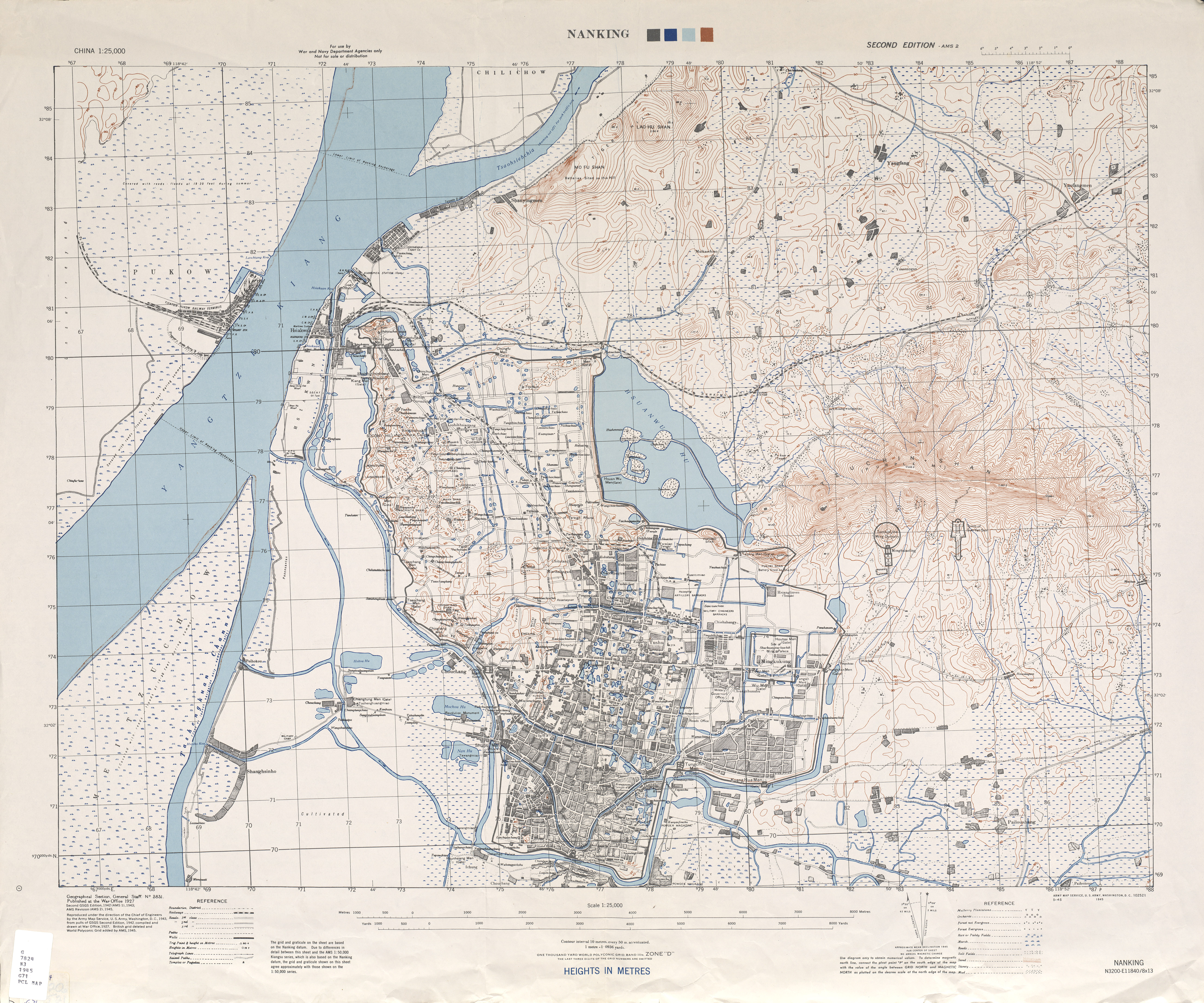
Script error: No such module "Navbox".
Template:Jiangsu topics Script error: No such module "Navbox". Template:Metropolitan cities of the People's Republic of China Template:Provincial capitals of China Script error: No such module "navbox". Template:Prefectural-level divisions of the People's Republic of China Template:Major cities along the Yangtze River Template:Youth Olympic Games Host Cities Template:Portal bar
Script error: No such module "Authority control".
- Pages with script errors
- Pages with broken file links
- Pages with reference errors
- ParserFunction errors
- Articles containing potentially dated statements from 2021
- Articles with invalid date parameter in template
- All articles containing potentially dated statements
- Articles containing potentially dated statements from 2010
- Nanjing
- Cities in Jiangsu
- Provincial capitals in China
- Sub-provincial cities in China
- Yangtze River Delta
- Port cities and towns in China
- National forest cities in China
- Jiangnan
- Populated places established in the 1st millennium BC
- National Civilized City
- National Famous Historical and Cultural City
- Populated places on the Yangtze River