Udi language
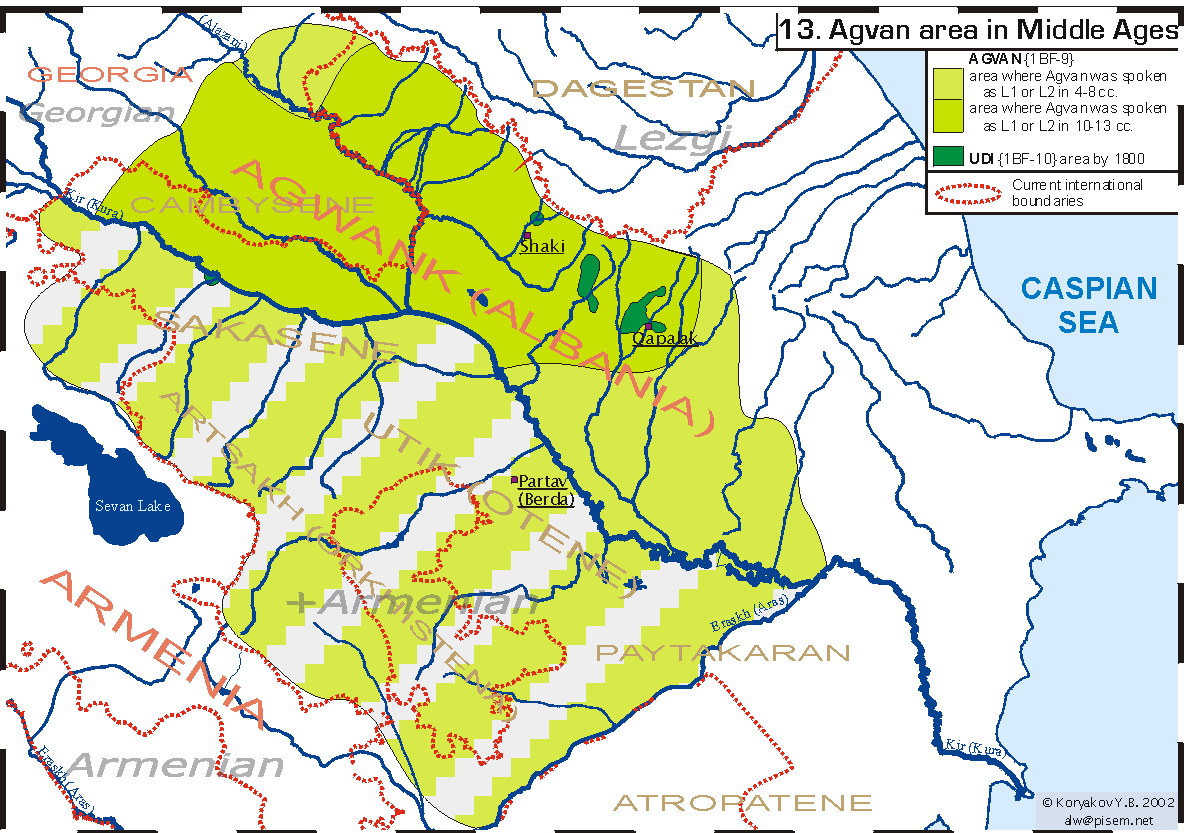
Template:Short description Script error: No such module "about". Script error: No such module "Infobox".Script error: No such module "Check for unknown parameters".<templatestyles src="Template:Infobox/styles-images.css" />Script error: No such module "Check for conflicting parameters". Udi (also called Uti or Udin)[1] is a language spoken by the Udi people and a member of the Lezgic branch of the Northeast Caucasian language family.Template:Sfnp It is believed an earlier form of it was the main language of Caucasian Albania, which stretched from south Dagestan to current day Azerbaijan.Template:Sfnp The Old Udi language is also called the Caucasian Albanian languageTemplate:Sfnp and possibly corresponds to the "Gargarian" language identified by medieval Armenian historians.Template:Sfnp Modern Udi is known simply as Udi.
History

The Udi language can most appropriately be broken up into five historical stages:Template:Sfnp
| Early Udi | around 2000 BC – 300 AD |
| Old Udi | 300–900 |
| Middle Udi | 900–1800 |
| Early Modern Udi | 1800–1920 |
| Modern Udi | 1920–present |
Soon after the year 700, the Old Udi language had probably ceased to be used for any purpose other than as the liturgical language of the Church of Caucasian Albania.Template:Sfnp
Speakers
The language is spoken by about 4,000 people in the village of Nij, Azerbaijan, in Qabala District, in Oghuz District, as well as in parts of the North Caucasus in Russia. It is also spoken by ethnic Udis living in the villages of Debetavan, Bagratashen, Ptghavan, and Haghtanak in Tavush Province of northeastern Armenia, and in the village of Zinobiani (former Oktomberi) in the Qvareli Municipality of the Kakheti province of Georgia.
Udi is endangered,[2] classified as "severely endangered" by UNESCO's Red Book of Endangered Languages.[3]
Phonology
Vowels
Consonants
Old Udi, unlike modern Udi, did not have the close-mid front rounded vowel /ø/.Template:Sfnp Old Udi contained an additional series of palatalized consonants.Template:Sfnp
Alphabets

The Old Udi language used the Caucasian Albanian alphabet. As evidenced by Old Udi documents discovered at Saint Catherine's Monastery in Egypt dating from the 7th century, the Old Udi language used 50 of the 52 letters identified by Armenian scholars in later centuries as having been used in Udi language texts.Template:Sfnp
In the 1930s, there was an attempt by Soviet authorities to create an Udi alphabet based on the Latin alphabet, as shown in the image, but its usage ceased after a short time.
In 1974, a Udi alphabet based on the Cyrillic alphabet was compiled by V. L. Gukasyan. The alphabet in his Udi-Azerbaijani-Russian Dictionary is as follows:
| А а | Аъ аъ | Аь аь | Б б | В в | Г г | Гъ гъ | Гь гь | Д д | Дж дж | ДжӀ джӀ |
| Дз дз | Е е | Ж ж | ЖӀ жӀ | З з | И и | Й й | К к | Ҝ ҝ | КӀ кӀ | Къ къ |
| Л л | М м | Н н | О о | Оь оь | П п | ПӀ пӀ | Р р | С с | Т т | ТӀ тӀ |
| У у | Уь Уь | Ф ф | Х х | Хъ хъ | Ц ц | Ц' ц' | ЦӀ цӀ | Ч ч | Ч' ч' | ЧӀ чӀ |
| Чъ чъ | Ш ш | ШӀ шӀ | Ы ы |
This alphabet was also used in the 1996 collection Nana oččal (Script error: No such module "Lang".).
In the mid-1990s, a new Latin-based Udi alphabet was created in Azerbaijan. A primer and two collections of works by Georgy Kechaari were published using it and it was also used for educational purposes in the village of Nic. The alphabet is as follows:[5]
| A a | B b | C c | Ç ç | D d | E e | Ə ə | F f | G g | Ğ ğ | H h |
| X x | I ı | İ i | Ҝ ҝ | J j | K k | Q q | L l | M m | N n | O o |
| Ö ö | P p | R r | S s | Ş ş | T t | U u | Ü ü | V v | Y y | Z z |
| Ц ц | Цı цı | Eъ eъ | Tı tı | Əъ əъ | Kъ kъ | Pı pı | Xъ xъ | Şı şı | Öъ öъ | Çı çı |
| Çъ çъ | Ć ć | Jı jı | Zı zı | Uъ uъ | Oъ oъ | İъ iъ | Dz dz |
In 2007 in Astrakhan, Vladislav Dabakov published a collection of Udi folklore with a Latin-based alphabet as follows:
| A a | Ă ă | Ә ә | B b | C c | Ĉ ĉ | Ç ç | Ç' ç' | Č č | Ć ć | D d |
| E e | Ĕ ĕ | F f | G g | Ğ ğ | H h | I ı | İ i | Ĭ ĭ | J j | Ĵ ĵ |
| K k | K' k' | L l | M m | N n | O o | Ö ö | Ŏ ŏ | P p | P' p' | Q q |
| Q' q' | R r | S s | Ś ś | S' s' | Ŝ ŝ | Ş ş | T t | T' t' | U u | Ü ü |
| Ŭ ŭ | V v | X x | Y y | Z z | Ź ź |
In 2013 in Russia, an Udi primer, Nanay muz (Script error: No such module "Lang".), was published with a Cyrillic-based alphabet, a modified version of the one used by V. L. Gukasyan in the Udi-Azerbaijani-Russian Dictionary. The alphabet is as follows:[6]
| А а | Аь аь | Аъ аъ | Б б | В в | Г г | Гъ гъ | Гь гь | Д д | Дз дз | Дж дж |
| Джъ джъ | Е е | Ж ж | Жъ жъ | З з | И и | Иъ иъ | Й й | К к | К' к' | Къ къ |
| Л л | М м | Н н | О о | Оь оь | Оъ оъ | П п | П' п' | Р р | С с | Т т |
| Т' т' | У у | Уь уь | Уъ уъ | Ф ф | Х х | Хъ хъ | Ц ц | Ц' ц' | Ч ч | Чъ чъ |
| Ч' ч' | Ч’ъ ч’ъ | Ш ш | Шъ шъ | Ы ы | Э э | Эъ эъ | Ю ю | Я я |
Morphology
Udi is agglutinating with a tendency towards being fusional. Udi affixes are mostly suffixes or infixes, but there are a few prefixes. Old Udi used mostly suffixes.Template:Sfnp Most affixes are restricted to specific parts of speech. Some affixes behave as clitics. The word order is SOV.[7]
Udi does not have gender, but has declension classes.Template:Sfnp Old Udi, however, did reflect grammatical gender within anaphoric pronouns.Template:Sfnp
Noun
Udi has a complex case system of 11 cases with 3 inflectional types:[8]
- Absolutive inflection (AI). Basis for oblique cases
- Oblique inflection (OI). Characterised by additional morpheme ("stem augment"), usually -n-
- Ergative inflection (EI). Serves as a basis for the other oblique cases.
Case
| Absolutive | Oblique | Ergative | ||
|---|---|---|---|---|
| Absolutive | - | ğar | mex | xe |
| Ergative | -en | ğar-en | mex-n-en | xe-n |
| Genitive | -Vy, -un | ğar-i | mex-n-ay | xe-n-ey |
| Dative1 | -V | ğar-a | mex-n-u | xe-n-e |
| Dative2 | -V-x | ğar-a-x | mex-n-u-x | xe-n-e-x |
| Ablative | -V-xo | ğar-a-xo | mex-n-u-xo | xe-n-e-xo |
| Comitative | -V-xol | g/ar-a-xol | --- | --- |
| Superessive | -V-l | ğar-a-l | mex-n-u-l | xe-n-e-l |
| Allative | -V-ć | ğar-a-ć | mex-n-u-ć | xe-n-e-ć |
| Adesssive | -V-st'a | ğar-a-st'a | mex-n-u-st'a | xe-n-est'e |
| Benefactive | -en-k'ena, -enk' | ğar-enk'ena | --- | --- |
ğar means 'son'; mex means 'scythe'; xe means 'water' (note that OI is more common for xe). -V denotes voiced consonant.
Sample text
| Cyrillic alphabet (2007)[9] | Latin alphabet (2007) | English translation |
|---|---|---|
| Script error: No such module "Lang". | Script error: No such module "Lang". | A king caught a king, imprisoned him and carried him to his own land, keeping in his own house. He ruled over that kingdom, too. After 20 years, the imprisoned king asked this king: "I'm thinking of my homeland, allow me to go to my land and I will examine it." |
See also
Citations
<templatestyles src="Reflist/styles.css" />
- ↑ Script error: No such module "citation/CS1".
- ↑ Published in: Encyclopedia of the world’s endangered languages. Edited by Christopher Moseley. London & New York: Routledge, 2007. 211–280.
- ↑ UNESCO Interactive Atlas of the World's Languages in Danger
- ↑ Script error: No such module "citation/CS1".
- ↑ Script error: No such module "citation/CS1".
- ↑ Script error: No such module "citation/CS1".
- ↑ Script error: No such module "citation/CS1".
- ↑ a b Script error: No such module "citation/CS1".
- ↑ Script error: No such module "citation/CS1".
Script error: No such module "Check for unknown parameters".
References
<templatestyles src="Refbegin/styles.css" />
- Script error: No such module "Citation/CS1".
- Script error: No such module "citation/CS1".
- Script error: No such module "citation/CS1".
- Script error: No such module "Citation/CS1".
Further reading
<templatestyles src="Refbegin/styles.css" />
- Script error: No such module "citation/CS1".
- Script error: No such module "citation/CS1".
- Script error: No such module "Citation/CS1".
- Script error: No such module "citation/CS1".
External links
Script error: No such module "Side box". Script error: No such module "Side box".
- Appendix:Cyrillic script
- The Udi Language: A grammatical description with sample text – Wolfgang Schulze 2001
- Udi basic lexicon at the Global Lexicostatistical Database
- The Udis
- Historical map
- A Functional Grammar of Udi, Wolfgang Schulze, 2002
- A Functional Grammar of Udi, Wolfgang Schulze, 2006
- The cognitive dimension of clausal organization in Udi, Wolfgang Schulze, 2000
- The Udi language, Wolfgang Schulze, 2002
- John M. Clifton: The Sociolinguistic Situation of the Udi in Azerbaijan. SIL International, 2005. (PDF-Datei; 206 kB)
Template:Languages of Azerbaijan Template:Northeast Caucasian languages Template:Languages of the Caucasus Script error: No such module "Authority control".