Salbit
Script error: No such module "Settlement short description".Script error: No such module "Infobox".Script error: No such module "Check for unknown parameters".Script error: No such module "Check for conflicting parameters".Expression error: Unexpected < operator Salbit (Template:Langx, also spelled Selbît[1]) was a Palestinian Arab village located Script error: No such module "convert". southeast of al-Ramla.[2] Salbit was depopulated during the 1948 Arab–Israeli War after a military assault by Israeli forces.[3] The Israeli locality of Shaalvim was established on the former village's lands in 1951.
History
Hebrew Bible
In 1883 the PEF's Survey of Western Palestine identified Salbit with Shaalabbin (Biblical Hebrew: Šʽlbyn/*Šʽlbyt),[4][5][6] which was located Script error: No such module "convert". northwest of biblical Aijalon (modern day Yalo).
Roman and Byzantine periods
Jerome (347–420) describes it as part of the territory of the Dan, transcribing its name at that time as Selebi, a form also used by Josephus (37-c. 100).[7][8]

In 1949, archaeologists excavated the remains of a Samaritan synagogue there that was dated to the late 4th or early 5th century.[9] Measuring 15.4 × 8 metres, its mosaic floor contains one Greek inscriptions and two in Samaritan (language and script).[9] In the centre of the mosaic is a mountain which is thought to be a depiction of Mount Gerizim, the holiest site in Samaritanism.[9] Rectangular in shape, the synagogue was longitudinally aligned more or less towards Mount Gerizim.[10][11]
Ottoman period
Salbit was not mentioned in 16th century records. It was an 'azba of Biddu and nearby villages (including Beit Duqqu and Beit 'Anan).[12]
In 1838, it was noted as Selbit, a Muslim village in the Ibn Humar area in the District of Er-Ramleh.[13]
In 1883 the PEF's Survey of Western Palestine (SWP) described Selbit: "Foundations and caves. The ruins are extensive. A square building stands in the middle. There is a ruined reservoir lined with cement, and walls of rubble."[14]
The village is believed to have been resettled in the late 19th century.[12] By the beginning of the 20th century, it was inhabited by residents from Biddu settled the site, establishing it as a dependency – or satellite village – of their home village.[15]
British Mandate
In the 1922 census of Palestine, conducted by the British Mandate authorities, Selbit had a population of 296, all Muslims,[16] increasing in the 1931 census, when it was counted together with Bayt Shanna, to 406, still all Muslims, in a total of 71 houses.[17]
The houses in Salbit were made of adobe and stone and were grouped around the village center where the mosque, suq and elementary school was located. The school, built in 1947, had 47 students. The villagers made their living by agriculture and the raising of livestock. The village's drinking water came from a local well.[18]
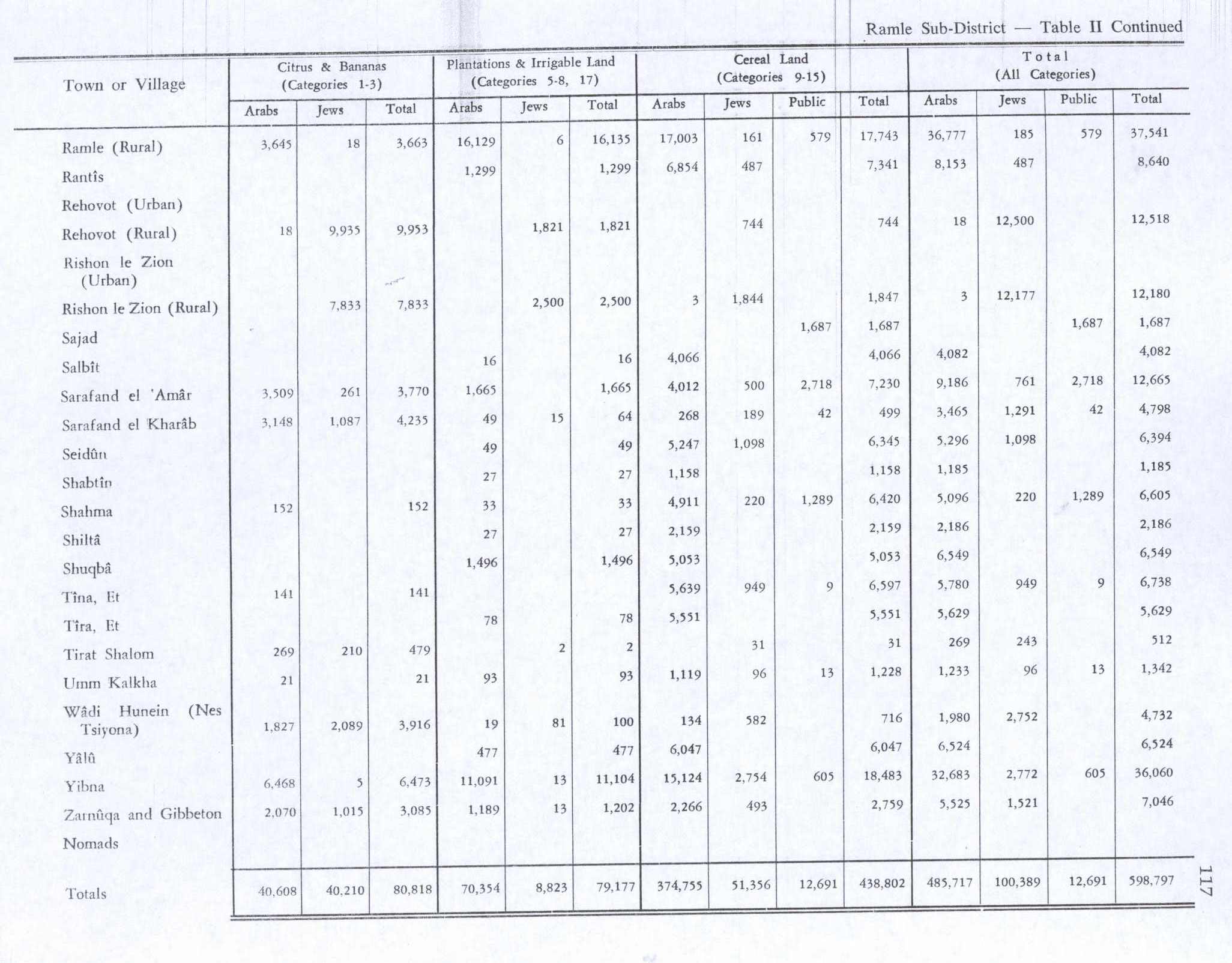
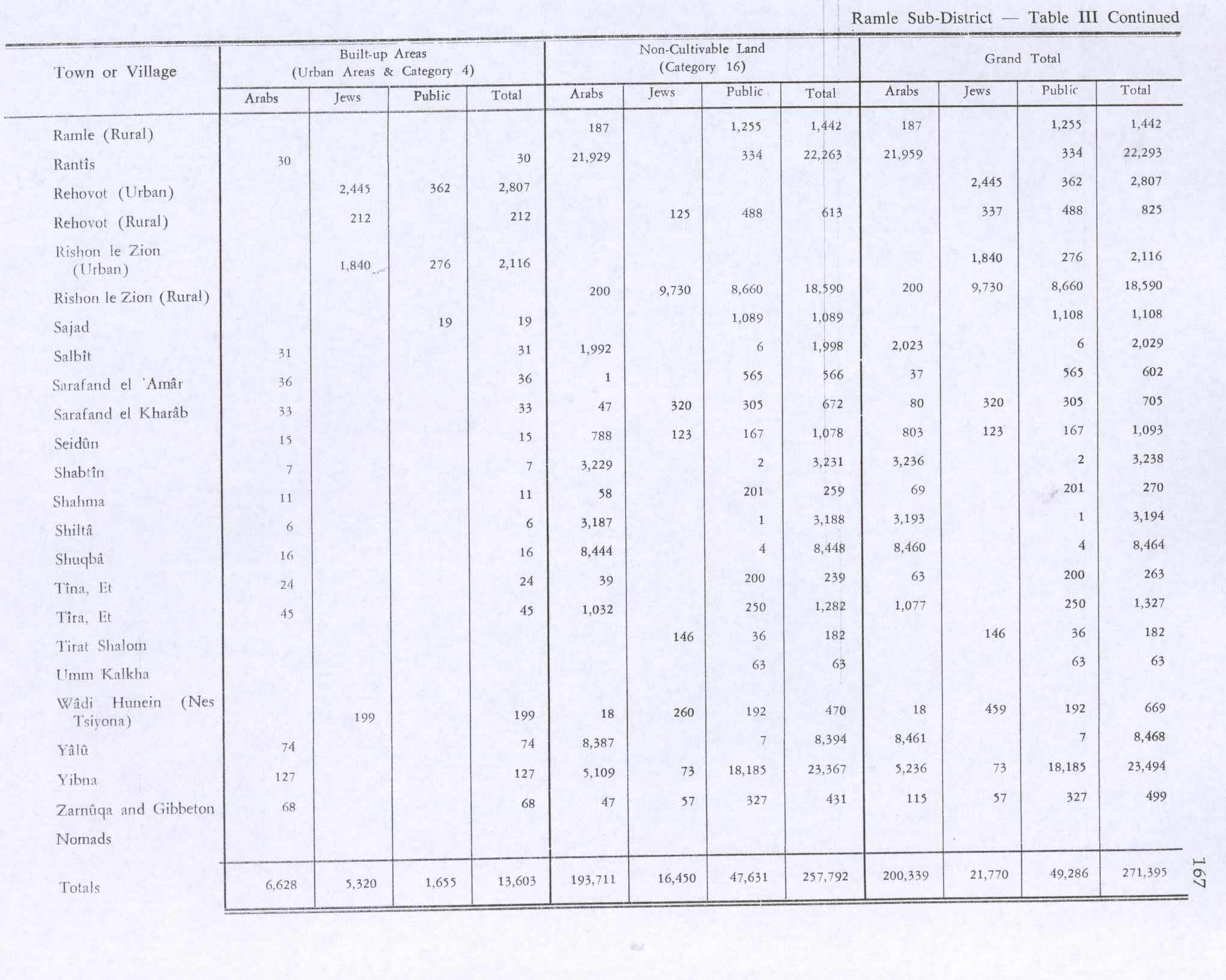
In the 1945 statistics, the population was 510, all Muslims,[19] while the total land area was 6,111 dunams, according to an official land and population survey.[20] Of this, a total of 4,066 dunums of land were used for cereals, 16 dunums were plantations or irrigated land,[21] while 31 dunams were classified as built-up public areas.[22]
-
Salbit 1942 1:20,000
-
Salbit 1945 Scale 1:250,000
-
Depopulated villages in the Ramle Subdistrict


1948 war and aftermath

During the 1948 Arab–Israeli War and the 1948 Palestinian expulsion from Lydda and Ramle, some of those forcibly expelled were bussed to Latrun on the front lines and from there ordered to walk northward to Salbit.[23] The Lydda death march, as it also became known as,[24] brought hundreds of refugee families to Salbit where they took shelter in a fig grove and were given water and rest for the night before trucks from the Arab Legion began moving some of the families to a Palestinian refugee camp in Ramallah.[23]
Salbit itself was depopulated after a military assault by Israeli forces on 15–16 July 1948.[3] After its depopulation, Israeli forces headed by Yigal Allon used it as a base from which to launch an attack on the strategic hill of Latrun on 18 July, which was spurned by the forces of the Arab Legion who managed to hold on to the site without inflicting any casualties on the Israeli forces.[25] The village structures of Salbit were subsequently completely destroyed, and according to Walid Khalidi, all that remains of the village today are "some cactus plants and shrubs."[2] The estimated number of Palestinian refugees from Salbit as of 1998 was 3,633.[2]
The kibbutz of Shaalvim, named per the site's biblical place name, was established on the former village lands on 13 August 1951 by a Nahal group from the ESRA movement.
References
<templatestyles src="Reflist/styles.css" />
- ↑ Script error: No such module "citation/CS1".
- ↑ a b c Script error: No such module "citation/CS1".
- ↑ a b Cite error: Script error: No such module "Namespace detect".Script error: No such module "Namespace detect".
- ↑ Conder and Kitchener, 1883, SWP III, pp. 53-54
- ↑ Cooke, 1918, p. 185
- ↑ Script error: No such module "Citation/CS1".
- ↑ Cite error: Script error: No such module "Namespace detect".Script error: No such module "Namespace detect".
- ↑ Robinson and Smith, 1841, vol 3, p. 20.
- ↑ a b c Stemburger and Tuschling, 2000, p. 228
- ↑ Pringle, 1998, p. 114
- ↑ Dauphin, 1998, p. 842
- ↑ a b Grossman, D. (1986). "Oscillations in the Rural Settlement of Samaria and Judaea in the Ottoman Period". in Shomron studies. Dar, S., Safrai, S., (eds). Tel Aviv: Hakibbutz Hameuchad Publishing House. p. 376
- ↑ Robinson and Smith, 1841, vol 3, Appendix 2, p. 120
- ↑ Conder and Kitchener, 1883, SWP III, p. 157
- ↑ Script error: No such module "Citation/CS1".
- ↑ Barron, 1923, Table VII, Sub-district of Jerusalem, p. 15
- ↑ Mills, 1932, p. 43
- ↑ Cite error: Script error: No such module "Namespace detect".Script error: No such module "Namespace detect".
- ↑ Cite error: Script error: No such module "Namespace detect".Script error: No such module "Namespace detect".
- ↑ Cite error: Script error: No such module "Namespace detect".Script error: No such module "Namespace detect".
- ↑ Government of Palestine, Department of Statistics. Village Statistics, April, 1945. Quoted in Hadawi, 1970, p. 117.
- ↑ Government of Palestine, Department of Statistics. Village Statistics, April, 1945. Quoted in Hadawi, 1970, p. 167
- ↑ a b Script error: No such module "citation/CS1".
- ↑ Saleh Abd al-Jawad (2007). "Zionist Massacres: the Creation of the Palestinian Refugee Problem in the 1948 War". In Eyal Benvenisti; Chaim Gans; Sari Hanafi (eds.). Israel and the Palestinian Refugees. Springer. pp. 70–71. Template:ISBN.
- ↑ Tal, 2004, p. 324.
Script error: No such module "Check for unknown parameters".
Bibliography
<templatestyles src="Refbegin/styles.css" />
- Script error: No such module "citation/CS1".
- Script error: No such module "citation/CS1".
- Script error: No such module "citation/CS1".
- Script error: No such module "citation/CS1".
- Script error: No such module "citation/CS1".
- Script error: No such module "citation/CS1".
- Script error: No such module "citation/CS1".
- Script error: No such module "citation/CS1".
- Script error: No such module "citation/CS1".
- Script error: No such module "citation/CS1".
- Script error: No such module "citation/CS1".
- Script error: No such module "citation/CS1".
- Script error: No such module "citation/CS1".
- Dictionary of Greek and Roman Geography: Iabadius-Zymethus
- Script error: No such module "citation/CS1".
- Script error: No such module "citation/CS1".
- Script error: No such module "citation/CS1".
External links
- Welcome to Salbit
- Salbit, Zochrot
- Survey of Western Palestine, Map 17: IAA, Wikimedia commons

Template:Palestinian Arab villages depopulated during the 1948 Palestine War