Ligustrum sinense
Template:Short description Template:Speciesbox
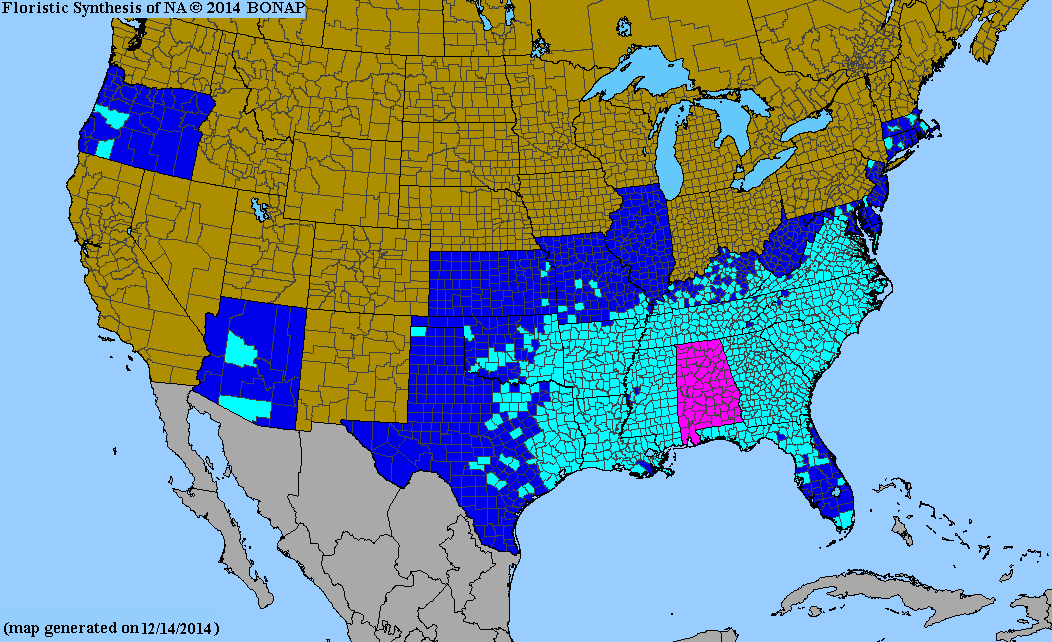
Ligustrum sinense (Chinese privet;[1] syn. L. villosum; in Mandarin: 杻; pinyin: chǒu) is a species of privet native to China, Taiwan and Vietnam,[2] and naturalized in Réunion, the Andaman Islands, Norfolk Island, Costa Rica, Honduras, Panama and much of the eastern and southern United States (from Texas and Florida north to Kansas, Illinois, New Jersey, Massachusetts and Connecticut).[3][4] The name "Chinese privet" may also refer to Ligustrum lucidum.[5]
Description
Ligustrum sinense is a deciduous shrub growing to 2–7 m tall, with densely hairy shoots. The leaves are opposite, 2–7 cm long and 1–3 cm broad, rarely larger, with an entire margin and a 2–8 mm petiole. The flowers are white, with a four-lobed corolla 3.5–5.5 mm long. The fruit is subglobose, 5–8 mm diameter,[2][6] and considered poisonous.[7]

Varieties
The following varieties are accepted by the Flora of China:[2]
- Ligustrum sinense var. sinense
- Ligustrum sinense var. concavum Template:Au
- Ligustrum sinense var. coryanum Template:Au
- Ligustrum sinense var. dissimile Template:Au
- Ligustrum sinense var. luodianense Template:Au
- Ligustrum sinense var. myrianthum Template:Au
- Ligustrum sinense var. opienense Template:Au
- Ligustrum sinense var. rugosulum Template:Au
Cultivation and uses

It is cultivated as an ornamental plant and for hedges. Several cultivars have been selected, including the very floriferous 'Multiflorum', the variegated cultivar 'Variegatum', and the dwarf cultivar 'Wimbei' growing to 0.5 m and with leaves only 6 mm long.[8]
It was introduced to North America to be used for hedges and landscaping where it has now escaped from cultivation and is listed as an invasive plant in southeastern states.[1][9] It is estimated that Chinese privet now occupies over one million hectares of land across 12 states ranging from Virginia to Florida and west to Texas, with detrimental effects to biodiversity and forest health.[10]
Etymology
Ligustrum means 'binder'. It was named by Pliny and Virgil.[11]
See also
References
<templatestyles src="Reflist/styles.css" />
- ↑ a b USDA Plants Profile: Ligustrum sinense
- ↑ a b c Flora of China: Ligustrum sinense
- ↑ Script error: No such module "citation/CS1".
- ↑ Biota of North America Program, Ligustrum sinense
- ↑ Script error: No such module "citation/CS1".
- ↑ Loureiro, João de. 1790. Flora cochinchinensis: sistens plantas in regno Cochinchina nascentes. Quibus accedunt aliæ observatæ in Sinensi imperio, Africa Orientali, Indiæque locis variis. Omnes dispositæ secundum systema sexuale Linnæanum. Ulyssipone. 1: 19. Ligustrum sinense
- ↑ Script error: No such module "citation/CS1".
- ↑ Huxley, A., ed. (1992). New RHS Dictionary of Gardening. Macmillan Template:ISBN.
- ↑ Script error: No such module "citation/CS1". This reference lists L. vulgare, L. obtusifolium, L. ovalifolium, and L. sinense as invasive.
- ↑ Hanula, J.L, Horn, S., Taylor, J.W. (2009). Chinese Privet (Ligustrum sinense) Removal and its Effect on Native Plant Communities of Riparian Forests. Invasive Plant Science and Management 2:292-300. Script error: No such module "CS1 identifiers".
- ↑ Gledhill, David (2008). "The Names of Plants". Cambridge University Press. Template:ISBN (hardback), Template:ISBN (paperback). p 237
Script error: No such module "Check for unknown parameters".
External links
- Species Profile - Chinese Privet (Ligustrum sinense), National Invasive Species Information Center, United States National Agricultural Library