Geoje
Template:Short description Script error: No such module "Settlement short description".Script error: No such module "Infobox".Script error: No such module "Check for unknown parameters".Script error: No such module "Check for conflicting parameters".Expression error: Unexpected < operator Geoje (Korean: Script error: No such module "Lang".Script error: No such module "Category handler".; Script error: No such module "IPA".) is a city located in South Gyeongsang Province, South Korea. It is located near Busan. Hanwha Ocean in Okpo and Samsung Heavy Industries (SHI) in Gohyeon are both located on Geoje Island. The city also offers a wide range of tourist sights. The city is made up of a number of islands, of which by far the largest is Geoje Island. There are multiple dong in the city: Jangpyeongdong, Okpo-dong and Gohyeon.
Etymology
Geoje is Korean for "great rescue", from the syllables geo (Korean: Script error: No such module "Lang".; Hanja: Script error: No such module "Lang".Script error: No such module "Category handler".) meaning great, and je (Script error: No such module "Lang".; Script error: No such module "Lang".Script error: No such module "Category handler".) meaning rescue.
History
Geoje has a history stretching back thousands of years. Various artifacts dating back to the Neolithic era have been found at archaeological digs on Naedo, Sandaldo, and Isudo. While no written history can be found from this era, the digs show evidence of numerous small establishments along the coasts. The first written mention of Geoje appears as, Geoje being one of two main divisions of the Dokro kingdom, a member of the Byeonhan confederacy (circa 0-300 AD). The Byeonhan confederacy slowly gave way to the Gaya confederacy(42-562 AD). The Gaya eventually submitted to the Kingdom of Silla.
In 757, Gyeongdeok of Silla classified the island as "Geoje-gun" "Script error: No such module "Lang".Script error: No such module "Category handler"." (Geoje county). Modern Geoje is classified as a "si" (Script error: No such module "Lang".Script error: No such module "Category handler".) (city). In 1170, Uijong of Goryeo secretly escaped to Geoje when Chŏng Chung-bu raised a rebellion against him, instating his brother, Myeongjong as king. Geoje served as a strategic location in preparation of the naval forces for the Gihae Eastern Expedition (Script error: No such module "Lang".Script error: No such module "Category handler".) of Tsushima Island in 1419 by the Korean general Yi Chongmu. At the time of the Seven-Year War in 1592, admiral Yi Sun-sin gained a great naval victory against Japanese invaders near the town of Okpo in Geoje. Since then. Yi was referred to by his noble title, "Chung Mu Gong," which roughly translates into English as "Earner of Great National Respect."
In the Korean War (1950–53), the military government of General Douglas MacArthur used the island as a place for the settlement for 170,000 POWs, and a Prisoner of war camp measuring at Script error: No such module "convert". was established during these years. The prison was rife with human rights abuses, including summary execution and the widespread use of torture against prisoners by Canadian and American troops. British journalist Alan Winnington and Australian journalist Wilfred Burchett conducted extensive research to document these human rights abuses, and jointly published their findings in 1952.[1] After the war, a portion (23,000 m2) was converted into a tourist attraction.[2]
During the last few decades Geoje has emerged as leader in the shipbuilding industries. Due to the continued industry, Geoje largely escaped the negative impacts of the Asian market crash of 1997.
Some notable people from Geoje include:
- Former President Kim Young-sam
- Poet Yu Chi-hwan, better known by his pen-name Cheongma.
- Former President Moon Jae-in
Demographics
According to the whitebook published by Geoje City in May 2014, Geoje had a population of 243,736, 12,240 of which are foreigners (non-Koreans). A significant portion of the population depends on shipbuilding to support their livelihood, and this can be evidenced by the fact that nearly 33% of workers are employed in the shipbuilding industry.
The population of Geoje Island is 232,807 as of October 2024.
Tourism
Geoje offers a variety of attractions, including Haegeumgang island, Oedo, a marine western-style botanical garden in Hallyeo-Haesang National Park, built by Lee Chang-ho and his wife when they settled on the island in 1969. Visitors visit by ferry boat from the harbor neighboring the islands.
Tourists also visit Jisim-do for trekking. Jisim is known for its Camellia vegetation. However, the Maemi typhoon in 2003 severely affected the island's plant life. Another popular tourist attraction at Haegeumgang-do (located southeast of Geoje) is the Sipja Donggul Cave. Buddhist and Shamanist sculptures can be found in the cave.
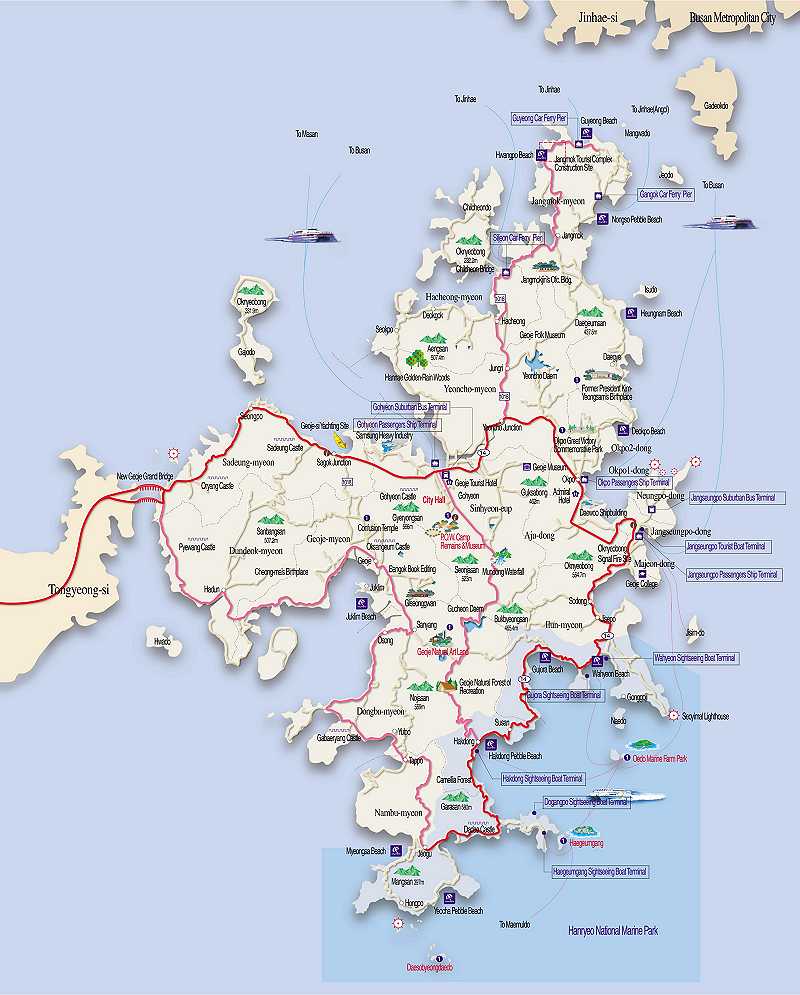
Geoje is the second largest island in Korea, so discovering these locations is most easily done using a tourist map.

Historic and cultural Sites
Geoje POW Camp
Geoje POW Camp (Script error: No such module "Lang".Script error: No such module "Category handler".) was a prisoner of war detention camp for captured North Koreans established during the Korean War from (1951). It was the site of a prison riot on May 8, 1952, which is the topic of Chinese-American writer Ha Jin's fictional War Trash.[3]
Gohyeon Castle

Gohyeon Castle is named the 46th national treasure of South Gyeongsang Province. Gohyeon Castle (Script error: No such module "Lang".Script error: No such module "Category handler".) and is located in Gohyeondong, Geoje. It was established during the Joseon period in 1451.
In the famous Joseon era geography book, Donggukyeojiseungram (Script error: No such module "Lang".), it was recorded that the Gohyeon castle had a circumference of 3,038 Cheok (Script error: No such module "Lang".) (equivalent to about Script error: No such module "convert".), and had a height of 13 Cheok (Script error: No such module "convert".). It was considered the largest castle in the South Sea.[4]
Geoje Township Government Office

The Geoje Township Government Office is regarded as Korea's 84th cultural treasure. During the time of the Japanese invasions, the office was established in 1470 to administer all military and shipbuilding plans.
Oksangeum Fortress Area

The Oksangeum Fortress Area (Script error: No such module "Lang".Script error: No such module "Category handler".) was an unsanctioned fortress built on the Sujeong peak to defend against Japanese invasion. Due to the strain it placed on the people during the building, the magistrate responsible was dismissed. Oksangeum Fortress is regarded as the South Gyeongsang Province's 10th cultural treasure.
Pyewang Fortress

Pyewang Fortress (Script error: No such module "Lang".Script error: No such module "Category handler".) is the oldest surviving fortress in Geoje. First built during the Silla Dynasty, Pyewang fortress later served the fortress refuge for the King Uijong the 18th king of the Goryeo dynasty, while escaping from a military coup. Pyewang fortress is located in Dundeok-myeon. Pyewang fortress is regarded as the South Gyeongsang Province's 11th cultural treasure, and National Historical Site no. 509.
Okpo Great Victory Park
Okpo Great Victory Park is located in Okpo2Dong within Geoje. It commemorates the great victory over the invading Japanese navy by the honored general Yi Sun-sin on May 7, 1592.[5]
Blue Horse (Poet) Museum
The Blue Horse (Cheongma, Script error: No such module "Lang".Script error: No such module "Category handler".) is a cultural exhibition and preserved birthplace museum of the poet "Blue Horse". It is located in Bangha village, Dundeokmyeon.
Jisimdo
Jisimdo (Script error: No such module "Lang".Script error: No such module "Category handler".) is an island of the east coast of Geoje. It is visited primarily for its vast amount of Camellia vegetation. Although damaged by Maemi typhoon, the camellias have mostly returned. It is also a site of a Japanese military installation, from the occupation of the early 20th century.[6]
Museums

Haegeumgang Theme Museum
Haegeumgang Theme Museum (Script error: No such module "Lang".Script error: No such module "Category handler".) is a museum of travel during the 1950s to the 1970s. It is located in Galgot village, Nambumyeon (Script error: No such module "Lang".Script error: No such module "Category handler".).
Geoje Shipbuilding Marine Cultural Center
The Geoje Shipbuilding Marine Cultural Center is an independently established combination of a Fishing Village Folk Museum and Shipbuilding Theme park museum located in Jisepo village, Ilunmyeon (Script error: No such module "Lang".Script error: No such module "Category handler"., Script error: No such module "Lang".Script error: No such module "Category handler".).
The Fishing Village Folk Museum covers two floors, including 4 exhibits: "The living sea/Traditions of the sea" and "Ocean experience/Renaissance of the sea".
Shipbuilding Theme park museum also covers two floors, including 5 exhibits: "Children's Shipbuilding yard/Dock 1" The history of sailing vessels/Dock 2 Shipbuilding technology/Dock 3 The future of the oceans/ Movie theatre
Geoje Museum
Geoje Museum (Script error: No such module "Lang".Script error: No such module "Category handler".) is located in Okpo. It features local artifacts used over the centuries by the people of Geoje.
Natural Attractions
Hill of Wind

The Hill of Wind (Script error: No such module "Lang".Script error: No such module "Category handler".) is located in Galgot village, Nambumyeon (Script error: No such module "Lang".Script error: No such module "Category handler".). It overlooks South Sea and there is a strong wind. A windmill is set on top of hill. It became famous after 2 Days & 1 Night, where one of the most popular Korean TV shows was filmed.[7]
Haegeumgang

Haegeumgang (Script error: No such module "Lang".Script error: No such module "Category handler".) is named for resemblance of the Haegeum mountain in North Korea. It is a primary tourist destinations in all of Geoje.[8]
Oedo and Naedo

Oedo (Script error: No such module "Lang".Script error: No such module "Category handler".)[9] and Naedo (Script error: No such module "Lang".Script error: No such module "Category handler".)[10] are two islands located in the southeast of Geoje island and of the two, Oedo hosts the second most visited attraction in all of Geoje, the expansive botanical gardens of Botania.
Sanbangsan Botanical Garden
Sanbangsan Botanical Garden (Script error: No such module "Lang".Script error: No such module "Category handler".) is a botanical garden in Sanbang-ri. This garden has many flower and tree varieties. Due to its remote location, it is much less busy than other botanical gardens.[11]
Mundong Waterfall
Mundong Waterfall (Script error: No such module "Lang".Script error: No such module "Category handler".) is a small waterfall located above the Mundong Reservoir. It features trails and picnic areas at this location.[12]
Gonggoji
Gonggoji (Script error: No such module "Lang".Script error: No such module "Category handler".) is a mountain side garden located opposite Naedo island. It features Camellia trees, and daffodil fields. Due to there being no road access, you must walk to get to this location.[13]
Beaches
|
|
Shipbuilding

There are various shipbuilding docks which provide tours from the Daewoo and Samsung corporation located in both Gohyeon and Okpo.[14]
Resorts
Daemyeong Resort
Daemyeong Resort is located in Ilun-myeon. It has various rooms. It offers a choice of several restaurants, karaoke rooms, billiards, table tennis and other entertainment options. There also the Ocean Bay Water Park on location, and the Marina Bay offers yacht and motor boat rentals.[15]
Other Recreational Activities
Geoje offers an abundance of trails that can be used to hike, cycle, and some are suitable for ATV use.
Administrative divisions

According to a 2014 study, Geoje's Korean population was 243,736, and the foreign national population was 12,240.[16] Although Gohyeon-dong is the fifth smallest of the dongs, it is the largest in population at 40,400. The cumulative area of Geoje is 402.3 km2, with Dongbu-myeon (Script error: No such module "Lang".Script error: No such module "Category handler".) being the widest, and Majeon-dong (Script error: No such module "Lang".Script error: No such module "Category handler".) being the narrowest.
In 2008 Shinhyeon-eup (Script error: No such module "Lang".Script error: No such module "Category handler".) was abolished, and in its place a new town was installed. It now divided into the separate dongs of Gohyeon-dong, Jangpyeong-dong, Sangmundong-dong, and Suyang-dong
The industrial area of Geoje has the highest man to women worker ratio in South Gyeongsang.
| Myeon·Dong | Hangeul | Hanja | Area(km2) | Population[17] | Map |
|---|---|---|---|---|---|
| Geoje-myeon | 거제면 | 巨濟面 | 37.30 | 7,114 | |
| Nambu-myeon | 남부면 | 南部面 | 31.87 | 1,945 | |
| Dongbu-myeon | 동부면 | 東部面 | 52.50 | 3,682 | |
| Dundeok-myeon | 둔덕면 | 屯德面 | 33.78 | 3,693 | |
| Sadeung-myeon | 사등면 | 沙等面 | 34.69 | 9,578 | |
| Yeoncho-myeon | 연초면 | 延草面 | 40.14 | 10,038 | |
| Ilun-myeon | 일운면 | 一運面 | 30.50 | 7,468 | |
| Jangmok-myeon | 장목면 | 長木面 | 36.89 | 5,410 | |
| Hacheong-myeon | 하청면 | 河淸面 | 29.10 | 5,148 | |
| Gohyeon-dong (Geoje city proper) | 고현동 | 古縣洞 | 5.14 | 40,400 | |
| Sangmun-dong (Geoje city proper) | 상문동 | 上門洞 | 20.97 | 21,783 | |
| Suyang-dong (Geoje city proper) | 수양동 | 水良洞 | 11.15 | 14,433 | |
| Jangpyeong-dong (Geoje City proper) | 장평동 | 長坪洞 | 6.98 | 29,867 | |
| Neungpo-dong | 능포동 | 菱浦洞 | 3.21 | 12,816 | |
| Aju-dong | 아주동 | 鵝州洞 | 12.45 | 13,557 | |
| Okpo 1-dong | 옥포1동 | 玉浦1洞 | 2.26 | 10,560 | |
| Okpo 2-dong | 옥포2동 | 玉浦2洞 | 8.61 | 30,250 | |
| Jangseungpo-dong | 장승포동 | 長承浦洞 | 2.15 | 4,409 | |
| Majeon-dong (Jangseungpo southside) | 마전동 | 麻田洞 | 1.92 | 5,673 |

Geography
Geoje covers an area of Script error: No such module "convert"., encompassing Geoje-do (Script error: No such module "convert".) and 60 other small islets, of which 10 are inhabited.[18] The main island is joined to land by two bridges from nearby Tongyeong. It is also connected via a series of bridges and underwater tunnels to Gadeokdo, then Busan, named the Busan–Geoje Bridge. A proposal has been made to connect Geoje to Masan by another set of bridges and tunnels named Yi Sun-sin Great Bridge (Script error: No such module "Lang".Script error: No such module "Category handler".).
Climate
Geoje experiences a humid subtropical climate (Köppen: Cfa/Cwa), and temperatures reaching below zero degrees Celsius in winter are frequent during December to February. However, the island is kept relatively warm by the influence of warm ocean currents.
On 2022, Typhoon Hinnamnor made landfall over the city, the eye centre directly passed over the city as a category 2 at 5:50 AM September 6, 2022. Leaving severe destruction around, including flooding.
Script error: No such module "weather box".Script error: No such module "Check for unknown parameters".
Produce
Due to Geoje's coastal sub-tropical location, the area grows and harvests several different crops, some of which are uncommon in most of Korea. Some of these crops include yuja, pineapples, and mushrooms.
Being an island also provides an abundance of seafood that is collected locally.
Islands of Geoje
Script error: No such module "Labelled list hatnote".
- Geoje (Script error: No such module "Lang".; Script error: No such module "Lang".Script error: No such module "Category handler".)
- Oedo
- Galgotdo (Haegeumgang)
- Chilcheondo
- Jisimdo
- Gajodo
- Haegando
- Sandaldo
- Hawdo
Education
There is an international school, International School of Koje (거제국제외국인학교).
Sister cities
- Template:Flagdeco Longjing, Jilin, China
- Template:Flagdeco Qinhuangdao, Hebei, China
- Template:Flagdeco Qidong, Jiangsu, China
- Template:Flagdeco Guam, United States
- Template:Flagdeco Yame, Fukuoka, Japan
Domestic
See also
References
<templatestyles src="Reflist/styles.css" />
- ↑ Script error: No such module "citation/CS1".
- ↑ Script error: No such module "citation/CS1".
- ↑ Script error: No such module "citation/CS1".
- ↑ Script error: No such module "Lang".. Script error: No such module "Lang".. 2009-01-31.
- ↑ Script error: No such module "citation/CS1".
- ↑ Script error: No such module "citation/CS1".
- ↑ Script error: No such module "citation/CS1".
- ↑ Script error: No such module "Lang".
- ↑ Script error: No such module "citation/CS1".
- ↑ Script error: No such module "citation/CS1".
- ↑ Script error: No such module "citation/CS1".
- ↑ Script error: No such module "citation/CS1".
- ↑ Script error: No such module "citation/CS1".
- ↑ Script error: No such module "citation/CS1".
- ↑ Script error: No such module "citation/CS1".Script error: No such module "Unsubst".
- ↑ Script error: No such module "citation/CS1".
- ↑ Script error: No such module "citation/CS1".
- ↑ Map of the region
Script error: No such module "Check for unknown parameters".
External links
Script error: No such module "Side box".
Template:South Gyeongsang Template:Metropolitan cities of South Korea Template:Most populous cities in South Korea Script error: No such module "Coordinates". Script error: No such module "Authority control".