Yucca elata
Template:Short description Script error: No such module "redirect hatnote". Template:Speciesbox
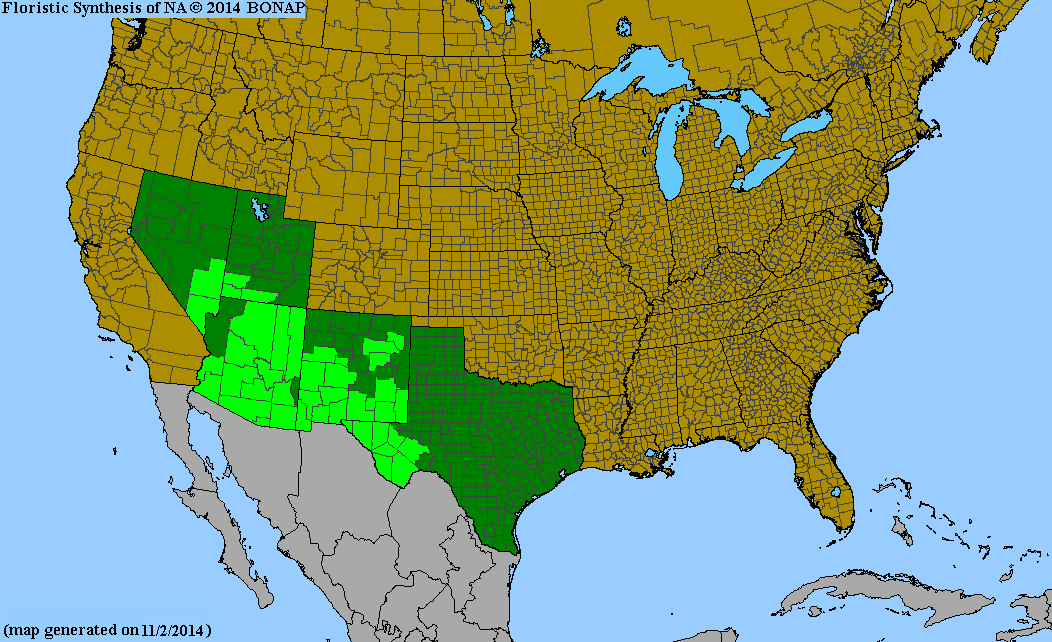
Yucca elata is a perennial plant, with common names that include soaptree, soaptree yucca, soapweed, and palmella.[1][2] It is native to southwestern North America, in the Sonoran Desert and Chihuahuan Desert in the United States (western Texas, New Mexico, Arizona), southern Nevada, southwestern Utah, and northern Mexico (Chihuahua, Coahuila, Sonora, Nuevo León).[3][4] Yucca elata is widely distributed, although its population appears to be decreasing.[5]
Description

This plant grows from 1.2 to 4.5 m tall, with a sparsely branched trunk. The trunk is brown, cylindrical in shape and has a small diameter and often has holes drilled by escaping yucca moth larvae. The leaves are arranged in a dense spiral whorl at the apex of the stems, each leaf 25–95 cm long and very slender, 0.2-1.3 cm broad. The white, bell-shaped flowers grow in a dense cluster on a slender stem at the apex of the stem, each flower 32–57 mm long, creamy white, often tinged pinkish or greenish.[6][7][8]
The soaptree yucca's fruit is a capsule 4–8 cm long and 2–4 cm broad, maturing brown in summer, when it splits into three sections to release the black seeds. They do not flower every year.[4]
Ecology
These plants fare best in dry, semi-desert conditions. They are very cold-hardy, but need much sunlight.[9]
Subspecies
There are three subordinate taxa are sometimes recognized, although sources differ as to whether these should be considered varieties or subspecies:[4][10]
- Yucca elata ssp. elata. Capsules large, 5–8 cm; leaves long, 30–95 cm. Throughout the species' range.
- Yucca elata ssp. verdiensis. Capsules small, 4-4.5 cm; leaves short, 25–45 cm. Arizona only.
- Yucca elata ssp. utahensis.
Uses

Native Americans used the fiber of the soaptree yucca's leaves to make sandals, belts, cloth, baskets, cords, and mats, among other items; they also ate the flowers.[11] Inside the trunk and roots of the plant is a soapy substance high in saponins. In the past, this substance was commonly used as soap and shampoo, which was used to treat dandruff and hairloss. At least one tribe, the Zuni, used a mixture of soap made from yucca sap and ground aster to wash newborn babies to stimulate hair growth. The Apaches also use yucca leaf fibers to make dental floss and rope. In times of drought ranchers have used the plant as an emergency food supply for their cattle; the chopped trunk and leaves can be eaten.[11]
Symbolism
Flowers of the genus Yucca are the state flowers of US state of New Mexico.[12] No species name is given in the statute citation,[13] however the New Mexico Centennial Blue Book from 2012 references the soaptree yucca (Yucca elata) as one of the more widespread species in New Mexico.[14]
References
<templatestyles src="Reflist/styles.css" />
- ↑ Common names of yucca species
- ↑ Script error: No such module "template wrapper".
- ↑ Biota of North America Project, Yucca elata
- ↑ a b c Flora of North America: Yucca elata
- ↑ Cite error: Script error: No such module "Namespace detect".Script error: No such module "Namespace detect".
- ↑ Fritz Hochstätter (Hrsg.): Yucca (Agavaceae). Band 1 Dehiscent-fruited species in the Southwest and Midwest of the USA, Canada and Baja California , Selbst Verlag, 2000. Template:ISBN
- ↑ Fritz Hochstätter (Hrsg.): Yucca (Agavaceae). Band 2 Indehiscent-fruited species in the Southwest, Midwest and East of the USA, Selbst Verlag. 2002. Template:ISBN
- ↑ Fritz Hochstätter (Hrsg.): Yucca (Agavaceae). Band 3 Mexico , Selbst Verlag, 2004. Template:ISBN
- ↑ Yucca plant care
- ↑ Tropicos, Yucca elata
- ↑ a b Script error: No such module "citation/CS1".
- ↑ Script error: No such module "citation/CS1".
- ↑ Section 12-3-4 NMSA 1978, <https://nmonesource.com/nmos/nmsa/en/item/4374/index.do#!b/12-3-4>, retrieved on 06/12/2021.
- ↑ Script error: No such module "citation/CS1".
Script error: No such module "Check for unknown parameters".
External links
Script error: No such module "Side box". Script error: No such module "Side box".
- Die Gattung Yucca Fritz Hochstätter
- Yucca I [1] Script error: No such module "webarchive". Verbreitungskarte I Fritz Hochstätter
- Blue Planet Biomes entry for the Soaptree yucca
Template:Taxonbar Script error: No such module "Authority control".
- Pages with script errors
- Pages with reference errors
- Pages with broken file links
- Yucca
- Flora of the Chihuahuan Desert
- Flora of Mexico
- Flora of Arizona
- Flora of New Mexico
- Flora of Texas
- Flora of Utah
- Flora of Chihuahua (state)
- Flora of Coahuila
- Flora of Nevada
- Plants described in 1882
- Taxa named by George Engelmann
- Saponaceous plants