Vitis californica
Template:Short description Template:Speciesbox
Vitis californica, with common names California wild grape, Northern California grape, and Pacific grape,[1] is a wild grape species native to western North America.
Description
Vitis californica is a deciduous vine. It is fast growing and can grow to over Script error: No such module "convert". in length.[2] It climbs on other plants or covers the ground with twisted, woody ropes of vine covered in green leaves. It typically flowers in May and June. In autumn, the leaves turn orange and yellow before falling.[3]

Distribution and habitat
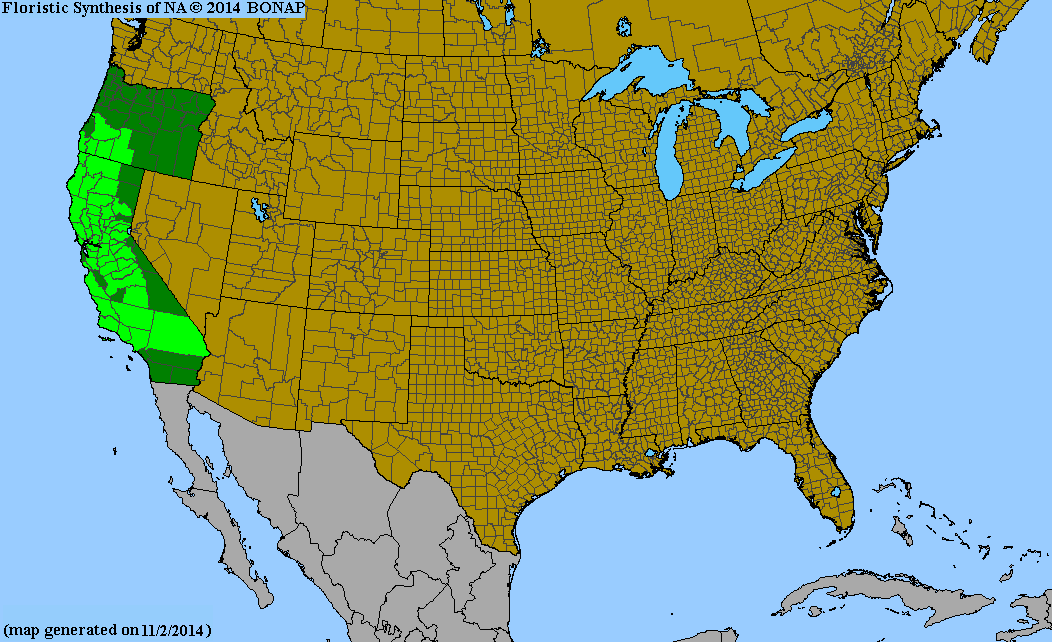
The species is widespread across much of California as well as southwestern Oregon.[4][5][3] It is distributed along the Coast Ranges from Douglas County, Oregon, south to San Luis Obispo County, California; in the Klamath Mountains, the Cascade Range, and the Sierra Nevada from Siskiyou to Kern counties, California; and in the Central Valley.[6] The grapes are a common sight along the banks of the Sacramento River.
The plant grows in canyons, alongside springs, and streams. It tends to thrive in damp conditions and so it is common in riparian areas.[7] It can be found on slopes as well as flat ground in wetland and forested habitats. Once matured[7] like most other native California plants it can withstand periods of dry conditions.[8]
Cultivation
Viticulture
The wild grape is strong and robust, and viticulturists worldwide often use it as rootstock for their wine grapes.[9] It prefers heavier soils.[2] In some areas where the plant is not native it has the capacity to become a noxious weed. However, its invasive nature can be kept under control and is very easy to pull out.[2]

Horticulture
Vitis californica is cultivated as an ornamental plant. The interesting shape and color of the leaves and the lush, trainable vines make this species an attractive garden plant. This vine is commonly used in native plant gardens, where once established it thrives without summer water.
The cultivar '<templatestyles src="Template:Visible anchor/styles.css" />Roger's Red' (named for noted horticulturist Roger Raiche) turns brilliant red in fall.[10] It is a hybrid with a wine grape, × Vitis vinifera cv. Alicante Bouschet.[10] The cultivar 'Walker Ridge' turns yellow in the autumn.[11]
Uses
Bunches of small and often sour but edible purple grapes hang from the vines in autumn, which can be made into wine or jelly.[12] The grapes provide an important food source for a variety of wild animals, especially birds, and the foliage provides thick cover.
References
<templatestyles src="Reflist/styles.css" />
- ↑ Template:GRIN
- ↑ a b c Script error: No such module "citation/CS1".
- ↑ a b Calflora taxon report, Vitis californica Benth. California grape, California wild grape
- ↑ Jepson Flora: Vitis californica
- ↑ Biota of North America Program 2014 county distribution map
- ↑ Script error: No such module "citation/CS1".
- ↑ a b Script error: No such module "citation/CS1".
- ↑ Script error: No such module "citation/CS1".
- ↑ Script error: No such module "Citation/CS1".
- ↑ a b Script error: No such module "citation/CS1".Template:RP This book cites this research. Script error: No such module "Citation/CS1".
- ↑ Script error: No such module "citation/CS1".
- ↑ Script error: No such module "citation/CS1".
Script error: No such module "Check for unknown parameters".
External links
- UWash Science: Vitis californica propagation protocol
- Jepson Manual eFlora (TJM2) treatment of Vitis californica
- USDA Plants Profile: Vitis californica (California wild grape)
- US Forest Service Fire Ecology
- Template:CalPhotos
- Template:Calflora
- Template:PFAF
- USDA Plant Guide: California Wild Grape
- University of San Diego Plant Details: California Wild Grape (Vitis californica)
- USDA Vitis Californica In Fire Effects Information System
- Calscape: Vitis californica (California Grape)
- Nation Library of Medicine: Hybridization of cultivated Vitis vinifera with wild V. californica and V. girdiana in California
- Pacific Horticulture: Vitis Rogers Red
- Pages with script errors
- Pages with broken file links
- Vitis
- Flora of California
- Flora of Oregon
- Flora of the Klamath Mountains
- Flora of the Sierra Nevada (United States)
- Fruits originating in North America
- Natural history of the California chaparral and woodlands
- Natural history of the California Coast Ranges
- Natural history of the Central Valley (California)
- Natural history of the San Francisco Bay Area
- Natural history of the Transverse Ranges
- Plants used in Native American cuisine
- Plants described in 1844
- Bird food plants
- Garden plants of North America
- Drought-tolerant plants
- Vines