United States S-class submarine
Template:Short description Template:Use American English Template:Use dmy dates
<templatestyles src="Template:Infobox ship/styles.css"/>
Script error: No such module "Infobox".Template:Template otherTemplate:Infobox ship/subboxTemplate:Infobox ship/subboxTemplate:Infobox ship/subboxTemplate:Infobox ship/subboxThe United States' S-class submarines, often simply called S-boats (sometimes "Sugar" boats, after the contemporary Navy phonetic alphabet for "S"), were the first class of submarines with a significant number built to United States Navy designs. They made up the bulk of the USN submarine service in the interwar years and could be found in almost every theater of operations. While not considered fleet submarines, they were the first submarines in the USN designed for open ocean, blue water operations. All previous submarines had been intended for harbor or coastal defense. These boats were intended to have greater speed and range than previous classes, with improved habitability and greater armament.
The S-class were designed during World War I, but not completed until after the war. Many boats of the class remained in service through World War II.
The United States Navy commissioned 51 S-class submarines from 1920 to 1925. The first boat in name sequence, Script error: No such module "WPSHIPS utilities"., was commissioned in 1920, and the last numerically, Script error: No such module "WPSHIPS utilities"., in 1922. Severe production difficulties encountered by the Electric Boat Company (EB) threw the production sequence into disarray and the last of the class actually commissioned was Script error: No such module "WPSHIPS utilities"., in September 1925.
The boats built by EB are referred to as the S-1 class, S-18 class, or Holland type. The Lake built S-2 design, was rejected by the Navy and was not repeated. The Navy built boats are referred to as the S-3 or S-4 class, the "Navy" type, the "Bureau" type, or the "Government" type. The Navy did contract Lake to build boats of their design.
Design and construction
Intelligence reports received from 1914 to 1916, showed that the German U-boats, then operating off Great Britain, far exceeded the capabilities of the H, K, L, and N classes of USN submarines then in service. If Great Britain were to fall, those boats would be unable to cross the Atlantic and fight, once they got there, and this drove the requirements for the designs that would become the S-class. The Navy's specifications called for a boat of Template:Cvt, with a speed of Template:Cvt, and a range between Template:Cvt. They would be armed with four 21 inch (533 mm) torpedo tubes and a [[4-inch/50-caliber gun|Template:Cvt/50 caliber]] deck gun. The Navy turned to its traditional submarine builders, the Electric Boat Company (EB) and Lake Torpedo Boat Company, and asked them to submit designs, but for the first time, the Navy itself developed a design to be built at its own Navy Yards. The Navy wanted to diversify the acquisition process and provide some level of competition to Electric Boat and Lake.Template:Sfn
The Navy requested a prototype from all three designers. The first three boats in name sequence, Script error: No such module "WPSHIPS utilities"., Script error: No such module "WPSHIPS utilities"., and Script error: No such module "WPSHIPS utilities"., were prototypes, authorized in Fiscal Year 1918, and were built to the same basic specifications: S-1 was a single-hull design by EB, S-2 was a double-hull by Lake, and S-3 was also a double-hull design by the Bureau of Construction and Repair (BuC&R) (later Bureau of Ships).Template:Sfn Even though the FY-18 boats were considered to be prototypes, the EB and the BuC&R designs, were intended for series production from the very beginning.Template:Sfn
The boats of the S-class may have been designed to the same set of specification, but like the classes that preceded them, they were very different between the builders. The S-class may be subdivided into four groups of different designs, five if you included the rejected Lake design:
- Group I (S-1 or S-18 class, or "Holland" type): 25 boats, S-1 and S-18 to S-29, were built by Bethlehem Steel, at their Fore River Shipyard, in Quincy, Massachusetts, and S-30 to S-41 at their Union Iron Works, in San Francisco, California, as the subcontractor for the Electric Boat Company.
- Group II (S-3 or S-4 class, or "Navy" type): 15 boats, S-3 to S-13, built at the Portsmouth Navy Yard, in Kittery, Maine, and S-14 to S-17, at the Lake Torpedo Boat Company, in Bridgeport, Connecticut.
- Group III (S-42 class, or "Modified Holland" type): 6 boats, S-42 to S-47, built by EB, in Quincy.
- Group IV (S-48 class, or "Modified Navy" type): 4 boats, S-48 to S-51, built by Lake, in Bridgeport.
_17_April_1920_Provincetown.jpg)
The EB design, S-1, formed the basis for the Group I and Group III boats, and were essentially enlarged versions of all their previous designs. A single hull design, all of the ballast tanks were contained within the pressure hull. The hull was a rounded spindle shape and the rudder was placed at the very end of the hull, aft of the twin screws.Template:Sfn Compared to the previous R-boats, Group I S-boats were Template:Cvt longer, with Template:Cvt more beam, Template:Cvt more draft, and 60% greater displacement. This allowed for greater range, larger engines, and higher speed, and more torpedo reloads, though the number of forward torpedo tubes was unchanged.

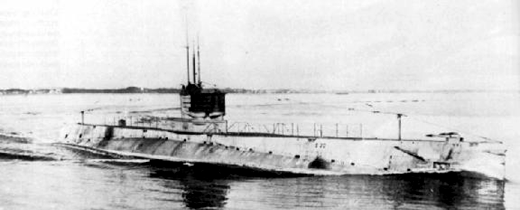
The Lake design, S-2, was a modified double-hull type, with ballast tanks wrapped around the inner pressure hull. The stern ended in a flat "shovel" shape which gave the stern needed buoyancy. The rudder was mounted beneath the stern and the pivot structure also supported the stern diving planes. To gain surface buoyancy, the superstructure atop the boat was partially watertight. Sea trials showed that the bow tended to burrow into the waves so Lake added a buoyancy tank to the bow, which gave it a humped appearance. This boat suffered from poor maneuverability and was overcomplicated. It proved to be unreliable and was not well liked by its crew. The Navy did not choose it for mass production and no further boats were produced to this design.Template:Sfn

The BuC&R design, S-3, formed the basis for the Group II and Group IV boats, was a full double hull type that incorporated some design features of both the Electric Boat and Lake designs. At Template:Cvt long, it was longer, and a little wider, than the other two designs. The battery was contained in one large compartment forward of the control room, giving the boat a long, sleek appearance. The long hull ended in a sharp vertical "chisel" at the stern, and the rudder and stern dive planes were ventrally mounted under the hull, behind the propellers.Template:Sfn One drawback to the "Navy" type was that their main ballast tanks were divided into an upper and lower tank, which caused them to dive slow due to the fact that the upper tank wouldn't start filling until it was submerged.Template:Sfn
After WWI, US officers were impressed by the stern torpedo tubes on the German U-boats, the last four of Group II, and all four of Group IV boats, had an additional single stern torpedo tube added.Template:Sfn Template:Sfn Group IV was also longer and had less draft. A Script error: No such module "convert". deck gun had initially been requested, but due to space restraints and drag, all S-boats were eventually outfitted with a Script error: No such module "convert"./50 caliber deck gun, a significant increase over the Script error: No such module "convert"./23 caliber and 3-in/50 caliber guns of previous US submarines. This was due to observations that the German U-boats frequently used their deck guns, and many U-boats were equipped with Template:Cvt deck guns. Another improvement was the conning tower fairwater. Previous US submarines had small fairwaters to reduce drag and improve submerged speed. Experience gained on North Atlantic patrols during World War I showed that the boats would be spending considerable time on the surface and thus needed better protection for the bridge watchstanders. Examination of captured U-boats after the Armistice also showed that a larger fairwater with permanent grab rails was preferable when surfaced in the North Atlantic, so S-boats were built or refitted with an improved and much larger fairwater.Template:SfnTemplate:SfnTemplate:SfnTemplate:Sfn
The first S-boat placed into commission was S-3, on 30 January 1919, followed in order by Script error: No such module "WPSHIPS utilities"., Script error: No such module "WPSHIPS utilities"., Script error: No such module "WPSHIPS utilities"., and S-2.Template:Sfn EB's contractors in Quincy and San Francisco, worked in parallel, with the first unit, S-1, built in Quincy, and commissioned on 5 June 1920, and the first unit from San Francisco, being the Script error: No such module "WPSHIPS utilities"., commissioned on 29 October 1920.Template:Sfn
SS-163 to SS-168, "Modified Holland", and SS-173 to SS-176, "Modified Navy", were cancelled, and contrary to later practice, the hull numbers were used for subsequent submarines.Template:Sfn Some of the material for these was used by EB to build the Peruvian Navy's four R-boats.
Future Admiral, Hyman G. Rickover, was assigned to Script error: No such module "WPSHIPS utilities".. He later credited the "faulty, sooty, dangerous and repellent engineering" of the S-class boats with inspiring his obsession for high engineering standards.Template:Sfn

In 1923, S-1 experimented with a Martin MS-1 seaplane, an idea the Japanese would later adopt. A cylindrical hangar was installed on the after deck to house a single Martin MS-1 seaplane. Tests showed the concept to be unworkable, and the equipment was subsequently removed. The hangar was later reused and rebuilt as the prototype for the McCann Rescue Chamber, a diving bell for rescuing crewmen from sunken submarines.Template:Sfn
Service
Between the Wars
The first two boats completed by EB were S-1 at Quincy and S-30 at San Francisco. During builder's sea trials both boats experienced severe torsional drive train vibrations during their required high-speed runs. The vibrations were so bad that both engines on both submarines were completely wrecked. Subsequent investigation showed that the crankshafts of the NELSECO 8-EB-15 diesel engines were of an insufficient diameter, and were not stiff enough to resist the power stroke of each cylinder/piston as it fired, resulting in excessive torsional twisting.Template:Sfn This was a serious deficiency, and a severe setback for EB production. Some boats lingered incomplete at the builder's yards, while others limped along at reduced power until a fix could be implemented. Eventually, the Navy Department, faced with the prospect of having a majority of the S-class being unable to meet its desired operational parameters, acquired additional funding for EB to rebuild the engines with a crankshaft of increased diameter. This solved the torsional vibration problem, but the rebuild work considerably delayed the delivery of the EB boats to the Navy, resulting in average build times exceeding 4 1/2 years.Template:Sfn Once the engine problem was resolved, the EB boats turned in excellent service to the USN, with many serving until the end of WWII.
The boats built to the BuC&R design, by Portsmouth and Lake, used a Bureau built MAN diesel engine, or in the case of Lake, a 2-cycle or 4-cycle Busch-Sulzer engine. These engine types, while still suffering from design and engineering problems inherent in all early diesel engines, were much more reliable than the NELSECO engines, used by EB, and they turned in acceptable performance throughout their service lives.Template:Sfn
World War II service
At the entry of the United States into World War II, in December 1941, the S-class submarines ranged in age from 16 to 21 years. While the US Navy had two older classes of submarines at that time, the O and R classes, originally commissioned in 1918 and 1919, the S-class was the oldest class of submarine, possibly in the world, to be used in combat operations.
The Navy had 37 S-boats in service when the United States entered the war. Twenty S-boats were awarded battle stars and 17 were credited with sinking a collective total of 42 Japanese ships. Six commissioned S-boats were lost during the war, three by grounding, one by collision, one by flooding, and one, Script error: No such module "WPSHIPS utilities"., in combat.
Some S-class boats were transferred to other navies. Five, S-1, Script error: No such module "WPSHIPS utilities"., Script error: No such module "WPSHIPS utilities"., Script error: No such module "WPSHIPS utilities"., and Script error: No such module "WPSHIPS utilities"., were transferred to the Royal Navy, between March and September 1942, and one, Script error: No such module "WPSHIPS utilities"., to Poland, in November 1941. These were mostly used for training in anti-submarine warfare (ASW) and removed from service by mid-1944.
S boats saw service in World War II, in both the Atlantic and the Pacific. Smaller and slower than the later fleet submarines produced for war service, and lacking the range for Pacific Ocean patrols, as well as being 20 years old, they were used in reconnaissance and supply roles, as well as for coastal defense.
Eight S-boats, Script error: No such module "WPSHIPS utilities". thru Script error: No such module "WPSHIPS utilities". and S-48, spent the war entirely in the Atlantic theater. Their operations ranged from Coco Solo, in Panama, to Casco Bay, in Maine.
S-boats operated in the Alaska theater, during the aftermath of the Battle of the Aleutian Islands, based out of Dutch Harbor. Some also operated out of Australia, in the Southwest Pacific Area. Most were withdrawn from front-line service by late 1943, as more Script error: No such module "WPSHIPS utilities". fleet submarines became available, and were relegated to ASW training. Two S boats, Script error: No such module "WPSHIPS utilities". and Script error: No such module "WPSHIPS utilities"., conducted combat patrols in 1944, with the last combat patrol by an S boat being conducted by S-42, from 5 August to 3 September 1944.
In World War II, S-class boats did not use the newer Mark 14 torpedo, standard in fleet submarines, due to shorter torpedo tubes, relying on the World War I-vintage Mark 10 instead. Due to production shortages, many fleet boats also used Mark 10s. Since the Mark 14 suffered from a high failure rate early in the war, this was not necessarily a disadvantage.
The most notable combat success for the class was by S-44. In the aftermath of the disastrous defeat of the USN and Royal Australian Navy (RAN), at the Battle of Savo Island, S-44 encountered the withdrawing Japanese force near Kavieng, on the morning of 10 August 1942. Having found themselves in the perfect position, the crew of S-44 launched a spread of four Mark 10s, three of which hit the Japanese heavy cruiser Script error: No such module "WPSHIPS utilities".Script error: No such module "Check for unknown parameters".. The mortally wounded cruiser sank in seven minutes and S-44 escaped.
As newer submarines were put in service during World War II, S-boats were withdrawn from combat service and provided training support instead. Starting in late 1944, a total of 11 boats were decommissioned, and used for experimental purposes, including being sunk by experimental weapons.
Thirteen S-boats were still in service when the Japanese surrendered, on 2 September 1945. Of the 13, 11 were decommissioned, in October 1945, one in November, and Script error: No such module "WPSHIPS utilities"., remained in commission until June 1946.
S-boat fates
Lost at sea between wars
4 submarines
- Script error: No such module "WPSHIPS utilities". - Sunk in a collision with the United States Coast Guard destroyer Script error: No such module "WPSHIPS utilities"., off Provincetown, Massachusetts, on 17 December 1927, 40 men were killed; later raised, repaired, and served as a salvage and submarine escape test boat, before finally being sunk as a target, 15 May 1936.Template:Sfn
- Script error: No such module "WPSHIPS utilities". - Lost 1 September 1920, in a diving accident off the Delaware Capes, with no loss of life. Subsequent salvage attempts failed and the boat was left on the bottom off Cape May, New Jersey.Template:Sfn
- Script error: No such module "WPSHIPS utilities". - Sunk in a diving accident, with no loss of life, before commissioning, 7 December 1921; raised and commissioned on 14 October 1922; served during World War II, and scrapped in 1946.Template:Sfn
- Script error: No such module "WPSHIPS utilities". - Sunk in a collision with SS City of Rome, off Block Island, 25 September 1925, 33 men were killed; raised and later scrapped 1930.Template:Sfn
Decommissioned and scrapped between before World War II
5 submarines
- Script error: No such module "WPSHIPS utilities". - scrapped, 14 September 1931
- Script error: No such module "WPSHIPS utilities". - 25 January 1937
- Script error: No such module "WPSHIPS utilities". - scrapped, 13 November 1936
- Script error: No such module "WPSHIPS utilities". - sunk as target, 18 December 1938
- Script error: No such module "WPSHIPS utilities". - scrapped, 1936
Decommissioned before WWII eventually scrapped
4 submarines
- Script error: No such module "WPSHIPS utilities". - scrapped, unknown date
- Script error: No such module "WPSHIPS utilities". - scrapped, unknown date
- Script error: No such module "WPSHIPS utilities". - scrapped, unknown date
- Script error: No such module "WPSHIPS utilities". - scrapped, unknown date
6 submarines
- Script error: No such module "WPSHIPS utilities". to RN as P.552, in 1942, removed from service, January 1944; returned to US, 16 October 1944, and scrapped, sold for scrapping 14 September 1945.
- Script error: No such module "WPSHIPS utilities". to RN as P.553, 14 September 1942; returned to US, 11 July 1944, and sunk as target, 23 March 1945.
- Script error: No such module "WPSHIPS utilities". to RN as P.554; returned to US, 11 July 1944, and sold for scrapping, 16 November 1945.
- Script error: No such module "WPSHIPS utilities". to RN as P.555; returned to US, and sunk as target, 25 August 1947.
- Script error: No such module "WPSHIPS utilities". to RN as P.551, 4 November 1941; later transferred to the Polish Navy, as ORP Jastrząb; scuttled after hit by friendly fire, 2 May 1942.
- Script error: No such module "WPSHIPS utilities". to RN as P.556; returned to US, on paper, in 1946, after battery explosion, partially scrapped in UK, 1947, scrapping completed in Spain, 1987.
Lost during World War II
7 submarines (1 to enemy action)
- Script error: No such module "WPSHIPS utilities". Sunk in a collision with Script error: No such module "WPSHIPS utilities"., in the Gulf of Panama, 24 January 1942;Template:Sfn The wreck was eventually found and surveyed by the Lost 52 Project.Template:Sfn
- Script error: No such module "WPSHIPS utilities". Grounded, 19 June 1942, off St. Makarius Point, Amchitka Island, Alaska. Abandoned, 25 June 1942.Template:Sfn
- Script error: No such module "WPSHIPS utilities". Sunk 4 July 1944, due to a hull failure, off Pearl Harbor. The wreck was found in two pieces by the Lost 52 Project, in December 2017.Template:Sfn
- Script error: No such module "WPSHIPS utilities". Grounded, on Taka Bakang Reef, in the Makassar Strait, Dutch East Indies. Scuttled, 21 January 1942.Template:Sfn
- Script error: No such module "WPSHIPS utilities". Grounded, 13 August 1942, off Rossel Island, in the Coral Sea.Template:Sfn
- Script error: No such module "WPSHIPS utilities". Lost to enemy action, enroute to her patrol area, near the Kuril Islands. Sunk by the Japanese escort ship Script error: No such module "WPSHIPS utilities".Script error: No such module "Check for unknown parameters"., 7 October 1943.Template:Sfn
- Script error: No such module "WPSHIPS utilities". Stricken and sold for scrap, 25 May 1931; hulked in 1936; hulk reacquired by the US Navy for "experimental purposes"; foundered and sank off Point Patience, in the Patuxent River, 16 December 1942.Template:Sfn This is not counted among the 52 US submarines lost during World War II, as the vessel was not in commission at the time.
Other fates
11 submarines
Decommissioned in 1944 and 1945, prior to the surrender of Japan. They were mostly expended as targets. The wrecksite of the target boat Script error: No such module "WPSHIPS utilities"., was located off Oahu, by the Lost 52 Project, in 2017, not far from S-28.
13 submarines
In commission when the Japanese surrendered, on 2 September 1945. All except one, S-15, were decommissioned by the end of November 1945. S-15 was decommissioned in June 1946.
General characteristics
Group I
1st Electric Boat (aka Holland) designTemplate:Sfn
- Displacement: Template:Cvt surfaced; Template:Cvt submerged
- Length: Template:Cvt
- Beam: Template:Cvt
- Draft: Template:Cvt
- Propulsion & power: 2 × New London Ship and Engine Company (NELSECO) diesel engines, Template:Cvt each; 2 × Electro-Dynamic (S-1, S-30-S-35), Ridgway (S-18, S-20 through S-29), or General Electric (S-36 through S-41) electric motors, Template:Cvt each; 2 × 60-cell Exide batteries; 2 × propellersTemplate:Sfn
- Bunkerage: Template:Cvt fuel oil
- Speed: Template:Cvt surfaced; Template:Cvt submerged
- Range: Template:Cvt at Template:Cvt surfaced
- Test depth: Template:Cvt
- Armament (as built): 4 × 21 inch (533 mm) torpedo tubes (bow), 12 torpedoes;Template:Sfn
1 × [[4"/50 caliber gun|Template:Cvt/50 caliber]] deck gunTemplate:Sfn - Crew: 38 (later 42) officers and menTemplate:Sfn
- Boats in Group: S-1, S-18 through S-41
Group II
1st Navy (aka Government) designTemplate:Sfn
- Displacement: Template:Cvt surfaced; Template:Cvt submerged
- Length: Template:Cvt
- Beam: Template:Cvt
- Draft: Template:CvtTemplate:Sfn
- Propulsion & power: 2 × MAN (S-3 through S-13) or Busch-Sulzer (S-14 through S-17) diesel engines, Template:Cvt each; 2 × Westinghouse Electric electric motors, 600 hp each; 1 × 120-cell Exide battery; 2 × propellersTemplate:Sfn
- Speed: Template:Cvt surfaced; 11 kn submerged
- Bunkerage: Template:Cvt fuel oil
- Range: 5,000 nmi at 10 kn surfaced
- Test depth: 200 ft
- Armament (as built): 4 × 21 in torpedo tubes (bow), 12 torpedoes (S-3 through S-9); 4 × 21 in torpedo tubes (bow), 1 × 21 in torpedo tubes (stern), 14 torpedoes(S-10 through S-13);Template:Sfn
1 × 4 inch (102 mm)/50 caliber deck gunTemplate:Sfn - Crew: 38 (later 42) officers and men
- Boats in Group: S-3 through S-17
Group III
2nd Electric Boat (aka Modified Holland) designTemplate:Sfn
- Displacement: Template:Cvt surfaced; Template:Cvt submerged
- Length: Template:Cvt, Template:Cvt overall
- Beam: Template:Cvt
- Draft: Template:CvtTemplate:Sfn
- Propulsion & power: 2 × NELSECO diesels, 600 hp (448 kW) each; 2 × Electro-Dynamic electric motors, 750 hp each; 1 × 120 cell Exide battery; 2 × propellersTemplate:Sfn
- Speed: 15 knots (28& km/h) surfaced; 11 knots (20 km/h) submerged
- Bunkerage: 185 tons oil fuelTemplate:Sfn
- Range: 5000 nmi at 10 kn surfaced
- Test depth: 200 ft (61 m)
- Armament (as built): 4 × 21 in torpedo tubes (bow), 12 torpedoes;
1 × 4 in/50 cal deck gunTemplate:Sfn - Crew: 38 (later 42) officers and men
- Boats in Group: S-42 through S-47
Group IV
2nd Navy (aka Modified Navy) designTemplate:Sfn
- Displacement: Template:Cvt surfaced; Template:Cvt submerged
- Length: Template:Cvt, Template:Cvt overall
- Beam: Template:Cvt
- Draft: Template:CvtTemplate:Sfn
- Propulsion & power: 2 × Busch-Sulzer diesel engines, Template:Cvt each; 2 × Ridgway electric motors, 750 hp each; 1 × 120 cell Exide battery; 2 × propellersTemplate:Sfn
- Bunkerage: 177 tons oil fuelTemplate:Sfn
- Speed: 14.5 knots surfaced; 11 knots submerged
- Range: Template:Cvt at Template:Cvt surfaced
- Depth: 200 ft
- Armament (as built): 4 × 21 in torpedo tubes (bow), 1 × 21 in torpedo tubes (stern), 14 torpedoes(S-10 through S-13);Template:Sfn
1 × 4 inch (102 mm)/50 caliber deck gunTemplate:Sfn - Crew: 38 (later 45) officers and men
- Boats in Group: S-48 through S-51
S-2
Lake Torpedo Boat Company designTemplate:Sfn
- Displacement: Template:Cvt surfaced; Template:Cvt submerged
- Length: Template:Cvt overall
- Beam: Template:Cvt
- Draft: Script error: No such module "convert".
- Propulsion & power: 2 × Busch-Sulzer diesel engines, 900 hp each; 2 × Diehl Manufacture Company electric motors, 750 hp each; 2 × propellersTemplate:Sfn
- Speed: 15 knots surfaced; 11 knots submerged
- Range: 8000 nmi at 10 kn surfaced
- Depth: 200 ft
- Armament (as built): 4 × 21 in torpedo tubes (bow), 12 torpedoes;Template:Sfn
1 × 4 in/50 cal deck gunTemplate:Sfn - Crew: 38 officers and men
See also
- Allied submarines in the Pacific War
- Unrestricted submarine warfare
- List of submarine classes of the United States Navy
- List of lost United States submarines
References
<templatestyles src="Reflist/styles.css" />
Script error: No such module "Check for unknown parameters".
Bibliography
<templatestyles src="Refbegin/styles.css" />
- Script error: No such module "citation/CS1".
- Script error: No such module "citation/CS1".
- Script error: No such module "citation/CS1".
- Script error: No such module "citation/CS1".
- Script error: No such module "citation/CS1".
- Script error: No such module "citation/CS1".
- Script error: No such module "citation/CS1".
- Script error: No such module "citation/CS1".
- Script error: No such module "citation/CS1".
- Script error: No such module "citation/CS1".
- Script error: No such module "citation/CS1".
- Script error: No such module "citation/CS1".
- Script error: No such module "citation/CS1".
- Script error: No such module "citation/CS1".
- Script error: No such module "citation/CS1".
- Script error: No such module "citation/CS1".
- Script error: No such module "citation/CS1".
- Script error: No such module "citation/CS1".
- Script error: No such module "citation/CS1".
Further reading
- Script error: No such module "citation/CS1".
- Script error: No such module "citation/CS1".
- Script error: No such module "citation/CS1".
- Script error: No such module "citation/CS1".
External links
- A picture
- NavSource early diesel submarines photo gallery index
- Pigboats.com S-boats photo gallery
- List of WWII US submarines at FleetSubmarine.com
- DiGiulian, Tony Navweaps.com 4"/50 caliber gun
- On Eternal Patrol, website dedicated to all US submarines and submariners lost to all causes
Script error: No such module "Military navigation". Template:WWII US ships