Termitomyces
Template:Short description Template:Automatic taxobox
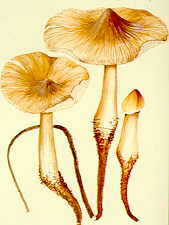
Termitomyces is a genus of the termite mushrooms, the basidiomycete fungi belonging to the family Lyophyllaceae.[1] Termitomyces fungi and fungus-farming termites (Macrotermitinae) co-depend to survive[2][3], as the termites house and culture the fungi, and the fungi in turn provide foods for the termites. Termitomyces mushrooms are edible, and are highly regarded for their flavor.[4]
Morphology
Termitomyces includes the largest edible mushroom in the world, Termitomyces titanicus of West Africa and Zambia, whose cap reaches 1 metre (3.28 ft) in diameter.[5] It also includes Termitomyces microcarpus that grows caps of a few centimeters in diameter.
Life as a Termitomyces fungus
These fungi grow on 'combs' which are formed from the termites' excreta, dominated by tough woody fragments.
Some chamber(s) of the nest each contains a structure, called comb or fungus garden, where the fungus dwells.[6] The termites collect and chew up dead wood, leaf litter and other vegetable debris, depositing their primary faeces as new portions of the fungus garden.[7] The fungus grow through the comb. The termites eat spherulesTemplate:Refn and old combs.[8]
The fungus forms mushrooms for spreading spores. For most species, the fungus grows long pseudorhizas to the surface of the ground, where mushrooms are formed.[9] For T. microcarpus, the mushrooms grow from fragments of fungus garden that are carried outside the nest by worker termites.[10]
When a new termite colony is established, in most cases, the fungus is introduced through the activities of the termites collecting spores from the environment.[3]
Pseudoxylaria the fungal weed
Fungi of Pseudoxylaria, a subgenus of Xylaria, are found in fungus-growing termite combs.[11] Being weedy and suppressed by fungus-growing termites,[12] they flourish when the termite nest is deteriorating or deserted.[11]
Research history
Termitomyces was described by Roger Heim in 1942.[13]
From 1955 to 1969 Arthur French [14] worked in Uganda (as a hobby) on the subject of fungi and termites. Some scientific literature about these fungal species existed previously, but these texts failed to adequately discuss the relationship between termites and their fungal symbiotes, while the various edible varieties were merely termed "termite mushrooms." French conducted some investigations with the help of the elderly Baganda women who gathered termite mushrooms, and published his findings.
Culinary use
They are foraged in Malaysia known as cendawan busut ("mound mushroom"). Tamil rubber tappers in Selangor long time ago would find a lot of T. schimperi growing in estate environments not long after raining.[15]Template:Rp They are widely eaten across India.[16][17][18]
Lookalikes
Many cases of mushroom poisoning in Malaysia happen because Chlorophyllum molybdites look similar to Termitomyces fungi.[19]
Species
As of July 2023[update]Script error: No such module "Check for unknown parameters"., Species Fungorum accepted 52 species of Termitomyces.[20]
- Termitomyces acriumbonatus Usman & Khalid (2020)
- Termitomyces albidus (Singer) L.D. Gómez (1995)
- Termitomyces aurantiacus (R. Heim) R. Heim (1977)
- Termitomyces biyi Otieno (1966)
- Termitomyces bulborhizus T.Z. Wei, Y.J. Yao, Bo Wang & Pegler (2004)
- Termitomyces citriophyllus R. Heim (1942)
- Termitomyces clypeatus R. Heim (1951)
- Termitomyces congolensis (Beeli) Singer (1948)
- Termitomyces dominicalensis L.D. Gómez (1995)
- Termitomyces entolomoides R. Heim (1951)
- Termitomyces epipolius (Singer) L.D. Gómez (1995)
- Termitomyces eurrhizus (Berk.) R. Heim (1942)
- Termitomyces floccosus S.M. Tang, Raspé & S.H. Li (2020)
- Termitomyces fragilis L. Ye, Karun, J.C. Xu, K.D. Hyde & Mortimer (2019)
- Termitomyces fuliginosus R. Heim (1942)
- Termitomyces gilvus C.S. Yee & J.S. Seelan (2020)
- Termitomyces globulus R. Heim & Gooss.-Font. (1951)
- Termitomyces griseiumbo Mossebo (2003)
- Termitomyces heimii Natarajan (1979)
- Termitomyces indicus Natarajan (1976)
- Termitomyces infundibuliformis Mossebo (2012)
- Termitomyces intermedius Har. Takah. & Taneyama (2016)
- Termitomyces lanatus R. Heim (1977)
- Termitomyces le-testui (Pat.) R. Heim (1942)
- Termitomyces magoyensis Otieno (1966)
- Termitomyces mammiformis R. Heim (1942)
- Termitomyces mboudaeinus Mossebo (2003)
- Termitomyces mbuzi Härkönen & Niemelä (2021)
- Termitomyces medius R. Heim & Grassé (1951)
- Termitomyces microcarpus (Berk. & Broome) R. Heim (1942)
- Termitomyces narobiensis Otieno (1966)
- Termitomyces perforans R. Heim (1977)
- Termitomyces poliomphax (Singer) L.D. Gómez (1995)
- Termitomyces rabuorii Otieno (1966)
- Termitomyces radicatus Natarajan (1977)
- Termitomyces reticulatus Van der Westh. & Eicker (1990)
- Termitomyces robustus (Beeli) R. Heim (1951)
- Termitomyces sagittiformis (Kalchbr. & Cooke) D.A. Reid (1975)
- Termitomyces schimperi (Pat.) R. Heim (1942)
- Termitomyces sheikhupurensis Izhar, Khalid & H. Bashir (2020)
- Termitomyces singidensis Saarim. & Härk. (1994)
- Termitomyces songolarum (Courtec.) Furneaux (2020)
- Termitomyces spiniformis R. Heim (1977)
- Termitomyces srilankensis Ediriweera, Voto, Karun. & Kularathne (2023)
- Termitomyces striatus (Beeli) R. Heim (1942)
- Termitomyces subclypeatus Mossebo (2003)
- Termitomyces subumkowaan Mossebo (2003)
- Termitomyces titanicus Pegler & Piearce (1980)
- Termitomyces tylerianus Otieno (1966)
- Termitomyces umkowaan (Cooke & Massee) D.A. Reid (1975)
- Termitomyces upsilocystidiatus S.M. Tang, Raspé & K.D. Hyde (2020)
Taxonomic identity unknown
- Termitomyces meipengianus (M. Zang & D.Z. Zhang) P.M. Kirk (2014)
- Not a Termitomyces fungus; the actual taxonomic identity of this mushroom is unclear.[21]
Misnomer
- Termitomyces albuminosus (Berk.) R.Heim (1941)
- This name is commonly misused to refer to mushrooms of Termitomyces;[22][23] the original specimen of T. albuminosus was deemed to be of Macrolepiota and its species name became M. albuminosa.[24]
Notes
<templatestyles src="Reflist/styles.css" />
Script error: No such module "Check for unknown parameters".
See also
References
<templatestyles src="Reflist/styles.css" />
- ↑ Script error: No such module "Citation/CS1".
- ↑ The Biggest Mushroom? — MykoWeb
- ↑ a b Script error: No such module "Citation/CS1".
- ↑ Script error: No such module "Citation/CS1".
- ↑ Script error: No such module "Citation/CS1".
- ↑ Script error: No such module "citation/CS1".
- ↑ Script error: No such module "citation/CS1".
- ↑ Script error: No such module "Citation/CS1".
- ↑ Script error: No such module "citation/CS1".
- ↑ Script error: No such module "citation/CS1".
- ↑ a b Script error: No such module "Citation/CS1".
- ↑ Script error: No such module "Citation/CS1".
- ↑ Script error: No such module "Citation/CS1".
- ↑ Script error: No such module "Citation/CS1".
- ↑ Script error: No such module "Citation/CS1".
- ↑ Script error: No such module "Citation/CS1".
- ↑ Script error: No such module "Citation/CS1".
- ↑ Script error: No such module "Citation/CS1".
- ↑ Script error: No such module "Citation/CS1".
- ↑ Script error: No such module "citation/CS1".
- ↑ Script error: No such module "Citation/CS1".
- ↑ Script error: No such module "citation/CS1".
- ↑ Script error: No such module "Citation/CS1".
- ↑ Script error: No such module "Citation/CS1".
Cite error: Script error: No such module "Namespace detect".Script error: No such module "Namespace detect".
Script error: No such module "Check for unknown parameters".
External links
- Tobias Frøslev's Termitomyces page
- Patterns of interaction specificity of fungus-growing termites and Termitomyces symbionts in South Africa
- Image of a Termitomyces
- UN FAO report about Wild edible fungi
Template:Taxonbar Script error: No such module "Authority control".