Suhmata
Template:Pp-extended Script error: No such module "Settlement short description".Script error: No such module "Infobox".Template:Template otherScript error: No such module "Check for unknown parameters".Script error: No such module "Check for conflicting parameters".Expression error: Unexpected < operator.
Suhmata (Template:Langx), was a Palestinian village, located Script error: No such module "convert". northeast of Acre. It was depopulated by the Golani Brigade during the 1948 Arab-Israeli war.
History
Separated from the neighboring village of Tarshiha by a deep gorge, the ruins of a Byzantine era church lay within Suhmata's village lands.[1][2] An underground water reservoir and a burial cave that apparently dates to the Roman period have been found at the village site.[3][4] Suhmata had a Christian population at least until the Persian invasion of Palestine (A.D. 614–627)[5] and presumably many people remained Christian for some time after that.[6] What was earlier termed a Crusader-era castle constructed in the village, which was rebuilt by Daher al-Umar in the latter half of the 18th century, turned out to be the Byzantine church.[2][6] Excavations in 1932 revealed an inscription in the church's mosaic floor that dates to 555 CE.[7][8]
The Crusaders referred to the village as Samueth or Samahete.[2] In 1179, Baldwin IV confirmed the sale from Viscountess Petronella of Acre of houses, vineyards and gardens in Samueth, the village of Suphie, and some houses in Castellum Regis to Count Jocelyn III, uncle of Baldwin IV, for 4,500 bezants.[9] However, Ronnie Ellenblum writes that it is unlikely that there was actual Frankish settlement in Suhmata at this time.[10]
Ottoman era
in the 1548/9 Ottoman tax records, it. was noted that Suhm-wata (grid-number 178/267) paid a tax on 4 olive oil presses.[11]
In the Ottoman era, in 1838, Suhmata was found to be a village with a mixed population of Christians and Muslims, located in the el-Jebel district, west of Safad.[12]
In 1875, Victor Guérin visited Suhmata, and noted that "the village [is] divided into two distinct quarters, occupies two hills near each other, between which is a great pond (birke), partly cut in the rock and partly built. One of these hills is crowned by the remains of a fortress flanked by towers and built with simple rubble; it contained several subterranean magazines, a mosque, and various chambers. The foundation is attributed to Dhaher el Amer. It is now three parts demolished, and on the place where it stood grow vines and tobacco."[13]
In 1881, the PEF's Survey of Western Palestine (SWP) described it as "a village, built of stone, containing about 400 Moslems, situated on [a] ridge and [the] slope of [a] hill, surrounded by figs, olives and arable land; there are several cisterns and a spring near.[14]
An elementary school for boys was founded in the village in 1886.[6] A population list from about 1887 showed Sahmata to have about 1,500 inhabitants; 1,400 Muslims and 100 Christians.[15]
British Mandate era
During the Mandatory Palestine, an agricultural school was established.[6] The schools, a mosque, a church, two rain-fed irrigation pools, existed up until 1948.[6]
In the 1922 census of Palestine conducted by the British Mandate authorities, Submata had a population of 632; 589 Muslims and 43 Melkite Christians,[16][17] increasing in the 1931 census to 796; 752 Muslims and 44 Christians, in a total of 175 houses.[18]
Over 70 percent of the village land was rocky and uncultivated, covered with oak and wild pears. The agricultural land was planted with wheat, barley, maize, tobacco, and vegetables. Suhmata's tobacco had a reputation for quality.[6]
During the 1929 Palestine riots, residents of Suhmata attempted to attack the Jewish community of nearby Peki'in, but the village's Druze mukhtar (chief), Abdallah Saleh, intervened to protect them. Nevertheless, the threat led several Jewish families to leave Peki'in.[19]
The residents of Suhmata participated in the 1936–1939 Arab revolt in Palestine, and in early 1938, the village police station was attacked. According to one of the guards, the station, which was manned by the constable and other Arab personnel, was suddenly stormed by dozens of armed assailants. They killed the station commander, captured the remaining officers, and later released them.[20]
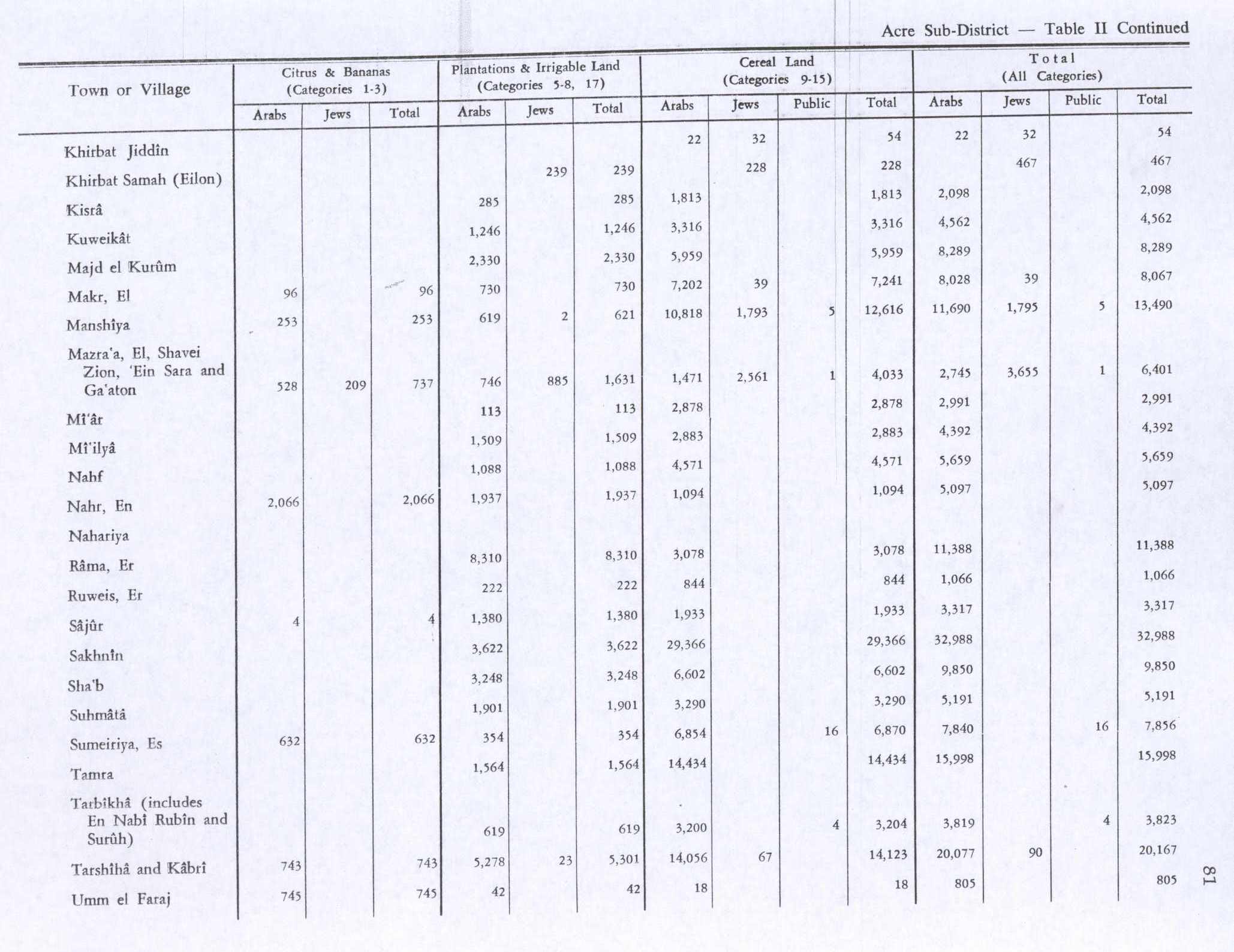
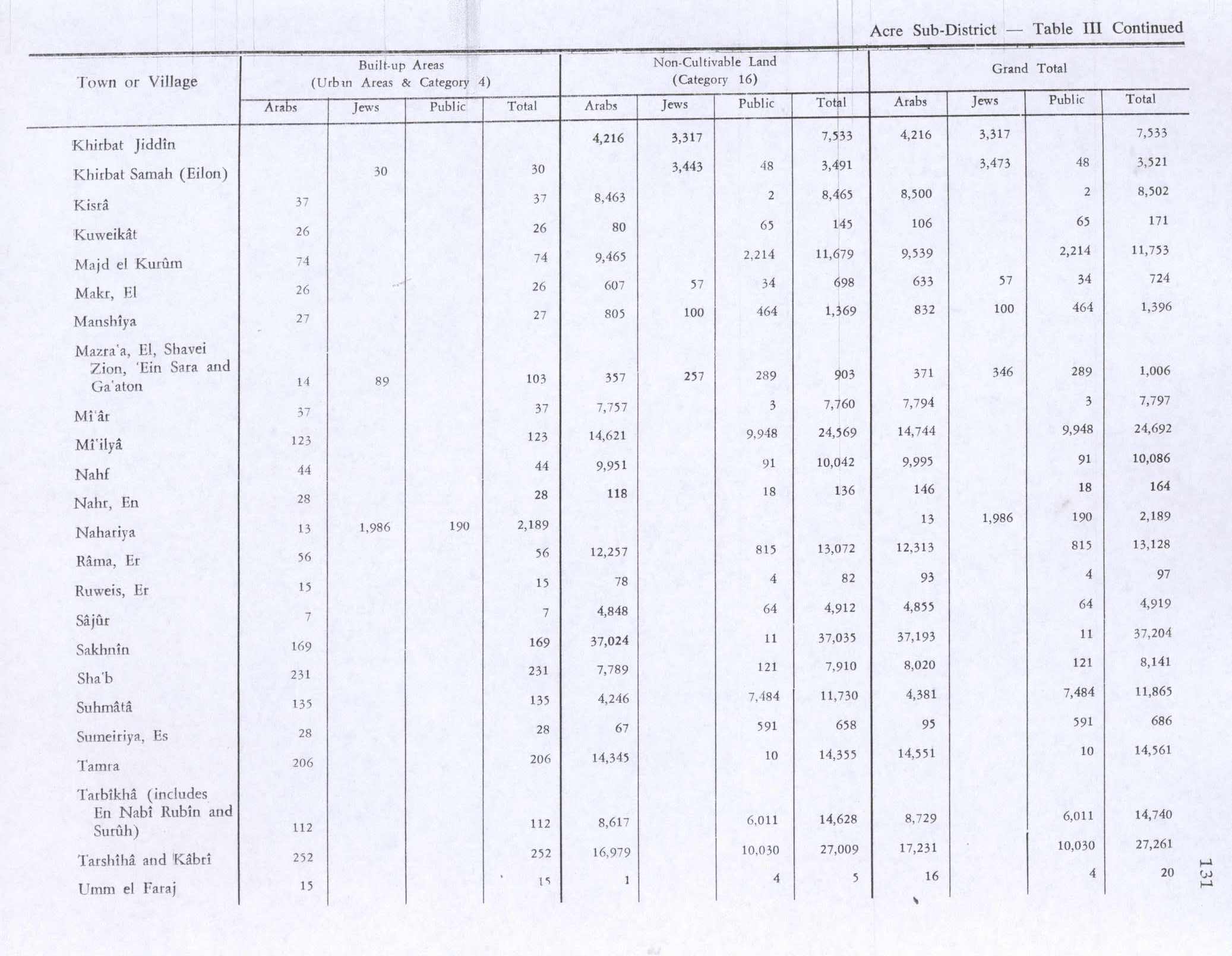
In the 1945 statistics, Suhmata had a population of 1,130; 1060 Muslims and 70 Christians,[21] with a total of 17,056 dunams of land.[22] Of this, a total of 3,290 dunums was allocated to cereals; 1,901 dunums were irrigated or used for orchards,[23] while 135 dunams were built-up (urban) area.[24]
Israeli period

During Operation Hiram, on 28 October 1948, the village was bombed from the air.[25] On 30 October, the First Battalion of Israel's Golani Brigade assaulted the village, resulting in its depopulation.[26] The village was left in ruins.[27]
A naming committee established by the Jewish National Fund, which operated from 1948 to 1951 until its incorporation into a Governmental Naming Committee set up by Israel, renamed Suhmata "Hosen", meaning "Strength." Meron Benvenisti writes that the committee chose this symbolic new name after determining that there was no known Jewish historical connection to the village of Suhmata.[28]
In 1992 the village site was described: "The site is covered with debris and broken walls from fallen stone houses, all of which are scattered among the olive trees that grow there. A castle and a wall that were probably built by the Crusaders still stand. The castle is on an elevated spot on the eastern side of the site, and the wall encloses the western quarter. The surrounding lands are partly forested and partly used as pasture."[29]
Suhmata's former inhabitants founded a village committee in 1993 which organizes volunteer efforts. The village committee also conducted a survey of the displaced population from Suhmata and their distribution inside Israel.[30] The village was also the focus of the 1996 play Sahmatah by Hanna Eady and Ed Mast.[31]
See also
- Depopulated Palestinian locations in Israel
- List of villages depopulated during the Arab–Israeli conflict
References
<templatestyles src="Reflist/styles.css" />
- ↑ Robinson and Smith, 1856, p. 76
- ↑ a b c Pringle, 1997, p. 118
- ↑ Lerer, 2008, Zuri’el Template:Webarchive
- ↑ Lerer, 2009, Suhmata Template:Webarchive
- ↑ Makhul, Naji 1977, (Acre and its villages since Ancient Times. In Arabic.) p.134, quoted in Khalidi, p.29
- ↑ a b c d e f Khalidi, 1992, p.29
- ↑ N. Makhouly and Avi-Yonah, 1933: "The Byzantine Church at Suhmata." The Quarterly of the Department of Antiquities in Palestine 3 (2) pp. 92-105, quoted in Khalidi, 1992, p. 29
- ↑ Dauphin, 1998, p. 636
- ↑ Strehlke, 1869, pp. 11-12, No. 11; cited in Röhricht, 1893, RRH, p. 156, No. 587; cited in Ellenblum, 2003, p. 45, note #10.
- ↑ Ellenblum, 2003, p. 45, note #10.
- ↑ Rhode, 1979, p. 144 Template:Webarchive
- ↑ Robinson and Smith, 1841, vol.3, 2nd appendix, p. 133
- ↑ Guérin, 1880, pp. 74-75, as translated in Conder and Kitchener, 1881, SWP I, p. 192
- ↑ Conder & Kitchener, 1881, SWP I, p.149
- ↑ Schumacher, 1888, p. 191
- ↑ Barron, 1923, Table XI, Sub-district of Acre, p. 36
- ↑ Barron, 1923, Table XVI, p. 50
- ↑ Mills, 1932, p. 108
- ↑ Script error: No such module "Citation/CS1".
- ↑ Script error: No such module "citation/CS1".
- ↑ Cite error: Script error: No such module "Namespace detect".Script error: No such module "Namespace detect".
- ↑ Cite error: Script error: No such module "Namespace detect".Script error: No such module "Namespace detect".
- ↑ Government of Palestine, Department of Statistics. Village Statistics, April, 1945. Quoted in Hadawi, 1970, p. 81
- ↑ Government of Palestine, Department of Statistics. Village Statistics, April, 1945. Quoted in Hadawi, 1970, p. 131
- ↑ Script error: No such module "Citation/CS1".
- ↑ Script error: No such module "citation/CS1".
- ↑ Mansour, 2004, p. 220.
- ↑ Benvenisti, 2000, pp. 34-35
- ↑ Cite error: Script error: No such module "Namespace detect".Script error: No such module "Namespace detect".
- ↑ Masalha and Said, 2005, p. 98
- ↑ Americans for Middle East Understanding Template:Webarchive February - March 1999
Script error: No such module "Check for unknown parameters".
Bibliography
<templatestyles src="Refbegin/styles.css" />
- Script error: No such module "citation/CS1".
- Script error: No such module "citation/CS1".
- Script error: No such module "citation/CS1".
- Script error: No such module "citation/CS1".
- Script error: No such module "citation/CS1".
- Script error: No such module "citation/CS1".
- Script error: No such module "citation/CS1".
- Script error: No such module "citation/CS1".
- Script error: No such module "citation/CS1".
- Script error: No such module "Citation/CS1".
- Script error: No such module "Citation/CS1".
- Script error: No such module "citation/CS1".
- Script error: No such module "citation/CS1".
- Script error: No such module "citation/CS1".
- Script error: No such module "citation/CS1".
- Script error: No such module "citation/CS1".
- Script error: No such module "citation/CS1".
- Script error: No such module "citation/CS1".
- Script error: No such module "citation/CS1".
- Script error: No such module "citation/CS1".
- Script error: No such module "Citation/CS1".
- Script error: No such module "citation/CS1".
External links
- Abnaa' Suhmata, "Sons of Suhmata", the website of the village committee established in 1993.
- Welcome to Suhmata at Palestineremembered
- Suhmata, Zochrot
- Survey of Western Palestine, Map 3: IAA, Wikimedia commons
- Suhmata is here, 29/10/2005, Zochrot.
- Hazneh Sama’an (Umm Afif), Suhmata, testimony, 2005, Zochrot.
- Suhmata at Khalil Sakakini Cultural Center
- Suhmata photosTemplate:Category handler[<span title="Script error: No such module "string".">usurped]Script error: No such module "Check for unknown parameters"., Dr. Moslih Kanaaneh
- http://www.yairgil.com/051029-zochrot/index.htm (29/10/2005)
- http://jacobk9.tripod.com/id37.html (29/10/2005)

Template:Palestinian Arab villages depopulated during the 1948 Palestine War Template:Authority control