Subi Reef
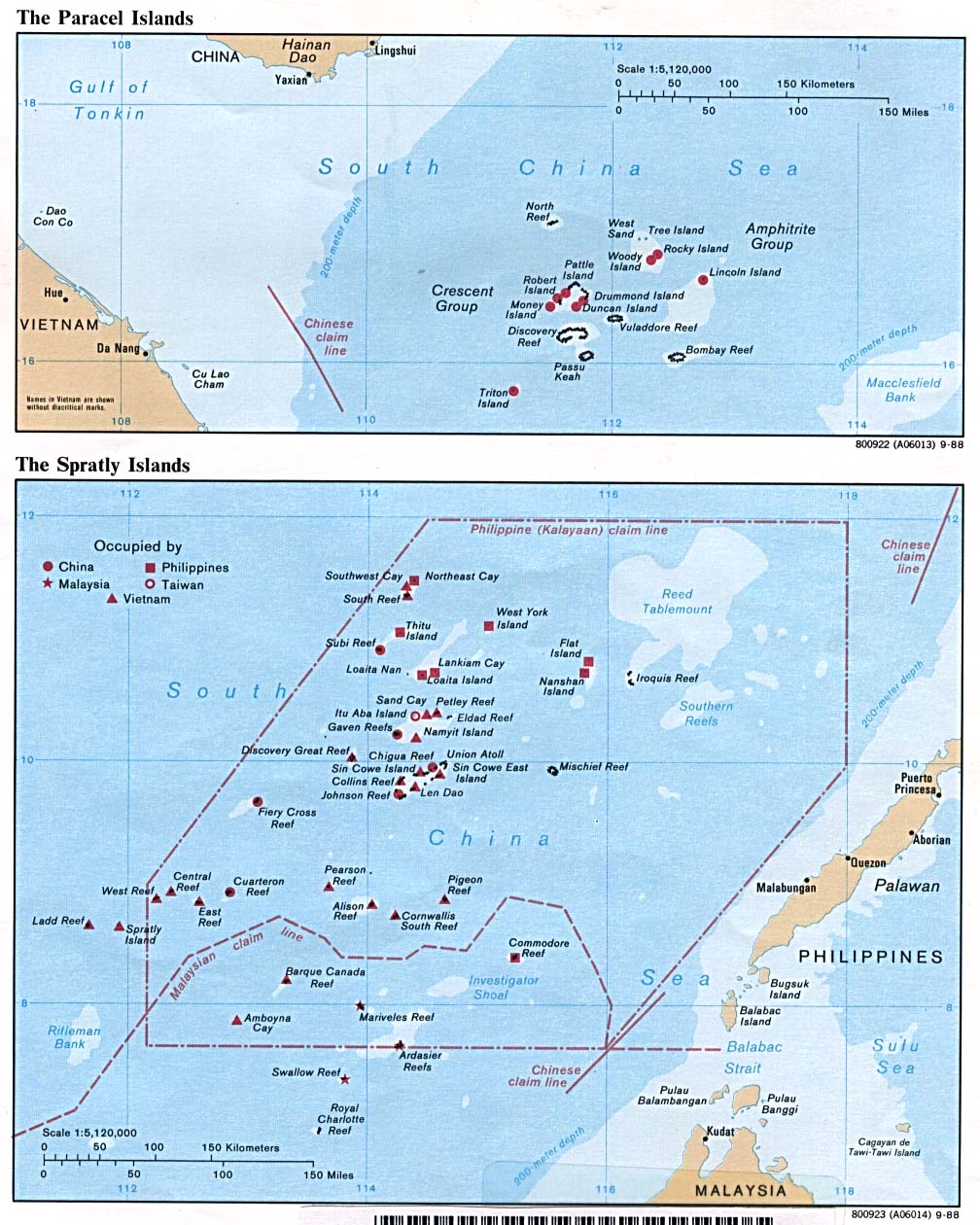
Template:Short description Script error: No such module "Infobox".Script error: No such module "Check for unknown parameters".Script error: No such module "Check for clobbered parameters". Subi Reef, also known as Xu Bi Reef (Template:Langx), Zamora Reef (Template:Langx), or Zhubi Reef (Template:Zh), is an atoll in the Spratly Islands of the South China Sea located Script error: No such module "convert". southwest of Thitu Island. It is occupied by China, and claimed by the Philippines, Taiwan and Vietnam.
Topography and features
The atoll measures Script error: No such module "convert". along its longer southwest-northeast axis, and is up to Script error: No such module "convert". wide. Its total area including the lagoon and rim of the atoll measures Script error: No such module "convert"., and the lagoon is up to Script error: No such module "convert". deep.[1]
Naturally above water only at low tide, the atoll surrounds a lagoon. The People's Republic of China has constructed a 4-story building, a weather observation station with doppler weather radar, wharfs, and an airport in the area. A buoyed channel guides ships to the inner lagoon which is Script error: No such module "convert". in diameter.[2][3][4][5]
UNCLOS Maritime Ruling
On 12 July 2016, the UNCLOS special arbitral tribunal in the Philippines v. China case confirmed that Subi Reef is, or in its natural condition was, exposed at low tide and submerged at high tide and is, accordingly a low-tide elevation that does not generate entitlement to a territorial sea, exclusive economic zone or continental shelf, but is within 12 miles of a high-tide feature Sandy Cay on the atoll's west of Thitu Island.[6]
As the Subi Reef is under the water, it is considered by the Third United Nations Conference on the Law of the Sea (UNCLOS III) as "sea bed" in "international waters". Although the PRC had ratified a limited UNCLOS III not allowing innocent passage of warships,[7] according to the UNCLOS III, features built on the sea bed cannot have territorial waters.[7]
Environmental issues
The PRC has ratified UNCLOS III;[7] the convention establishes general obligations for safeguarding the marine environment and protecting freedom of scientific research on the high seas, and also creates an innovative legal regime for controlling mineral resource exploitation in deep seabed areas beyond national jurisdiction, through an International Seabed Authority and the Common heritage of mankind principle.[8]
Territorial disputes

.jpg)
The atoll is controlled by China (PRC), with a 2014 estimate of 200 troops stationed there,[9] and also claimed by Taiwan (ROC), Vietnam and the Philippines. In July 2012, a large fleet of 30 Chinese fishing vessels arrived at the atoll from Hainan.[10]
In April 2015, a Philippine Navy aircraft patrolling near the atoll received "aggressive action" from a Chinese ship.[11] Also in 2015, the USS Lassen sailed within 12 nautical miles (which if applicable is the territorial waters limit of the atoll), prompting the Chinese Foreign Ministry to call the action a "provocation" and vowed to keep building up in the South China Sea. As per the US Navy, this was a routine "freedom of navigation" exercise. Similar exercises are performed routinely about 12–28 times per year.[12][13]

During 2014, the PRC started reclaiming land at Subi Reef, and by the end of 2015 had developed it into an island of Script error: No such module "convert"., with a military base, a large harbor, and an airstrip of about Script error: No such module "convert"..[14][15] In November 2015, two U.S. B-52 strategic bombers flew in airspace near the area. They were contacted by Chinese ground control, but were allowed to continue their mission undeterred.[16] In April 2016 a new lighthouse 55 meters (180') high commenced operations.[17] A civilian test flight to the new airport was conducted by a passenger jet of Hainan Airlines on July 13, 2016.[18]
See also
References
<templatestyles src="Reflist/styles.css" />
- ↑ Atoll Area, Depth and Rainfall: ZhubiScript error: No such module "Unsubst".Template:Cbignore
- ↑ Script error: No such module "citation/CS1".
- ↑ Script error: No such module "citation/CS1".
- ↑ Script error: No such module "citation/CS1".
- ↑ Script error: No such module "citation/CS1".
- ↑ Script error: No such module "citation/CS1". p.174
- ↑ a b c Script error: No such module "citation/CS1".
- ↑ Jennifer Frakes, The Common Heritage of Mankind Principle and the Deep Seabed, Outer Space, and Antarctica: Will Developed and Developing Nations Reach a Compromise? Wisconsin International Law Journal. 2003; 21:409
- ↑ Script error: No such module "citation/CS1".
- ↑ Script error: No such module "citation/CS1".
- ↑ Script error: No such module "citation/CS1".
- ↑ Script error: No such module "citation/CS1".
- ↑ Script error: No such module "citation/CS1".
- ↑ Script error: No such module "citation/CS1".
- ↑ Script error: No such module "citation/CS1".
- ↑ [1]
- ↑ Script error: No such module "citation/CS1".
- ↑ Script error: No such module "citation/CS1".
Script error: No such module "Check for unknown parameters".
External links
Script error: No such module "Side box".