Solar eclipse of September 22, 1968
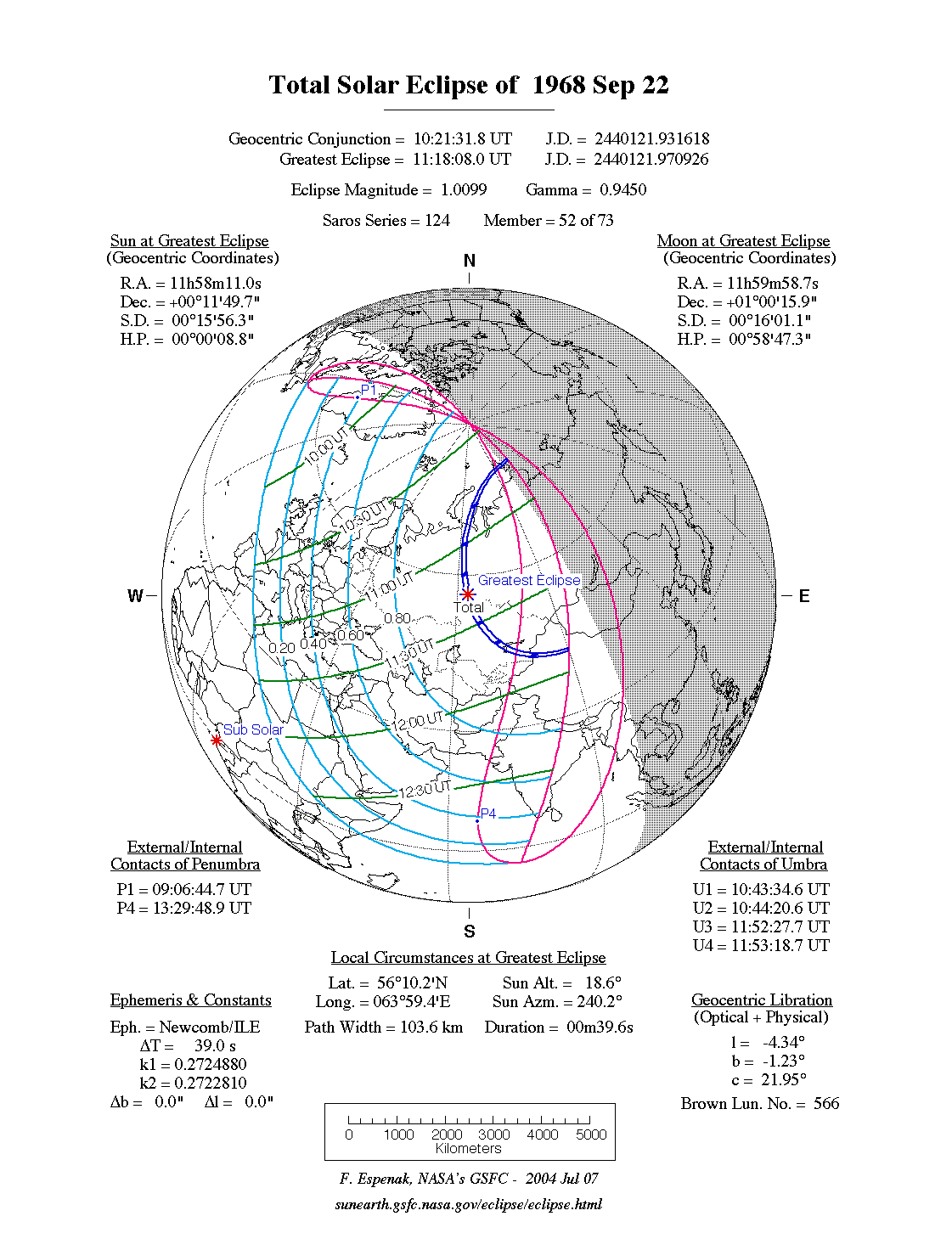
Template:Short description Script error: No such module "Solar eclipse". A total solar eclipse occurred at the Moon's descending node of orbit on Sunday, September 22, 1968,[1] with a magnitude of 1.0099. A solar eclipse occurs when the Moon passes between Earth and the Sun, thereby totally or partly obscuring the image of the Sun for a viewer on Earth. A total solar eclipse occurs when the Moon's apparent diameter is larger than the Sun's, blocking all direct sunlight, turning day into darkness. Totality occurs in a narrow path across Earth's surface, with the partial solar eclipse visible over a surrounding region thousands of kilometres wide. Occurring about 3.4 days before perigee (on September 25, 1968, at 21:20 UTC), the Moon's apparent diameter was larger.[2]
Totality was visible from the Soviet Union (today's Russia and Kazakhstan) and Xinjiang in Northwestern China. A partial eclipse was visible for parts of Europe, Northeast Africa, West Asia, Central Asia, and South Asia.
Observation
Soviet Union
A company named Opton proposed to the Sternberg Astronomical Institute to observe this solar eclipse in Sary Shagan on the west bank of Lake Balkhash, and also wrote to the Soviet Ministry of Railways for help to get to the destination faster. The observation team obtained spectrum of the corona. Students also assisted in taking pictures of the corona with MTO-1000 lens.[3]
China
This is the first total solar eclipse visible in the country since the founding of the People's Republic of China. It occurred during the Cultural Revolution, when astronomers including Zhang Yuzhe who organized observations of the total solar eclipse of June 19, 1936 and September 21, 1941 were excluded from key positions. The Chinese Academy of Sciences sent a team of 200 including Zhang Kuisan (张魁三), the then deputy director of the Geophysics Bureau to Xinjiang. The observation was code-named "532", named after the time February 1953 when Mao Zedong visited the Purple Mountain Observatory in Nanjing. The travel to Ürümqi by train first took 3 days, and another 7 days by car to the optical observation site Zhaosu Town (Mongolküre Town), Zhaosu County and the radio observation site Kashgar. Gravity measurements were also conducted in mountain caves. In order to avoid the turmoil of the Cultural Revolution, Zhou Enlai sent Liu Xiyao to lead the army to the local area and provide the whole team with meals and accommodation. The observation team completed the first monochromatic light observation and high-resolution radio observation of the sun in China. This was also the first time in China that a solar eclipse was observed by plane. Shanghai Scientific and Educational Film Studio also produced a science and education film of the total solar eclipse.[4][5]
The Soviet Union and China were the only two countries the path of this total solar eclipse passed. Due to the Sino-Soviet split, the two countries did not conduct any joint observations. About half a year after the eclipse, on January 23, 1969, the People's Daily published an article claiming that the observation of this eclipse "achieved brilliant results", repeatedly criticized the Soviet Union of "obstructing" it, and also mentioned that the Soviet Union "plundered data" of the annular solar eclipse of April 19, 1958.[6][7]
Eclipse details
Shown below are two tables displaying details about this particular solar eclipse. The first table outlines times at which the moon's penumbra or umbra attains the specific parameter, and the second table describes various other parameters pertaining to this eclipse.[8]
| Event | Time (UTC) |
|---|---|
| First Penumbral External Contact | 1968 September 22 at 09:07:22.9 UTC |
| Equatorial Conjunction | 1968 September 22 at 10:22:09.4 UTC |
| First Umbral External Contact | 1968 September 22 at 10:44:14.2 UTC |
| First Central Line | 1968 September 22 at 10:44:37.1 UTC |
| First Umbral Internal Contact | 1968 September 22 at 10:45:00.3 UTC |
| Ecliptic Conjunction | 1968 September 22 at 11:08:44.2 UTC |
| Greatest Eclipse | 1968 September 22 at 11:18:46.0 UTC |
| Greatest Duration | 1968 September 22 at 11:20:13.7 UTC |
| Last Umbral Internal Contact | 1968 September 22 at 11:53:04.0 UTC |
| Last Central Line | 1968 September 22 at 11:53:29.7 UTC |
| Last Umbral External Contact | 1968 September 22 at 11:53:55.1 UTC |
| Last Penumbral External Contact | 1968 September 22 at 13:30:26.7 UTC |
| Parameter | Value |
|---|---|
| Eclipse Magnitude | 1.00990 |
| Eclipse Obscuration | 1.01989 |
| Gamma | 0.94507 |
| Sun Right Ascension | 11h58m11.0s |
| Sun Declination | +00°11'49.6" |
| Sun Semi-Diameter | 15'56.3" |
| Sun Equatorial Horizontal Parallax | 08.8" |
| Moon Right Ascension | 11h59m58.7s |
| Moon Declination | +01°00'16.0" |
| Moon Semi-Diameter | 16'01.1" |
| Moon Equatorial Horizontal Parallax | 0°58'47.3" |
| ΔT | 38.9 s |
Eclipse season
Script error: No such module "Labelled list hatnote". This eclipse is part of an eclipse season, a period, roughly every six months, when eclipses occur. Only two (or occasionally three) eclipse seasons occur each year, and each season lasts about 35 days and repeats just short of six months (173 days) later; thus two full eclipse seasons always occur each year. Either two or three eclipses happen each eclipse season. In the sequence below, each eclipse is separated by a fortnight.
| September 22 Descending node (new moon) |
October 6 Ascending node (full moon) |
|---|---|
| File:SE1968Sep22T.png | File:Lunar eclipse chart close-1968Oct06.png |
| Total solar eclipse Solar Saros 124 |
Total lunar eclipse Lunar Saros 136 |


Related eclipses
Eclipses in 1968
- A partial solar eclipse on March 28.
- A total lunar eclipse on April 13.
- A total solar eclipse on September 22.
- A total lunar eclipse on October 6.
Metonic
- Preceded by: Solar eclipse of December 4, 1964
- Followed by: Solar eclipse of July 10, 1972
Tzolkinex
- Preceded by: Solar eclipse of August 11, 1961
- Followed by: Solar eclipse of November 3, 1975
Half-Saros
- Preceded by: Lunar eclipse of September 17, 1959
- Followed by: Lunar eclipse of September 27, 1977
Tritos
- Preceded by: Solar eclipse of October 23, 1957
- Followed by: Solar eclipse of August 22, 1979
Solar Saros 124
- Preceded by: Solar eclipse of September 12, 1950
- Followed by: Solar eclipse of October 3, 1986
Inex
- Preceded by: Solar eclipse of October 12, 1939
- Followed by: Solar eclipse of September 2, 1997
Triad
- Preceded by: Solar eclipse of November 21, 1881
- Followed by: Solar eclipse of July 24, 2055
Solar eclipses of 1968–1971
This eclipse is a member of a semester series. An eclipse in a semester series of solar eclipses repeats approximately every 177 days and 4 hours (a semester) at alternating nodes of the Moon's orbit.[9]
The partial solar eclipse on July 22, 1971 occurs in the next lunar year eclipse set.
| Solar eclipse series sets from 1968 to 1971 | ||||||
|---|---|---|---|---|---|---|
| Ascending node | Descending node | |||||
| Saros | Map | Gamma | Saros | Map | Gamma | |
| 119 | March 28, 1968 File:SE1968Mar28P.png Partial |
−1.037 | 124 | September 22, 1968 File:SE1968Sep22T.png Total |
0.9451 | |
| 129 | March 18, 1969 File:SE1969Mar18A.png Annular |
−0.2704 | 134 | September 11, 1969 File:SE1969Sep11A.png Annular |
0.2201 | |
| 139 File:C72pct (4321372614).jpg Totality in Williamston, NC USA |
March 7, 1970 File:SE1970Mar07T.png Total |
0.4473 | 144 | August 31, 1970 File:SE1970Aug31A.png Annular |
−0.5364 | |
| 149 | February 25, 1971 File:SE1971Feb25P.png Partial |
1.1188 | 154 | August 20, 1971 File:SE1971Aug20P.png Partial |
−1.2659 | |


Saros 124
Template:Solar Saros series 124
Metonic series
The metonic series repeats eclipses every 19 years (6939.69 days), lasting about 5 cycles. Eclipses occur in nearly the same calendar date. In addition, the octon subseries repeats 1/5 of that or every 3.8 years (1387.94 days). All eclipses in this table occur at the Moon's descending node.
| 21 eclipse events between July 11, 1953 and July 11, 2029 | ||||
|---|---|---|---|---|
| July 10–11 | April 29–30 | February 15–16 | December 4 | September 21–23 |
| 116 | 118 | 120 | 122 | 124 |
| File:SE1953Jul11P.png July 11, 1953 |
File:SE1957Apr30A.png April 30, 1957 |
File:SE1961Feb15T.png February 15, 1961 |
File:SE1964Dec04P.png December 4, 1964 |
File:SE1968Sep22T.png September 22, 1968 |
| 126 | 128 | 130 | 132 | 134 |
| File:SE1972Jul10T.png July 10, 1972 |
File:SE1976Apr29A.png April 29, 1976 |
File:SE1980Feb16T.png February 16, 1980 |
File:SE1983Dec04A.png December 4, 1983 |
File:SE1987Sep23A.png September 23, 1987 |
| 136 | 138 | 140 | 142 | 144 |
| File:SE1991Jul11T.png July 11, 1991 |
File:SE1995Apr29A.png April 29, 1995 |
File:SE1999Feb16A.png February 16, 1999 |
File:SE2002Dec04T.png December 4, 2002 |
File:SE2006Sep22A.png September 22, 2006 |
| 146 | 148 | 150 | 152 | 154 |
| File:SE2010Jul11T.png July 11, 2010 |
File:SE2014Apr29A.png April 29, 2014 |
File:SE2018Feb15P.png February 15, 2018 |
File:SE2021Dec04T.png December 4, 2021 |
File:SE2025Sep21P.png September 21, 2025 |
| 156 | ||||
| File:SE2029Jul11P.png July 11, 2029 | ||||


Tritos series
Template:Solar Tritos series 2001 June 21
Inex series
Template:Solar Inex series 2026 August 12
References
<templatestyles src="Reflist/styles.css" />
- ↑ Script error: No such module "citation/CS1".
- ↑ Script error: No such module "citation/CS1".
- ↑ Script error: No such module "citation/CS1".
- ↑ Script error: No such module "citation/CS1".
- ↑ Script error: No such module "citation/CS1".
- ↑ Script error: No such module "citation/CS1".
- ↑ Script error: No such module "citation/CS1".
- ↑ Script error: No such module "citation/CS1".
- ↑ Script error: No such module "citation/CS1".
Script error: No such module "Check for unknown parameters".
External links
- Earth visibility chart and eclipse statistics Eclipse Predictions by Fred Espenak, NASA/GSFC
- Photos from solar eclipse of September 22, 1968 in USSR (Russian)
Script error: No such module "Navbox". Script error: No such module "Side box".