Solar eclipse of September 10, 1923
Template:Short description Script error: No such module "Solar eclipse".
.jpg)
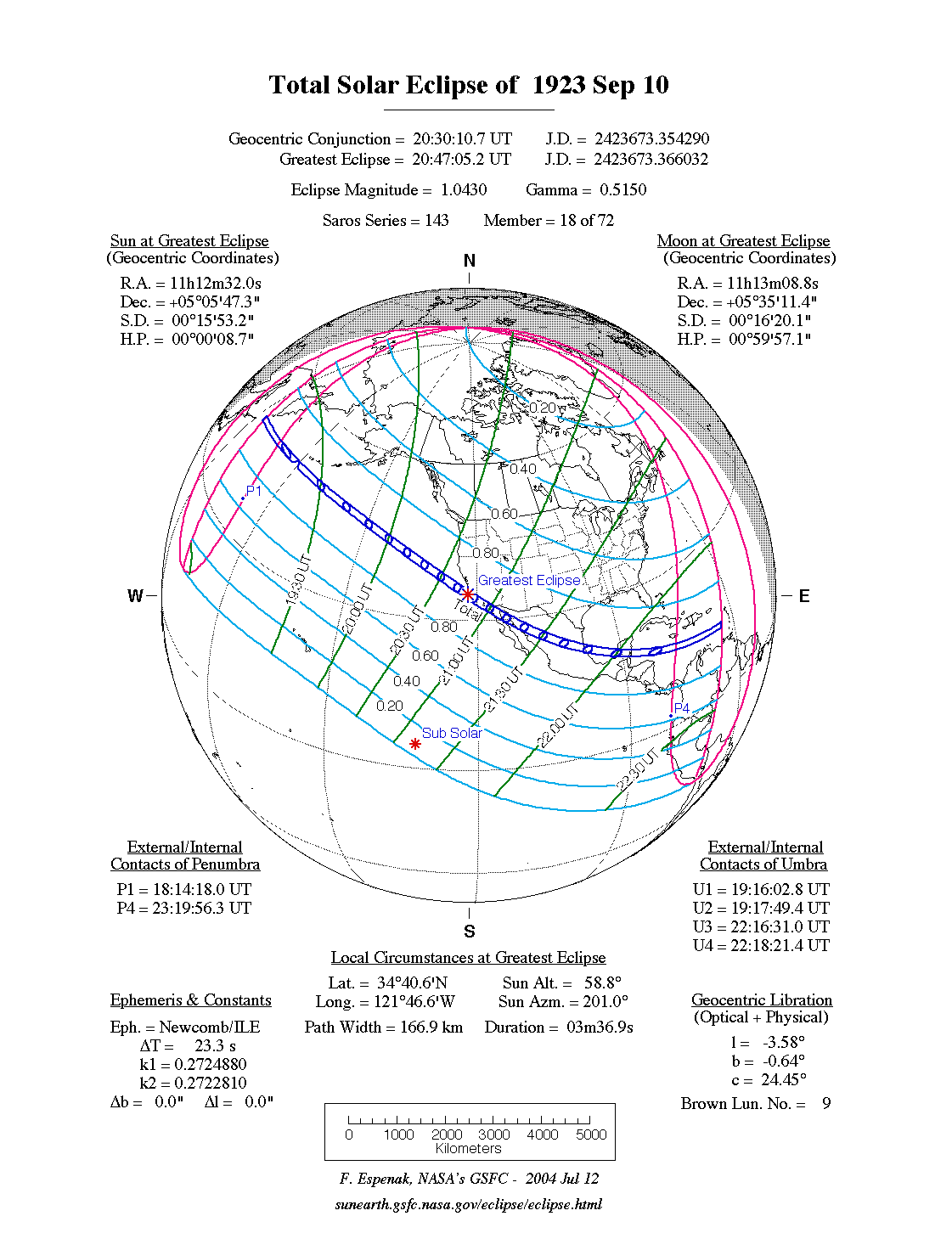
A total solar eclipse occurred at the Moon's ascending node of orbit between Monday, September 10, and Tuesday, September 11, 1923,[1] with a magnitude of 1.043. A solar eclipse occurs when the Moon passes between Earth and the Sun, thereby totally or partly obscuring the image of the Sun for a viewer on Earth. A total solar eclipse occurs when the Moon's apparent diameter is larger than the Sun's, blocking all direct sunlight, turning day into darkness. Totality occurs in a narrow path across Earth's surface, with the partial solar eclipse visible over a surrounding region thousands of kilometres wide. Occurring about 2.1 days before perigee (on September 12, 1923, at 23:20 UTC), the Moon's apparent diameter was larger.[2]
The path of totality started at the southeastern tip of Shiashkotan in Japan (now in Russia) on September 11, and crossed the Pacific Ocean, southwestern California including the whole Channel Islands, northwestern and northern Mexico, Yucatan Peninsula, British Honduras (today's Belize), Swan Islands in Honduras, and two outlying reefs in Colombia—Serranilla Bank and Bajo Nuevo, on September 10. The eclipse was over 90% in Los Angeles, San Diego, and Santa Barbara on the Southern California coast. A partial eclipse was visible for parts of far east Russia, northeastern Japan, North America, Central America, the Caribbean, and northern South America.
Viewings

At Santa Catalina Island, off the coast of California, a large group of scientists gathered to observe the eclipse were foiled by clouds, with the Los Angeles Times saying that "nothing of the eclipse was seen save two glimpses that showed the crescent of the sun, a sickly, white watermelon rind with the wavering black moon and a few rags of black clouds fast blotting out the white light":[3]
All day the scientists from Yerkes Observatory of the University of Chicago, from the University of Wisconsin, from Dearborn University, from Drake University and Carleton College, had rehearsed and rehearsed to the counting of the seconds and there they stood now while the moon covered the sun and the world was dark and still, and though the counter counted there was no possibility of taking pictures; no chance of seeing anything but that gray, blue, purple shadow moving across the sky.[3]
Even as late as 11:30 when the eclipse began, the scientists had hopes. They had come thousands of miles, had worked hard, had spent much money, all for a few minutes of clear sky. They had worked in the sweltering sun for weeks and weeks 1302 feet above the sea. There had not been one moment of one day that was not flooded with sunshine. "And surely," said Prof. Edwin Frost of the University of Chicago, "surely we will have these few minutes today."[3]
In Bakersfield, where the last eclipse of the Sun had taken place 123 years earlier, many watched the eclipse from streets, chickens were confused, and "all the astronomical apparatus of Bakersfield" was trained on the eclipse.[4] In New York City the eclipse, while partial, was viewed successfully; in the area of totality, it was "studied by astronomers who [were] depending on it to help them test out Einstein's famous theory of relativity and whether light rays are bent by the attraction of gravity".[5]
A team from the University of Arizona took images of the corona in Puerto Libertad, Sonora, Mexico, on the east coast of the Gulf of California.[6] A team from Sproul Observatory observed it in Yerbanís in eastern Durango state, Mexico.[7]
Eclipse details
Shown below are two tables displaying details about this particular solar eclipse. The first table outlines times at which the moon's penumbra or umbra attains the specific parameter, and the second table describes various other parameters pertaining to this eclipse.[8]
| Event | Time (UTC) |
|---|---|
| First Penumbral External Contact | 1923 September 10 at 18:14:41.7 UTC |
| First Umbral External Contact | 1923 September 10 at 19:16:26.6 UTC |
| First Central Line | 1923 September 10 at 19:17:19.8 UTC |
| First Umbral Internal Contact | 1923 September 10 at 19:18:13.2 UTC |
| Equatorial Conjunction | 1923 September 10 at 20:30:34.7 UTC |
| Greatest Eclipse | 1923 September 10 at 20:47:29.1 UTC |
| Greatest Duration | 1923 September 10 at 20:47:52.3 UTC |
| Ecliptic Conjunction | 1923 September 10 at 20:52:49.7 UTC |
| Last Umbral Internal Contact | 1923 September 10 at 22:16:55.2 UTC |
| Last Central Line | 1923 September 10 at 22:17:50.4 UTC |
| Last Umbral External Contact | 1923 September 10 at 22:18:45.5 UTC |
| Last Penumbral External Contact | 1923 September 10 at 23:20:20.4 UTC |
| Parameter | Value |
|---|---|
| Eclipse Magnitude | 1.04302 |
| Eclipse Obscuration | 1.08790 |
| Gamma | 0.51493 |
| Sun Right Ascension | 11h12m32.0s |
| Sun Declination | +05°05'47.3" |
| Sun Semi-Diameter | 15'53.2" |
| Sun Equatorial Horizontal Parallax | 08.7" |
| Moon Right Ascension | 11h13m08.8s |
| Moon Declination | +05°35'11.3" |
| Moon Semi-Diameter | 16'20.1" |
| Moon Equatorial Horizontal Parallax | 0°59'57.1" |
| ΔT | 23.3 s |
Eclipse season
Script error: No such module "Labelled list hatnote". This eclipse is part of an eclipse season, a period, roughly every six months, when eclipses occur. Only two (or occasionally three) eclipse seasons occur each year, and each season lasts about 35 days and repeats just short of six months (173 days) later; thus two full eclipse seasons always occur each year. Either two or three eclipses happen each eclipse season. In the sequence below, each eclipse is separated by a fortnight.
| August 26 Descending node (full moon) |
September 10 Ascending node (new moon) |
|---|---|
| File:Lunar eclipse chart close-1923Aug26.png | File:SE1923Sep10T.png |
| Partial lunar eclipse Lunar Saros 117 |
Total solar eclipse Solar Saros 143 |


Related eclipses
Eclipses in 1923
- A partial lunar eclipse on March 3.
- An annular solar eclipse on March 17.
- A partial lunar eclipse on August 26.
- A total solar eclipse on September 10.
Metonic
- Preceded by: Solar eclipse of November 22, 1919
- Followed by: Solar eclipse of June 29, 1927
Tzolkinex
- Preceded by: Solar eclipse of July 30, 1916
- Followed by: Solar eclipse of October 21, 1930
Half-Saros
- Preceded by: Lunar eclipse of September 4, 1914
- Followed by: Lunar eclipse of September 14, 1932
Tritos
- Preceded by: Solar eclipse of October 10, 1912
- Followed by: Solar eclipse of August 10, 1934
Solar Saros 143
- Preceded by: Solar eclipse of August 30, 1905
- Followed by: Solar eclipse of September 21, 1941
Inex
- Preceded by: Solar eclipse of September 29, 1894
- Followed by: Solar eclipse of August 20, 1952
Triad
- Preceded by: Solar eclipse of November 9, 1836
- Followed by: Solar eclipse of July 11, 2010
Solar eclipses of 1921–1924
This eclipse is a member of a semester series. An eclipse in a semester series of solar eclipses repeats approximately every 177 days and 4 hours (a semester) at alternating nodes of the Moon's orbit.[9]
The partial solar eclipse on July 31, 1924 occurs in the next lunar year eclipse set.
| Solar eclipse series sets from 1921 to 1924 | ||||||
|---|---|---|---|---|---|---|
| Descending node | Ascending node | |||||
| Saros | Map | Gamma | Saros | Map | Gamma | |
| 118 | April 8, 1921 File:SE1921Apr08A.png Annular |
0.8869 | 123 | October 1, 1921 File:SE1921Oct01T.png Total |
−0.9383 | |
| 128 | March 28, 1922 File:SE1922Mar28A.png Annular |
0.1711 | 133 | September 21, 1922 File:SE1922Sep21T.png Total |
−0.213 | |
| 138 | March 17, 1923 File:SE1923Mar17A.png Annular |
−0.5438 | 143 | September 10, 1923 File:SE1923Sep10T.png Total |
0.5149 | |
| 148 | March 5, 1924 File:SE1924Mar05P.png Partial |
−1.2232 | 153 | August 30, 1924 File:SE1924Aug30P.png Partial |
1.3123 | |


Saros 143
This eclipse is a part of Saros series 143, repeating every 18 years, 11 days, and containing 72 events. The series started with a partial solar eclipse on March 7, 1617. It contains total eclipses from June 24, 1797 through October 24, 1995; hybrid eclipses from November 3, 2013 through December 6, 2067; and annular eclipses from December 16, 2085 through September 16, 2536. The series ends at member 72 as a partial eclipse on April 23, 2897. Its eclipses are tabulated in three columns; every third eclipse in the same column is one exeligmos apart, so they all cast shadows over approximately the same parts of the Earth.
The longest duration of totality was produced by member 16 at 3 minutes, 50 seconds on August 19, 1887, and the longest duration of annularity will be produced by member 51 at 4 minutes, 54 seconds on September 6, 2518. All eclipses in this series occur at the Moon’s ascending node of orbit.[10]
| Series members 12–33 occur between 1801 and 2200: | ||
|---|---|---|
| 12 | 13 | 14 |
| File:SE1815Jul06T.png July 6, 1815 |
File:SE1833Jul17T.png July 17, 1833 |
File:SE1851Jul28T.png July 28, 1851 |
| 15 | 16 | 17 |
| File:SE1869Aug07T.png August 7, 1869 |
File:SE1887Aug19T.png August 19, 1887 |
File:SE1905Aug30T.png August 30, 1905 |
| 18 | 19 | 20 |
| File:SE1923Sep10T.png September 10, 1923 |
File:SE1941Sep21T.png September 21, 1941 |
File:SE1959Oct02T.png October 2, 1959 |
| 21 | 22 | 23 |
| File:SE1977Oct12T.png October 12, 1977 |
File:SE1995Oct24T.png October 24, 1995 |
File:SE2013Nov03H.png November 3, 2013 |
| 24 | 25 | 26 |
| File:SE2031Nov14H.png November 14, 2031 |
File:SE2049Nov25H.png November 25, 2049 |
File:SE2067Dec06H.png December 6, 2067 |
| 27 | 28 | 29 |
| File:SE2085Dec16A.png December 16, 2085 |
File:SE2103Dec29A.png December 29, 2103 |
File:SE2122Jan08A.png January 8, 2122 |
| 30 | 31 | 32 |
| File:SE2140Jan20A.png January 20, 2140 |
File:SE2158Jan30A.png January 30, 2158 |
File:SE2176Feb10A.png February 10, 2176 |
| 33 | ||
| File:SE2194Feb21A.png February 21, 2194 | ||


Metonic series
Template:Solar Metonic series 1859–1946
Tritos series
Template:Solar Tritos series 2000 February 5
Inex series
Template:Solar Inex series 2010 July 11
Notes
<templatestyles src="Reflist/styles.css" />
- ↑ Script error: No such module "citation/CS1".
- ↑ Script error: No such module "citation/CS1".
- ↑ a b c Script error: No such module "citation/CS1".
- ↑ Script error: No such module "citation/CS1".
- ↑ Script error: No such module "citation/CS1".
- ↑ Script error: No such module "citation/CS1".
- ↑ Script error: No such module "citation/CS1".
- ↑ Script error: No such module "citation/CS1".
- ↑ Script error: No such module "citation/CS1".
- ↑ Script error: No such module "citation/CS1".
Script error: No such module "Check for unknown parameters".
References
- Earth visibility chart and eclipse statistics Eclipse Predictions by Fred Espenak, NASA/GSFC
- Foto and sketchs of Solar Corona September 10, 1923
Script error: No such module "Navbox". Script error: No such module "Side box".