Solar eclipse of March 9, 1997
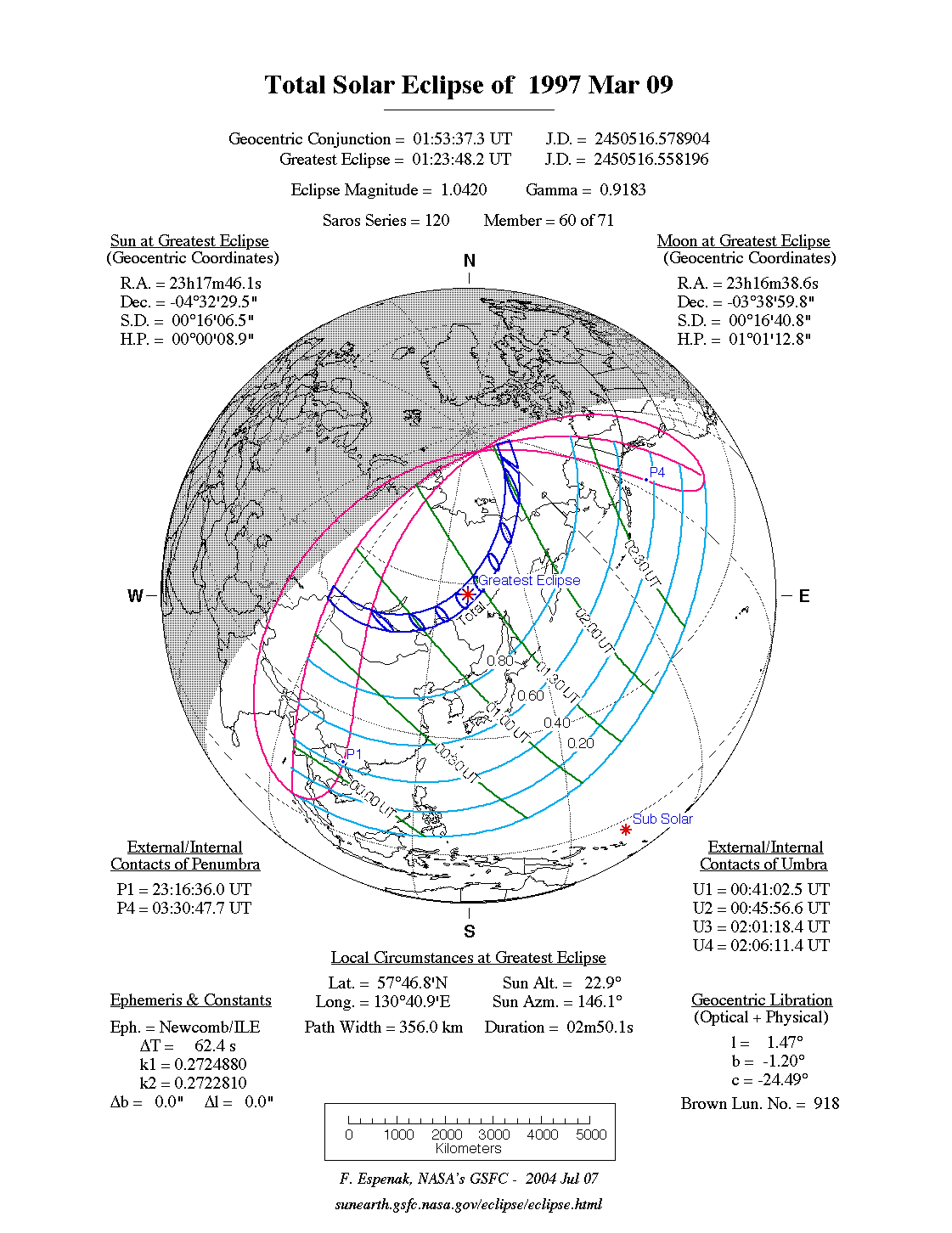
Template:Short description Script error: No such module "Solar eclipse". A total solar eclipse occurred at the Moon's descending node of orbit between Saturday, March 8 and Sunday, March 9, 1997,[1] with a magnitude of 1.042. A solar eclipse occurs when the Moon passes between Earth and the Sun, thereby totally or partly obscuring the image of the Sun for a viewer on Earth. A total solar eclipse occurs when the Moon's apparent diameter is larger than the Sun's, blocking all direct sunlight, turning day into darkness. Totality occurs in a narrow path across Earth's surface, with the partial solar eclipse visible over a surrounding region thousands of kilometres wide. Occurring about 18.5 hours after perigee (on March 8, 1997, at 9:00 UTC), the Moon's apparent diameter was larger.[2]
Totality was visible in eastern Russia, northern Mongolia, the northern tip of Xinjiang and Northeastern China and the eastern tip of Kazakhstan. A partial eclipse was visible for parts of Southeast Asia, East Asia, Alaska, and western Canada.
Unusual gravity variations
This solar eclipse is somewhat special in the sense that some unexplained gravity anomalies of about 7 10−8 m/s2 during the solar eclipse were observed. Attempts (e.g., Van Flandern–Yang hypothesis) to explain these anomalies have not been able to reach a definite conclusion.[3]
Observations
Russia
Russian Academy of Sciences sent an observation team near Lake Baikal to study multiple aspects of the solar corona, providing complement to the imperfections of the corona observation of the Solar and Heliospheric Observatory spacecraft.[4]
China
In China, only a partial eclipse was visible from most areas. The path of totality covered only two narrow areas not adjacent to each other. In Northwestern China, it covered the northern part of Altay Prefecture, Xinjiang. In Northeast China, it covered the northern part of Hulunbuir League (now the city of Hulumbuir), Inner Mongolia and the northern part of neighbouring Daxing'anling Prefecture, Heilongjiang. Therefore, observations of the total eclipse in China are concentrated in these two areas.
In Altay Prefecture, Xinjiang, the total phase occurred right after sunrise. By observing the change in the brightness in Altay, the Xia–Shang–Zhou Chronology Project concluded that the phrase of "day dawned twice in Zheng" in the ancient chronicle Bamboo Annals referred to a solar eclipse on April 21, 899 BC which also occurred right after sunrise, thus determining the year of the Battle of Muye and the starting year of the Zhou dynasty.[5] However, doubts also exist on this conclusion. For example, Douglas J. Keenan published on the journal East Asian History, stating that calculations show that the eclipse in 899 BC reduced the brightness perceived subjectively by a human observer by less than 25%, and clouds can even cause the same effect very often, thus questioning the conclusion.
Mohe County (now Mohe City), Heilongjiang, the northernmost county in China, was considered the best observation site in China due to the high solar zenith angle and the long duration of totality. Within the county, the longest duration occurred in Mohe Township (now Beiji Township), the northernmost township in China. Comet Hale–Bopp also appeared during totality, which also attracted many Chinese to travel to this northernmost town.[6] In addition, the first amateur radio communication experiment during a total solar eclipse in mainland China,[7] and China Central Television's first live broadcast of a solar eclipse[8] were also completed there.
Images

Eclipse details
Shown below are two tables displaying details about this particular solar eclipse. The first table outlines times at which the moon's penumbra or umbra attains the specific parameter, and the second table describes various other parameters pertaining to this eclipse.[9]
| Event | Time (UTC) |
|---|---|
| First Penumbral External Contact | 1997 March 8 at 23:17:38.3 UTC |
| First Umbral External Contact | 1997 March 9 at 00:42:04.9 UTC |
| First Central Line | 1997 March 9 at 00:44:28.2 UTC |
| First Umbral Internal Contact | 1997 March 9 at 00:46:59.1 UTC |
| Ecliptic Conjunction | 1997 March 9 at 01:15:36.8 UTC |
| Greatest Duration | 1997 March 9 at 01:24:17.2 UTC |
| Greatest Eclipse | 1997 March 9 at 01:24:50.6 UTC |
| Equatorial Conjunction | 1997 March 9 at 01:54:40.0 UTC |
| Last Umbral Internal Contact | 1997 March 9 at 02:02:20.9 UTC |
| Last Central Line | 1997 March 9 at 02:04:51.3 UTC |
| Last Umbral External Contact | 1997 March 9 at 02:07:14.0 UTC |
| Last Penumbral External Contact | 1997 March 9 at 03:31:50.3 UTC |
| Parameter | Value |
|---|---|
| Eclipse Magnitude | 1.04202 |
| Eclipse Obscuration | 1.08580 |
| Gamma | 0.91830 |
| Sun Right Ascension | 23h17m46.1s |
| Sun Declination | -04°32'29.2" |
| Sun Semi-Diameter | 16'06.5" |
| Sun Equatorial Horizontal Parallax | 08.9" |
| Moon Right Ascension | 23h16m38.7s |
| Moon Declination | -03°38'59.4" |
| Moon Semi-Diameter | 16'40.8" |
| Moon Equatorial Horizontal Parallax | 1°01'12.9" |
| ΔT | 62.4 s |
Eclipse season
Script error: No such module "Labelled list hatnote". This eclipse is part of an eclipse season, a period, roughly every six months, when eclipses occur. Only two (or occasionally three) eclipse seasons occur each year, and each season lasts about 35 days and repeats just short of six months (173 days) later; thus two full eclipse seasons always occur each year. Either two or three eclipses happen each eclipse season. In the sequence below, each eclipse is separated by a fortnight.
| March 9 Descending node (new moon) |
March 24 Ascending node (full moon) |
|---|---|
| File:SE1997Mar09T.png | File:Lunar eclipse chart close-1997Mar24.png |
| Total solar eclipse Solar Saros 120 |
Partial lunar eclipse Lunar Saros 132 |


Related eclipses
Eclipses in 1997
- A total solar eclipse on March 9.
- A partial lunar eclipse on March 24.
- A partial solar eclipse on September 2.
- A total lunar eclipse on September 16.
Metonic
- Preceded by: Solar eclipse of May 21, 1993
- Followed by: Solar eclipse of December 25, 2000
Tzolkinex
- Preceded by: Solar eclipse of January 26, 1990
- Followed by: Solar eclipse of April 19, 2004
Half-Saros
- Preceded by: Lunar eclipse of March 3, 1988
- Followed by: Lunar eclipse of March 14, 2006
Tritos
- Preceded by: Solar eclipse of April 9, 1986
- Followed by: Solar eclipse of February 7, 2008
Solar Saros 120
- Preceded by: Solar eclipse of February 26, 1979
- Followed by: Solar eclipse of March 20, 2015
Inex
- Preceded by: Solar eclipse of March 28, 1968
- Followed by: Solar eclipse of February 17, 2026
Triad
- Preceded by: Solar eclipse of May 9, 1910
- Followed by: Solar eclipse of January 7, 2084
Solar eclipses of 1997–2000
This eclipse is a member of a semester series. An eclipse in a semester series of solar eclipses repeats approximately every 177 days and 4 hours (a semester) at alternating nodes of the Moon's orbit.[10]
The partial solar eclipses on July 1, 2000 and December 25, 2000 occur in the next lunar year eclipse set.
| Solar eclipse series sets from 1997 to 2000 | ||||||
|---|---|---|---|---|---|---|
| Descending node | Ascending node | |||||
| Saros | Map | Gamma | Saros | Map | Gamma | |
| 120 File:Total solar eclipse of March 9 1997.jpg Totality in Chita, Russia |
March 9, 1997 File:SE1997Mar09T.png Total |
0.9183 | 125 | September 2, 1997 File:SE1997Sep02P.png Partial |
−1.0352 | |
| 130 File:Ecl002-2 (4321047401).jpg Totality near Guadeloupe |
February 26, 1998 File:SE1998Feb26T.png Total |
0.2391 | 135 | August 22, 1998 File:SE1998Aug22A.png Annular |
−0.2644 | |
| 140 | February 16, 1999 File:SE1999Feb16A.png Annular |
−0.4726 | 145 File:Solar eclipse 1999 4.jpg Totality in France |
August 11, 1999 File:SE1999Aug11T.png Total |
0.5062 | |
| 150 | February 5, 2000 File:SE2000Feb05P.png Partial |
−1.2233 | 155 | July 31, 2000 File:SE2000Jul31P.png Partial |
1.2166 | |


.jpg)


Saros 120
This eclipse is a part of Saros series 120, repeating every 18 years, 11 days, and containing 71 events. The series started with a partial solar eclipse on May 27, 933 AD. It contains annular eclipses from August 11, 1059 through April 26, 1492; hybrid eclipses from May 8, 1510 through June 8, 1564; and total eclipses from June 20, 1582 through March 30, 2033. The series ends at member 71 as a partial eclipse on July 7, 2195. Its eclipses are tabulated in three columns; every third eclipse in the same column is one exeligmos apart, so they all cast shadows over approximately the same parts of the Earth.
The longest duration of annularity was produced by member 11 at 6 minutes, 24 seconds on September 11, 1113, and the longest duration of totality was produced by member 60 at 2 minutes, 50 seconds on March 9, 1997. All eclipses in this series occur at the Moon’s descending node of orbit.[11]


Metonic series
The metonic series repeats eclipses every 19 years (6939.69 days), lasting about 5 cycles. Eclipses occur in nearly the same calendar date. In addition, the octon subseries repeats 1/5 of that or every 3.8 years (1387.94 days). All eclipses in this table occur at the Moon's descending node.
| 21 eclipse events between May 21, 1993 and May 20, 2069 | ||||
|---|---|---|---|---|
| May 20–21 | March 9 | December 25–26 | October 13–14 | August 1–2 |
| 118 | 120 | 122 | 124 | 126 |
| File:SE1993May21P.png May 21, 1993 |
File:SE1997Mar09T.png March 9, 1997 |
File:SE2000Dec25P.png December 25, 2000 |
File:SE2004Oct14P.png October 14, 2004 |
File:SE2008Aug01T.png August 1, 2008 |
| 128 | 130 | 132 | 134 | 136 |
| File:SE2012May20A.png May 20, 2012 |
File:SE2016Mar09T.png March 9, 2016 |
File:SE2019Dec26A.png December 26, 2019 |
File:SE2023Oct14A.png October 14, 2023 |
File:SE2027Aug02T.png August 2, 2027 |
| 138 | 140 | 142 | 144 | 146 |
| File:SE2031May21A.png May 21, 2031 |
File:SE2035Mar09A.png March 9, 2035 |
File:SE2038Dec26T.png December 26, 2038 |
File:SE2042Oct14A.png October 14, 2042 |
File:SE2046Aug02T.png August 2, 2046 |
| 148 | 150 | 152 | 154 | 156 |
| File:SE2050May20H.png May 20, 2050 |
File:SE2054Mar09P.png March 9, 2054 |
File:SE2057Dec26T.png December 26, 2057 |
File:SE2061Oct13A.png October 13, 2061 |
File:SE2065Aug02P.png August 2, 2065 |
| 158 | ||||
| File:SE2069May20P.png May 20, 2069 | ||||


Tritos series
Template:Solar Tritos series 2008 February 7
Inex series
Template:Solar Inex series 2026 February 17
See also
References
<templatestyles src="Reflist/styles.css" />
- ↑ Script error: No such module "citation/CS1".
- ↑ Script error: No such module "citation/CS1".
- ↑ Script error: No such module "Citation/CS1".
- ↑ Script error: No such module "citation/CS1".
- ↑ Script error: No such module "citation/CS1".
- ↑ Script error: No such module "citation/CS1".
- ↑ Script error: No such module "Citation/CS1".
- ↑ Script error: No such module "citation/CS1".
- ↑ Script error: No such module "citation/CS1".
- ↑ Script error: No such module "citation/CS1".
- ↑ Script error: No such module "citation/CS1".
Script error: No such module "Check for unknown parameters".
External links
- solar-eclipse.de: The total solar eclipse of 03/09/1997
- Earth visibility chart and eclipse statistics Eclipse Predictions by Fred Espenak, NASA/GSFC
Photos:
Script error: No such module "Navbox". Script error: No such module "Side box".