Solar eclipse of July 11, 2010
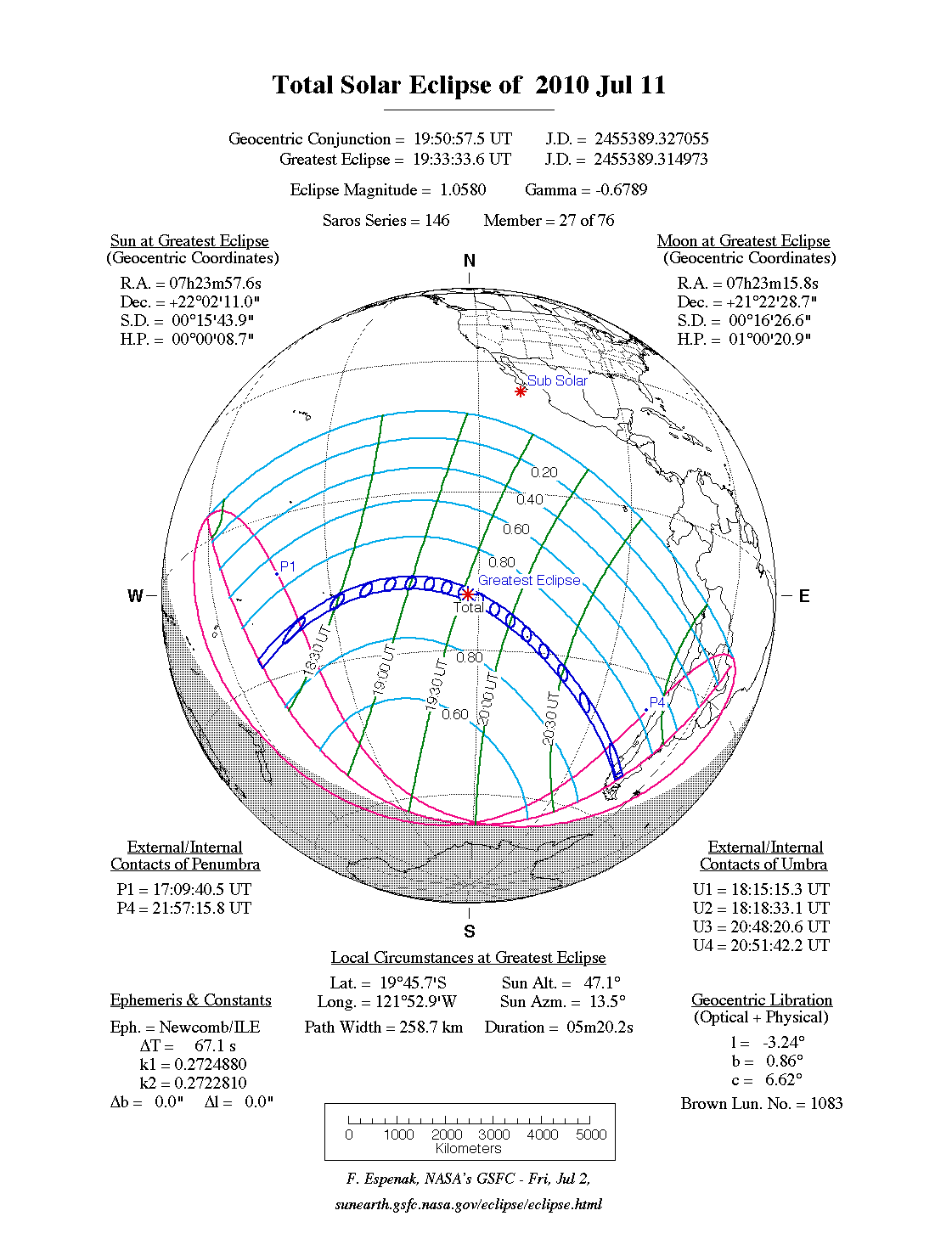
Template:Short description Script error: No such module "Solar eclipse". A total solar eclipse occurred at the Moon's descending node of orbit between Sunday, July 11 and Monday, July 12, 2010,[1][2][3][4] with a magnitude of 1.058. A solar eclipse occurs when the Moon passes between Earth and the Sun, thereby totally or partly obscuring the image of the Sun for a viewer on Earth. A total solar eclipse occurs when the Moon's apparent diameter is larger than the Sun's, blocking all direct sunlight, turning day into darkness. Totality occurs in a narrow path across Earth's surface, with the partial solar eclipse visible over a surrounding region thousands of kilometres wide. Occurring about 1.6 days before perigee (on July 13, 2010, at 12:20 UTC), the Moon's apparent diameter was larger.[5]
Visibility

The eclipse on this day was one of the most remote in recorded history. It was visible over much of the southern Pacific Ocean, touching Mangaia (most southerly of the Cook Islands), several atolls in French Polynesia, Easter Island, and Chile and Argentina's Patagonian plains including the Southern Patagonian Ice Field.[6]
Fred Espenak, a NASA astrophysicist, said: Template:Quote
In French Polynesia, the eclipse was seen with 98 percent totality. During that time, the diamond ring effect and the Baily's beads occurred.
It ended at sunset over the southern tips of Argentina and Chile in South America, including the town of El Calafate. The Sun's altitude was only 1° during the 2 minute 47 second total phase, but Argentino Lake offered an adequate line-of-sight to the eclipse hanging just above the rugged Andes skyline.[2]
A 58% partiality occurred at sunset in Santiago, Chile, but it was not visible due to adverse weather conditions. In other cities such as Valparaíso and Coquimbo, clearer skies permitted the event to be witnessed in continental Chile.
Observations


Total eclipse began Script error: No such module "convert". southeast of Tonga at approximately 18:15 UTC and reached Easter Island by 20:11 UTC.[7] The global sky photography project The World At Night stationed photographers throughout the eclipse's visibility track. Eclipse chasers photographed the event on board a chartered airplane,[8] cruise ships, numerous Pacific islands, and in Argentina's Patagonia region. Totality was observed for four minutes and 41 seconds (4:41) on Easter Island,[6] where it was observed for the first time in 1,400 years.[9] Approximately 4,000 observers visited Easter Island for this eclipse, including tourists, scientists, photographers, filmmakers and journalists,[10] prompting an increase in security at its important moai archeological sites. The eclipse occurred at the same time that the final game of the 2010 FIFA World Cup was being played in South Africa, and many soccer fans in Tahiti watched the match instead of observing the partial eclipse with a high percentage of obscuring the sun by over 98%.[7][11] The path of totality of this eclipse barely missed some significant inhabited islands, including passing just about 20 km south of the southern end of Tahiti.[2]
This eclipse was the first one to happen over French Polynesia in 350 years. An estimated 5,000 tourists visited various islands in the archipelago to observe the event. Nearly 120,000 pairs of special glasses were distributed for observers.[12] Eclipse chasers were also able to observe the eclipse at El Calafate, near the southern tip of Argentina, before the sun set just two minutes later.[6]
Several hours after the eclipse was observed in continental Chile, a magnitude 6.2 earthquake struck in the Antofagasta Region. There were no major injuries or damage in the nearby cities of Calama, Chile and San Pedro de Atacama.[13]
Eclipse details
Shown below are two tables displaying details about this particular solar eclipse. The first table outlines times at which the moon's penumbra or umbra attains the specific parameter, and the second table describes various other parameters pertaining to this eclipse.[14]
| Event | Time (UTC) |
|---|---|
| First Penumbral External Contact | 2010 July 11 at 17:10:44.0 UTC |
| First Umbral External Contact | 2010 July 11 at 18:16:18.5 UTC |
| First Central Line | 2010 July 11 at 18:17:56.9 UTC |
| First Umbral Internal Contact | 2010 July 11 at 18:19:36.2 UTC |
| Greatest Duration | 2010 July 11 at 19:32:32.2 UTC |
| Greatest Eclipse | 2010 July 11 at 19:34:37.9 UTC |
| Ecliptic Conjunction | 2010 July 11 at 19:41:33.7 UTC |
| Equatorial Conjunction | 2010 July 11 at 19:52:01.5 UTC |
| Last Umbral Internal Contact | 2010 July 11 at 20:49:26.0 UTC |
| Last Central Line | 2010 July 11 at 20:51:07.2 UTC |
| Last Umbral External Contact | 2010 July 11 at 20:52:47.5 UTC |
| Last Penumbral External Contact | 2010 July 11 at 21:58:20.8 UTC |
| Parameter | Value |
|---|---|
| Eclipse Magnitude | 1.05805 |
| Eclipse Obscuration | 1.11946 |
| Gamma | −0.67877 |
| Sun Right Ascension | 07h23m57.6s |
| Sun Declination | +22°02'11.0" |
| Sun Semi-Diameter | 15'43.9" |
| Sun Equatorial Horizontal Parallax | 08.7" |
| Moon Right Ascension | 07h23m15.8s |
| Moon Declination | +21°22'29.3" |
| Moon Semi-Diameter | 16'26.6" |
| Moon Equatorial Horizontal Parallax | 1°00'20.9" |
| ΔT | 66.2 s |
Eclipse season
Script error: No such module "Labelled list hatnote". This eclipse is part of an eclipse season, a period, roughly every six months, when eclipses occur. Only two (or occasionally three) eclipse seasons occur each year, and each season lasts about 35 days and repeats just short of six months (173 days) later; thus two full eclipse seasons always occur each year. Either two or three eclipses happen each eclipse season. In the sequence below, each eclipse is separated by a fortnight.
| June 26 Ascending node (full moon) |
July 11 Descending node (new moon) |
|---|---|
| File:Lunar eclipse chart close-2010jun26.png | File:SE2010Jul11T.png |
| Partial lunar eclipse Lunar Saros 120 |
Total solar eclipse Solar Saros 146 |


Related eclipses
Eclipses in 2010
- An annular solar eclipse on January 15.
- A partial lunar eclipse on June 26.
- A total solar eclipse on July 11.
- A total lunar eclipse on December 21.
Metonic
- Preceded by: Solar eclipse of September 22, 2006
- Followed by: Solar eclipse of April 29, 2014
Tzolkinex
- Preceded by: Solar eclipse of May 31, 2003
- Followed by: Solar eclipse of August 21, 2017
Half-Saros
- Preceded by: Lunar eclipse of July 5, 2001
- Followed by: Lunar eclipse of July 16, 2019
Tritos
- Preceded by: Solar eclipse of August 11, 1999
- Followed by: Solar eclipse of June 10, 2021
Solar Saros 146
- Preceded by: Solar eclipse of June 30, 1992
- Followed by: Solar eclipse of July 22, 2028
Inex
- Preceded by: Solar eclipse of July 31, 1981
- Followed by: Solar eclipse of June 21, 2039
Triad
- Preceded by: Solar eclipse of September 10, 1923
- Followed by: Solar eclipse of May 11, 2097
Solar eclipses of 2008–2011
This eclipse is a member of a semester series. An eclipse in a semester series of solar eclipses repeats approximately every 177 days and 4 hours (a semester) at alternating nodes of the Moon's orbit.[15]
The partial solar eclipses on June 1, 2011 and November 25, 2011 occur in the next lunar year eclipse set.


Saros 146
Template:Solar Saros series 146
Metonic series
The metonic series repeats eclipses every 19 years (6939.69 days), lasting about 5 cycles. Eclipses occur in nearly the same calendar date. In addition, the octon subseries repeats 1/5 of that or every 3.8 years (1387.94 days). All eclipses in this table occur at the Moon's descending node.
| 21 eclipse events between July 11, 1953 and July 11, 2029 | ||||
|---|---|---|---|---|
| July 10–11 | April 29–30 | February 15–16 | December 4 | September 21–23 |
| 116 | 118 | 120 | 122 | 124 |
| File:SE1953Jul11P.png July 11, 1953 |
File:SE1957Apr30A.png April 30, 1957 |
File:SE1961Feb15T.png February 15, 1961 |
File:SE1964Dec04P.png December 4, 1964 |
File:SE1968Sep22T.png September 22, 1968 |
| 126 | 128 | 130 | 132 | 134 |
| File:SE1972Jul10T.png July 10, 1972 |
File:SE1976Apr29A.png April 29, 1976 |
File:SE1980Feb16T.png February 16, 1980 |
File:SE1983Dec04A.png December 4, 1983 |
File:SE1987Sep23A.png September 23, 1987 |
| 136 | 138 | 140 | 142 | 144 |
| File:SE1991Jul11T.png July 11, 1991 |
File:SE1995Apr29A.png April 29, 1995 |
File:SE1999Feb16A.png February 16, 1999 |
File:SE2002Dec04T.png December 4, 2002 |
File:SE2006Sep22A.png September 22, 2006 |
| 146 | 148 | 150 | 152 | 154 |
| File:SE2010Jul11T.png July 11, 2010 |
File:SE2014Apr29A.png April 29, 2014 |
File:SE2018Feb15P.png February 15, 2018 |
File:SE2021Dec04T.png December 4, 2021 |
File:SE2025Sep21P.png September 21, 2025 |
| 156 | ||||
| File:SE2029Jul11P.png July 11, 2029 | ||||


Tritos series
Template:Solar Tritos series 2010 July 11
Inex series
Template:Solar Inex series 2010 July 11
Notes
<templatestyles src="Reflist/styles.css" />
- ↑ Script error: No such module "citation/CS1".
- ↑ a b c Script error: No such module "citation/CS1".
- ↑ Script error: No such module "citation/CS1".
- ↑ Script error: No such module "citation/CS1".
- ↑ Script error: No such module "citation/CS1".
- ↑ a b c Script error: No such module "citation/CS1".
- ↑ a b Script error: No such module "citation/CS1".
- ↑ Script error: No such module "citation/CS1".
- ↑ Script error: No such module "citation/CS1".
- ↑ Eclipse chasing: four minutes of bliss Script error: No such module "webarchive"., Australian Geographic, July 16, 2010
- ↑ Script error: No such module "citation/CS1".
- ↑ Script error: No such module "citation/CS1".
- ↑ Script error: No such module "citation/CS1".
- ↑ Script error: No such module "citation/CS1".
- ↑ Script error: No such module "citation/CS1".
Script error: No such module "Check for unknown parameters".
References
Script error: No such module "Side box".
- Earth visibility chart and eclipse statistics Eclipse Predictions by Fred Espenak, NASA/GSFC
- NASA pdf map
- Eclipser: 2010 July 11 Total Solar Eclipse
- Eclipse.org.uk: Total Eclipse of the Sun: 2010 July 11 Script error: No such module "webarchive".
- www.spaceweather.com
- Easter Island Eclipse, APOD 7/14/2010
- Andes Sunset Eclipse, APOD 7/15/2010, totality from 400 meters above Argentino Lake
- The Crown of the Sun, APOD 7/21/2010, totality from Easter Island
- Diamond Ring and Shadow Bands, APOD 7/24/2010, totality from Hao, French Polynesia
- Eclipse on the Beach, APOD 7/30/2010, totality from Anakena Beach, Easter Island
- Eclipse Shadow Cone Over Patagonia, APOD 8/4/2010, totality from Patagonia, Argentina
Script error: No such module "Navbox".