Solar eclipse of February 16, 1980
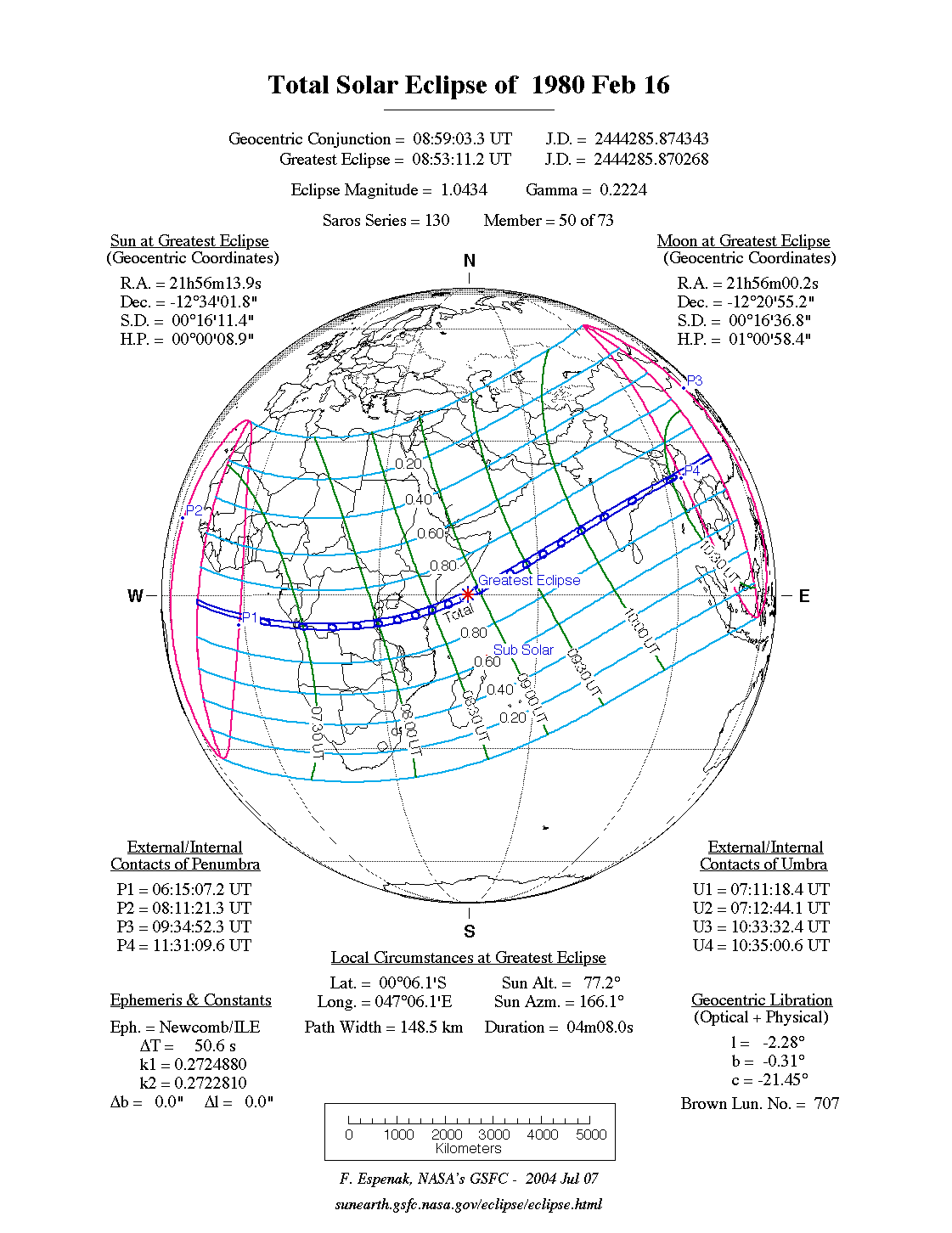
Template:Short description Script error: No such module "Solar eclipse". A total solar eclipse occurred at the Moon's descending node of orbit on Saturday, February 16, 1980,[1] with a magnitude of 1.0434. A solar eclipse occurs when the Moon passes between Earth and the Sun, thereby totally or partly obscuring the image of the Sun for a viewer on Earth. A total solar eclipse occurs when the Moon's apparent diameter is larger than the Sun's, blocking all direct sunlight, turning day into darkness. Totality occurs in a narrow path across Earth's surface, with the partial solar eclipse visible over a surrounding region thousands of kilometres wide. Occurring about 1 day before perigee (on February 17, 1980, at 8:50 UTC), the Moon's apparent diameter was larger.[2]
The path of totality crossed parts of Angola, Zaire, Tanzania, Kenya, southern India, Bangladesh, Burma, and China at sunset. The southern part of Mount Kilimanjaro, the highest mountain in Africa, also lay in the path of totality. A partial eclipse was visible for parts of Africa, West Asia, Central Asia, South Asia, and Southeast Asia.
Observations
India

This was the third total solar eclipse visible from mainland India excluding the Andaman and Nicobar Islands in the 20th century. However, most of the path of totality of the solar eclipse of August 21, 1914 in British India now belongs to Pakistan, and the only place within the path of totality of the solar eclipse of June 30, 1954 in India was in the Thar Desert where a total eclipse occurred right before sunset. Therefore, this was actually the first total solar eclipse visible from India with good observation conditions since January 22, 1898.[3]
The Indian Institute of Astrophysics established two camps at Hosur near Hubli and at Jawalagera near Raichur, analyzing the chromospheric and coronal radiation. Observation teams from Czechoslovakia and Yugoslavia also made observations nearby.[4] The Astronomical Institute of Slovak Academy of Sciences also sent a team of 7 people near Jawalagera. The weather condition was good and the team took images of the corona.[5]
China
In China, the eclipse occurred on the exact date of the Lunar New Year.
Being the first total solar eclipse visible from China after the Cultural Revolution, this eclipse offered much better conditions for observations, compared with the solar eclipse of September 22, 1968, the previous total one visible from China. Although both occurred before sunset with a low solar zenith angle in China, the maximum duration of totality within China was more than 1 minute and 40 seconds for this eclipse, and less than half a minute for the one in 1968.
The Chinese Academy of Sciences held a solar physics conference in Kunming in April 1975, proposing to form a joint observation of the eclipse. In March 1976, a field trip to select the location of observation was conducted. A total of 31 aspects of observations were organized, including solar optical and radio observations, ionosphere, Earth's magnetic field and gravitational field measurements. The meteorological department also studied weather changes during the eclipse. Optical observations in China were mainly conducted at Yingpan Mountain in Ruili County (now Ruili City), Yunnan, while radio observations were at Yunnan Astronomical Observatory in Fenghuang Mountain, Kunming. In addition, Shanghai Scientific and Educational Film Studio made a documentary on the entire process of the observation.[6][7]
Eclipse season
Script error: No such module "Labelled list hatnote". This eclipse is part of an eclipse season, a period, roughly every six months, when eclipses occur. Only two (or occasionally three) eclipse seasons occur each year, and each season lasts about 35 days and repeats just short of six months (173 days) later; thus two full eclipse seasons always occur each year. Either two or three eclipses happen each eclipse season. In the sequence below, each eclipse is separated by a fortnight.
| February 16 Descending node (new moon) |
March 1 Ascending node (full moon) |
|---|---|
| File:SE1980Feb16T.png | File:Lunar eclipse chart close-1980Mar01.png |
| Total solar eclipse Solar Saros 130 |
Penumbral lunar eclipse Lunar Saros 142 |


Related eclipses
Eclipses in 1980
- A total solar eclipse on February 16.
- A penumbral lunar eclipse on March 1.
- A penumbral lunar eclipse on July 27.
- An annular solar eclipse on August 10.
- A penumbral lunar eclipse on August 26.
Metonic
- Preceded by: Solar eclipse of April 29, 1976
- Followed by: Solar eclipse of December 4, 1983
Tzolkinex
- Preceded by: Solar eclipse of January 4, 1973
- Followed by: Solar eclipse of March 29, 1987
Half-Saros
- Preceded by: Lunar eclipse of February 10, 1971
- Followed by: Lunar eclipse of February 20, 1989
Tritos
- Preceded by: Solar eclipse of March 18, 1969
- Followed by: Solar eclipse of January 15, 1991
Solar Saros 130
- Preceded by: Solar eclipse of February 5, 1962
- Followed by: Solar eclipse of February 26, 1998
Inex
- Preceded by: Solar eclipse of March 7, 1951
- Followed by: Solar eclipse of January 26, 2009
Triad
- Preceded by: Solar eclipse of April 16, 1893
- Followed by: Solar eclipse of December 17, 2066
Solar eclipses of 1979–1982
This eclipse is a member of a semester series. An eclipse in a semester series of solar eclipses repeats approximately every 177 days and 4 hours (a semester) at alternating nodes of the Moon's orbit.[8]
The partial solar eclipses on June 21, 1982 and December 15, 1982 occur in the next lunar year eclipse set.
| Solar eclipse series sets from 1979 to 1982 | ||||||
|---|---|---|---|---|---|---|
| Descending node | Ascending node | |||||
| Saros | Map | Gamma | Saros | Map | Gamma | |
| 120 File:1979 Solar eclipse, Brandon Manitoba Canada (35907221663).jpg Totality in Brandon, MB, Canada |
February 26, 1979 File:SE1979Feb26T.png Total |
0.8981 | 125 | August 22, 1979 File:SE1979Aug22A.png Annular |
−0.9632 | |
| 130 | February 16, 1980 File:SE1980Feb16T.png Total |
0.2224 | 135 | August 10, 1980 File:SE1980Aug10A.png Annular |
−0.1915 | |
| 140 | February 4, 1981 File:SE1981Feb04A.png Annular |
−0.4838 | 145 | July 31, 1981 File:SE1981Jul31T.png Total |
0.5792 | |
| 150 | January 25, 1982 File:SE1982Jan25P.png Partial |
−1.2311 | 155 | July 20, 1982 File:SE1982Jul20P.png Partial |
1.2886 | |


Saros 130
This eclipse is a part of Saros series 130, repeating every 18 years, 11 days, and containing 73 events. The series started with a partial solar eclipse on August 20, 1096. It contains total eclipses from April 5, 1475 through July 18, 2232. There are no annular or hybrid eclipses in this set. The series ends at member 73 as a partial eclipse on October 25, 2394. Its eclipses are tabulated in three columns; every third eclipse in the same column is one exeligmos apart, so they all cast shadows over approximately the same parts of the Earth.
The longest duration of totality was produced by member 30 at 6 minutes, 41 seconds on July 11, 1619. All eclipses in this series occur at the Moon’s descending node of orbit.[9]
| Series members 41–62 occur between 1801 and 2200: | ||
|---|---|---|
| 41 | 42 | 43 |
| File:SE1817Nov09T.gif November 9, 1817 |
File:SE1835Nov20T.gif November 20, 1835 |
File:SE1853Nov30T.gif November 30, 1853 |
| 44 | 45 | 46 |
| File:SE1871Dec12T.gif December 12, 1871 |
File:SE1889Dec22T.png December 22, 1889 |
File:SE1908Jan03T.png January 3, 1908 |
| 47 | 48 | 49 |
| File:SE1926Jan14T.png January 14, 1926 |
File:SE1944Jan25T.png January 25, 1944 |
File:SE1962Feb05T.png February 5, 1962 |
| 50 | 51 | 52 |
| File:SE1980Feb16T.png February 16, 1980 |
File:SE1998Feb26T.png February 26, 1998 |
File:SE2016Mar09T.png March 9, 2016 |
| 53 | 54 | 55 |
| File:SE2034Mar20T.png March 20, 2034 |
File:SE2052Mar30T.png March 30, 2052 |
File:SE2070Apr11T.png April 11, 2070 |
| 56 | 57 | 58 |
| File:SE2088Apr21T.png April 21, 2088 |
File:SE2106May03T.png May 3, 2106 |
File:SE2124May14T.png May 14, 2124 |
| 59 | 60 | 61 |
| File:SE2142May25T.png May 25, 2142 |
File:SE2160Jun04T.png June 4, 2160 |
File:SE2178Jun16T.png June 16, 2178 |
| 62 | ||
| File:SE2196Jun26T.png June 26, 2196 | ||


Metonic series
The metonic series repeats eclipses every 19 years (6939.69 days), lasting about 5 cycles. Eclipses occur in nearly the same calendar date. In addition, the octon subseries repeats 1/5 of that or every 3.8 years (1387.94 days). All eclipses in this table occur at the Moon's descending node.
| 21 eclipse events between July 11, 1953 and July 11, 2029 | ||||
|---|---|---|---|---|
| July 10–11 | April 29–30 | February 15–16 | December 4 | September 21–23 |
| 116 | 118 | 120 | 122 | 124 |
| File:SE1953Jul11P.png July 11, 1953 |
File:SE1957Apr30A.png April 30, 1957 |
File:SE1961Feb15T.png February 15, 1961 |
File:SE1964Dec04P.png December 4, 1964 |
File:SE1968Sep22T.png September 22, 1968 |
| 126 | 128 | 130 | 132 | 134 |
| File:SE1972Jul10T.png July 10, 1972 |
File:SE1976Apr29A.png April 29, 1976 |
File:SE1980Feb16T.png February 16, 1980 |
File:SE1983Dec04A.png December 4, 1983 |
File:SE1987Sep23A.png September 23, 1987 |
| 136 | 138 | 140 | 142 | 144 |
| File:SE1991Jul11T.png July 11, 1991 |
File:SE1995Apr29A.png April 29, 1995 |
File:SE1999Feb16A.png February 16, 1999 |
File:SE2002Dec04T.png December 4, 2002 |
File:SE2006Sep22A.png September 22, 2006 |
| 146 | 148 | 150 | 152 | 154 |
| File:SE2010Jul11T.png July 11, 2010 |
File:SE2014Apr29A.png April 29, 2014 |
File:SE2018Feb15P.png February 15, 2018 |
File:SE2021Dec04T.png December 4, 2021 |
File:SE2025Sep21P.png September 21, 2025 |
| 156 | ||||
| File:SE2029Jul11P.png July 11, 2029 | ||||


Tritos series
Template:Solar Tritos series 2001 December 14
Inex series
Template:Solar Inex series 2009 January 26
References
<templatestyles src="Reflist/styles.css" />
- ↑ Script error: No such module "citation/CS1".
- ↑ Script error: No such module "citation/CS1".
- ↑ Script error: No such module "Citation/CS1".
- ↑ Script error: No such module "citation/CS1".
- ↑ Script error: No such module "citation/CS1".
- ↑ Script error: No such module "citation/CS1".
- ↑ Script error: No such module "citation/CS1".
- ↑ Script error: No such module "citation/CS1".
- ↑ Script error: No such module "citation/CS1".
Script error: No such module "Check for unknown parameters".
- Earth visibility chart and eclipse statistics Eclipse Predictions by Fred Espenak, NASA/GSFC
- Foto Solar eclipse of February 16, 1980
- Prof. Druckmüller's eclipse photography site, Solar eclipse of February 16, 1980
Script error: No such module "Navbox".