Solar eclipse of December 14, 2001
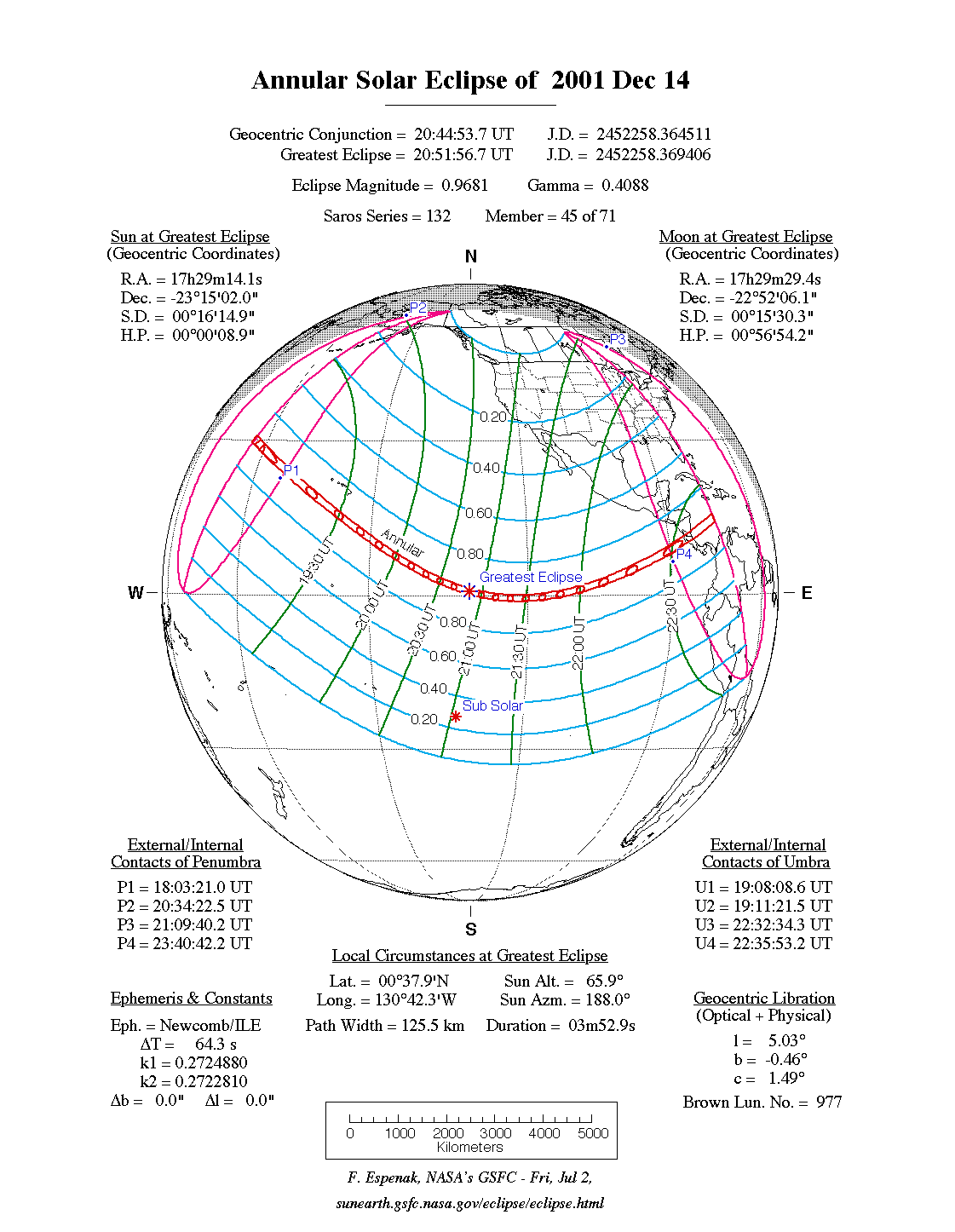
Template:Short description Script error: No such module "Solar eclipse". An annular solar eclipse occurred at the Moon's descending node of orbit on Friday, December 14, 2001,[1][2][3][4] with a magnitude of 0.9681. A solar eclipse occurs when the Moon passes between Earth and the Sun, thereby totally or partly obscuring the image of the Sun for a viewer on Earth. An annular solar eclipse occurs when the Moon's apparent diameter is smaller than the Sun's, blocking most of the Sun's light and causing the Sun to look like an annulus (ring). An annular eclipse appears as a partial eclipse over a region of the Earth thousands of kilometres wide. The Moon's apparent diameter was near the average diameter because it occurred 7.9 days after perigee (on December 6, 2001, at 22:40 UTC) and 6.7 days before apogee (on December 21, 2001, at 13:00 UTC).[5]
Annularity was visible across the Pacific Ocean, southern Costa Rica, northern Nicaragua and San Andrés Island, Colombia. The central shadow passed just south of Hawaii in early morning and ended over Central America near sunset. A partial eclipse was visible for parts of North America, Central America, northwestern South America, and Hawaii.
Observation
The path of annularity was mostly on the sea, so observers were concentrated in Central America, the only land covered by the path, especially in Costa Rica with the largest area covered by the path and highest solar zenith angle. However, it was cloudy or rainy in many parts of the country during the eclipse, and only a few observers saw the annular eclipse.[6] The International Occultation Timing Association made up of scientists from different countries planned to measure the diameter of the sun with Baily's beads that appeared at the moment of the second and third contacts in Santa Rosa National Park on the northern edge of the path of annularity, but failed.[7] A team of professors from the University of Costa Rica and abroad traveled to Ostional Mixed Wildlife Refuge, kilometres north of Nosara. The sun could be seen through the clouds after the eclipse started, but it was completely clouded out when 80% was blocked by the moon. All the stages after that, including the annularity, could not be seen.[8]
Coincidentally, the 2001 Geminids peaked in the early morning of December 14 local time, less than 24 hours before the annular solar eclipse.[7]
Images

Gallery
-
Partial from Siesta Key, Florida at sunset
.jpg)
Eclipse season
Script error: No such module "Labelled list hatnote". This eclipse is part of an eclipse season, a period, roughly every six months, when eclipses occur. Only two (or occasionally three) eclipse seasons occur each year, and each season lasts about 35 days and repeats just short of six months (173 days) later; thus two full eclipse seasons always occur each year. Either two or three eclipses happen each eclipse season. In the sequence below, each eclipse is separated by a fortnight.
| December 14 Descending node (new moon) |
December 30 Ascending node (full moon) |
|---|---|
| File:SE2001Dec14A.png | File:Lunar eclipse chart close-2001Dec30.png |
| Annular solar eclipse Solar Saros 132 |
Penumbral lunar eclipse Lunar Saros 144 |


Related eclipses
Eclipses in 2001
- A total lunar eclipse on January 9.
- A total solar eclipse on June 21.
- A partial lunar eclipse on July 5.
- An annular solar eclipse on December 14.
- A penumbral lunar eclipse on December 30.
Metonic
- Preceded by: Solar eclipse of February 26, 1998
- Followed by: Solar eclipse of October 3, 2005
Tzolkinex
- Preceded by: Solar eclipse of November 3, 1994
- Followed by: Solar eclipse of January 26, 2009
Half-Saros
- Preceded by: Lunar eclipse of December 9, 1992
- Followed by: Lunar eclipse of December 21, 2010
Tritos
- Preceded by: Solar eclipse of January 15, 1991
- Followed by: Solar eclipse of November 13, 2012
Solar Saros 132
- Preceded by: Solar eclipse of December 4, 1983
- Followed by: Solar eclipse of December 26, 2019
Inex
- Preceded by: Solar eclipse of January 4, 1973
- Followed by: Solar eclipse of November 25, 2030
Triad
- Preceded by: Solar eclipse of February 14, 1915
- Followed by: Solar eclipse of October 14, 2088
Solar eclipses of 2000–2003
This eclipse is a member of a semester series. An eclipse in a semester series of solar eclipses repeats approximately every 177 days and 4 hours (a semester) at alternating nodes of the Moon's orbit.[9]
The partial solar eclipses on February 5, 2000 and July 31, 2000 occur in the previous lunar year eclipse set.


.jpg)


.jpg)

Saros 132
This eclipse is a part of Saros series 132, repeating every 18 years, 11 days, and containing 71 events. The series started with a partial solar eclipse on August 13, 1208. It contains annular eclipses from March 17, 1569 through March 12, 2146; hybrid eclipses on March 23, 2164 and April 3, 2182; and total eclipses from April 14, 2200 through June 19, 2308. The series ends at member 71 as a partial eclipse on September 25, 2470. Its eclipses are tabulated in three columns; every third eclipse in the same column is one exeligmos apart, so they all cast shadows over approximately the same parts of the Earth.
The longest duration of annularity was produced by member 25 at 6 minutes, 56 seconds on May 9, 1641, and the longest duration of totality will be produced by member 61 at 2 minutes, 14 seconds on June 8, 2290. All eclipses in this series occur at the Moon’s descending node of orbit.[10]
| Series members 34–56 occur between 1801 and 2200: | |||
|---|---|---|---|
| 34 | 35 | 36 | |
| File:SE1803Aug17A.png August 17, 1803 |
File:SE1821Aug27A.png August 27, 1821 |
File:SE1839Sep07A.png September 7, 1839 | |
| 37 | 38 | 39 | |
| File:SE1857Sep18A.png September 18, 1857 |
File:SE1875Sep29A.png September 29, 1875 |
File:SE1893Oct09A.png October 9, 1893 | |
| 40 | 41 | 42 | |
| File:SE1911Oct22A.png October 22, 1911 |
File:SE1929Nov01A.png November 1, 1929 |
File:SE1947Nov12A.png November 12, 1947 | |
| 43 | 44 | 45 | |
| File:SE1965Nov23A.png November 23, 1965 |
File:SE1983Dec04A.png December 4, 1983 |
File:SE2001Dec14A.png December 14, 2001 | |
| 46 | 47 | 48 | |
| File:SE2019Dec26A.png December 26, 2019 |
File:SE2038Jan05A.png January 5, 2038 |
File:SE2056Jan16A.png January 16, 2056 | |
| 49 | 50 | 51 | |
| File:SE2074Jan27A.png January 27, 2074 |
File:SE2092Feb07A.png February 7, 2092 |
File:SE2110Feb18A.png February 18, 2110 | |
| 52 | 53 | 54 | |
| File:SE2128Mar01A.png March 1, 2128 |
File:SE2146Mar12A.png March 12, 2146 |
File:SE2164Mar23H.png March 23, 2164 | |
| 55 | 56 | ||
| File:SE2182Apr03H.png April 3, 2182 |
File:SE2200Apr14T.png April 14, 2200 | ||


Metonic series
The metonic series repeats eclipses every 19 years (6939.69 days), lasting about 5 cycles. Eclipses occur in nearly the same calendar date. In addition, the octon subseries repeats 1/5 of that or every 3.8 years (1387.94 days). All eclipses in this table occur at the Moon's descending node.
| 21 eclipse events between July 22, 1971 and July 22, 2047 | ||||
|---|---|---|---|---|
| July 22 | May 9–11 | February 26–27 | December 14–15 | October 2–3 |
| 116 | 118 | 120 | 122 | 124 |
| File:SE1971Jul22P.png July 22, 1971 |
File:SE1975May11P.png May 11, 1975 |
File:SE1979Feb26T.png February 26, 1979 |
File:SE1982Dec15P.png December 15, 1982 |
File:SE1986Oct03H.png October 3, 1986 |
| 126 | 128 | 130 | 132 | 134 |
| File:SE1990Jul22T.png July 22, 1990 |
File:SE1994May10A.png May 10, 1994 |
File:SE1998Feb26T.png February 26, 1998 |
File:SE2001Dec14A.png December 14, 2001 |
File:SE2005Oct03A.png October 3, 2005 |
| 136 | 138 | 140 | 142 | 144 |
| File:SE2009Jul22T.png July 22, 2009 |
File:SE2013May10A.png May 10, 2013 |
File:SE2017Feb26A.png February 26, 2017 |
File:SE2020Dec14T.png December 14, 2020 |
File:SE2024Oct02A.png October 2, 2024 |
| 146 | 148 | 150 | 152 | 154 |
| File:SE2028Jul22T.png July 22, 2028 |
File:SE2032May09A.png May 9, 2032 |
File:SE2036Feb27P.png February 27, 2036 |
File:SE2039Dec15T.png December 15, 2039 |
File:SE2043Oct03A.png October 3, 2043 |
| 156 | ||||
| File:SE2047Jul22P.png July 22, 2047 | ||||


Tritos series
Template:Solar Tritos series 2001 December 14
Inex series
Template:Solar Inex series 2001 December 14
References
<templatestyles src="Reflist/styles.css" />
- ↑ Script error: No such module "citation/CS1".
- ↑ Script error: No such module "citation/CS1".
- ↑ Script error: No such module "citation/CS1".
- ↑ Script error: No such module "citation/CS1".
- ↑ Script error: No such module "citation/CS1".
- ↑ Script error: No such module "citation/CS1".
- ↑ a b Script error: No such module "citation/CS1".
- ↑ Script error: No such module "citation/CS1".
- ↑ Script error: No such module "citation/CS1".
- ↑ Script error: No such module "citation/CS1".
Script error: No such module "Check for unknown parameters".
- NASA Press release: Annular Solar Eclipse of 2001 December 14
- Earth visibility chart and eclipse statistics Eclipse Predictions by Fred Espenak, NASA/GSFC
Photos:
- Photos of solar eclipse around the world
- Template:APOD
- Partial Solar Eclipse from the USA
- SpaceWeather.com Dec 14, 2001, Solar Eclipse Gallery and [1]
Script error: No such module "Navbox". Script error: No such module "Side box".