Solar eclipse of August 2, 2027
Template:Short description Script error: No such module "Solar eclipse". A total solar eclipse will occur at the Moon's descending node of orbit on Monday, August 2, 2027,[1] with a magnitude of 1.079. A solar eclipse occurs when the Moon passes between Earth and the Sun, thereby totally or partly obscuring the image of the Sun for a viewer on Earth. A total solar eclipse occurs when the Moon's apparent diameter is larger than the Sun's, blocking all direct sunlight, turning day into darkness. Totality occurs in a narrow path across Earth's surface, with the partial solar eclipse visible over a surrounding region thousands of kilometres wide. Occurring about 2.5 hours before perigee (on August 2, 2027, at 7:25 UTC), the Moon's apparent diameter will be larger.[2]
Path
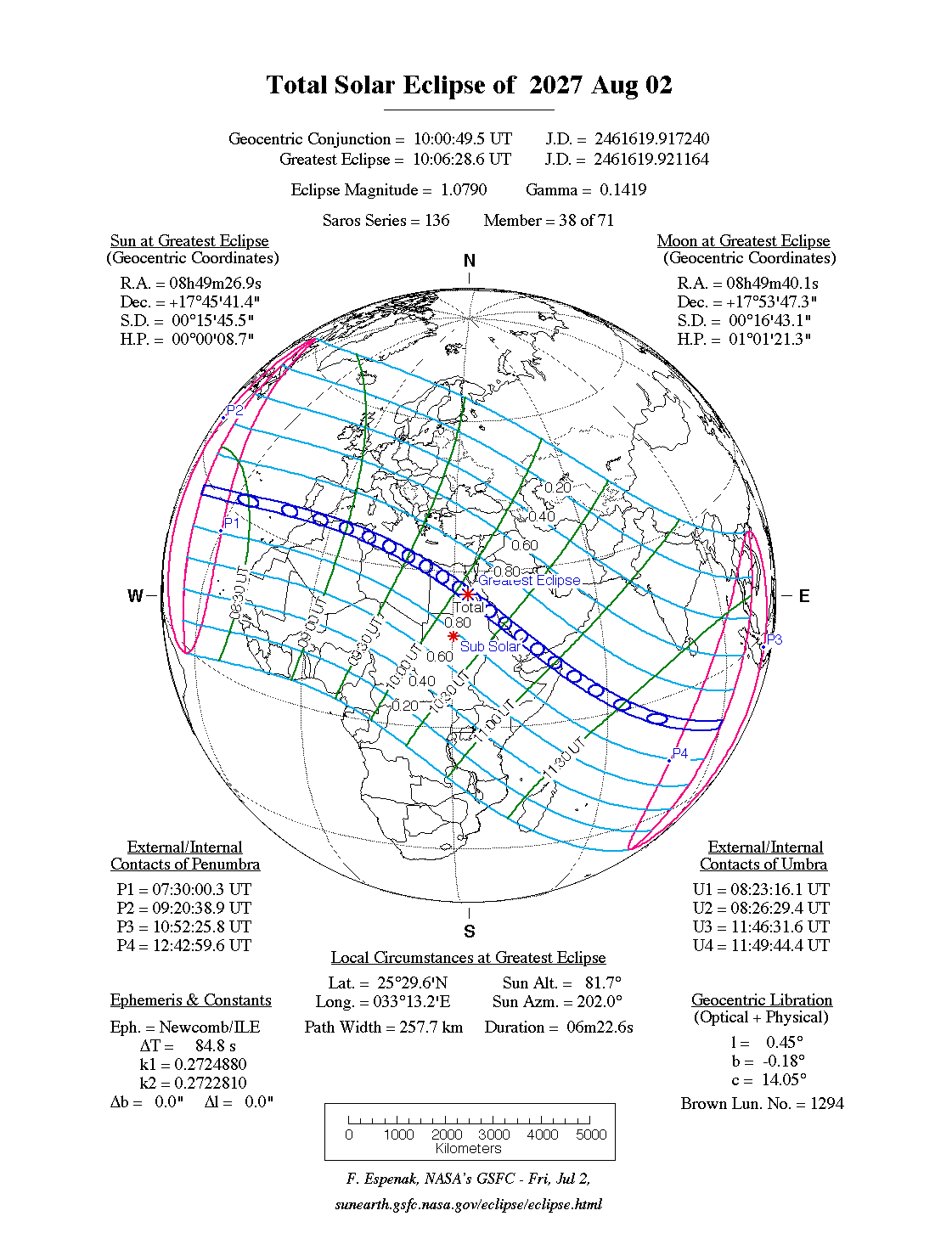
Totality will commence over the eastern Atlantic Ocean and travel across the Strait of Gibraltar between Spain and Morocco, and continue across parts of North Africa and the Middle East. Major cities and locations under the path of totality will include:[3]
- Cadiz and Malaga, in southern Spain
- Gibraltar
- Tangier, Morocco
- Oran, Algeria
- Sfax, Tunisia
- Benghazi, Libya
- Luxor in central Egypt
- Jeddah and Mecca in southwest Saudi Arabia
- Sana'a in western Yemen
- The tip of the Horn of Africa in extreme northeast Somalia
- Islands in the British Indian Ocean Territory
The maximum duration of totality will be observed in Egypt, approximately Script error: No such module "convert". southeast of Luxor, and will last 6 minutes and 22 seconds.[4]
A partial solar eclipse will be visible from the extreme east tip of Maine, United States, far eastern Quebec and the Atlantic Provinces in Canada, southern Greenland, Iceland, Ireland, Great Britain, nearly the entirety of the European continent, all but the southern quarter of Africa, the Middle East, and from South and Southeast Asia.[3]
It will be the first of three total solar eclipses that are observable in Tunisia in the 21st century, passing over the central part of the country.[5] It will be the second total eclipse in Spain within a year, after August 2026. An annular eclipse will appear in Spain in January 2028. A national eclipse committee has been established to coordinate eclipse-related activities.[6]
Duration
This is the second longest total solar eclipse in the 21st century, the longest being the eclipse prior to this one in Solar Saros 136, that of July 22, 2009. The 2009 eclipse maximum duration of 6 minutes and 39.5 seconds occurred on the Pacific Ocean, and the longest duration on land was on remote, uninhabited North Iwo Jima.[7] The maximum duration of this eclipse is 6 minutes and 23.2 seconds, occurring in the northeastern part of Egypt's New Valley Governorate. The location of the greatest eclipse is about Script error: No such module "convert". southeast in Red Sea Governorate, with a slightly shorter duration. This is the longest total solar eclipse on easily accessible land in the 21st century; a longer one will not occur until June 3, 2114.[8]
Images
File:SE2027Aug02T.gif
Animated path

Details of totality in some places or cities
| Country or Territory | Place or City | Start
of |
Start of total eclipse (Local Time) |
End of total eclipse (Local Time) |
Duration of total eclipse |
End of partial eclipse (Local Time) |
Magnitude |
|---|---|---|---|---|---|---|---|
| Script error: No such module "flag". | Tangier | 08:40:33 | 09:44:38 | 09:49:29 | 4 min 50s | 11:00:20 | 1,072 |
| Script error: No such module "flag". | Tarifa | 09:40:50 | 10:45:05 | 10:49:44 | 4 min 39 s | 12:00:42 | 1,072 |
| Script error: No such module "flag". | Tétouan | 08:40:47 | 09:45:10 | 09:50:01 | 4 min 51s | 11:01:10 | 1,072 |
| Script error: No such module "flag". | Cadiz | 09:40:42 | 10:45:18 | 10:48:21 | 3 min 03 s | 11:59:35 | 1,072 |
| Script error: No such module "flag". | Ceuta | 09:40:58 | 10:45:19 | 10:50:07 | 4 min 48 s | 12:01:11 | 1,072 |
| Script error: No such module "flag". | Algeciras | 09:41:01 | 10:45:25 | 10:49:54 | 4 min 29 s | 12:00:59 | 1,072 |
| File:Flag of Gibraltar.svg Gibraltar | Gibraltar | 09:41:04 | 10:45:30 | 10:50:01 | 4 min 31 s | 12:01:07 | 1,072 |
| Script error: No such module "flag". | Marbella | 09:41:37 | 10:46:46 | 10:50:05 | 3 min 18 s | 12:01:50 | 1,072 |
| Script error: No such module "flag". | Benalmádena | 09:41:55 | 10:47:26 | 10:50:19 | 2 min 53 s | 12:02:26 | 1,072 |
| Script error: No such module "flag". | Malaga | 09:42:04 | 10:48:07 | 10:50:00 | 1 min 53 s | 12:02:36 | 1,072 |
| Script error: No such module "flag". | Melilla | 09:42:22 | 10:48:12 | 10:52:44 | 4 min 33 s | 12:05:20 | 1,073 |
| Script error: No such module "flag". | Nador | 08:42:22 | 09:48:13 | 09:52:44 | 4 min 31 s | 11:05:21 | 1,073 |
| Script error: No such module "flag". | Motril | 09:42:43 | 10:49:18 | 10:50:59 | 1 min 41 s | 12:04:04 | 1,073 |
| Script error: No such module "flag". | Oujda | 08:42:56 | 09:50:55 | 09:52:27 | 1 min 32 s | 11:07:16 | 1,073 |
| Script error: No such module "flag". | Tlemcen | 08:43:30 | 09:50:56 | 09:54:07 | 3 min 11 s | 11:08:19 | 1,073 |
| Script error: No such module "flag". | Oran | 08:44:26 | 09:51:03 | 09:56:11 | 5 min 08 s | 11:09:22 | 1,073 |
| Script error: No such module "flag". | Bou Saâda | 08:48:46 | 09:57:55 | 10:03:12 | 5 min 17 s | 11:18:30 | 1,075 |
| Script error: No such module "flag". | Blida | 08:47:55 | 09:57:10 | 10:00:01 | 2 min 51 s | 11:15:21 | 1,074 |
| Script error: No such module "flag". | Batna | 08:51:01 | 10:01:03 | 10:06:20 | 5 min 17 s | 11:22:09 | 1,075 |
| Script error: No such module "flag". | Sfax | 08:56:23 | 10:08:46 | 10:14:26 | 5 min 40 s | 11:31:45 | 1,076 |
| Script error: No such module "flag". | Kairouan | 08:55:43 | 10:08:49 | 10:11:33 | 2 min 44 s | 11:29:36 | 1,076 |
| Script error: No such module "flag". | Northeast of Tripoli | 09:59:46 | 11:16:28 | 11:17:23 | 55 s | 12:38:32 | 1,077 |
| Script error: No such module "flag". | Al-Khums | 10:01:17 | 11:18:40 | 11:19:23 | 43 s | 12:40:53 | 1,077 |
| Script error: No such module "flag". | Benghasi | 10:10:41 | 11:27:51 | 11:34:00 | 6 m 09 s | 12:53:15 | 1,078 |
| Script error: No such module "flag". | Siwa Oasis | 11:22:11 | 12:42:33 | 12:48:03 | 5 min 30 s | 14:08:04 | 1,079 |
| Script error: No such module "flag". | Asyut | 11:35:29 | 12:56:52 | 13:02:59 | 6 min 07 s | 14:21:28 | 1,079 |
| Script error: No such module "flag". | Sohag | 11:37:13 | 12:58:44 | 13:05:07 | 6 min 22 s | 14:23:25 | 1,079 |
| Script error: No such module "flag". | Qena | 11:39:51 | 13:01:33 | 13:07:45 | 6 min 12 s | 14:25:48 | 1,079 |
| Script error: No such module "flag". | Luxor | 11:40:12 | 13:02:02 | 13:08:23 | 6 min 21 s | 14:26:30 | 1,079 |
| Script error: No such module "flag". | Jeddah | 12:00:22 | 13:22:16 | 13:28:16 | 6 min 00 s | 14:43:44 | 1,079 |
| Script error: No such module "flag". | Mecca | 12:01:56 | 13:24:02 | 13:29:09 | 5 min 07 s | 14:44:41 | 1,079 |
| Script error: No such module "flag". | Taif | 12:03:32 | 13:26:02 | 13:29:55 | 3 min 53 s | 14:45:43 | 1,079 |
| Script error: No such module "flag". | Abha | 12:13:08 | 13:34:14 | 13:40:07 | 6 min 03 s | 14:53:46 | 1,078 |
| Script error: No such module "flag". | Khamis Mushait | 12:13:26 | 13:34:26 | 13:40:27 | 6 min 01 s | 14:53:51 | 1,078 |
| Script error: No such module "flag". | Jizan | 12:15:13 | 13:38:18 | 13:41:14 | 2 min 56 s | 14:56:09 | 1,078 |
| Script error: No such module "flag". | Sana'a | 12:21:54 | 13:44:11 | 13:46:32 | 2 min 21 s | 15:00:26 | 1,078 |
| Script error: No such module "flag". | Ataq | 12:29:00 | 13:48:10 | 13:53:57 | 5 min 47 s | 15:04:41 | 1,077 |
| Script error: No such module "flag". | Bosaso | 12:39:39 | 13:58:08 | 14:02:10 | 4 min 02 s | 15:11:56 | 1,076 |
| Script error: No such module "flag". | Bandar Beyla | 12:46:05 | 14:04:20 | 14:06:26 | 2 min 08 s | 15:15:55 | 1,076 |
| File:Flag of the Commissioner of the British Indian Ocean Territory.svg British Indian Ocean Territory | Salomon Islands, Peros Banhos and Nelsons Island in Chagos Archipelago | 16:37:41 | 17:40:10 | 17:43:29 | 3 min 19 s | 18:39:42 | 1,067 |


Eclipse details
Shown below are two tables displaying details about this particular solar eclipse. The first table outlines times at which the moon's penumbra or umbra attains the specific parameter, and the second table describes various other parameters pertaining to this eclipse.[9]
| Event | Time (UTC) |
|---|---|
| First Penumbral External Contact | 2027 August 2 at 07:31:21.9 UTC |
| First Umbral External Contact | 2027 August 2 at 08:24:37.8 UTC |
| First Central Line | 2027 August 2 at 08:26:14.5 UTC |
| First Umbral Internal Contact | 2027 August 2 at 08:27:51.1 UTC |
| First Penumbral Internal Contact | 2027 August 2 at 09:22:00.9 UTC |
| Greatest Duration | 2027 August 2 at 10:01:33.8 UTC |
| Equatorial Conjunction | 2027 August 2 at 10:02:10.7 UTC |
| Ecliptic Conjunction | 2027 August 2 at 10:06:23.6 UTC |
| Greatest Eclipse | 2027 August 2 at 10:07:50.2 UTC |
| Last Penumbral Internal Contact | 2027 August 2 at 10:53:47.0 UTC |
| Last Umbral Internal Contact | 2027 August 2 at 11:47:53.1 UTC |
| Last Central Line | 2027 August 2 at 11:49:29.5 UTC |
| Last Umbral External Contact | 2027 August 2 at 11:51:05.9 UTC |
| Last Penumbral External Contact | 2027 August 2 at 12:44:21.3 UTC |
| Parameter | Value |
|---|---|
| Eclipse Magnitude | 1.07903 |
| Eclipse Obscuration | 1.16430 |
| Gamma | 0.14209 |
| Sun Right Ascension | 08h49m26.9s |
| Sun Declination | +17°45'41.3" |
| Sun Semi-Diameter | 15'45.5" |
| Sun Equatorial Horizontal Parallax | 08.7" |
| Moon Right Ascension | 08h49m40.1s |
| Moon Declination | +17°53'47.8" |
| Moon Semi-Diameter | 16'43.1" |
| Moon Equatorial Horizontal Parallax | 1°01'21.4" |
| ΔT | 72.8 s |
Bright stars and planets visible during totality
The eclipsed Sun will be in mid-Cancer, a few degrees southeast of the Beehive Cluster (which will not be visible to the naked eye) and Venus (which will most definitely be seen if the sky is at all transparent). Mercury will be several degrees west of Venus and lined up with Pollux and Castor. Saturn will be many degrees west of the Sun. Jupiter and Regulus will be close together in Leo about 20 degrees east of the Sun, and Mars will be many degrees farther east in Virgo. Over most of the continental areas in the path of totality, the Winter Hexagon will be visible, although on the Arabian Peninsula its westernmost stars -- Aldebaran and Rigel—will be low. In the British Indian Ocean Territory the Winter Hexagon stars will either have disappeared below the western horizon or will be very low, but Alpha Centauri, Beta Centauri and the Southern Cross will be well up in the south.
Eclipse season
Script error: No such module "Labelled list hatnote". This eclipse is part of an eclipse season, a period, roughly every six months, when eclipses occur. Only two (or occasionally three) eclipse seasons occur each year, and each season lasts about 35 days and repeats just short of six months (173 days) later; thus two full eclipse seasons always occur each year. Either two or three eclipses happen each eclipse season. In the sequence below, each eclipse is separated by a fortnight. The first and last eclipse in this sequence is separated by one synodic month.
| July 18 Ascending node (full moon) |
August 2 Descending node (new moon) |
August 17 Ascending node (full moon) |
|---|---|---|
| File:Lunar eclipse chart close-2027Jul18.png | File:SE2027Aug02T.png | File:Lunar eclipse chart close-2027Aug17.png |
| Penumbral lunar eclipse Lunar Saros 110 |
Total solar eclipse Solar Saros 136 |
Penumbral lunar eclipse Lunar Saros 148 |


Related eclipses
Eclipses in 2027
- An annular solar eclipse on February 6.
- A penumbral lunar eclipse on February 20.
- A penumbral lunar eclipse on July 18.
- A total solar eclipse on August 2.
- A penumbral lunar eclipse on August 17.
Metonic
- Preceded by: Solar eclipse of October 14, 2023
- Followed by: Solar eclipse of May 21, 2031
Tzolkinex
- Preceded by: Solar eclipse of June 21, 2020
- Followed by: Solar eclipse of September 12, 2034
Half-Saros
- Preceded by: Lunar eclipse of July 27, 2018
- Followed by: Lunar eclipse of August 7, 2036
Tritos
- Preceded by: Solar eclipse of September 1, 2016
- Followed by: Solar eclipse of July 2, 2038
Solar Saros 136
- Preceded by: Solar eclipse of July 22, 2009
- Followed by: Solar eclipse of August 12, 2045
Inex
- Preceded by: Solar eclipse of August 22, 1998
- Followed by: Solar eclipse of July 12, 2056
Triad
- Preceded by: Solar eclipse of October 1, 1940
- Followed by: Solar eclipse of June 3, 2114
Solar eclipses of 2026–2029
This eclipse is a member of a semester series. An eclipse in a semester series of solar eclipses repeats approximately every 177 days and 4 hours (a semester) at alternating nodes of the Moon's orbit.[10]
The partial solar eclipses on June 12, 2029 and December 5, 2029 occur in the next lunar year eclipse set.
| Solar eclipse series sets from 2026 to 2029 | ||||||
|---|---|---|---|---|---|---|
| Ascending node | Descending node | |||||
| Saros | Map | Gamma | Saros | Map | Gamma | |
| 121 | February 17, 2026 File:SE2026Feb17A.png Annular |
−0.97427 | 126 | August 12, 2026 File:SE2026Aug12T.png Total |
0.89774 | |
| 131 | February 6, 2027 File:SE2027Feb06A.png Annular |
−0.29515 | 136 | August 2, 2027 File:SE2027Aug02T.png Total |
0.14209 | |
| 141 | January 26, 2028 File:SE2028Jan26A.png Annular |
0.39014 | 146 | July 22, 2028 File:SE2028Jul22T.png Total |
−0.60557 | |
| 151 | January 14, 2029 File:SE2029Jan14P.png Partial |
1.05532 | 156 | July 11, 2029 File:SE2029Jul11P.png Partial |
−1.41908 | |


Saros 136
This eclipse is a part of Saros series 136, repeating every 18 years, 11 days, and containing 71 events. The series started with a partial solar eclipse on June 14, 1360. It contains annular eclipses from September 8, 1504 through November 12, 1594; hybrid eclipses from November 22, 1612 through January 17, 1703; and total eclipses from January 27, 1721 through May 13, 2496. The series ends at member 71 as a partial eclipse on July 30, 2622. Its eclipses are tabulated in three columns; every third eclipse in the same column is one exeligmos apart, so they all cast shadows over approximately the same parts of the Earth.
The longest duration of annularity was produced by member 9 at 32 seconds on September 8, 1504, and the longest duration of totality was produced by member 34 at 7 minutes, 7.74 seconds on June 20, 1955. All eclipses in this series occur at the Moon’s descending node of orbit.[11]
| Series members 26–47 occur between 1801 and 2200: | ||
|---|---|---|
| 26 | 27 | 28 |
| File:SE1811Mar24T.png March 24, 1811 |
File:SE1829Apr03T.png April 3, 1829 |
File:SE1847Apr15T.png April 15, 1847 |
| 29 | 30 | 31 |
| File:SE1865Apr25T.gif April 25, 1865 |
File:SE1883May06T.png May 6, 1883 |
File:SE1901May18T.png May 18, 1901 |
| 32 | 33 | 34 |
| File:SE1919May29T.png May 29, 1919 |
File:SE1937Jun08T.png June 8, 1937 |
File:SE1955Jun20T.png June 20, 1955 |
| 35 | 36 | 37 |
| File:SE1973Jun30T.png June 30, 1973 |
File:SE1991Jul11T.png July 11, 1991 |
File:SE2009Jul22T.png July 22, 2009 |
| 38 | 39 | 40 |
| File:SE2027Aug02T.png August 2, 2027 |
File:SE2045Aug12T.png August 12, 2045 |
File:SE2063Aug24T.png August 24, 2063 |
| 41 | 42 | 43 |
| File:SE2081Sep03T.png September 3, 2081 |
File:SE2099Sep14T.png September 14, 2099 |
File:SE2117Sep26T.png September 26, 2117 |
| 44 | 45 | 46 |
| File:SE2135Oct07T.png October 7, 2135 |
File:SE2153Oct17T.png October 17, 2153 |
File:SE2171Oct29T.png October 29, 2171 |
| 47 | ||
| File:SE2189Nov08T.png November 8, 2189 | ||


Metonic series
The metonic series repeats eclipses every 19 years (6939.69 days), lasting about 5 cycles. Eclipses occur in nearly the same calendar date. In addition, the octon subseries repeats 1/5 of that or every 3.8 years (1387.94 days). All eclipses in this table occur at the Moon's descending node.
| 21 eclipse events between May 21, 1993 and May 20, 2069 | ||||
|---|---|---|---|---|
| May 20–21 | March 9 | December 25–26 | October 13–14 | August 1–2 |
| 118 | 120 | 122 | 124 | 126 |
| File:SE1993May21P.png May 21, 1993 |
File:SE1997Mar09T.png March 9, 1997 |
File:SE2000Dec25P.png December 25, 2000 |
File:SE2004Oct14P.png October 14, 2004 |
File:SE2008Aug01T.png August 1, 2008 |
| 128 | 130 | 132 | 134 | 136 |
| File:SE2012May20A.png May 20, 2012 |
File:SE2016Mar09T.png March 9, 2016 |
File:SE2019Dec26A.png December 26, 2019 |
File:SE2023Oct14A.png October 14, 2023 |
File:SE2027Aug02T.png August 2, 2027 |
| 138 | 140 | 142 | 144 | 146 |
| File:SE2031May21A.png May 21, 2031 |
File:SE2035Mar09A.png March 9, 2035 |
File:SE2038Dec26T.png December 26, 2038 |
File:SE2042Oct14A.png October 14, 2042 |
File:SE2046Aug02T.png August 2, 2046 |
| 148 | 150 | 152 | 154 | 156 |
| File:SE2050May20H.png May 20, 2050 |
File:SE2054Mar09P.png March 9, 2054 |
File:SE2057Dec26T.png December 26, 2057 |
File:SE2061Oct13A.png October 13, 2061 |
File:SE2065Aug02P.png August 2, 2065 |
| 158 | ||||
| File:SE2069May20P.png May 20, 2069 | ||||


Tritos series
Template:Solar Tritos series 2005 October 3
Inex series
Template:Solar Inex series 2027 August 2
References
<templatestyles src="Reflist/styles.css" />
- ↑ Script error: No such module "citation/CS1".
- ↑ Script error: No such module "citation/CS1".
- ↑ a b Script error: No such module "citation/CS1".
- ↑ Script error: No such module "citation/CS1".
- ↑ Script error: No such module "Citation/CS1".
- ↑ Script error: No such module "citation/CS1".
- ↑ Script error: No such module "citation/CS1".
- ↑ Script error: No such module "citation/CS1".
- ↑ Script error: No such module "citation/CS1".
- ↑ Script error: No such module "citation/CS1".
- ↑ Script error: No such module "citation/CS1".
Script error: No such module "Check for unknown parameters".
Script error: No such module "Side box".
External links
Script error: No such module "Navbox".