Solar eclipse of April 29, 1976
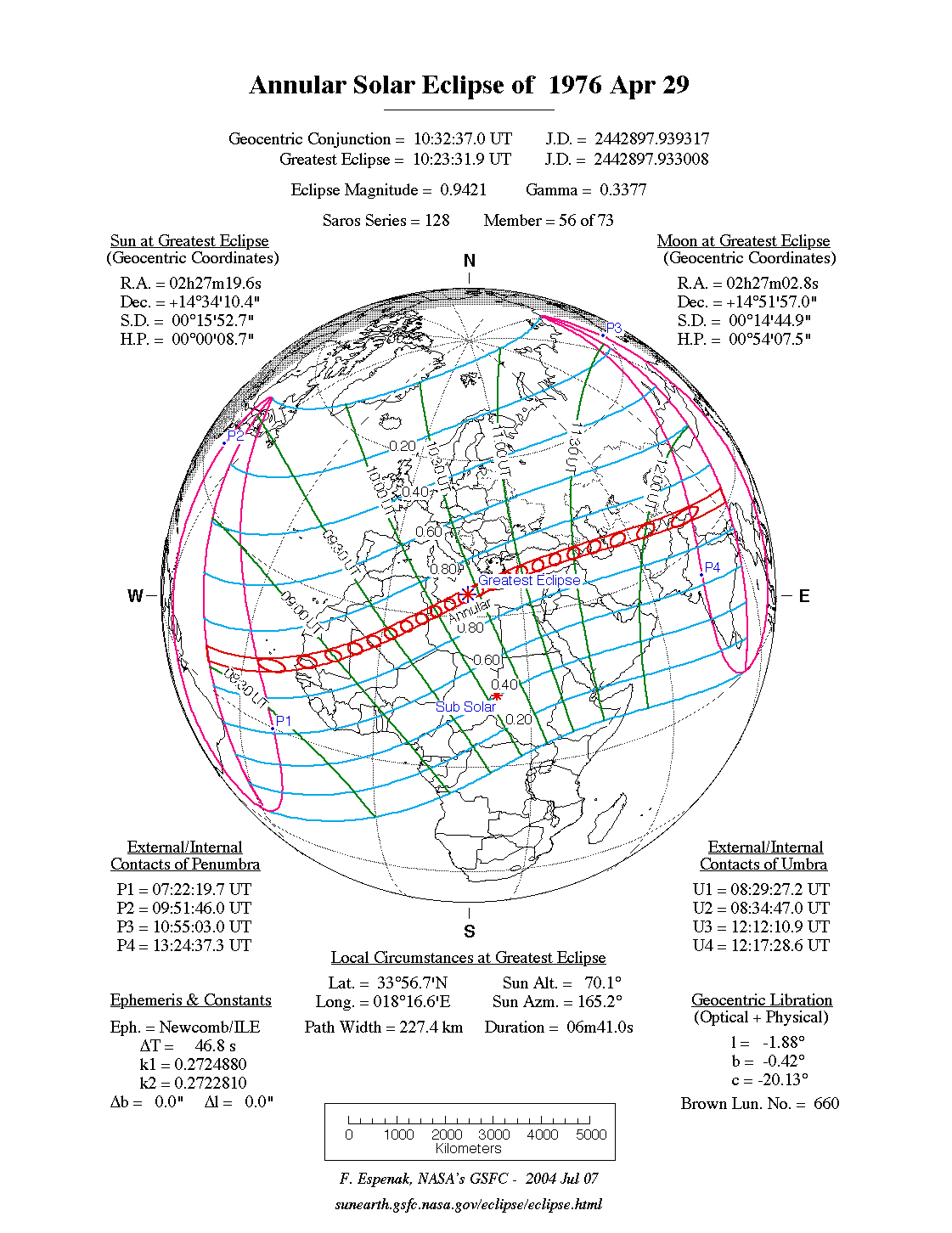
Template:Short description Script error: No such module "Solar eclipse". An annular solar eclipse occurred at the Moon's descending node of orbit on Thursday, April 29, 1976,[1] with a magnitude of 0.9421. A solar eclipse occurs when the Moon passes between Earth and the Sun, thereby totally or partly obscuring the image of the Sun for a viewer on Earth. An annular solar eclipse occurs when the Moon's apparent diameter is smaller than the Sun's, blocking most of the Sun's light and causing the Sun to look like an annulus (ring). An annular eclipse appears as a partial eclipse over a region of the Earth thousands of kilometres wide. Occurring about 1.9 days after apogee (on April 27, 1976, at 13:30 UTC), the Moon's apparent diameter was smaller.[2]
Annularity was visible from North Africa, Greece, Turkey, Middle East, central Asia, India, China. 5 of the 14 eight-thousanders in Pakistan and China—Nanga Parbat, K2, Broad Peak, Gasherbrum II and Gasherbrum I, lie in the path of annularity. A partial eclipse was visible for parts of the Canadian Maritimes, North Africa, Central Africa, Europe, the Middle East, Central Asia, and South Asia.
Note that the central line of this annular solar eclipse followed a path extremely similar to that of the total eclipse that will occur 112 years later on April 21, 2088.
Observation
The Institute of Physics and Institute of Mathematics of the Chinese Academy of Sciences and the Xinjiang Earthquake Team conducted observations of gravitational effects using gravimeters, inclinometers, pendulum clocks and seismometers in southwestern Hotan County, Hotan Prefecture, Xinjiang near the Karakoram Pass at an altitude of Script error: No such module "convert".. Results showed that the gravitational acceleration had no obvious effect within the accuracy of the instruments. No inclination was recorded on the photosensitive paper of the inclinometer due to the width of its lines. Three inclinations were pen-recorded, whose time and direction were clearly related to that of the eclipse. Due to the difficult conditions with the high altitude, the observation team was unable to obtain more comparative data.[3]
Eclipse details
Shown below are two tables displaying details about this particular solar eclipse. The first table outlines times at which the moon's penumbra or umbra attains the specific parameter, and the second table describes various other parameters pertaining to this eclipse.[4]
| Event | Time (UTC) |
|---|---|
| First Penumbral External Contact | 1976 April 29 at 07:23:05.3 UTC |
| First Umbral External Contact | 1976 April 29 at 08:30:13.1 UTC |
| First Central Line | 1976 April 29 at 08:32:52.8 UTC |
| First Umbral Internal Contact | 1976 April 29 at 08:35:32.9 UTC |
| First Penumbral Internal Contact | 1976 April 29 at 09:52:32.8 UTC |
| Ecliptic Conjunction | 1976 April 29 at 10:20:15.6 UTC |
| Greatest Eclipse | 1976 April 29 at 10:24:17.7 UTC |
| Greatest Duration | 1976 April 29 at 10:30:53.5 UTC |
| Equatorial Conjunction | 1976 April 29 at 10:33:23.0 UTC |
| Last Penumbral Internal Contact | 1976 April 29 at 10:55:47.8 UTC |
| Last Umbral Internal Contact | 1976 April 29 at 12:12:56.6 UTC |
| Last Central Line | 1976 April 29 at 12:15:35.7 UTC |
| Last Umbral External Contact | 1976 April 29 at 12:18:14.3 UTC |
| Last Penumbral External Contact | 1976 April 29 at 13:25:23.3 UTC |
| Parameter | Value |
|---|---|
| Eclipse Magnitude | 0.94208 |
| Eclipse Obscuration | 0.88752 |
| Gamma | 0.33783 |
| Sun Right Ascension | 02h27m19.6s |
| Sun Declination | +14°34'10.4" |
| Sun Semi-Diameter | 15'52.7" |
| Sun Equatorial Horizontal Parallax | 08.7" |
| Moon Right Ascension | 02h27m02.8s |
| Moon Declination | +14°51'57.3" |
| Moon Semi-Diameter | 14'44.9" |
| Moon Equatorial Horizontal Parallax | 0°54'07.6" |
| ΔT | 46.8 s |
Eclipse season
Script error: No such module "Labelled list hatnote". This eclipse is part of an eclipse season, a period, roughly every six months, when eclipses occur. Only two (or occasionally three) eclipse seasons occur each year, and each season lasts about 35 days and repeats just short of six months (173 days) later; thus two full eclipse seasons always occur each year. Either two or three eclipses happen each eclipse season. In the sequence below, each eclipse is separated by a fortnight.
| April 29 Descending node (new moon) |
May 13 Ascending node (full moon) |
|---|---|
| File:SE1976Apr29A.png | File:Lunar eclipse chart close-1976May13.png |
| Annular solar eclipse Solar Saros 128 |
Partial lunar eclipse Lunar Saros 140 |


Related eclipses
Eclipses in 1976
- An annular solar eclipse on April 29.
- A partial lunar eclipse on May 13.
- A total solar eclipse on October 23.
- A penumbral lunar eclipse on November 6.
Metonic
- Preceded by: Solar eclipse of July 10, 1972
- Followed by: Solar eclipse of February 16, 1980
Tzolkinex
- Preceded by: Solar eclipse of March 18, 1969
- Followed by: Solar eclipse of June 11, 1983
Half-Saros
- Preceded by: Lunar eclipse of April 24, 1967
- Followed by: Lunar eclipse of May 4, 1985
Tritos
- Preceded by: Solar eclipse of May 30, 1965
- Followed by: Solar eclipse of March 29, 1987
Solar Saros 128
- Preceded by: Solar eclipse of April 19, 1958
- Followed by: Solar eclipse of May 10, 1994
Inex
- Preceded by: Solar eclipse of May 20, 1947
- Followed by: Solar eclipse of April 8, 2005
Triad
- Preceded by: Solar eclipse of June 28, 1889
- Followed by: Solar eclipse of February 28, 2063
Solar eclipses of 1975–1978
This eclipse is a member of a semester series. An eclipse in a semester series of solar eclipses repeats approximately every 177 days and 4 hours (a semester) at alternating nodes of the Moon's orbit.[5]
| Solar eclipse series sets from 1975 to 1978 | ||||||
|---|---|---|---|---|---|---|
| Descending node | Ascending node | |||||
| Saros | Map | Gamma | Saros | Map | Gamma | |
| 118 | May 11, 1975 File:SE1975May11P.png Partial |
1.0647 | 123 | November 3, 1975 File:SE1975Nov03P.png Partial |
−1.0248 | |
| 128 | April 29, 1976 File:SE1976Apr29A.png Annular |
0.3378 | 133 | October 23, 1976 File:SE1976Oct23T.png Total |
−0.327 | |
| 138 | April 18, 1977 File:SE1977Apr18A.png Annular |
−0.399 | 143 | October 12, 1977 File:SE1977Oct12T.png Total |
0.3836 | |
| 148 | April 7, 1978 File:SE1978Apr07P.png Partial |
−1.1081 | 153 | October 2, 1978 File:SE1978Oct02P.png Partial |
1.1616 | |


Saros 128
This eclipse is a part of Saros series 128, repeating every 18 years, 11 days, and containing 73 events. The series started with a partial solar eclipse on August 29, 984 AD. It contains total eclipses from May 16, 1417 through June 18, 1471; hybrid eclipses from June 28, 1489 through July 31, 1543; and annular eclipses from August 11, 1561 through July 25, 2120. The series ends at member 73 as a partial eclipse on November 1, 2282. Its eclipses are tabulated in three columns; every third eclipse in the same column is one exeligmos apart, so they all cast shadows over approximately the same parts of the Earth.
The longest duration of totality was produced by member 27 at 1 minutes, 45 seconds on June 7, 1453, and the longest duration of annularity was produced by member 48 at 8 minutes, 35 seconds on February 1, 1832. All eclipses in this series occur at the Moon’s descending node of orbit.[6]
| Series members 47–68 occur between 1801 and 2200: | ||
|---|---|---|
| 47 | 48 | 49 |
| File:SE1814Jan21A.gif January 21, 1814 |
File:SE1832Feb01A.gif February 1, 1832 |
File:SE1850Feb12A.gif February 12, 1850 |
| 50 | 51 | 52 |
| File:SE1868Feb23A.gif February 23, 1868 |
File:SE1886Mar05A.gif March 5, 1886 |
File:SE1904Mar17A.png March 17, 1904 |
| 53 | 54 | 55 |
| File:SE1922Mar28A.png March 28, 1922 |
File:SE1940Apr07A.png April 7, 1940 |
File:SE1958Apr19A.png April 19, 1958 |
| 56 | 57 | 58 |
| File:SE1976Apr29A.png April 29, 1976 |
File:SE1994May10A.png May 10, 1994 |
File:SE2012May20A.png May 20, 2012 |
| 59 | 60 | 61 |
| File:SE2030Jun01A.png June 1, 2030 |
File:SE2048Jun11A.png June 11, 2048 |
File:SE2066Jun22A.png June 22, 2066 |
| 62 | 63 | 64 |
| File:SE2084Jul03A.png July 3, 2084 |
File:SE2102Jul15A.png July 15, 2102 |
File:SE2120Jul25A.png July 25, 2120 |
| 65 | 66 | 67 |
| File:Saros128 65van73 SE2138Aug05P.jpg August 5, 2138 |
File:Saros128 66van73 SE2156Aug16P.jpg August 16, 2156 |
File:Saros128 67van73 SE2174Aug27P.jpg August 27, 2174 |
| 68 | ||
| File:Saros128 68van73 SE2192Sep06P.jpg September 6, 2192 | ||


Metonic series
The metonic series repeats eclipses every 19 years (6939.69 days), lasting about 5 cycles. Eclipses occur in nearly the same calendar date. In addition, the octon subseries repeats 1/5 of that or every 3.8 years (1387.94 days). All eclipses in this table occur at the Moon's descending node.
| 21 eclipse events between July 11, 1953 and July 11, 2029 | ||||
|---|---|---|---|---|
| July 10–11 | April 29–30 | February 15–16 | December 4 | September 21–23 |
| 116 | 118 | 120 | 122 | 124 |
| File:SE1953Jul11P.png July 11, 1953 |
File:SE1957Apr30A.png April 30, 1957 |
File:SE1961Feb15T.png February 15, 1961 |
File:SE1964Dec04P.png December 4, 1964 |
File:SE1968Sep22T.png September 22, 1968 |
| 126 | 128 | 130 | 132 | 134 |
| File:SE1972Jul10T.png July 10, 1972 |
File:SE1976Apr29A.png April 29, 1976 |
File:SE1980Feb16T.png February 16, 1980 |
File:SE1983Dec04A.png December 4, 1983 |
File:SE1987Sep23A.png September 23, 1987 |
| 136 | 138 | 140 | 142 | 144 |
| File:SE1991Jul11T.png July 11, 1991 |
File:SE1995Apr29A.png April 29, 1995 |
File:SE1999Feb16A.png February 16, 1999 |
File:SE2002Dec04T.png December 4, 2002 |
File:SE2006Sep22A.png September 22, 2006 |
| 146 | 148 | 150 | 152 | 154 |
| File:SE2010Jul11T.png July 11, 2010 |
File:SE2014Apr29A.png April 29, 2014 |
File:SE2018Feb15P.png February 15, 2018 |
File:SE2021Dec04T.png December 4, 2021 |
File:SE2025Sep21P.png September 21, 2025 |
| 156 | ||||
| File:SE2029Jul11P.png July 11, 2029 | ||||


Tritos series
Template:Solar Tritos series 2009 January 26
Inex series
Template:Solar Inex series 2005 April 8
Notes
<templatestyles src="Reflist/styles.css" />
Script error: No such module "Check for unknown parameters".
References
- Earth visibility chart and eclipse statistics Eclipse Predictions by Fred Espenak, NASA/GSFC
- Solar eclipse of April 29, 1976 in Russia Script error: No such module "webarchive".
Script error: No such module "Navbox". Script error: No such module "Side box".