Saudi Arabian–Kuwaiti neutral zone

(2 December 1922 – 18 January 1970)
(Established by the Uqair Convention of December 1922)
The Saudi Arabian–Kuwaiti neutral zone, also known as the Divided Zone, was an area of Template:Convert between the borders of Saudi Arabia and Kuwait that was left undefined when the border was established by the Uqair Convention of 2 December 1922.[1][2]
According to Daniel Yergin, "The Neutral Zone was the two thousand or so square miles of barren desert that had been carved out by the British in 1922 in the course of drawing a border between Kuwait and Saudi Arabia. In order to accommodate the Bedouins, who wandered back and forth between Kuwait and Saudi Arabia and for whom nationality was a hazy concept, it was agreed that the two countries would share sovereignty over the area."[3]
The Uqair Convention stated that "the Government of Najd and Kuwait will share equal rights until through the good offices of the Government of Great Britain a further agreement is made between Najd and Kuwait concerning it".
However, there was little interest in a more definitive settlement in the so-called "Neutral Zone" until the 1938 discovery of oil in the Burgan (Burqan) area of Kuwait. With the possibility of oil within the "Neutral Zone" itself, concessions were granted by Kuwait in 1948 to the American Independent Oil Company and in 1949 by Saudi Arabia to the Pacific Western Oil Corporation, the two companies cooperatively explored and developed the zone. Oil was discovered in March 1953 and the reservoirs were of significant size.[3] In 1957, Saudi Arabia signed a concession agreement with the Japanese-owned Arabian Oil Co., and Kuwait signed in 1958. That concession expired in 2000.[4] The company made its first offshore discovery in January 1960.[3]Template:Rp
The partitioning negotiations commenced shortly after the rulers of Kuwait and Saudi Arabia met and decided, in October 1960, that the Neutral Zone should be divided. On 7 July 1965, the two governments signed an agreement to partition the zone (which took effect on 25 July 1966). A demarcation agreement dividing the Neutral Zone was signed on 17 December 1967 but did not formally take effect until the exchange of instruments and signing which took place in Kuwait on 18 December 1969.[5] Ratification followed on 18 January 1970, and the agreement was published in the Kuwaiti Official Gazette on 25 January 1970.[6]
The zone was never assigned an ISO 3166 code since it was partitioned before the adoption of ISO 3166 in 1974. But for example in trade journals of the oil industry it was treated separately like a country.
The area was quickly, but briefly, overrun during the First Gulf War by Iraqi forces in 1991 after they invaded and occupied Kuwait; however, Coalition forces composed of American and Saudi contingents repelled the Iraqi offensive and liberated the area and the rest of Kuwait.[7]
Despite the zone being partitioned half a century ago, oil pumping is still done by agreements.Template:Clarify[8][9]
Oil industry
The conclusion of the negotiations between American Independent and the Kuwaiti government was announced on July 6, 1948.[10]
Geologist Paul T. Walton on behalf of Western Pacific Oil negotiated with King Ibn Saud in the Shepheard's Hotel in Cairo. The concession was granted for a $9.5 million initial bonus, 55 cents per barrel production royalty with a minimum of $1 million to be paid each year and a 25% interest in net profits.[11]
The headquarters for the exploration crews was a refurbished Landing Ship, Tank, LST 1014, renamed MV Aminoil. The conversion was carried out by Levingston Shipbuilding Company in Orange, Texas from June 15 till September 30, 1949. The ship and the 3,000 tons of cargo represented an investment of $2 million. With the arrival of this mobile base camp via the Suez Canal in the Persian Gulf in November 1949, exploration in the neutral zone commenced. The first drilling location was 25 miles inland on the border with Kuwait, in proximity to the prolific Burghan field.[12][13]
During 1950, three dry holes were drilled. Wafra No. 1 was completed on February 4, Wafra No. 2 was spudded 2 miles west of No. 1 on February 22 and abandoned on June 9. Wafra No. 3 reached 5,000ft on October 20.[14]
Late in 1953 a 34 mile 8- and 10-inch pipeline was completed to Mina Abdulla in Kuwait.[15]
| Year | Wafra | Khafji | Fuwaris | Gudair | Al Hout |
|---|---|---|---|---|---|
| 1954 | 6,023 | ||||
| 1955 | 8,848 | ||||
| 1956 | 11,725 | ||||
| 1957 | 23,300 | ||||
| 1958 | 29,510 | ||||
| 1959 | 41,980 | 420 | |||
| 1960 | 49,270 | 540 | |||
| 1961 | 57,705 | 7,482 | |||
| 1962 | 67,319 | 21,936 | |||
| 1963 | 66,254 | 48,246 | |||
| 1964 | 68,200 | 61,251 | 1,949 | ||
| 1965 | 64,970 | 65,235 | 2,046 | ||
| 1966 | 56,210 | 92,969 | 1,545 | 2,700 | |
| 1967 | 49,665 | 101,848 | 1,207 | 0 | |
| 1968 | 33,412 | 109,504 | 706 | 13,078 | |
| 1969 | 30,373 | 110,596 | 392 | 4,699 | 7,092 |
| 1970 | 39,936 | 119,305 | 490 | 16,944 | 7,225 |
| 1971 | 45,000 | 127,809 | 832 | 19,441 | 6,031 |
| 1972 | 38,422 | 144,896 | 788 | 17,885 | 5,309 |
| 1973 | 30,020 | 139,836 | 876 | 16,167 | 4,029 |
| 1974 | 39,655 | 135,918 | 910 | 19,108 | 2,558 |
| 1975 | 43,441 | 117,000 | 945 | 18,149 | 2,100 |
| 1976 | 40,165 | 109,490 | 1,142 | 17,991 | 2,925 |
| 1977 | 42,657 | 69,380 | 1,068 | 20,200 | 2,900 |
| 1978 | 38,520 | 109,118 | 1,204 | 19,280 | 2,026 |
| 1979 | 40,723 | 134,600 | 955 | 18,538 | 2,320 |
| 1980 | 38,040 | 137,345 | 588 | 17,930 | 2,555 |
| Year | Oil | Gas | Dry | Wildcats | Feet |
|---|---|---|---|---|---|
| 1953 | 5 | 0 | 0 | 0 | 20,635 |
| 1954 | |||||
| 1955 | |||||
| 1956 | |||||
| 1957 | 46 | 0 | 8 | 0 | 110,390 |
| 1958 | 37 | 0 | 12 | 0 | 102,424 |
| 1959 | 40 | 0 | 0 | 0 | 104,267 |
| 1960 | 80 | 0 | 0 | 0 | 202,038 |
Recent developments
In December 2022, Saudi Aramco and Kuwait Gulf Oil Company signed a Memorandum of Understanding to jointly develop the Durra gas field, located in the neutral zone. The development aims at producing Template:Convert of natural gas and 84,000 barrels of LNG per day.[17]
On 26 May, 2025, Saudi Arabia and Kuwait announced a new discovery (500bpd of 26 to 27 API gravity) 5 kilometers north of Wafra field.[18][19]
See also
- Geography of Kuwait
- Geography of Saudi Arabia
- Kuwait–Saudi Arabia border
- Kuwait–Saudi Arabia relations
- Saudi Arabian–Iraqi neutral zone
- Unification of Saudi Arabia
References
Template:Reflist Template:Notelist
External links
- Script error: No such module "citation/CS1".
- Template:Cite report
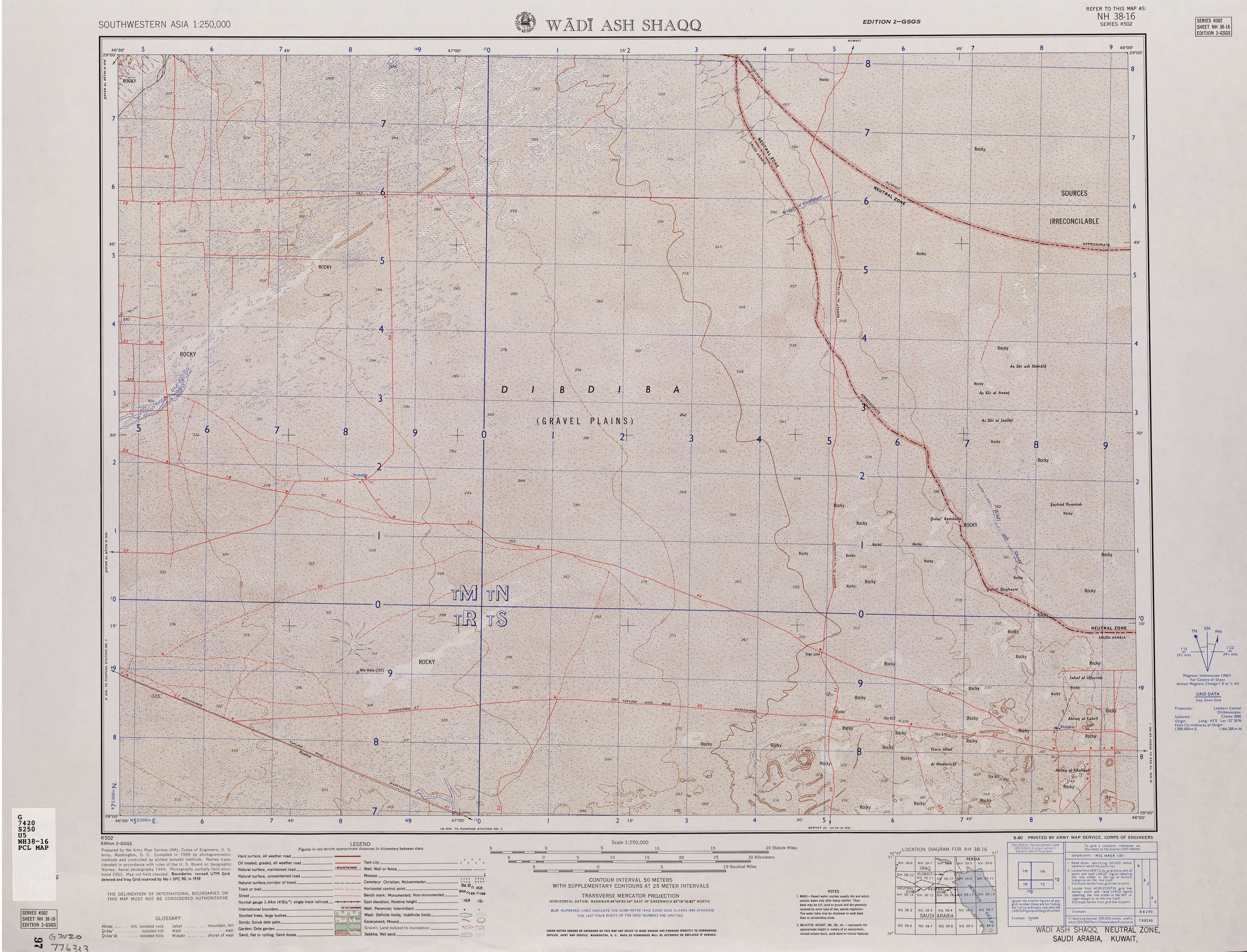
- U.S. Army Map Sheet NH38-16 1:250.000 (map sheet with western part of former Neutral Zone)
- ↑ Script error: No such module "Citation/CS1".
- ↑ Script error: No such module "Citation/CS1".
- ↑ a b c Script error: No such module "citation/CS1".
- ↑ Script error: No such module "citation/CS1".
- ↑ Script error: No such module "citation/CS1".
- ↑ Template:Cite report
- ↑ Template:Cite report
- ↑ Script error: No such module "citation/CS1".
- ↑ Script error: No such module "citation/CS1".
- ↑ Script error: No such module "citation/CS1".
- ↑ Script error: No such module "citation/CS1".
- ↑ Script error: No such module "citation/CS1".
- ↑ Template:Cite magazine
- ↑ Template:Cite magazine
- ↑ Template:Cite magazine
- ↑ Script error: No such module "citation/CS1".
- ↑ Script error: No such module "citation/CS1".
- ↑ Script error: No such module "citation/CS1".
- ↑ Script error: No such module "citation/CS1".
- Pages with script errors
- Pages with broken file links
- 20th century in Saudi Arabia
- 20th century in Kuwait
- Disputed territories in the Persian Gulf
- Territorial disputes of Saudi Arabia
- Kuwait–Saudi Arabia border
- Kuwait–Saudi Arabia relations
- Demilitarized zones
- 1922 establishments in Asia
- 1970 disestablishments in Asia