Sakurajima
Template:Short description Script error: No such module "about". Template:Infobox mountain
Sakurajima (Template:Langx, Template:Literal) is an active stratovolcano, formerly an island and now a peninsula, in Kagoshima Prefecture in Kyushu, Japan.[1] The lava flows of the 1914 eruption connected it with the Ōsumi Peninsula.[2] It is the most active volcano in Japan.[3]
since November 2025[update]Template:Dated maintenance category (articles)Script error: No such module "Check for unknown parameters"., the volcanic activity continues,[4][5] dropping volcanic ash on the surroundings. Earlier eruptions built the white sand highlands in the region. On September 13, 2016, a team of experts from Bristol University and the Sakurajima Volcano Research Centre in Japan suggested that the volcano could have a major eruption within 30 years; since then many eruptions have occurred.[6][5]
Sakurajima is a stratovolcano. Its summit has three peaks, Kita-dake (northern peak), Naka-dake (central peak) and Minami-dake (southern peak) which is active now.
Kita-dake is Sakurajima's highest peak, rising to Script error: No such module "convert". above sea level. The mountain is in a part of Kagoshima Bay known as Kinkō-wan. The former island is part of the city of Kagoshima which is only 4 km across the bay.[7] The surface of this volcanic peninsula is about Script error: No such module "convert"..
Sakurajima has a population of a few thousand residents, formerly incorporated as Sakurajima town, with a number of schools, shrines, and shops on the island. It is serviced by the Sakurajima Ferry which runs 24/7. It is a tourist destination known for its onsen, local pottery made from volcanic ash, and produce such as the Sakurajima daikon radish and Sakurajima komikan orange which grow in the immensely fertile volcanic soil.
Sakurajima has many natural areas and the ecosystems in different areas where recent eruptions have taken place have been researched as an example of ecological succession.
History
Geological history

Sakurajima is in the 25 km (15 mi)-wide Aira caldera, which formed in an enormous "blow-out-and-cave-in" eruption around 22,000 years ago.[8] Several hundred cubic kilometres of ash and pumice were ejected, causing the magma chamber underneath the erupting vents to collapse. The resulting caldera is over Template:Cvt across. Tephra fell as far as Script error: No such module "convert". from the volcano. Sakurajima is a modern active vent of the same Aira caldera volcano.
Sakurajima was formed by later activity within the caldera, beginning about 13,000 years ago.[9] It is about Script error: No such module "convert". south of the centre of the caldera. Its first eruption in recorded history was in 963 AD.[10] Most of its eruptions are Strombolian,[10] affecting only the summit areas, but larger Plinian eruptions have occurred in 1471–1476, 1779–1782 and 1914.[11]
Volcanic activity at Kita-dake ended around 4,900 years ago: later eruptions have been centered on Minami-dake.[12] Initially since 2006, activity was centred on Showa crater, to the east of the summit of Minami-dake,[13] but by 2025 had moved to the summit crater.[5]
1914 eruption

The 1914 eruption began on January 11 and was the most powerful in twentieth-century Japan. The volcano had been dormant for over a century until 1914.[8] Almost all residents had left the island in the previous days; several large earthquakes had warned them that an eruption was imminent. Initially, the eruption was very explosive, generating eruption columns and pyroclastic flows, but after a very large earthquake on January 12, and another the day after, it became effusive, generating a large lava flow.[8] The January 12 earthquake killed 35, and in total, 58 people died.[14][8] Lava flows filled the narrow strait between the island and the mainland, turning it into a peninsula. Lava flows are rare in Japan—because the silica content of the magmas is high, explosive eruptions are far more common[15]—but the lava flows at Sakurajima continued for months.[8] The island grew, engulfing several smaller islands nearby, and eventually became connected to the mainland by a narrow isthmus. Parts of Kagoshima Bay became significantly shallower, and it made tides higher.[8]
During the last stages of the eruption, emptying of the underlying magma chamber sank the centre of the Aira Caldera by about Script error: No such module "convert"..[8] This showed that Sakurajima draws its magma from the same magma reservoir that fed the ancient caldera-forming eruption.[8] The eruption partly inspired a 1914 movie, The Wrath of the Gods, centering on a family curse that ostensibly causes the eruption.
Recent activity


Sakurajima's activity became more prominent in 1955, and the volcano has been erupting almost constantly ever since. Thousands of small explosions happen each year, throwing ash to heights of up to a few kilometers above the mountain. The Sakurajima Volcano Observatory was set up in 1960 to monitor these eruptions.[10]
Monitoring of the volcano and predictions of large eruptions are particularly important because it is in a densely populated area, with the city of Kagoshima's 680,000 residents just a few kilometers from the volcano. The city conducts regular evacuation drills, and a number of shelters have been built where people can take refuge from falling volcanic debris.[16]
In light of the dangers it presents to nearby populations, Sakurajima was designated a Decade Volcano in 1991, identifying it as worthy of particular study as part of the United Nations' International Decade for Natural Disaster Reduction.[17]
Sakurajima is part of the Kirishima-Yaku National Park, and its lava flows are a major tourist attraction. The area around Sakurajima contains several hot spring resorts. One of the main agricultural products of Sakurajima is a huge basketball-sized white radish (Sakurajima daikon).[18]
2009
On March 10, 2009, Sakurajima erupted, sending debris up to Script error: No such module "convert".. An eruption had been expected following a series of smaller explosions over the weekend. It is not thought there was any damage caused.[19]
2010
An eruption occurred from the Minami-dake summit crater at 5:38 on Sunday, August 9, 2010, sending debris up to 5000 m (16,000 ft).[20]
2011 2012
In 2011 and 2012, Sakurajima experienced several significant eruptions; volcanic activity continued into 2013.[21]
2013
On August 18, 2013, the volcano erupted from Showa crater and produced its highest recorded plume of ash since 2006, rising 5,000 metres high and causing darkness and significant ash falls on the central part of Kagoshima city. The eruption occurred at 16:31 and was the 500th eruption of the year.[22]
2015
In August 2015, Japan's meteorological agency issued a level 4 emergency warning, which urges residents to prepare to evacuate.[23] Scientists warned that a major eruption could soon take place at the volcano;[24] it eventually did erupt around 20:00 on February 5, 2016.[25]
2016
After a long pause of eruptions at the vent, the eruptions abruptly stopped there and returned to the Showa crater, on April 4, 2016, some 8–9 days preceding major earthquakes on the Median Tectonic Line near Kumamoto, Japan.[26] Then, three months later, on July 26, it spewed volcanic ash Script error: No such module "convert". into the air.[27]
2020
On October 3, 2020, at 07:35 UTC, the volcano erupted once again, this time from the Aira caldera. A volcanic ash advisory for aviation was issued by the Volcanic Ash Advisory Center Tokyo (VAAC) at 07:43 UTC, showing the ash cloud to be stationary and reaching FL100 (10,000 feet).[28]
2022
On July 24, 2022, at 20:05 JST, an explosive eruption occurred at the summit crater of the volcano, and cinders scattered up to Template:Cvt from the crater.[29][30] Following this eruption, at 20:50 JST, the Japan Meteorological Agency raised the eruption alert level from Level 3 to Level 5, the highest level, and urged maximum precaution and evacuation.[29] This was the first time an eruption alert level 5 has been issued for Sakurajima.[31]
2023
On February 9, 2023, an eruption occurred at the Showa crater on Sakurajima at 10:52 JST.[32] The plumes had risen to Script error: No such module "convert". at 11:10 JST, according to the Kagoshima Meteorological Office.[32] People in a Template:Cvt radius were sent a warning by the local weather observatory against pyroclastic flows and falling rocks.[33]
2024
On February 14, 2024, an eruption occurred at the southern peak's Minamidake crater on Sakurajima at 18:33 JST, emitting plumes of over Script error: No such module "convert". in height and spewing rocks as far as Template:Cvt away.[34] Minamidake crater again erupted on October 18, 2024 with a plume above Template:Cvt.[5]
2025
Between May 15 and May 16, 2025 multiple small eruptions with volcanic plumes up to Template:Cvt high occurred disturbing local air travel.[35] On November 16, 2025, Minamidake crater erupted at 00:57 JST with an eruption plume that reached Template:Cvt high.[5] Volcanic rocks from the eruption reached as far as the fifth station, some Template:Cvt from the crater and a level 3 alert was issued.[36]
-
Eruption in 1914
-
Sakurajima eruption in 1974
-
Space radar image of Sakurajima in 1994
-
2004
-
2009
-
2010
-
Eruption on 2013-09-23
-
A print of Sakurajima by Hiroshige
-
Sakurajima from a ferry in Kagoshima Bay, 2019-07-01
-
Seen from an aircraft in 2009
-
Satellite view in January 2020
-
April 2021


.jpg)
,_VV_-_decibel_gamma0_-_orthorectified.jpg)
.jpg)
Culture

Sakurajima is a novella written in 1946 by the Japanese writer Haruo Umezaki, about a disillusioned Navy officer stationed on the island towards the end of World War II as American planes bomb Japan. The story is one of Umezaki's most famous works. It is based on his own experience; during World War II, he was stationed at a military cipher base in the nearby city of Kagoshima.
"Sakurajima" is also the name of a song by Japanese singer Tsuyoshi Nagabuchi. In 2004, Nagabuchi held an Template:Ill at a quarry of Sakurajima that attracted an audience of 75,000. After the concert, a statue showing Nagabuchi screaming with a guitar was installed on the site of the concert.[37]
See also
Script error: No such module "Portal".
- List of volcanoes in Japan
- Flag of Kagoshima Prefecture, which features Sakurajima
Notes
<templatestyles src="Reflist/styles.css" />
- ↑ Nussbaum, Louis-Frédéric. (2005). "Sakurajima" in Japan Encyclopedia, p. 814; see photo, caption -- Kagoshima after Sakurashima eruption, Illustrated London News. January 1914.
- ↑ Script error: No such module "Citation/CS1".
- ↑ Script error: No such module "citation/CS1".
- ↑ Script error: No such module "citation/CS1".
- ↑ a b c d e Script error: No such module "citation/CS1".
- ↑ Script error: No such module "citation/CS1".
- ↑ Nussbaum, "Kagoshima prefecture" at p. 447.
- ↑ a b c d e f g h Script error: No such module "citation/CS1".
- ↑ Script error: No such module "citation/CS1".
- ↑ a b c Script error: No such module "citation/CS1".
- ↑ Script error: No such module "citation/CS1".
- ↑ Template:Cite gvp
- ↑ Script error: No such module "Citation/CS1".
- ↑ Cite error: Script error: No such module "Namespace detect".Script error: No such module "Namespace detect".
- ↑ Script error: No such module "citation/CS1".
- ↑ Script error: No such module "citation/CS1".
- ↑ Script error: No such module "citation/CS1".
- ↑ Script error: No such module "citation/CS1".
- ↑ Script error: No such module "citation/CS1".
- ↑ Script error: No such module "citation/CS1".
- ↑ Script error: No such module "citation/CS1".
- ↑ Script error: No such module "citation/CS1".
- ↑ Script error: No such module "citation/CS1".
- ↑ Script error: No such module "Citation/CS1".
- ↑ Script error: No such module "citation/CS1".
- ↑ Script error: No such module "citation/CS1".
- ↑ Script error: No such module "citation/CS1".
- ↑ Script error: No such module "citation/CS1".
- ↑ a b Script error: No such module "citation/CS1".
- ↑ Script error: No such module "citation/CS1".
- ↑ Script error: No such module "citation/CS1".
- ↑ a b Script error: No such module "citation/CS1".
- ↑ Script error: No such module "citation/CS1".
- ↑ Script error: No such module "citation/CS1".
- ↑ Script error: No such module "citation/CS1".
- ↑ Script error: No such module "citation/CS1".
- ↑ Script error: No such module "citation/CS1".

Script error: No such module "Check for unknown parameters".
References
- Townley, S.D. (1915). "Seismographs at the Panama-Pacific Exposition," Bulletin of the Seismological Society of America. Stanford, California: Seismological Society of America. Template:Catalog lookup link
- Teikoku's Complete Atlas of Japan, Teikoku-Shoin Co., Ltd. Tokyo 1990
Further reading
- Aramaki S. (1984), Formation of the Aira Caldera, Southern Kyūshū, ~22,000 years ago, Journal of Geophysical Research, v. 89, issue B10, p. 8485.
- Guide-books of the Excursions: Pan-Pacific Science Congress, 1926, Japan. Tokyo: Tokyo Printing Co. Template:Catalog lookup link
- Johnson, H & Kuwahara, S (2016), Sakurajima: Maintaining an island essence, Shima: The International Journal of Research into Island Cultures, vol. 10, no.1, pp. 48–66.
External links
- Sakurajima: National catalogue of the active volcanoes in Japan - Japan Meteorological Agency
- Sakurajima Volcano Research Center - Kyoto University
- Aira / Sakurajima, Global Volcanic Program
- Footage of the March 2009 eruption - BBC
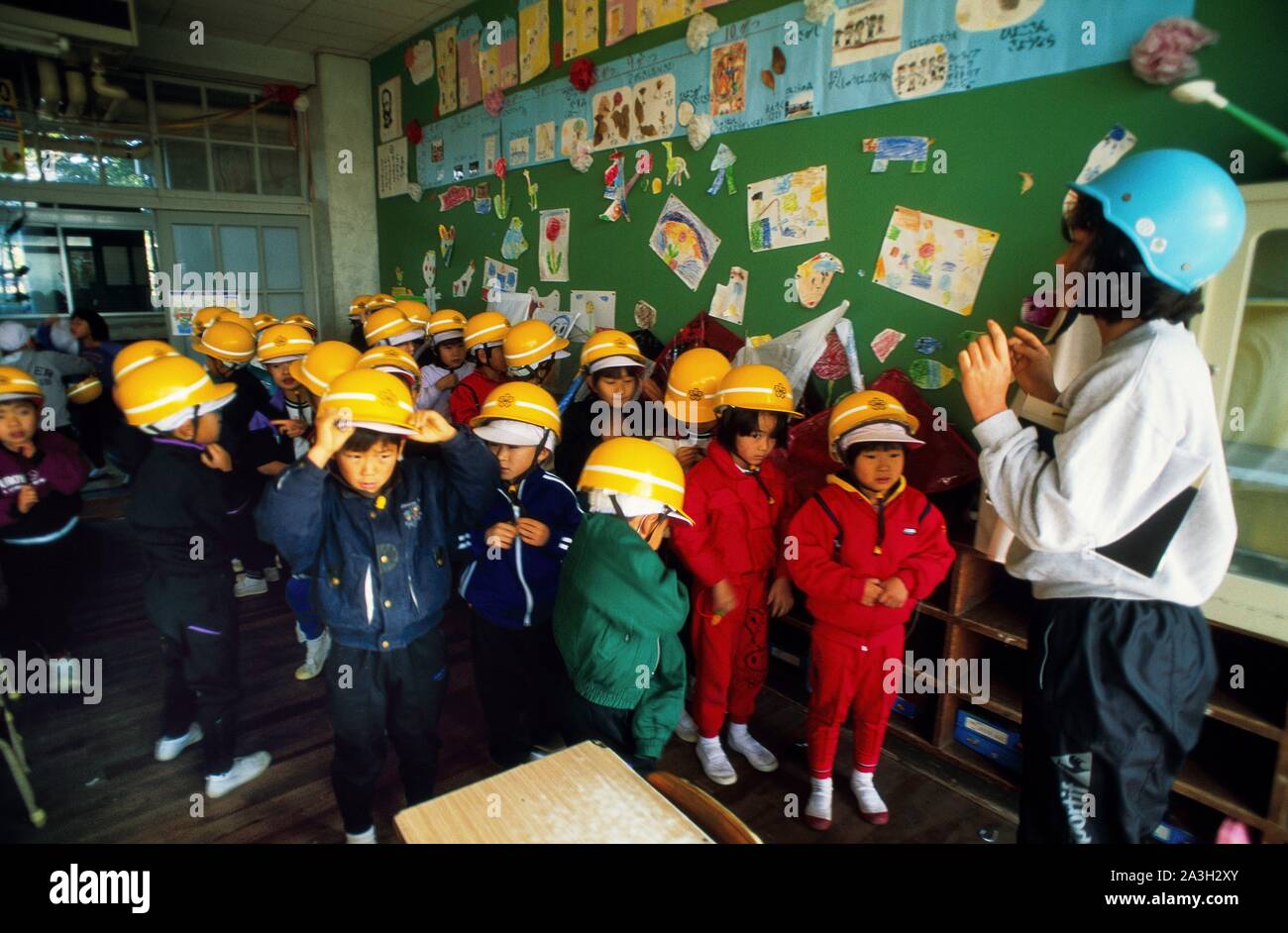
- Schoolchildren in Kagoshima wearing helmets to protect against stones thrown out by the nearby Sakurajima volcano (which is in background)Script error: No such module "Unsubst".
- Schoolchildren and their teacher wearing helmets
- Google Earth air view
- Google Earth ground view approaching Sakurajima from the mainland
- Smithsonian Institution's Global Volcanism Program (GVP) (entry for Aira /Sakurajima)
- Pages with script errors
- Pages with broken file links
- Pages with reference errors
- Landforms of Kagoshima Prefecture
- Volcanoes of Kyushu
- Stratovolcanoes of Japan
- Subduction volcanoes
- Decade Volcanoes
- Active volcanoes
- VEI-6 volcanoes
- 20th-century volcanic events
- Former islands
- Volcanic eruptions in 2022
- Volcanic eruptions in 2023