Sabbarin
Script error: No such module "Settlement short description".Script error: No such module "Infobox".Script error: No such module "Check for unknown parameters".Script error: No such module "Check for conflicting parameters".Expression error: Unexpected < operator Subbarin was a Palestinian Arab village located 28 kilometers south of Haifa. It was depopulated and destroyed during the 1948 Palestine war as part of the 1948 Palestinian expulsion and the Nakba.
History
Late Ottoman period
In 1859 Subbarin had about 600 inhabitants, who cultivated 55 faddans (1 faddan =100-250 dunums) of land.[1]
The French explorer Victor Guérin visited the village in 1870, and noted that the villagers cultivated sesame. A well, called Bir Sabbarin, appeared well built. The village had an estimated 1000 inhabitants, with homes constructed of stones or adobe.[2]
In the 1882, the PEF's Survey of Western Palestine described Sabbarin as a "large" village, situated on a slope. The well was said to be the head of the Caesarea aqueduct.[3] The oval well was 15 feet diameter and 15 feet deep.[4]
A population list from about 1887 showed that Subbarin had about 1,160 inhabitants; all Muslims.[5]
British Mandate period
In the 1922 census of Palestine, conducted by the British Mandate authorities, Sabbarin had a population of 845; 833 Muslims and 12 Christian,[6] where the Christians were all Roman Catholics.[7] The population had increased in the 1931 census to 1,108; 18 Christians and the rest Muslim, in a total of 256 houses.[8]
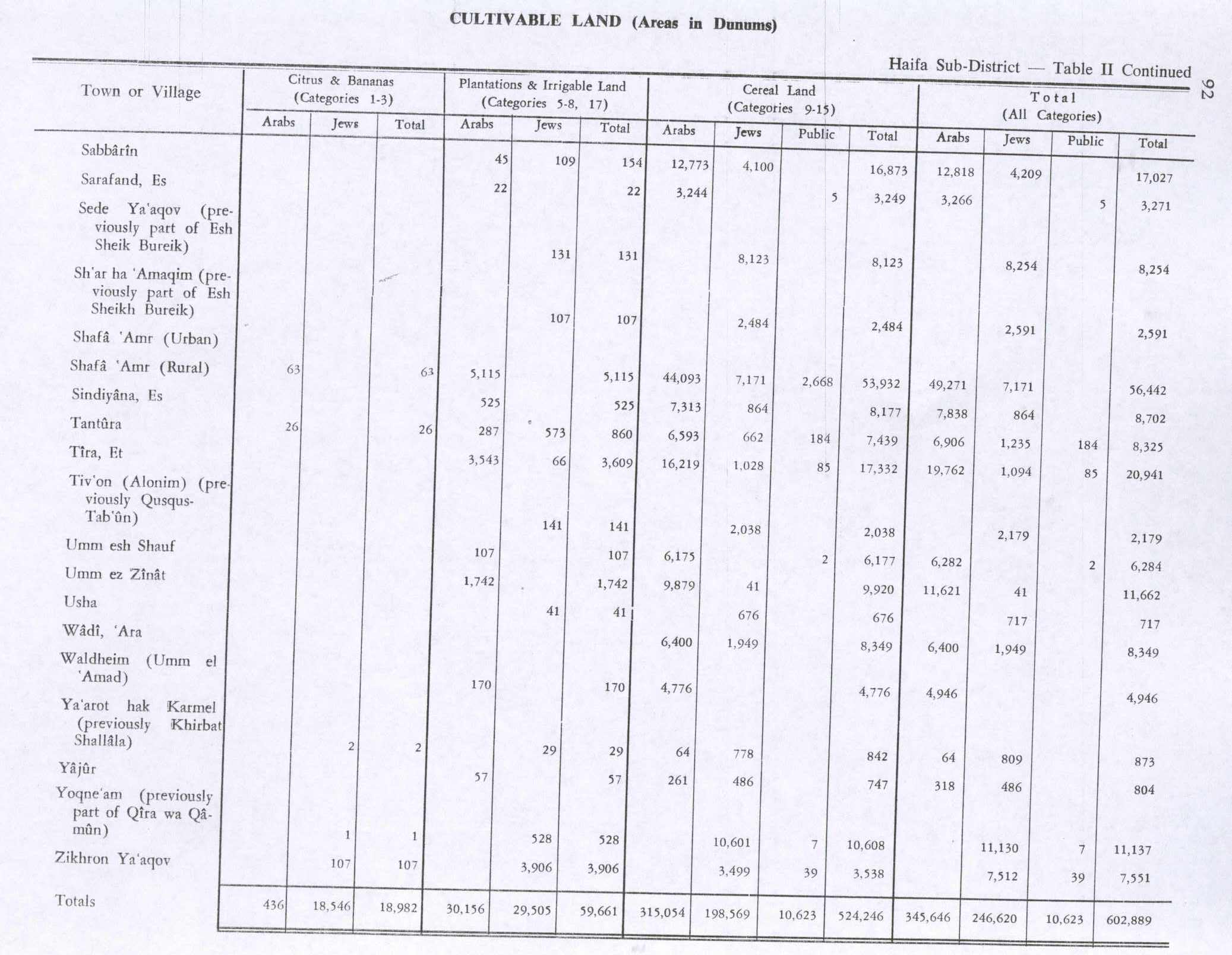
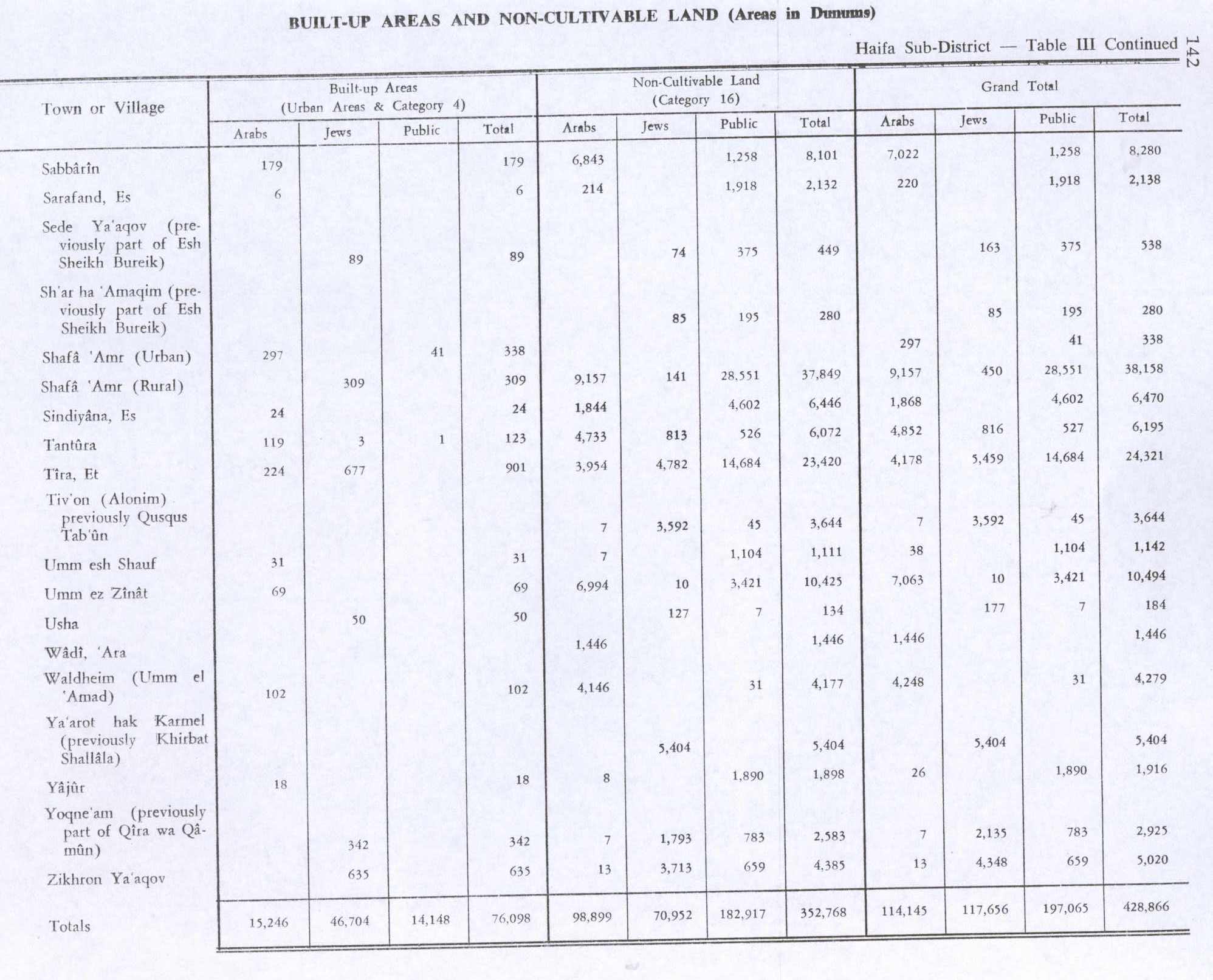
In the 1945 statistics, the village had a population of 1,700; 1,670 Muslims and 30 Christians[9] and the village's lands spanned 25,307 dunams.[10] 12,773 dunums of land used for cereals; 45 dunums were irrigated or used for orchards,[11][12] while 179 dunams were built-up (urban) land.[13]
1948 war and destruction
Script error: No such module "labelled list hatnote".
Script error: No such module "Sidebar".
Sabbarin was captured by Israeli forces on May 12, 1948, during the 1947–1948 civil war in Mandatory Palestine in Operation Coastal Clearing. It was defended by a local militia and possibly the Arab Liberation Army. According to Benny Morris, the Irgun (IZL) encountered resistance there and the majority of the villagers fled after 20 of them were killed in a firefight, with an IZL armoured car firing on the villagers as they fled. More than one hundred people who had not fled, including the elderly, women, and children, were held behind barbed wire for a few days before being expelled to nearby Umm al-Fahm.Template:Refn Others who had fled earlier ended up in refugee camps in the Jenin area.[14]
Historian Saleh Abdel Jawad writes that a massacre was committed by the Irgun in the village on 12-14 May.Template:Refn
Following the war the area was incorporated into the State of Israel. Kibbutz Ramot Menashe was established northeast of the site in 1948, and Moshav Amikam was founded in 1950, 1 km south of the village site.[11]
Khalidi described the remains of the village in 1992:
The large site, strewn with the stone debris of houses, is overgrown with wild thorns. The thorns are interspersed with cactuses and pine, fig, olive and mulberry trees. Some of the surrounding lands are used by Israelis as pasture and growing fruit trees.[11]
Sabbarin is among the Palestinian villages for which commemorative Marches of Return have taken place, such as those organized by the Association for the Defence of the Rights of the Internally Displaced.[15]
Families from Sabbarin
From Palestineremembered.com.[14]
- Hamidi (Arabic: حميدي)
- Al-Abhari (Arabic: العبهري )
- Al-Abdallah (Arabic: ال عبدالله )
- Al-Hajj Mahmud (Arabic: الحج محمود )
- Al-De'emeh (Arabic: الدعمة )
- Abu Libdi (Arabic: ابو لبده )
- Ghnima (Arabic: غنيمه )
- Hatab (Arabic: حطاب )
- Al-Samada'a (Arabic: الصمادعة )
- Abu Diab (Arabic: ابو ذياب)
- Al Mallah (Arabic: الملاح)
- Al-Hmedih
- Al-Masri (Arabic: المصري)
- Abu Kabir
- Abu Sammen (Arabic: أبو سمن )
- Faraj (Arabic: فرج )
-
Villager of Sabbarin in 1940
-
Villager of Sabbarin in 1940
-
Villager of Sabbarin in 1940


References
<templatestyles src="Reflist/styles.css" />
- ↑ Conder and Kitchener, 1882, SWP II, p. 43
- ↑ Guérin, 1875, p. 304
- ↑ Conder and Kitchener, 1882, SWP II, p. 43. Quoted in Khalidi, 1992, p. 187
- ↑ Conder and Kitchener, 1882, SWP II, p. 68
- ↑ Schumacher, 1888, p. 178
- ↑ Barron, 1923, Table XI, Sub-district of Haifa, p. 34
- ↑ Barron, 1923, Table XVI, p. 49
- ↑ Mills, 1932, p. 95
- ↑ Cite error: Script error: No such module "Namespace detect".Script error: No such module "Namespace detect".
- ↑ Cite error: Script error: No such module "Namespace detect".Script error: No such module "Namespace detect".
- ↑ a b c Khalidi, 1992, p.187
- ↑ Government of Palestine, Department of Statistics. Village Statistics, April, 1945. Quoted in Hadawi, 1970, p. 92
- ↑ Government of Palestine, Department of Statistics. Village Statistics, April, 1945. Quoted in Hadawi, 1970, p. 142
- ↑ a b Sabbarin, Palestineremembered.com
- ↑ Script error: No such module "citation/CS1".
Script error: No such module "Check for unknown parameters".
Bibliography
<templatestyles src="Refbegin/styles.css" />
- Script error: No such module "citation/CS1".
- Script error: No such module "citation/CS1".
- Script error: No such module "citation/CS1".
- Script error: No such module "citation/CS1".
- Script error: No such module "citation/CS1".
- Script error: No such module "citation/CS1".
- Script error: No such module "citation/CS1".
- Script error: No such module "citation/CS1".
- Script error: No such module "citation/CS1".
- Script error: No such module "Citation/CS1".
External links
- Welcome To Sabbarin
- Sabbarin, Zochrot
- Survey of Western Palestine, Map 8: IAA, Wikimedia commons
- Sabbarin, at Khalil Sakakini Cultural Center
- Mey Kedem, archaeological site in Moshav Amikam centered on a Roman water tunnel starting at Ein Tzabarin Springs

Template:Palestinian Arab villages depopulated during the 1948 Palestine War