Sabal minor
Template:Short description Template:Speciesbox
Sabal minor, commonly known as the dwarf palmetto,[1] is a small species of palm. It is native to the deep southeastern and south-central United States and northeastern Mexico. It is naturally found in a diversity of habitats, including maritime forests, swamps, floodplains, and occasionally on drier sites.[2] It is often found growing in calcareous marl soil.[3] Sabal minor is one of the most frost and cold tolerant among North American palms.
Distribution
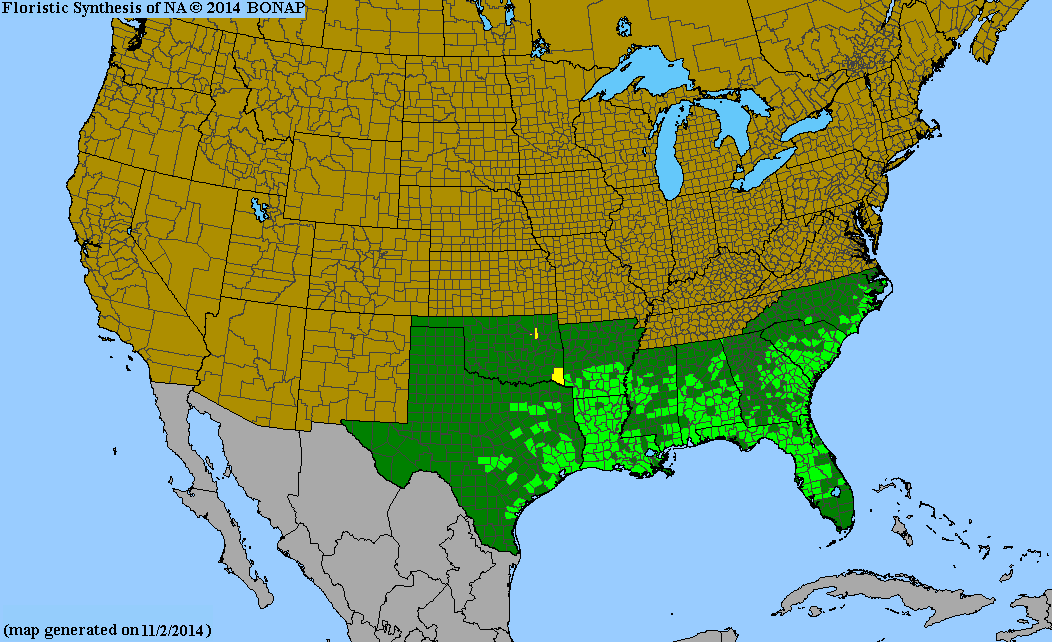
This palm's native range spans on the Atlantic Coast from central Florida north to Monkey Island, North Carolina.[3] On the Gulf Coast, it spans from central Florida to central Texas, Arkansas, north to southern Oklahoma and northern Alabama, then south in the State of Nuevo León in Mexico.[4]
Description
Sabal minor grows up to Script error: No such module "convert". in height, with a trunk up to Script error: No such module "convert". diameter. It is a fan palm (Arecaceae tribe Corypheae), with the leaves with a bare petiole terminating in a rounded fan of numerous leaflets. Each leaf is Script error: No such module "convert". long, with 40 leaflets up to Script error: No such module "convert". long, conjoined over half of this length. The flowers are yellowish-white, Script error: No such module "convert". across, produced in large compound panicles up to Script error: No such module "convert". long, extending out beyond the leaves. The fruit is a black drupe Script error: No such module "convert". long containing a single seed.[2]
While usually being small and shrubby, Sabal minor can become tree-like as it ages.[5]
Cultivation
Sabal minor is one of the most cold hardy palms in cultivation; however, it does best when grown in continental climates with hot and humid tropical summer conditions, and may struggle or grow slowly in cool summer oceanic climates. It is hardy to around Script error: No such module "convert".,[6] with selected cultivars hardy to Script error: No such module "convert". when established.[7] It is generally cultivated in subtropical and warm temperate climates. S.Script error: No such module "String".minor can grow in a wide variety of soil types, and is often found submerged in swamps in the southeastern United States. It grows in both full sun and shaded locations, though it will do best in the cooler garden zones (below USDA Zone 7) in full sun and a wind-sheltered location.
In the United States, since the 1960s, cultivation of Sabal minor has spread beyond the deep southern United States. S.Script error: No such module "String".minor is cultivated along the East Coast from Florida to Connecticut, and on the West Coast from Vancouver BC south to San Diego. It is a recommended horticultural plant by the Virginia Cooperative Extension.[8] There are several cultivars, including those from the Outer Banks of North Carolina (northernmost strains), and those from Oklahoma and Texas. One popular strain is 'McCurtain', named after McCurtain County, Oklahoma, where they are native. These tend to remain trunkless and smaller than those from warmer areas. S.Script error: No such module "String".minor is a popular landscape palm in coastal resort areas from Virginia Beach, Virginia, to southern Texas.
Gallery
-
Sabal minor at Reed Bingham State Park, Georgia.
-
Dwarf palmettos (Sabal minor) at Palmetto State Park, Texas
-
Sabal minor growing under an oak canopy, Big Thicket National Preserve, Hardin County, Texas
-
A dwarf palmetto frond in Congaree National Park, South Carolina
-
Sabal minor in saltwater marsh habitat, Hatteras North Carolina.
-
Sabal minor often start showing a trunk once they get very old. This example is around 100 years old in Frisco, North Carolina.
-
Sabal minor (front) and Rhapidophyllum hystrix (needle palm; behind fence), are some of the world's most freeze-hardy palm species. Roslyn Harbor, New York.
-
Young Sabal minor seedling
-
A naturalistic planting of Sabal minor outside the National Air and Space Museum in Washington, D.C.A naturalistic planting of Sabal minor outside the National Air and Space Museum in Washington, D.C.
-
Sabal minor fruit (herbarium specimen, MHNT)


.jpg)


References
<templatestyles src="Reflist/styles.css" />
- ↑ Script error: No such module "template wrapper".
- ↑ a b Sabal minor in Flora of North America
- ↑ a b Script error: No such module "citation/CS1".
- ↑ Kew World Checklist of Selected Plant Families
- ↑ Script error: No such module "citation/CS1".
- ↑ Script error: No such module "citation/CS1".
- ↑ Script error: No such module "citation/CS1".
- ↑ Care Sheet for Sabal minor or "Dwarf Palmetto" in Virginia Landscapes Fact and Care Sheet for Virginia Gardens
Script error: No such module "Check for unknown parameters".
External links
Script error: No such module "Side box".