Royal Standard of Spain
Template:Short description Script error: No such module "For". Script error: No such module "Unsubst".

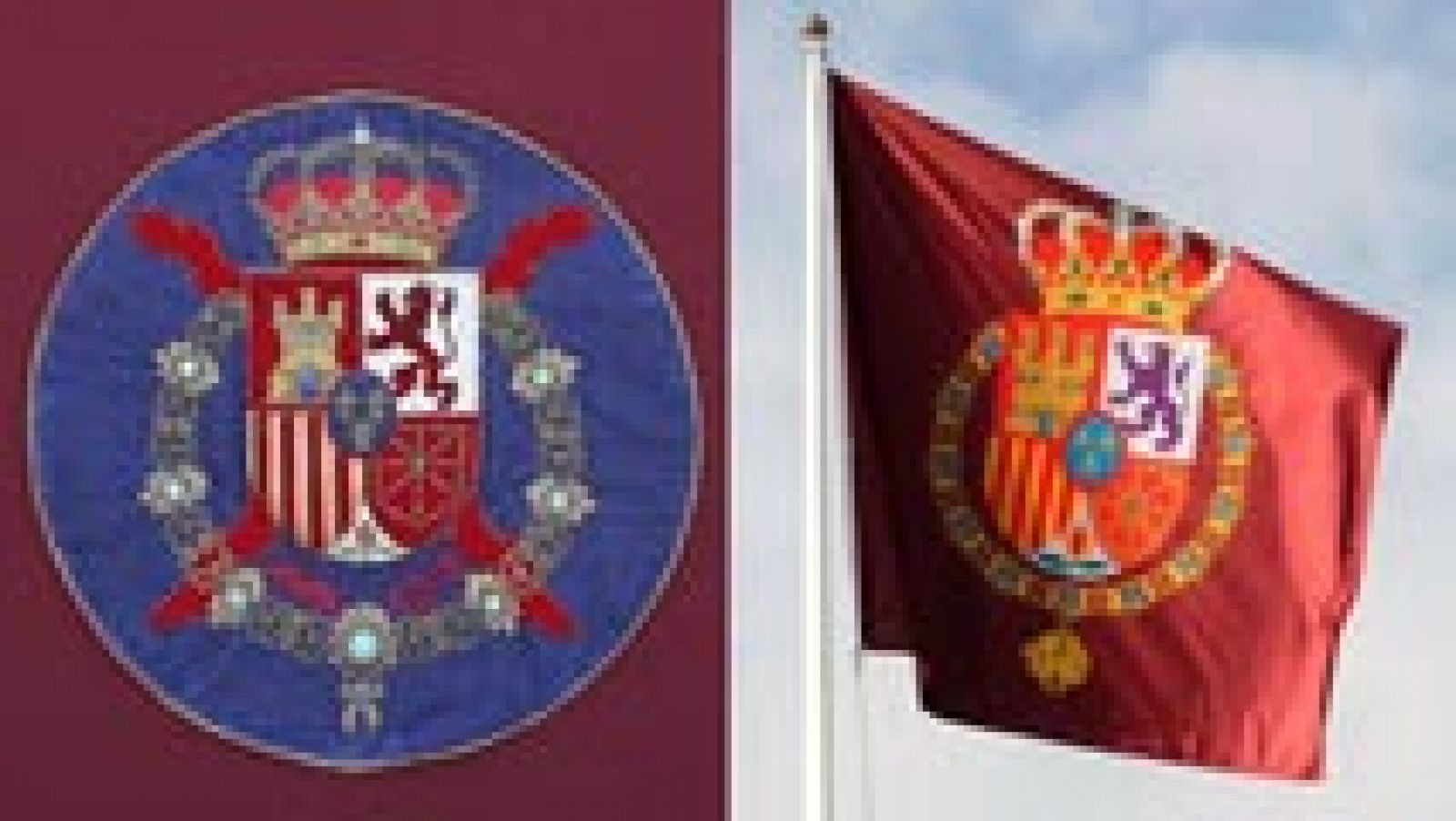
The Royal Standard (Spain) (Estandarte Real or Estandarte del Rey) is the official flag of the King of Spain. It comprises a crimson square, traditional colour of both Castilian and Spanish monarchs, with the coat of arms of the King in the center. It is raised over the official royal residence in Madrid, the Palacio de la Zarzuela and other Spanish royal sites, when the monarch is in residence and displayed on his official car as small flag. The current flag was adopted when Felipe VI acceded the throne as King of Spain on 19 June 2014. The Royal Standard is regulated by Rule 2 of Royal Decree 527/2014, 20 June, an amendment to Title II of Spanish Royal Decree 1511/1977 adopting Flags, Standards, Guidons, Insignia and Emblems Regulation.[1]
The Royal Guidon

The Royal Guidon (Guión), the military personal ensign, was also adopted on 19 June 2014. It is described by Rule 1 of Royal Decree 527/2014, an amendment to Title II, Rule 1 of Spanish Royal Decree 1511/1977.[1]

It is similar to the Royal Standard except the Royal Guidon has a gold surround. It is made of silk's taffeta and measures 80 x 80 cm in size. It is the personal command sign or positional flag of the monarch and traditionally was carried with him. The proportions of the coat of arms are smaller than on the standard.[2]
Historical standards, guidons and banners of arms of Spanish monarchs
The heraldic standard, also known as the pendón real, has been, as in other European monarchies, the personal flag of the Spanish monarchs and has been used in events of greater solemnity. It was formed by the elements of the monarch's shield without the exterior adornments and has not recovered since its disappearance in 1931.
The royal standard is the personal banner of the monarch. The guidon, of military use, was formed from the reign of Philip II by the same elements of the standard but incorporating the Cross of Burgundy, a fringe and a cordoncillo. During the period of the House of Austria, the Cross of Burgundy did not appear frequently in the royal standard. The Catholic Monarchs and Charles I (as monarchs of Castile) used the guidon of the Castilian monarchs, the Banda de Castilla which was a square flag of crimson color in which there was a band between two dragons. The Catholic Monarchs included in the Band of Castile the yoke and arrows which were replaced with the Columns of Hercules during the reign of Charles I. Fernando the Catholic also used the guidon that corresponded to him as monarch of Aragon. The Catholic Monarchs also frequently used, since 1492, a banner that consisted of a white cloth with their coat of arms.
Evolution
- The Banner is the ceremonial ensign of the monarch and the royal standard or royal flag is his ensign for public use.
- From Philip II's reign the Royal Guidon was the same as the royal standard or royal flag with a cross of Burgundy and gold surround.
| The Banners of Arms | ||
| Banner of Arms | Dates | Details |
|---|---|---|
| 1475–1506 | The banner of arms of the Catholic Monarchs, Isabella I of Castile and Ferdinand II of Aragon, whose marriage unified Spain, were on a crimson background:[3]
Quarterly, 1 and 4. quarterly Castile-León, 2 and 3. per pale Aragon and Aragon-Sicily. After the 1492 Conquest of Granada, the kingdom was represented in the Royal Arms by the addition enté en point of Granada's arms. The heraldic banner has long been used by the Catholic Monarchs as their military ensign. | |
| Script error: No such module "Check for unknown parameters". | 1518–1556 | In 1504, Archduke Philip the Handsome (King of Castile and Leon by marriage with Joanna) immediately staked his claim to her inheritance by quartering his own arms with those of the Catholic Monarchs, the Spanish quarters were given precedence over his. Hence the arrangement became, quarterly: 1. and 4. grand quarters, quarterly: A. and D. quarterly Castile-León, B. and C. per pale Aragon-Sicily, the grand quarter enté en point for Granada; 2. and 3. grand quarters, quarterly Austria, Burgundy ancient, Burgundy modern, Brabant, with an escutcheon per pale Flanders and Tyrol. In 1518 their son Charles I of Spain (Charles V as Holy Roman Emperor) adopted a banner of arms that comprised these arms on a crimson background. The arms were crowned with the old royal crown (an open crown). After his election as Holy Roman Emperor in 1519 Charles used more often the imperial banner: A shield with his own arms surmounting a black double-headed eagle on a golden background.[4] |
| Script error: No such module "Check for unknown parameters". | 1580–1668 | During the reign of King Phillip II the arms of the Spanish Monarchy become fixed for the remainder of the House of Austria. Originally Philip II used the simplified arms as devised for his father, namely per fess with the Spanish quarters in chief and the Austrian quarters in base.
After the dynastic union with Portugal in 1580, the arms of the Monarchy became per fess, in chief per pale, A. quarterly Castile and Leon, B. per pale Aragon and Aragon-Sicily, the whole enté en point Granada and with an escutcheon of Portugal on the honor point; in base quarterly Austria, Burgundy ancient, Burgundy modern and Brabant, with an escutcheon (in the nombril point) per pale Flanders and Tyrol. |
| Script error: No such module "Check for unknown parameters". | 1668–1700 | Even though Portugal and its possessions were lost in 1640, the Spanish kings retained the use of the Portuguese arms as arms of pretence until 1668. |
| Script error: No such module "Check for unknown parameters". | 1700–1761 | The arms of Bourbon-Anjou were added in 1700 when Phillip V became king of Spain. He introduced changes in the royal arms of Spain. The king's new arms were designed by the French heraldist Clairambault in November 1700, and were as follows:
Per fess: 1. per pale, quarterly Castile and Aragon, enté en point Granada, and per pale, Aragon and Aragon-Sicily; 2. Quarterly, Austria, Burgundy ancient, Burgundy modern and Brabant; enté en point, per pale Flanders and Tyrol. Overall an escutcheon Anjou. |
| Script error: No such module "Check for unknown parameters". | 1761–1868 1875–1931 |
In 1761 Charles III modified the arms as follows:
Quarterly of six (in three rows of two each): 1. per pale Aragon and Aragon-Sicily; 2. per pale Austria and Burgundy modern; 3. Farnese 4. Medici; 5. Burgundy ancient; 6. Brabant; enté en point per pale Flanders and Tyrol. Overall an escutcheon quarterly of Castile and León enté en point of Granada, overall Anjou. The royal arms were removed by the revolution of 1868. When the Bourbons were restored with Alfonso XII, a decree (8 January 1875) recovered the coat of arms (and the banner of arms) as it stood until 29 September 1868 as personal arms. In 1930 Alfonso XIII, substituted the Aragon quarter with Jerusalem. The Spanish Monarch hasn't used a Banner of Arms since 14 April 1931, when the Second Spanish Republic was proclaimed.[5] |


.svg)
.svg)
.svg)
| Royal Standard or Royal Flag | ||
| Standard | Dates | Details |
|---|---|---|
| File:Estandarte real de 1475-1492.svg | 1475–1492 Script error: No such module "Check for unknown parameters". |
The common royal banner of the Catholic Monarchs, used until 1492, was an oblong white flag with the arms of Isabella I of Castile and Ferdinand II of Aragon in the center with an open royal crown and without supporters. |
| File:Royal Standard of the Catholic Monarchs (1475-1492).svg | 1475–1492 Script error: No such module "Check for unknown parameters". |
The Royal Standard or Royal Flag of the Catholic Monarchs was a white flag with the arms of Isabella I of Castile and Ferdinand II of Aragon in the center with an open royal crown. The Catholic Monarchs's arms were borne by the eagle of Saint John, sable. The Bundle of arrows of Ferdinand II of Aragon and the Yoke of Isabella of Castile where shown as external ornaments. |
| File:Royal Standard of the Catholic Monarchs (1492-1506).svg | 1492–1506 Script error: No such module "Check for unknown parameters". |
From 1492 the conquest of Granada was symbolized by the addition enté en point, a Pomegranate, of a quarter for Granada. |
| File:Estandarte real de 1556-1580 y 1668-1700.svg | 1556–1580 Script error: No such module "Check for unknown parameters".1668–1700 |
The Spanish Monarchs of the House of Habsburg used a crimson flag with the royal arms, crowned with a royal crown with three visible arches and the Order of the Golden Fleece. |
| File:Estandarte real de 1580-1668.svg | 1580–1668 Script error: No such module "Check for unknown parameters". |
After the dynastic union with Portugal in 1580 an escutcheon of Portugal was added on the honor point in the royal arms. |
| File:Estandarte real de 1700-1761.svg | 1700–1761 Script error: No such module "Check for unknown parameters". |
Philip V introduced in the Royal Standard the changes of the royal arms of Spain with a royal crown with five visible arches. |
| File:Estandarte real de 1761-1833.svg | 1761–1834 Script error: No such module "Check for unknown parameters". |
In 1761 Charles III modified the royal arms, added the Farnese and Medici arms. |
| File:Estandarte real de 1833-1868 y 1875-1931.svg | 1838–1868 Script error: No such module "Check for unknown parameters".1875–1931 |
In 1838 the colour of the Royal Standard was modified (crimson to Purpure). |
| File:Estandarte Real de Juan Carlos I.svg | Script error: No such module "Check for unknown parameters". | Juan Carlos I used a dark blue background instead of the traditional crimson. The proportions of the coat of arms were reduced. Joined to the shield was the red saltire of Burgundy and, to the dexter and sinister of the base point, the yoke gules in its natural position with ribbons, of the field, and the sheaf of five arrows gules with the arrowheads inverted and ribbons, of the field, which used to be the symbol of the Catholic Monarchs.[6] |

.svg)
.svg)


The Standard and the Guidon of the Princess or Prince of Asturias

the Princess of Asturias
The Standard of the Princess of Asturias (Estandarte de la Princesa de Asturias) is regulated by Royal Decree 979/2015, an amendment to Title II of Spanish Royal Decree 1511/1977.[7]
The Princess's Standard comprises a light blue (the colour of the Flag of Asturias) square flag displaying the coat of arms of the Prince of Asturias in the center. The Guidon, her military ensign, has a gold surround.
Other Standards
| File:Personal Standard of Letizia, Queen of Spain.svg | Personal Standard of Letizia, Queen of Spain Script error: No such module "Check for unknown parameters".
(Not officialized) |
| File:Personal Standard of Sofia, Queen of Spain (Golden Fleece).svg | Personal Standard of Sofia, Queen of Spain Script error: No such module "Check for unknown parameters".
(Not officialized) |
| File:Personal Standard of Infanta Elena of Spain, Duchess of Lugo.svg | Personal Standard of Infanta Elena, Duchess of Lugo Script error: No such module "Check for unknown parameters".
(Not officialized) |
| File:Personal Standard of Infanta Cristina of Spain.svg | Personal Standard of Infanta Cristina Script error: No such module "Check for unknown parameters".
(Not officialized) |
| File:Personal Standard of Infanta Margarita of Spain, Duchess of Soria and Hernani.svg | Personal Standard of Infanta Margarita, Duchess of Soria and Hernani Script error: No such module "Check for unknown parameters".
(Not officialized) |

.svg)


Spanish Royal Banners in Windsor
Script error: No such module "Multiple image". A banner of arms is a square or oblong heraldic flag that is larger than a pennon. It bears the entire coat of arms of the owner, composed precisely as upon a shield but in a square or rectangular shape. Banners of knights of the Order of the Garter are displayed during their lifetime at St George's Chapel in Windsor.[8] From Victorian times, Garter banners have been approximately 5 feet by 5 feet[9] and have a fringe. Reigning European monarchs are admitted to the Order as "Strangers". Juan Carlos I and his successor Felipe VI are concurrently Stranger Knights of the Garter. The Spanish monarch's banner (like the arms) is divided into four quarters: the 1st for Castile, 2nd for León, 3rd for Aragon and 4th for Navarre; enté en point, with a pomegranate for Granada and an inescutcheon with the arms of the regnant House of Bourbon-Anjou. The fringe is golden, as for other foreign monarchs and British Royal Family members.[10]
The castle of Castile, with three windows and narrow, and the Navarrese chains are carefully detailed in both banners, according to the designs displayed in the amendment to Title II of Royal Decree 527/2014 (for King Felipe VI) and the original contents of Title II of Spanish Royal Decree 1511/1977 (for King Juan Carlos).[11][12]
The tinctures of the pomegranate are changed in the banner of King Juan Carlos, Gules seeded Or, and it is carefully designed and coloured in his successor's one, proper (light) seeded Gules. The colour of the lion is so darkly in the case of King Juan Carlos[13] and precise in Felipe VI's heraldic flag.[14] Other Spanish members of the Garter were Alfonso V of Aragon (1450-†1458), Ferdinand the Catholic, Charles I (1508-†1558), Philip II (1554-†1598), Ferdinand VII (1814–†1833), Alfonso XII (1881–†1885) and Alfonso XIII (1902–†1941).[15]
Former Standards
Personal Standards of former members of the Royal House, and standards previously used by current members of the royal house.
Personal Standard of Infante Carlos, Duke of Calabria Script error: No such module "Check for unknown parameters".
| |
Personal Standard of Infanta Alicia,
Duchess Dowager of Calabria Script error: No such module "Check for unknown parameters".
| |
Personal Standard of Infanta Pilar, Duchess of Badajoz Script error: No such module "Check for unknown parameters".
| |
| Script error: No such module "Check for unknown parameters". | |
| File:Personal Standard of Sofia, Queen of Spain.svg | Script error: No such module "Check for unknown parameters". |


See also
- Coat of arms of the King of Spain
- Coat of arms of the Prince of Asturias
- Heraldic flag
- Spanish monarchy
References
Inline citations
<templatestyles src="Reflist/styles.css" />
- ↑ a b Script error: No such module "citation/CS1".
- ↑ Script error: No such module "citation/CS1".
- ↑ History of Spanish Flag, Spanish Army. Template:In lang Script error: No such module "webarchive".
- ↑ The Standard of Charles I of Spain, Cervantesvirtual.com (Cervantes Virtual Library) Template:In lang
- ↑ The Royal Banner 1761- 1868, 1874–1931 (Flags of the World)
- ↑ Script error: No such module "citation/CS1".
- ↑ Script error: No such module "citation/CS1".
- ↑ Garter Banner List (online) Script error: No such module "webarchive"., accessed 12 October 2015
- ↑ Script error: No such module "citation/CS1".
- ↑ St George’s Chapel Banners of Arms Hand-Painted by Flagmakers. Flagmakers. Acceded 4 June 2018.
- ↑ Standard, guidon and arms of King Juan Carlos. Flags of the World. Acceded 4 June 2018.
- ↑ Armorial achievements of King Juan Carlos I (design before 2014) and Felipe VI. RTVE. Acceded 4 June 2018.
- ↑ Garter banner of King Juan Carlos image. Acceded 4 June 2018.
- ↑ Royal Decree 1511/1977, adopting Flags, Standards, Guidons, Insignia and Emblems Regulation..Spanish Official Journal. Acceded 4 June 2018.
- ↑ Script error: No such module "citation/CS1".
- ↑ From Becoming Queen Consort in 1975 to being appointed to the Order of the Golden Fleece in 2025
Script error: No such module "Check for unknown parameters".
Sources referenced
- Royal Decree 1511/1977, including amendments. BOE.es Template:In lang
- The flag in the Spanish Armada. Armada Española Template:In lang
- The Royal Standard of Spain. Flags of the World
- The Standard of the Prince of Asturias. Flags of the World
External links
Script error: No such module "Navbox". Template:Flags, Banners and Standards of Heads of State and Government