Qabalan
Script error: No such module "Settlement short description".Script error: No such module "Infobox".Script error: No such module "Check for unknown parameters".Script error: No such module "Check for conflicting parameters".Expression error: Unexpected < operator
Qabalan (Template:Langx) is a Palestinian town in the Nablus Governorate in the eastern West Bank, located Script error: No such module "convert". southeast of Nablus. According to the Palestinian Central Bureau of Statistics (PCBS), the town had a population of 8,195 inhabitants in 2017.[1]
Location
Qabalan is located Script error: No such module "convert". south of Nablus. It is bordered by Aqraba and Jurish to the east, Talfit and As Sawiya to the south, As Sawiya and Yatma to the west, and Beita and Osarin to the north.[2]
Qabalan sits atop a slope that descends into a small, fertile valley.[3]
History
Potsherds from the Iron Age I and Iron Age II have been found here.[3]
The SWP noted that: "the ruin to the east [of the village] consists of heaps of stones".[4] Finkelstein noted that "most of the area of the present village is relatively modern".[3]
Ottoman era
In 1517, the village was included in the Ottoman empire with the rest of Palestine, and it appeared in the 1596 tax-records as Qabalan, located in the Nahiya of Jabal Qubal of the Liwa of Nablus. The population was 4 households, all Muslim. They paid a fixed tax rate of 33,3% on agricultural products, such as wheat, barley, olive trees, goats and beehives, in addition to occasional revenues and a fixed tax for people of Nablus area; a total of 2,410 akçe.[5] Sherds from the early Ottoman era have also been found here.[3]
In 1838 Edward Robinson noted Kubalan on the south side of the valley, "surrounded by vineyards and large groves of olive and fig trees."[6] It was located in El-Beitawy district, east of Nablus.[7]
In 1882, the PEF's Survey of Western Palestine (SWP) described Kubalan as: "a village of moderate size, on high ground, with olives round it, and wells."[8]
British Mandate era
In the 1922 census of Palestine, conducted by the British Mandate authorities, Qabalan had a population of 771 Muslims,[9] increasing in the 1931 census to 936 Muslims, in 207 houses.[10]
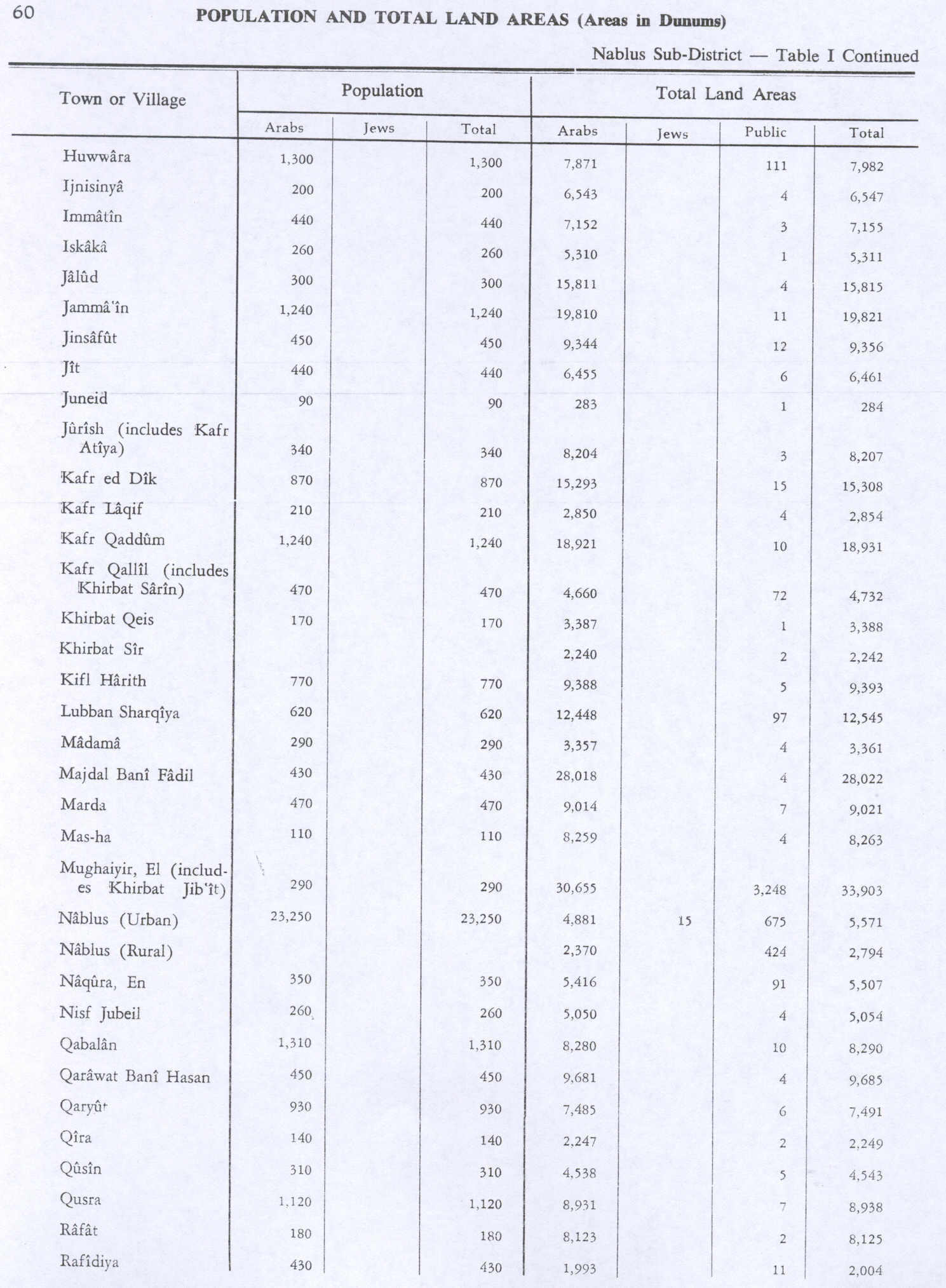
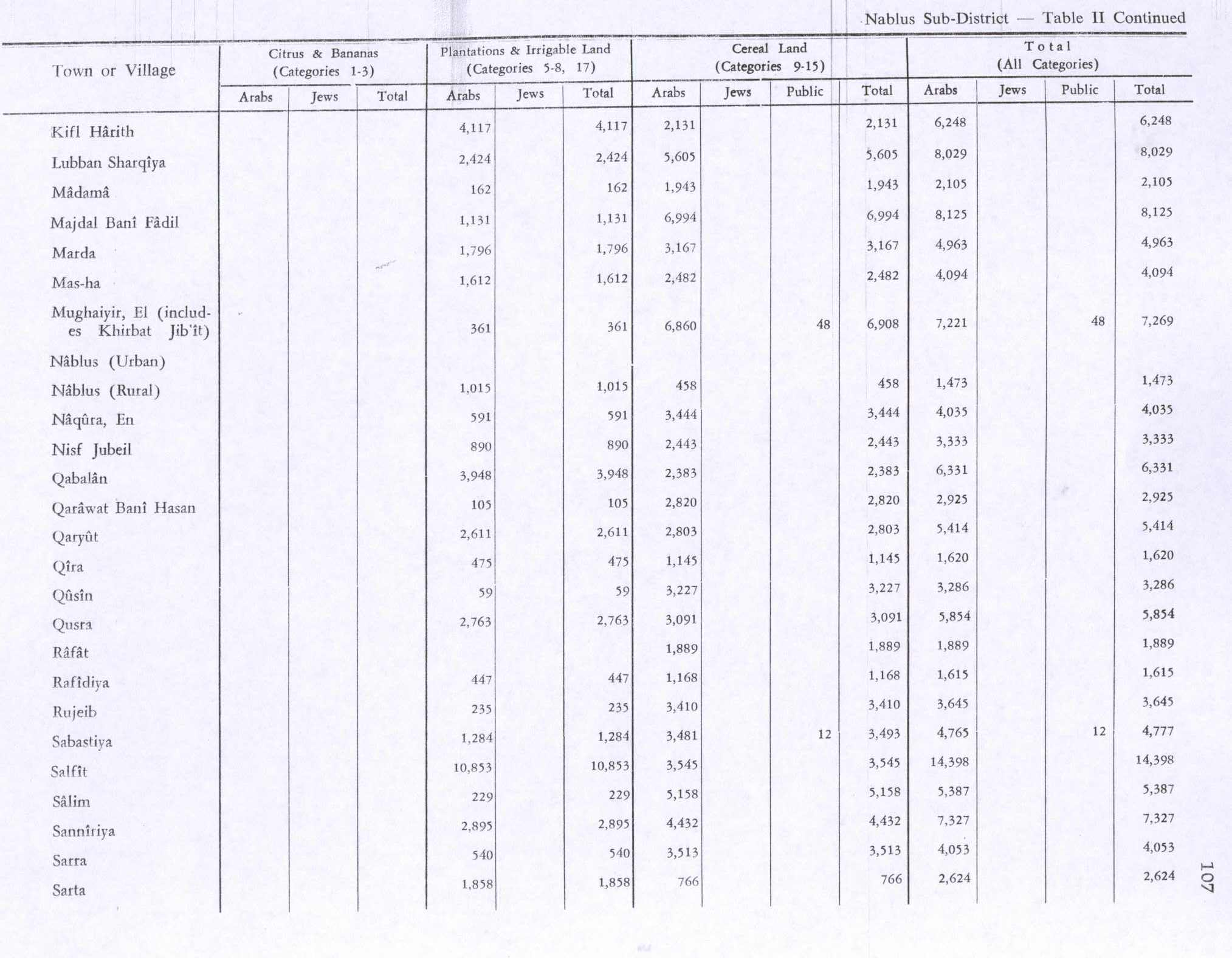
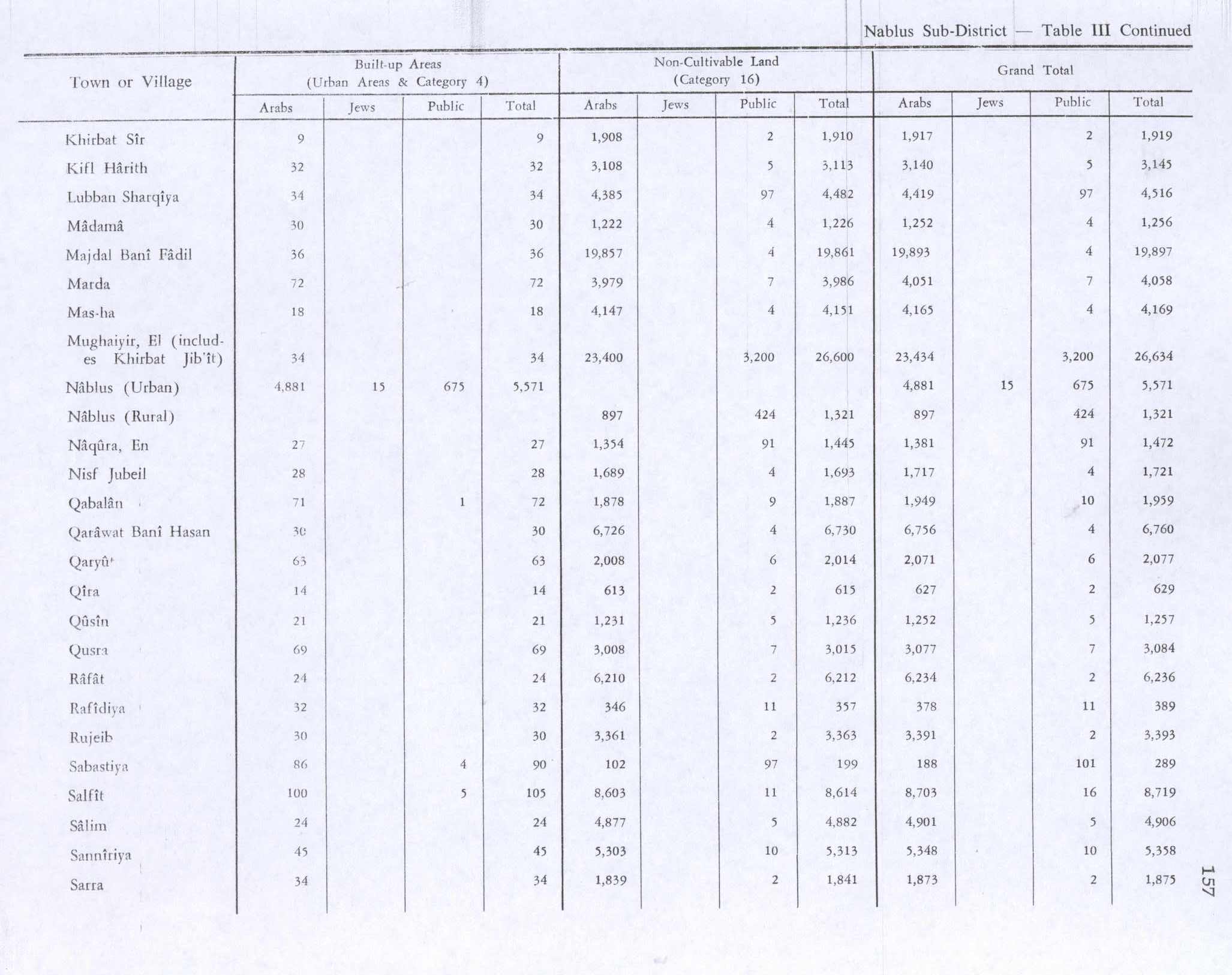
In the 1945 statistics Qabalan had a population of 1,310, all Muslims,[11] with 8,290 dunams of land, according to an official land and population survey.[12] Of this, 3,948 dunams were plantations and irrigable land, 2,383 were used for cereals,[13] while 72 dunams were built-up land.[14]
Jordanian era
In the wake of the 1948 Arab–Israeli War, and after the 1949 Armistice Agreements, Qabalan came under Jordanian rule.
The Jordanian census of 1961 found 1,867 inhabitants.[15]
1967, aftermath
Script error: No such module "Labelled list hatnote". Since the Six-Day War in 1967, Qabalan has been under Israeli occupation along with the rest of the Palestinian territories.
After the 1995 accords, 67% of the village land is in Area B, while the remaining 33% is in Area C. There have been a number of attacks on the people of Qabalan, their land and property from the nearby Israeli settlements.[16][17]
Demography
According to the geographer David Grossman, the inhabitants of Qabalan trace their origins to the town of Halhul near Hebron, the village of Kafr Atiyya near Nablus, and areas in present-day Syria.[18]
References
<templatestyles src="Reflist/styles.css" />
- ↑ Cite error: Script error: No such module "Namespace detect".Script error: No such module "Namespace detect".
- ↑ Qabalan town profile, ARIJ, p. 4
- ↑ a b c d Finkelstein et al, 1997, p. 656
- ↑ Conder and Kitchener, 1882, SWP II, p. 358
- ↑ Hütteroth and Abdulfattah, 1977, p. 131
- ↑ Robinson and Smith, vol 3, p. 92
- ↑ Robinson and Smith, 1841, vol 3, Appendix 2, p. 128
- ↑ Conder and Kitchener, 1882, SWP II, p. 288
- ↑ Barron, 1923, Table IX, Sub-district of Nablus, p. 25
- ↑ Mills, 1932, p. 63
- ↑ Government of Palestine, Department of Statistics, 1945, p. 19
- ↑ Government of Palestine, Department of Statistics. Village Statistics, April, 1945. Quoted in Hadawi, 1970, p. 60
- ↑ Government of Palestine, Department of Statistics. Village Statistics, April, 1945. Quoted in Hadawi, 1970, p. 107
- ↑ Government of Palestine, Department of Statistics. Village Statistics, April, 1945. Quoted in Hadawi, 1970, p. 157
- ↑ Government of Jordan, Department of Statistics, 1964, p. 26
- ↑ Qabalan town profile, ARIJ, p. 17
- ↑ Shin Bet: Israel's Extreme Rightists Organizing Into Terror Groups, Chaim Levinson and Oz Rosenberg, Sep. 13, 2011, Haaretz
- ↑ Grossman, D. (1986). "Oscillations in the Rural Settlement of Samaria and Judaea in the Ottoman Period". in Shomron studies. Dar, S., Safrai, S., (eds). Tel Aviv: Hakibbutz Hameuchad Publishing House. p. 356

Script error: No such module "Check for unknown parameters".
Bibliography
<templatestyles src="Refbegin/styles.css" />
- Script error: No such module "citation/CS1".
- Script error: No such module "citation/CS1".
- Script error: No such module "citation/CS1".
- Script error: No such module "citation/CS1".
- Script error: No such module "citation/CS1".
- Script error: No such module "citation/CS1".
- Script error: No such module "citation/CS1".
- Script error: No such module "citation/CS1".
- Script error: No such module "citation/CS1".
- Script error: No such module "citation/CS1".
External links
- http://qabalan.org
- Welcome to Qabalan
- Survey of Western Palestine, Map 14: IAA, Wikimedia commons
- Qabalan town profile, Applied Research Institute–Jerusalem (ARIJ)
- Qabalan, aerial photo, ARIJ
- Development Priorities and Needs in Qabalan, ARIJ


Script error: No such module "Navbox".
Script error: No such module "Authority control".