Pycnanthemum incanum
Template:Short description Template:Speciesbox
Pycnanthemum incanum, with the common name hoary mountainmint, "mountain mint", wild basil or hoary basil, is a herbaceous perennial in the mint family.[1][2]
Distribution
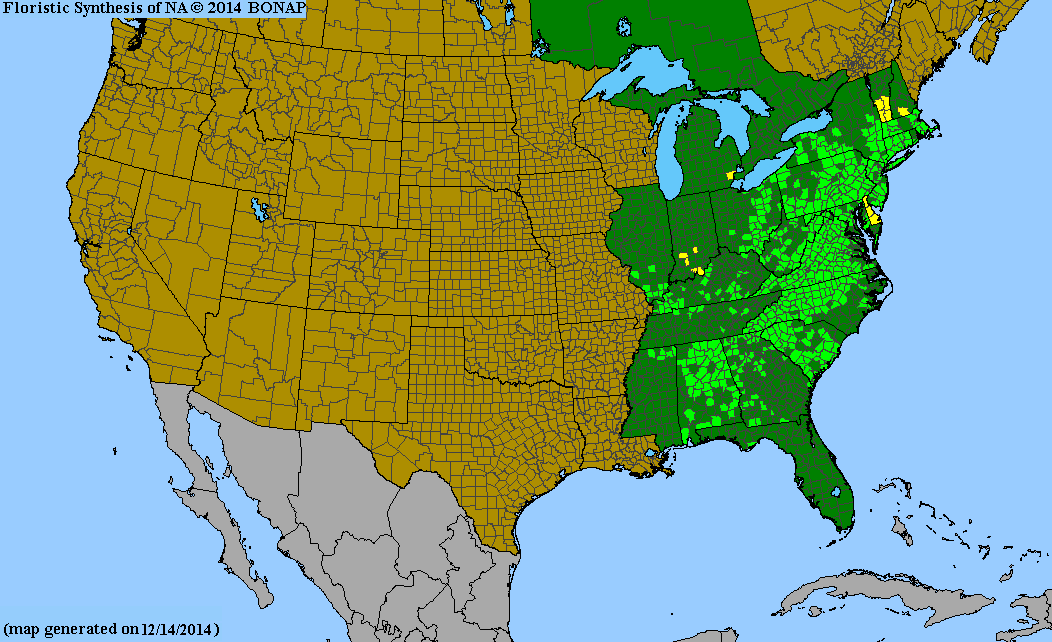
The plant is widespread across Eastern United States and into Ontario, Canada.[1][2][3][4] It prefers rocky, gravelly or sandy soil, and typically grows in woods, thickets, fields, and hills.Script error: No such module "Unsubst".
Conservation
It is listed as an endangered species in Vermont and New Hampshire, and in Ontario where there are only two remaining populations located within a single stretch of oak savanna near Burlington. There is currently a recovery strategy in place organized by the Ontario Ministry of Natural Resources to monitor these last populations.[5][6][7]
Description
Pycnanthemum incanum grows to Script error: No such module "convert". high by Script error: No such module "convert". wide. The stems are covered with a soft, whitish down. A vigorous and often aggressive grower, this plant spreads by long rhizomes.
White blooms appear from July to September. Pycnanthemum means "dense flower-clusters" in Greek, and the flowers are favored by butterflies, moths, honeybees, and some species of wasps.
Varieties
There are two varieties:[3]Script error: No such module "Unsubst".
- Pycnanthemum incanum var. incanum - Ontario, eastern US
- Pycnanthemum incanum var. puberulum (E.Grant & Epling) Fernald - West Virginia, Alabama, North + South Carolina
Uses
When crushed, the leaves emit a strong minty aroma, and are often used to flavor teas.Script error: No such module "Unsubst".
Medicinal use
Script error: No such module "Unsubst". This species contains tannin and is considered to be an astringent.
The Choctaw put the mashed leaves in warm water, which the patient drank, and which was poured over the head to relieve headaches. For patients who were sickly all the time, the leaves were mashed in water, the doctor took a mouthful of water, and blew it onto the patient, three times on the head, three times on the back, and three times on the chest. Before the next sunrise, the patient was bathed in the medicine.
The Koasati mashed the leaves in water, and used the water to treat laziness. The patient bathed his face in the cold water and drank it. For nosebleeds, the plant was wetted, and put up into the nostrils to stop the bleed. The roots were boiled along with Black Willow, and drunk to relieve headache.
It is considered to be a food source for large mammals, as well.
References
<templatestyles src="Reflist/styles.css" />
- ↑ a b Script error: No such module "template wrapper".
- ↑ a b Germplasm Resources Information Network− GRIN-Global Web v 1.9.6.2: taxonomy of Pycnanthemum incanum
- ↑ a b Kew World Checklist of Selected Plant Families
- ↑ Biota of North America Program 2013 county distribution map
- ↑ E-laws.gov.on.ca: Ontario Endangered Species Act of 1990
- ↑ Mnr.gov.on.ca: Pycnanthemum incanum
- ↑ Rom.on.ca/ontario: Pycnanthemum incanum
Script error: No such module "Check for unknown parameters".
Bibliography
- Native American Ethnobotany Database: Pycnanthemum incanum (Hoary Mountainmint)
- Endangered Species Act of 1990, Ontario, Canada
- Darlington, William "Flora Cestrica", published by Lindsay and Blakiston, 1853
- Wood, Alphonso "A Class-book of Botany", published by Manufactering Co., 1851
- Gray, Asa "Gray's School and Field Book of Botany, published by Ivison, Blakeman, Taylor, & Company, 1879
- Elliot, William "The Washington Guide", published by F. Taylor, 1837
- Taylor, Lyda Averill "Plants Used As Curatives by Certain Southeastern Tribes", published by Botanical Museum of Harvard University, Cambridge, MA, 1940
- Mnr.gov.on.ca: Ontario Endangered species - Pycnanthemum incanum
- Rom.on.ca/ontario/risk: Pycnanthemum incanum
External links
- Pages with script errors
- Pycnanthemum
- Flora of the Northeastern United States
- Flora of the Southeastern United States
- Flora of Ontario
- Flora of the Appalachian Mountains
- Flora of the Great Lakes region (North America)
- Medicinal plants of North America
- Plants used in traditional Native American medicine
- Plants described in 1753
- Taxa named by Carl Linnaeus
- Endangered flora of the United States
- Endangered flora of North America
- Flora without expected TNC conservation status