Pelecyphora missouriensis
Template:Short description Template:Speciesbox Pelecyphora missouriensis, the Missouri foxtail cactus and formerly Coryphantha missouriensis, is a species of low-growing North American cacti.
Description
Pelecyphora missouriensis grows up to Script error: No such module "convert". high and forms clumps to Script error: No such module "convert". or greater in diameter. They are generally larger in the Southwest. The plants are primarily unbranched, except eastern populations that can be profusely branched. The warts are elongated and up to 18 millimeters long. There are 10 to 20 spines that are bright white, pale gray, or pale tan, weathering to gray or yellowish brown.[1] The plant blooms in April to June, with flowers that are pale greenish yellow to yellow-green with midstripes of green or rose-pink to pale brown, flowers are 2.5 to 6.2 centimeters long and in diameter. The red fruits are 1 to 2 centimeters long.[1][2]
Pelecyphora missouriensis has been extirpated from many of its historically known sites by introduced fire ants, suburban development, brush encroachment following fire suppression, and over-grazing.[1]
-
Plant
-
Spines
-
Growing in habitat
.jpg)
.jpg)
.jpg)
Subspecies
There are two recognized subspecies.
| Image | Name | Distribution |
|---|---|---|
| File:Escobaria missouriensis var. asperispina.jpg | Pelecyphora missouriensis subsp. asperispina (Boed.) N.P.Taylor | Mexico (Coahuila de Zaragoza, Nuevo Leon) |
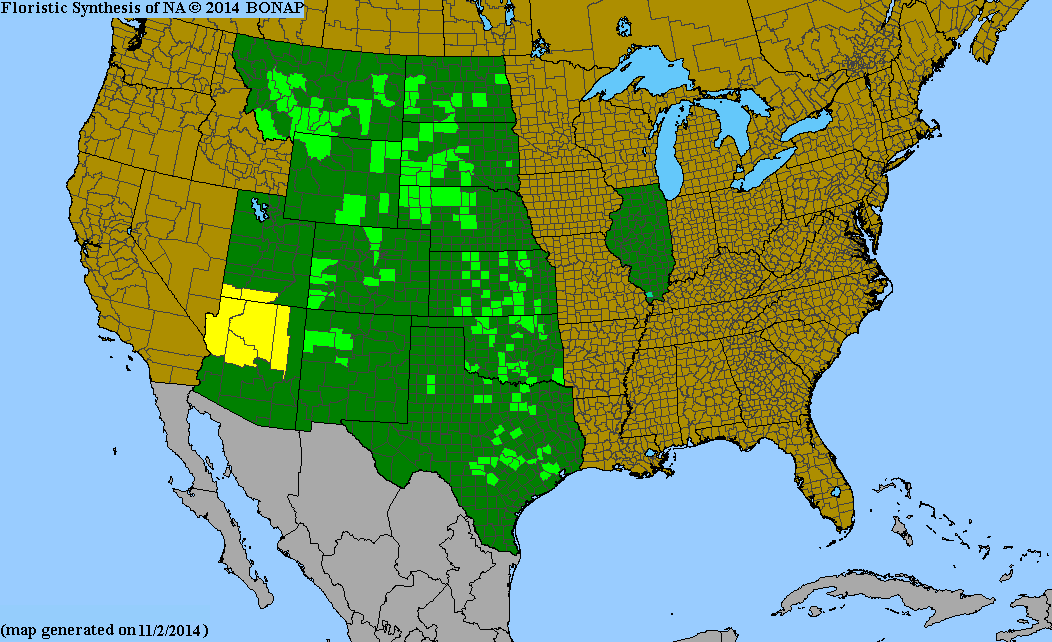
| File:Escobaria missouriensis subsp. missouriensis.jpg | Pelecyphora missouriensis subsp. missouriensis | United States (Arizona, Colorado, Illinois, Kansas, Missouri, Montana, Nebraska, New Mexico, North Dakota, Oklahoma, South Dakota, Texas, Utah, Wyoming ) |


Distribution
It is found in along the Missouri River in the tallgrass prairie and shortgrass Great Plains, from Texas to Montana and the Dakotas, and in the Rocky Mountains woodlands of Ponderosa pine (Pinus ponderosa), pinyon-juniper, and Gambel oak (Quercus gambelii) west of it. It is also native to the Southwestern United States in Idaho, Kansas,Arizona, New Mexico, and Utah and Mexico in the states of Coahuila and Nuevo León.[1][3][4]
Taxonomy
It was first described in 1818 by Thomas Nuttall as Cactus mammillaris.[5] The specific epithet missouriensis refers to the occurrence of the species near the Missouri River. However, this description was not valid (nom. illegal ICBN article 53.1), as the name was already given by Carl Linnaeus in 1753.[6] Robert Sweet named the species Mammillaria missouriensis in 1826. In 1978, the species was reclassified as Escobaria missouriensis by David Richard Hunt. David Aquino & Daniel Sánchez moved the species to Pelecyphora based on phylogenetic studies in 2022.[7] Further nomenclature synonyms are Cactus missouriensis (Sweet) Kuntze (1891), Mammillaria missouriensis Sweet ex K.Schum. (1898), Coryphantha missouriensis (Sweet) Britton & Rose (1913), Neobesseya missouriensis (Sweet) Britton & Rose (1923) and Neomammillaria missouriensis (Sweet) Britton & Rose ex Rydb. (1932).
References
<templatestyles src="Reflist/styles.css" />
- ↑ a b c d Flora of North America, Missouri foxtail cactus Coryphantha missouriensis . accessed 4.4.2011
- ↑ NPIN_Escobaria missouriensis . accessed 4.4.2011
- ↑ United States Department of Agriculture plants profile, Escobaria missouriensis . accessed 4.4.2011
- ↑ Biota of North America Program, 2014 county distribution map
- ↑ Script error: No such module "citation/CS1".
- ↑ Script error: No such module "citation/CS1".
- ↑ Script error: No such module "Citation/CS1".
Script error: No such module "Check for unknown parameters".
External links
- Template:Sister-inline
- Template:Sister-inline
- Flora of North America — Coryphantha missouriensis (Escobaria missouriensis)
- United States Department of Agriculture Plants Profile: Escobaria missouriensis
- Lady Bird Johnson Wildflower Center, University of Texas: Escobaria missouriensis (Missouri foxtail cactus)