PDP-5
Template:Short description Template:Infobox information appliance The PDP-5 was Digital Equipment Corporation's first 12-bit computer, introduced in 1963.[1]Template:Rp
History
An earlier 12-bit computer, named LINC has been described as the first minicomputer[2] and also "the first modern personal computer."[3] It had 2,048 12-bit words, and the first LINC was built in 1962.
DEC's founder, Ken Olsen, had worked with both it and a still earlier computer, the 18-bit 64,000-word TX-0, at MIT's Lincoln Laboratory.
Neither of these machines was mass-produced.
Applicability
Although the LINC computer was intended primarily for laboratory use, the PDP-5's 12-bit system had a far wider range of use. An example of DEC's "The success of the PDP-5 ... proved that a market for minicomputers did exist" is:
- "Data-processing computers have accomplished for mathematicians what the wheel did for transportation"[4]
- "Very reliable data was obtained with ..."[5]
- "A PDP-5 computer was used very successfully aboard Evergreen[NB 1] for ..."[6]
all of which described the same PDP-5 used by the United States Coast Guard.
The architecture of the PDP-5 was specified by Alan Kotok and Gordon Bell; the principal logic designer was the young engineer Edson de Castro[7][8] who went on later to found Data General.
Hardware
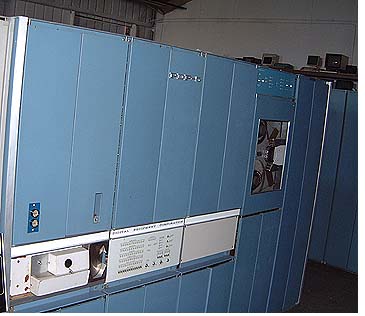
By contrast with the 4-cabinet PDP-1,[9] the minimum configuration of the PDP-5 was a single 19-inch cabinet with "150 printed circuit board modules holding over 900 transistors."[10] Additional cabinets were required to house many peripheral devices.
The minimum configuration weighed about Script error: No such module "convert"..[11]
The machine was offered with from 1,024 to 32,768 12-bit words of core memory. Addressing more than 4,096 words of memory required the addition of a Type 154 Memory Extension Control unit (in modern terms, a memory management unit); this allowed adding additional Type 155 4,096 word core memory modules.[12][13]
Instruction set
Of the 12 bits in each word, exactly 3 were used for instruction op-codes.[12][14]
The PDP-5's instruction set was later expanded in its successor, the PDP-8. The biggest change was that, in the PDP-5, the program counter was stored in memory location zero, while on PDP-8 computers, it was a register inside the CPU. Another significant change was that microcoded instructions on the PDP-5 could not combine incrementing and clearing the accumulator, while these could be combined on the PDP-8. This allowed loading of many small constants in a single instruction on the PDP-8. The PDP-5 was one of the first computer series with more than 1,000 built.[15][16]
Software
DEC provided an editor, an assembler, a FORTRAN II Compiler and DDT (a debugger).[12]
Marketplace
With a base price of $27,000 and designed for those not in need of the 18-bit PDP-4, yet having "applications needing solutions too complicated to be solved efficiently by modules systems" the PDP-5, when introduced in 1963, came at a time when the minicomputer market was gaining a foothold.[17][1]
Photos
- PDP-5 computer, including Teletype Model 33 ASR
- PDP-5 from Ed Thelen's collection
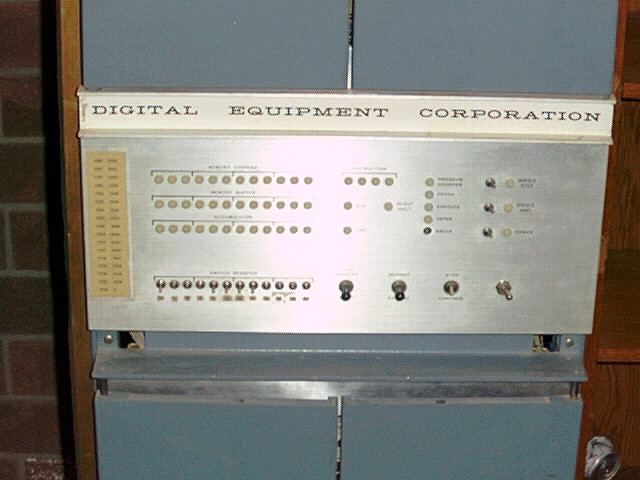
- Front panel of a PDP-5
Notes
<templatestyles src="Reflist/styles.css" />
- ↑ U. S. Coast Guard Oceanographic Vessel — Evergreen (WAGO-295)
Script error: No such module "Check for unknown parameters".
References
<templatestyles src="Reflist/styles.css" />
- ↑ a b Script error: No such module "citation/CS1".
- ↑ Script error: No such module "citation/CS1".
- ↑ Script error: No such module "citation/CS1".
- ↑ Script error: No such module "citation/CS1".
- ↑ Script error: No such module "citation/CS1".
- ↑ Script error: No such module "citation/CS1".
- ↑ Script error: No such module "citation/CS1".
- ↑ Script error: No such module "citation/CS1".
- ↑ Script error: No such module "citation/CS1".
- ↑ Script error: No such module "citation/CS1".
- ↑ Script error: No such module "citation/CS1".
- ↑ a b c Programmed Data Processor 5, Digital Equipment Corp., Mar. 1964; this is a promotional brochure.
- ↑ Script error: No such module "citation/CS1".
- ↑ Script error: No such module "citation/CS1".
- ↑ Script error: No such module "citation/CS1".
- ↑ Cite error: Script error: No such module "Namespace detect".Script error: No such module "Namespace detect".
- ↑ Script error: No such module "citation/CS1".
Script error: No such module "Check for unknown parameters".
Script error: No such module "Navbox".