Orionids
Template:Short description Template:Infobox meteor shower
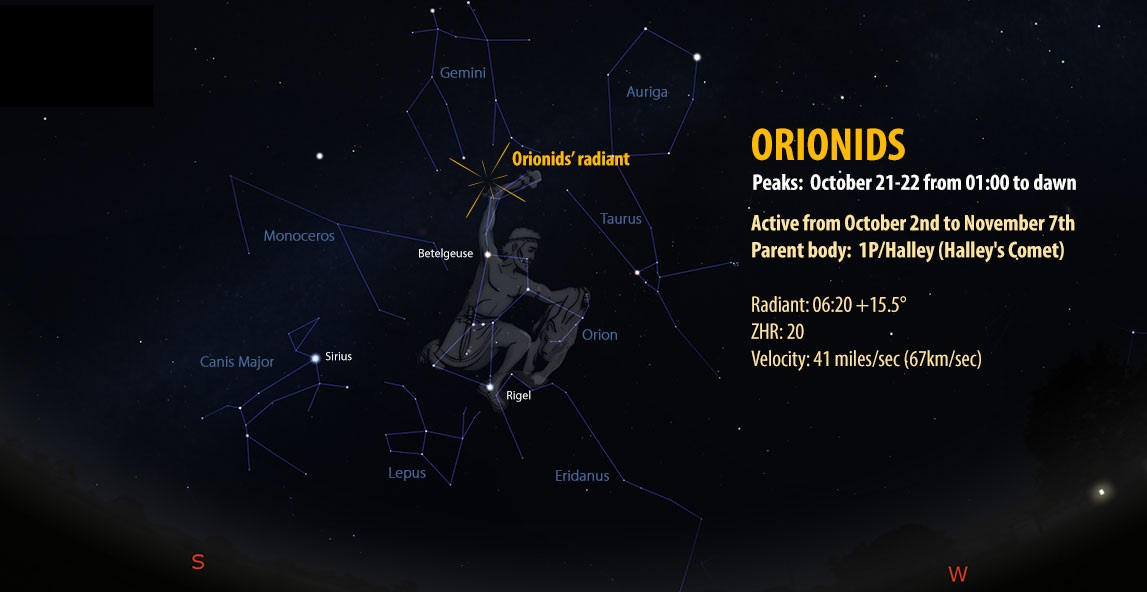
The Orionids meteor shower, often shortened to the Orionids, is one of two meteor showers associated with Halley's Comet. The Orionids are so-called because the point they appear to come from, called the radiant, lies in the constellation Orion, but they can be seen over a large area of the sky. The Orionids are an annual meteor shower which last approximately one week in late October. In some years, meteors may occur at rates of 50–70 per hour.[1][2]
Orionid outbursts occurred in 585, 930, 1436, 1439, 1465, and 1623.[3] The Orionids occur at the ascending node of Halley's comet. The ascending node reached its closest distance to Earth around 800 BCE. Currently Earth approaches Halley's orbit at a distance of Script error: No such module "convert". during the Orionids. The next outburst might be in 2070 as a result of particles trapped in a 2:13 MMR with Jupiter.[3]
History
Meteor showers first designated "shooting stars" were connected to comets in the 1800s. E.C. Herrick made an observation in 1839 and 1840 about the activity present in the October night skies. A. S. Herschel produced the first documented record that gave accurate forecasts for the next meteor shower.[4] The Orionids meteor shower is produced by Halley's Comet, which was named after the astronomer Edmund Halley and last passed through the inner Solar System in 1986 on its 75–76 year orbit.[5] When the comet passes through the Solar System, the Sun sublimates some of the ice, allowing rock particles to break away from the comet. These particles continue on the comet's trajectory and appear as meteors ("falling stars") when they pass through Earth's upper atmosphere.
The meteor shower radiant is located in Orion about 10 degrees northeast of Betelgeuse.[6] The Orionids normally peak around October 21–22 and are fast meteors that make atmospheric entry at about Script error: No such module "convert"..[7] Back in the era of 417 and 585, the Orionids took place around September 24 instead of October 21.[8] Halley's comet is also responsible for creating the Eta Aquariids, which occur each May as a result of the descending node of Halley's comet.[3]
An outburst with a zenithal hourly rate of 100+ occurred on 21 October 2006 as a result of Earth passing through the 1266 BCE, 1198 BCE, and 911 BCE meteoroid streams.[9] In 2015, the meteor shower peaked on October 26.[10]
| Year | Activity Date Range | Peak Date | ZHRmax |
|---|---|---|---|
| 1839 | October 8–15[4] | ||
| 1864 | October 18–20[4] | ||
| 1936 | October 19[9] | ||
| 1981 | October 18–21[4] | October 23 | 20 |
| 1984 | October 21–24[4] | October 21–24 | (flat maximum) |
| 2006 | October 2 — November 7[4][11] | October 21–24[11][12] | 100+[9] |
| 2007 | October 20–24[13] | October 21 (predicted)[13] | 70[14] |
| 2008 | October 15–29[15] | October 20–22 (predicted)[15] | 39 |
| 2009 | October 18–25 [4] | October 22[16] | 45[16] |
| 2010 | October 23 | 38 | |
| 2011 | October 22 | 33 | |
| 2012 | October 2 — November 7 | October 20 and October 23 | 43[17] |
| 2013 | October 22 | ~30[18] | |
| 2014 | October 2 — November 7 | October 21 | 28 |
| 2015 | October 2 — November 7 | October 26 | 37 |
| 2016 | October 2 — November 7 | October 21[19] | 84[10] |
| 2017 | October 21 | 55 | |
| 2018 | October 21 | 58 | |
| 2019 | October 22 | 40 | |
| 2020 | October 22 | 36 | |
| 2021 | October 21 | 41 | |
| 2022 | October 22 | 38 | |
| 2023 | October 21 | 48[10] |
* This meteor shower may give double peaks as well as plateaus, and time periods of flat maxima lasting several days.[4]
The radiant of the Orionids is located between the constellations Orion and Gemini (in the southeastern sky before dawn, as viewed from mid-northern latitudes.[4]
Gallery
-
An Orionid near the center.
-
A fish-eye view.
-
Two Orionids and the Milky Way.
-
A multicolored Orionid.
-
An Orionid to the left.
-
The brightest meteor, a fireball, leaves a persistent smoky trail drifting in high-altitude winds, which is seen on the right side of the image.

.JPG)


See also
References
<templatestyles src="Reflist/styles.css" />
- ↑ Script error: No such module "citation/CS1".
- ↑ Script error: No such module "citation/CS1".
- ↑ a b c Script error: No such module "Citation/CS1".
- ↑ a b c d e f g h i Script error: No such module "citation/CS1".
- ↑ Script error: No such module "citation/CS1".
- ↑ Script error: No such module "citation/CS1". (JPG)
- ↑ Script error: No such module "citation/CS1".
- ↑ Script error: No such module "Citation/CS1".(Table 3)
- ↑ a b c Script error: No such module "Citation/CS1".
- ↑ a b c MeteorFlux 2.3 (Select Shower: ORI, uncheck "Use temporary database", select year (such as 2016) and click "Create graph")
- ↑ a b Script error: No such module "citation/CS1".
- ↑ Script error: No such module "citation/CS1".
- ↑ a b Script error: No such module "citation/CS1".
- ↑ Orionids 2007: visual data quicklook. imo.net
- ↑ a b Script error: No such module "citation/CS1".
- ↑ a b Orionids 2009. imo.net
- ↑ Orionids 2012: visual data quicklook. imo.net
- ↑ Script error: No such module "citation/CS1".
- ↑ Script error: No such module "citation/CS1".
Cite error: Script error: No such module "Namespace detect".Script error: No such module "Namespace detect".
Cite error: Script error: No such module "Namespace detect".Script error: No such module "Namespace detect".
Script error: No such module "Check for unknown parameters".
External links
- MeteorFlux 2.1 Realtime Viewer: ORI (International Meteor Organization)
- Orionids Peak This Weekend (Carl Hergenrother : 2012 Oct 20)
- Orionids 2012: visual data quicklook (web archive of International Meteor Organization)
- Spaceweather.com: 2009 Orionid Meteor Shower photo gallery: Page 1
- Orionids at Constellation Guide