Neostapfia
Template:Short description Script error: No such module "Italic title". Template:Speciesbox
Neostapfia is a genus of endemic Californian bunchgrasses, in the subfamily Chloridoideae of the grass family, Poaceae.[1][2][3][4][5] The only known species is Neostapfia colusana, with the common name Colusa grass.[2]
Distribution
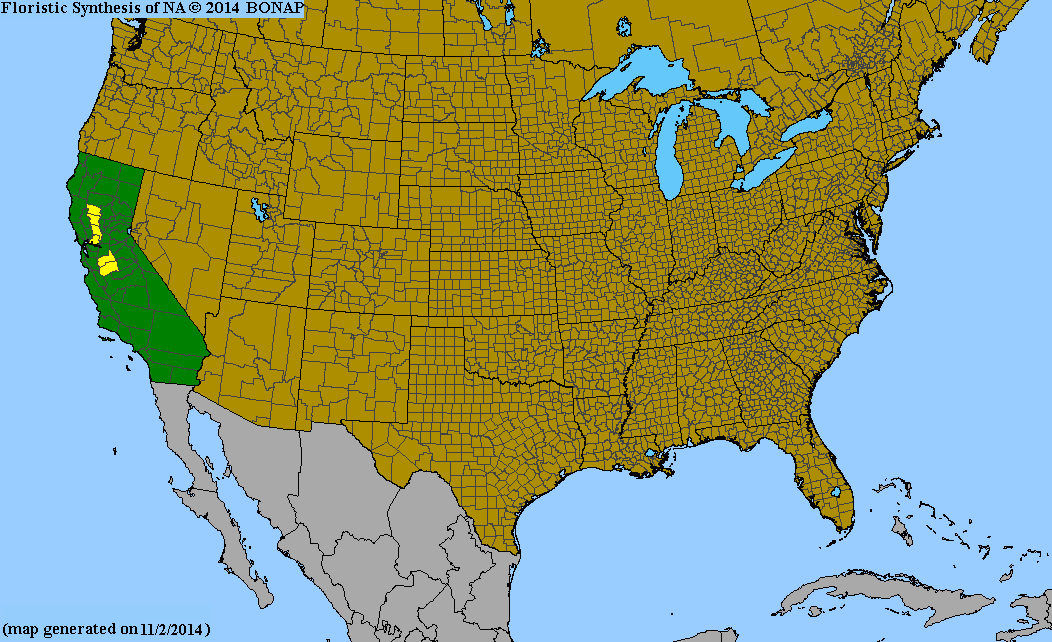
Neostapfia colusana is endemic to the Central Valley of California, in the northern section's Sacramento Valley and in the southern section's San Joaquin Valley.[2] The bunchgrass grows in vernal pools, which are seasonal shallow freshwater ponds.
It is native to the Central Valley counties of Glenn, Colusa, Yolo, Solano, Stanislaus, and Merced.[6][7]
This rare grass is a federally listed threatened species in the United States.[8][1]
Description
Neostapfia colusana is a clumping bunchgrass with distinctive cylindrical inflorescences covered in flat spikelets. The inflorescences are said to resemble tiny ears of corn. They fruit in grains covered in a gluey secretion, and when a plant is mature, each clump becomes brown and sticky with the exudate. The genus was named for botanist Otto Stapf.
Conservation
The plant is limited to vernal pool habitats, a type of ecosystem that is increasingly rare as Central Valley land is consumed by development and agriculture, and damaged by flood-control regimens and other alterations of hydrology.[9]
References
<templatestyles src="Reflist/styles.css" />
- ↑ a b USDA: Neostapfia colusana
- ↑ a b c Cite error: Script error: No such module "Namespace detect".Script error: No such module "Namespace detect".
- ↑ Davy, Joseph Burtt. 1898. "Stapfia, a new genus of Meliceae, and other noteworthy grasses." Erythea 6 (11): 109-113, text.
- ↑ Davy, Joseph Burtt. 1898. "Stapfia, a new genus of Meliceae, and other noteworthy grasses." Erythea 6 (11): plate 1, line drawings of Neostapfia colusana, named as Stapfia colusana
- ↑ Davy, Joseph Burtt 1899. "Concerning Stapfia." Erythea 7 (43)
- ↑ Calflora Database: Neostapfia colusana, with county distribution maps.
- ↑ Biota of North America Program 2013 county distribution maps for Neostapfia colusana
- ↑ The Calflora Database: Information on California plants for education, research and conservation, with data contributed by public and private institutions and individuals, including the Consortium of California Herbaria. 2015. Berkeley, California
- ↑ California Native Plant Society Rare Plant Profile
Script error: No such module "Check for unknown parameters".