Mount Edgecumbe (Alaska)
Template:Short description Template:Infobox mountain
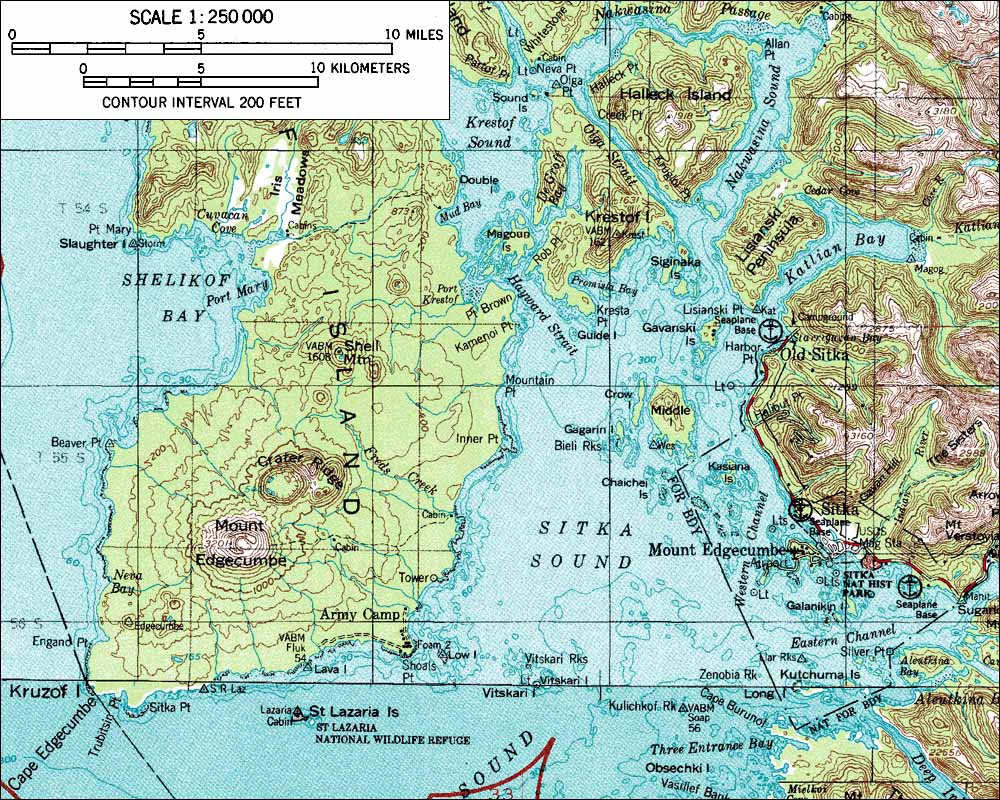
Mount Edgecumbe (Template:Langx, Template:Langx) is located at the southern end of Kruzof Island, Alaska, about Script error: No such module "convert". west of Sitka. The dormant volcano is about Script error: No such module "convert". east of the Queen Charlotte Fault that separates the North American and Pacific Plates, and is the highest point in the Mount Edgecumbe volcanic field, an area of about Script error: No such module "convert". on Kruzof Island that also includes Crater Ridge and Shell Mountain.[1]
Mount Edgecumbe has not had a major eruption in 4000 years. Recent earthquake activity shows magma intrusion at a depth of Script error: No such module "convert"., but as of 2022, an eruption does not appear to be imminent. It has been classified by the Alaska Volcano Observatory (AVO) as "historically active". Mount Edgecumbe was a prop in a 1974 April Fools' Joke, which involved tricking the citizens of Sitka into believing the volcano was erupting.[2]
Name
The indigenous Tlingit people consider the mountain to be sacred.[3] In the Tlingit language, the mountain is called Script error: No such module "Lang".,Template:RTemplate:R which means "to flash" or "blinking", because the Tlingit people first discovered it while it was smoking or erupting.[3]
On August 16, 1775, Spanish explorer Juan de la Bodega named the mountain Montaña de San Jacinto to honor Saint Hyacinth, whose feast day is celebrated on 17 August.[4] Captain James Cook passed the mountain on May 2, 1778, during his third voyage and named it Mount Edgecumbe, presumably after a hill overlooking Plymouth Sound, England, or possibly for George, Earl of Edgcumbe.[5] Explorer George Vancouver later adopted the name chosen by Cook, and it came into popular usage.[6]
Ascent

The first recorded ascent was made in July 1805 by Captain Urey Lisianski of the Imperial Russian Navy.[6] In the 1930s a trail to the top of the mountain was made by the Civilian Conservation Corps as part of a New Deal program to ease the Great Depression.[7]
The Mt. Edgecumbe Trail is roughly Script error: No such module "convert"., ascending through taiga and muskeg before becoming steep and ending in a barren landscape of snow and red volcanic ash above the treeline, at about Script error: No such module "convert"., with sign-posts directing hikers toward the crater rim.[7] A three-sided cabin built by the Conservation Corps lies about Script error: No such module "convert". up trail.[7] The trail can be muddy and wet in places, the last Script error: No such module "convert". are a steep climb, and bears may be present.[8] The difficulty of the trail is listed as "moderate."[7]
Eruptions
Eruption hoax

On April 1, 1974, a local prankster named Oliver "Porky" Bickar ignited 70 old kerosene-soaked tires in the crater,[2] which he had flown in for an April Fools' Day joke.[10] The dark smoke rising from the crater convinced nearby residents of Sitka, Alaska, that the volcano was erupting. The hoax was soon revealed, as around the rim of the volcano, "April Fool" was spray-painted in Script error: No such module "convert". letters. Porky had notified the FAA and the Sitka Police Department beforehand but had forgotten to notify the Coast Guard.[11] The prank made the Associated Press and was printed in newspapers across the country.[12] The Guardian reports that Bickar had been planning the prank for four years, and lists it among the ten best Aprils Fools hoaxes of all time.[13]
Recent activity
After about 800 years of "dormancy" at Mount Edgecumbe, researchers observed hundreds of small earthquakes in April 2022. Analysis by the AVO following the swarm revealed deformation starting in August 2018 in an Script error: No such module "convert". diameter area to the east of the mountain. Uplift totalled Script error: No such module "convert". since the start and occurred at Script error: No such module "convert". a year in its center. This deformation is likely related to a magmatic intrusion at Script error: No such module "convert". depth, but does not necessarily indicate an impending eruption.[14] "Intrusions of new magma under volcanoes do not always result in volcanic eruptions. The deformation and earthquake activity at Edgecumbe may cease with no eruption occurring. If the magma rises closer to the surface, this would lead to changes in the deformation pattern and an increase in earthquake activity. Therefore, it is very likely that if an eruption were to occur it would be preceded by additional signals that would allow advance warning."[15]
On 23 May 2022 the AVO announced that they had "placed a seismometer and GPS sensor on Kruzof Island to better monitor the Mount Edgecumbe volcanic field. This station will improve our ability to detect smaller earthquakes, locate earthquakes more precisely, and measure deformation."[16]
See also
References
<templatestyles src="Reflist/styles.css" />
- ↑ Script error: No such module "citation/CS1".
- ↑ a b Script error: No such module "citation/CS1".
- ↑ a b Script error: No such module "citation/CS1".
- ↑ Script error: No such module "citation/CS1".
- ↑ Script error: No such module "citation/CS1".
- ↑ a b Script error: No such module "citation/CS1".
- ↑ a b c d Script error: No such module "citation/CS1".
- ↑ Script error: No such module "citation/CS1".
- ↑ Template:Cite gvp
- ↑ Script error: No such module "citation/CS1".
- ↑ Script error: No such module "citation/CS1".
- ↑ Script error: No such module "citation/CS1".
- ↑ Script error: No such module "citation/CS1".
- ↑ Script error: No such module "citation/CS1".
- ↑ Script error: No such module "citation/CS1".
- ↑ Script error: No such module "citation/CS1".
Cite error: <ref> tag with name "Joseph" defined in <references> is not used in prior text.
<ref> tag with name "Thornton" defined in <references> is not used in prior text.Script error: No such module "Check for unknown parameters".
External links
Script error: No such module "Sister project links".Script error: No such module "Check for unknown parameters".
- Pages with script errors
- Pages with reference errors
- Pages with broken file links
- Dormant volcanoes
- Stratovolcanoes of Alaska
- Volcanoes of Sitka, Alaska
- Civilian Conservation Corps in Alaska
- Mountains of Sitka, Alaska
- Hoaxes in the United States
- Holocene stratovolcanoes
- Sacred mountains of the United States
- Tlingit culture