Malus baccata
Template:Short description Template:Speciesbox
Malus baccata is an Asian species of apple known by the common names Siberian crab apple,[1] Siberian crab,[2] Manchurian crab apple and Chinese crab apple.[3][4][5] It is native to many parts of Asia, but is also grown elsewhere as an ornamental tree and for rootstock. It is used for bonsai. It bears plentiful, fragrant, white flowers and edible red to yellow fruit of about Script error: No such module "convert". diameter.
Description

The trees grow up to Script error: No such module "convert". high. They have arching or overhanging red-brown branches and red-brown buds. The petioles are Script error: No such module "convert". long, with few glands. Leaves are elliptical or egg-shaped, Script error: No such module "convert".. The pedicels are slender and Script error: No such module "convert". long. They bear white, fragrant flowers of Script error: No such module "convert". in diameter in groups of four to six. Petals are white and egg-shaped, about Script error: No such module "convert". long. Fruits are red to yellow and spherical, only about Script error: No such module "convert". in diameter; they form dense clusters and resemble cherries from a distance. Flowering occurs in spring, with fruits appearing in September and October.[6][4][5]
Taxonomy
The subordinate taxa include these varieties:[3][6][5]
- Malus baccata var. baccata (Script error: No such module "convert". tall) – China, Korea, Russia, Mongolia
- Malus baccata var. daochengensis
- Malus baccata var. gracilis (Script error: No such module "convert".) – Gansu and Shaanxi in China
- Malus baccata var. himalaica
- Malus baccata var. jinxianensis
- Malus baccata var. mandshurica (Manchurian crab apple, Script error: No such module "convert".)
- Malus baccata var. xiaojinensis
Distribution and habitat
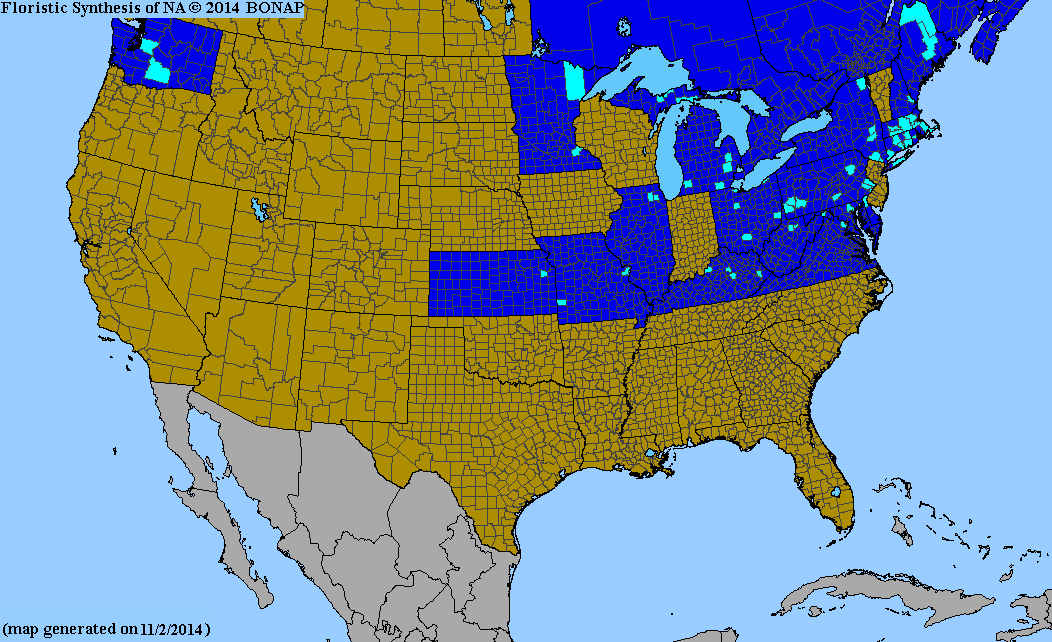
The species is native to Russia, Mongolia, China, Korea, Bhutan, India, and Nepal,[3] where it is common to mixed forests on hilly slopes at elevations up to Script error: No such module "convert"..[6] The tree is found in Japan,[5] and it has also been introduced to Europe and North America, where it is found in the wild mostly in the Great Lakes Region and in the Northeastern United States.[7][8]
Uses
The species is used as ornament for its flowers and fruit. The fruits are edible and are eaten fresh or dried. It is one of the tallest and most resistant to cold and pest[9] species of its genus, thus is used for experimental breeding and grafting of other crab and domesticated apples.[10][11] In particular, it is a common genetic source for M. pumila and M. asiatica in northern and northeastern China.[3][6] M. b. var. mandshurica is used for bonsai.[12]
See also
References
<templatestyles src="Reflist/styles.css" />
- ↑ Script error: No such module "template wrapper".
- ↑ Template:BSBI 2007
- ↑ a b c d Script error: No such module "template wrapper".
- ↑ a b Script error: No such module "citation/CS1".
- ↑ a b c d Script error: No such module "citation/CS1".
- ↑ a b c d Malus baccata in Flora of China @. Efloras.org. Retrieved on 2011-02-22.
- ↑ PLANTS Profile for Malus baccata (Siberian crab apple) | USDA PLANTS. Plants.usda.gov (2005-04-04). Retrieved on 2011-02-22.
- ↑ Biota of North America Program 2014 county distribution map
- ↑ Script error: No such module "citation/CS1".
- ↑ Script error: No such module "citation/CS1".
- ↑ Script error: No such module "citation/CS1".
- ↑ Script error: No such module "citation/CS1".
Script error: No such module "Check for unknown parameters".
Script error: No such module "Side box".
External links
- line drawing, Flora of China Illustrations vol. 9, fig. 77, 1-3
- photo of herbarium specimen at Missouri Botanical Garden, collected in Missouri in 1970
- University of Florida Fact Sheet
- Plants for a future
- Script error: No such module "citation/CS1".
- Script error: No such module "citation/CS1".