Mabel Taliaferro
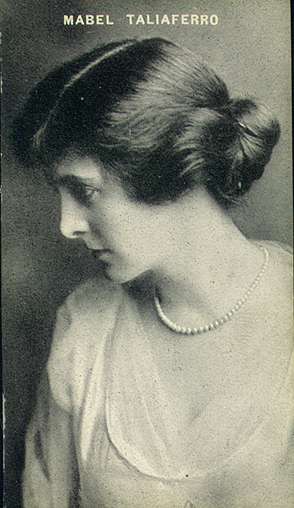
Template:Short description Template:Use American English Script error: No such module "Unsubst". Script error: No such module "infobox".Script error: No such module "Check for unknown parameters".Script error: No such module "Check for clobbered parameters".Template:Wikidata image Mabel Taliaferro (born Maybelle Evelyn Taliaferro; May 21, 1887 – January 24, 1979) was an American stage and silent-screen actress, known as "the Sweetheart of American Movies."[1]
Early years
Taliaferro was born as Maybelle Evelyn Taliaferro in Manhattan, New York City and raised in Richmond, Virginia. She was descended on her father's side from one of the early families who settled in Virginia in the 17th century, the Taliaferros, whose roots are from a northern Italian immigrant to England in the 16th century.[2]
Taliaferro was a sister of film and stage actress Edith Taliaferro and the cousin of actress Bessie Barriscale.[3]
Career

Taliaferro began acting on stage at age 2[1] with Chauncey Olcott. Later she appeared with James A. Hearne and with Sol Smith Russell in A Poor Relation. In 1899, she achieved distinction in the role of little Esther in Israel Zangwill's play, Children of the Ghetto. A year later she played the witching elf-child in Yeats's Gaelic fantasy, The Land of Heart's Desire. In 1902-3 Taliaferro appeared in An American Invasion with John E. Dodson and Miss Annie Irish. The following year she was seen in the support of Louis Mann in The Consul. Her greatest opportunity came when she was cast for Lovey Mary in Mrs. Wiggs of the Cabbage Patch, a part she played continuously for two and one-half years. In 1905 she supported Arnold Daly in You Never Can Tell and later went on tour in The Bishop's Carriage. After a brief season in vaudeville she joined William Collier's company in a tour of Australia.[4]
In the first decade of the 20th century, Taliaferro's husband and manager, Frederic Thompson, announced that her first name would be changed to Nell for billing purposes. Her first production with her new name was Springtime, and the change brought an outcry of opposition from the public. By 1910, she was once again Mabel.[5]
In 1911, her movie career began with the Selig Studios in The Three of Us and the film version of Cinderella[1] co-starring her then-husband Thomas Carrigan.[6] She continued performing in films through her retirement in 1921. In 1940, she appeared in her final picture, My Love Came Back.[2] Her final Broadway success was in ''Bloomer Girl'' (1944).[1]
On November 20, 1950, Taliaferro co-starred with Glenn Langan in "The Floor of Heaven" on Studio One on TV.[7]
Suffrage activism
Mabel Taliaferro was known as favoring women's suffrage.[8] In February 1914 she participated in a suffrage gathering that drew 1,500 people to honor the work of Anna Howard Shaw.[9]
Personal life and death

In 1906, Taliaferro married (as her first husband) Frederic Thompson, who created Luna Park in Coney Island as well as the New York Hippodrome, under whose management she starred in the Broadway play Polly of the Circus.[10][11][12]
On January 11, 1920, Taliaferro married army officer Josephus P. O'Brien in Darien, Connecticut. They were divorced in Reno, Nevada on June 3, 1929.[13] She also married and divorced actor Thomas Jay Carrigan.[14][15] Taliaferro married Robert Ober. He died in 1950.[16] She had one child.[17]
In 1907, she was injured in a car crash.[18] She died in Honolulu, Hawaii, on January 24, 1979, aged 91.[1]
Filmography
- My Love Came Back (1940)
- Alexander Hamilton (1924)
- The Rich Slave (1921)
- Sentimental Tommy (1921)
- The Mite of Love (1919)
- Draft 258 (1917)
- Peggy Leads the Way (1917, extant)
- The Jury of Fate (1917)
- Peggy, the Will O' the Wisp (1917)
- A Magdalene of the Hills (1917)
- The Barricade (1917)
- A Wife by Proxy (1917, extant)
- The Sunbeam (1916)
- The Dawn of Love (1916)
- God's Half Acre (1916), extant)
- The Snowbird (1916), extant)
- Her Great Price (1916)
- The Three of Us (1914)
- The Sunbeam (1912)
- Cinderella (1911; released January 1, 1912)
Stage
.jpg)
- Springtime Folly (1951)
- Bloomer Girl (1946)
- Victory Belles (1944)
- George Washington Slept Here (1941)
- The Prince's Secret (1935)[19]
- Back Fire (1932)
- The Piper (1920)
- Luck in Pawn (1919)
- Young Wisdom (1914)
- The Call of the Cricket (1910)
- Springtime (1909)
- Polly of the Circus (1907)
- Pippa Passes (1906)
- You Never Can Tell (1905)
- Mrs. Wiggs of the Cabbage Patch (1905)
- The Land of Heart's Desire (1903)
- The Consul (1903)
- The Little Princess (1903)
- An American Invasion (1902)
- The Price of Peace (1901)
- Lost River (1900)
- Children of the Ghetto (1899)
TV
- The De Santre Story (1956)
- The Hat from Hangtown (1952)
- Mistress Sims Inherits (1949)
- You Can't Take It with You (1945)
References
<templatestyles src="Reflist/styles.css" />
- ↑ a b c d e Script error: No such module "citation/CS1".Template:Link note
- ↑ a b Script error: No such module "citation/CS1".
- ↑ New York Times. Saturday, December 1, 1906
- ↑ Script error: No such module "Citation/CS1".
- ↑ Script error: No such module "citation/CS1".
- ↑ Pictorial History of the Silent Screen by Daniel Blum c. 1953 page 25
- ↑ Script error: No such module "citation/CS1".
- ↑ Script error: No such module "citation/CS1".
- ↑ Script error: No such module "citation/CS1".
- ↑ Script error: No such module "citation/CS1".Template:Link note
- ↑ Script error: No such module "citation/CS1".Template:Link note
- ↑ Script error: No such module "citation/CS1".Template:Link note
- ↑ Script error: No such module "citation/CS1".
- ↑ Script error: No such module "citation/CS1".
- ↑ Script error: No such module "citation/CS1".Template:Link note
- ↑ Script error: No such module "citation/CS1".Template:Open access
- ↑ Script error: No such module "citation/CS1".
- ↑ Script error: No such module "citation/CS1".Template:Link note
- ↑ Script error: No such module "citation/CS1".
Script error: No such module "Check for unknown parameters".
External links
Script error: No such module "Side box".
- Mabel Taliaferro at IMDbTemplate:EditAtWikidataScript error: No such module "Check for unknown parameters".
- Template:PAGENAMEBASE at the Internet Broadway DatabaseTemplate:EditAtWikidataTemplate:WikidataCheck
- Mabel Taliaferro portrait gallery of Mabel Taliaferro NY Public Library
- portrait of Mabel Taliaferro 1910s (moviecard)
Script error: No such module "Authority control".
- Pages with script errors
- Pages containing links to subscription-only content
- Pages with broken file links
- 1887 births
- 1979 deaths
- American film actresses
- American silent film actresses
- Actresses from Richmond, Virginia
- Actresses from Honolulu
- Taliaferro family (Virginia)
- American vaudeville performers
- 20th-century American actresses
- Actresses from Manhattan
- American people of English descent
- American people of Italian descent