Lifta
Template:Short descriptionTemplate:Pp-30-500 Script error: No such module "Unsubst".
Script error: No such module "Settlement short description".Script error: No such module "Infobox".Script error: No such module "Check for unknown parameters".Script error: No such module "Check for conflicting parameters".Expression error: Unexpected < operator


Lifta (Template:Langx; Template:Langx) was a Palestinian village on the outskirts of Jerusalem. The village's Palestinian Arab inhabitants were expelled by Zionist paramilitary forces during the 1948 Palestine war.
During the Ottoman period, the village was recorded to have a population of 400 Arabs, all Muslim households. In 1834, a battle took place in the village during the Palestinian Peasants' Revolt. A British 1922 census registered Lifta's population at 1,451, all Muslims.[1]
Prior to 1948, the village had orchards, several olive presses, a winepress, in addition to a modern clinic, two coffeehouses, two carpentry shops, barbershops, a butcher, and a mosque.[2][3] In the 1945 statistics the population of Lifta was 2,250; 2,230 Muslims and 20 Christians.[4] In addition, a small number of Jews resided in the village, and one former Jewish inhabitant described the relationship her family and the Palestinian Arab majority as 'excellent'.[3]
During the 1948 Palestine war, a massacre occurred on 28 December 1947, when a Jewish militia launched a machine-gun and grenade assault on a cafe in Lifa. The mukhtar's home was also incinerated by the Zionist forces and 20 buildings were blown up as the village was put under siege.[5] The village's Palestinian Arab inhabitants were expelled, and the abandoned village was later repopulated by Jewish immigrants until 1970s. In July 2017, Israel declared Lifta (called Mei Neftoach) as a national nature reserve.[6] It has been referred to as the "Palestinian Pompeii".[7]
History
Antiquity
A perennial spring located in the channel's upper section is believed to be the site where the village first developed. Surrounding this spring, artifacts including a burial cave and pottery shards from the Middle Bronze Age II and Iron Age II periods were uncovered.[8]
Archaeological remains dating as far back as Iron Age II have been found in the village.[2][9][10]
Biblical identification
The site is considered by some to be identical with biblical Template:Langx Mei Neftoach. It was populated since ancient times; "Nephtoah" (Hebrew: נפתח, lit. spring of the corridor) is mentioned in the Hebrew Bible as the border between the Israelite tribes of Judah and Benjamin,[11] and was the northernmost demarcation point of the territory of the Tribe of Judah.[12][2] Other scholars hold the identification to be plausible but by no means certain.[13] Kitchener and Conder found the identification with Nephtoah unsatisfactory, and preferred to identify Lifta with Eleph of Benjamin (Joshua 18:28).[14]
Roman and Byzantine periods
The Romans and Byzantines called it Nephtho, and the Crusaders referred to it as Clepsta.[15]
Crusader period
The remains of a court-yard home from the Crusader period remains in the centre of the village.[16]
Ottoman era
In 1596, Lifta was a village in the Ottoman Empire, nahiya (subdistrict) of Jerusalem under the liwa' (district) of Jerusalem, and it had a population 72 Muslim households, an estimated 396 persons. It paid taxes on wheat, barley, olives, fruit orchards and vineyards; a total of 4,800 akçe. All of the revenue went to a waqf.[17]
In 1834, a battle took place here, during the revolt of that year. The Egyptian Ibrahim Pasha and his army fought and defeated local rebels, led by Shaykh Qasim al-Ahmad, a prominent local ruler. However, the Qasim al-Ahmad family remained powerful and ruled the region southwest of Nablus from their fortified villages of Deir Istiya and Bayt Wazan some Script error: No such module "convert". due north of Lifta.[18] In 1838 Edward Robinson noted Lifta as a Muslim village, located in the Beni Malik area, west of Jerusalem.[19][20] Robinson hired muleteers from Lifta, noting that in Lifta "every peasant keeps his mule and usually accompanies it".[21]
In 1863 Victor Guérin described Lifta as being surrounded by gardens of lemon-trees, oranges, figs, pomegranates, alms and apricots.[22] An Ottoman village list of about 1870 indicated 117 houses and a population of 395, though the population count included men, only.[23][24]
The PEF's Survey of Western Palestine in 1883 described it as a village on the side of a steep hill, with a spring and rock-cut tombs to the south.[25]
In 1896 the population of Lifta was estimated to be about 966 persons.[26]
In 1907 the German historian Gustav Rothstein was invited to Lifta by his Arabic language teacher, Elias Nasrallah Haddad. Rothstein wrote a 20-pages article describing the marriage celebrations and religious festivals in Lifta.[27]
British Mandate era
.jpg)
In 1917, Lifta surrendered to the British forces with white flags and, as a symbolic gesture, the keys to the village.[28]
In the 1922 census of Palestine, Lifta had a population 1,451, all Muslims,[1] increasing in the 1931 census (when Lifta was counted with "Shneller's Quarter"), to 1,893; 1,844 Muslims, 35 Jews and 14 Christians, in a total of 410 houses.[29]
During the 1929 Palestine riots, according to one Israeli source, some villagers from Lifta were among gangs that participated in a number of robberies and attacks on nearby Jewish communities.[30][31][32]

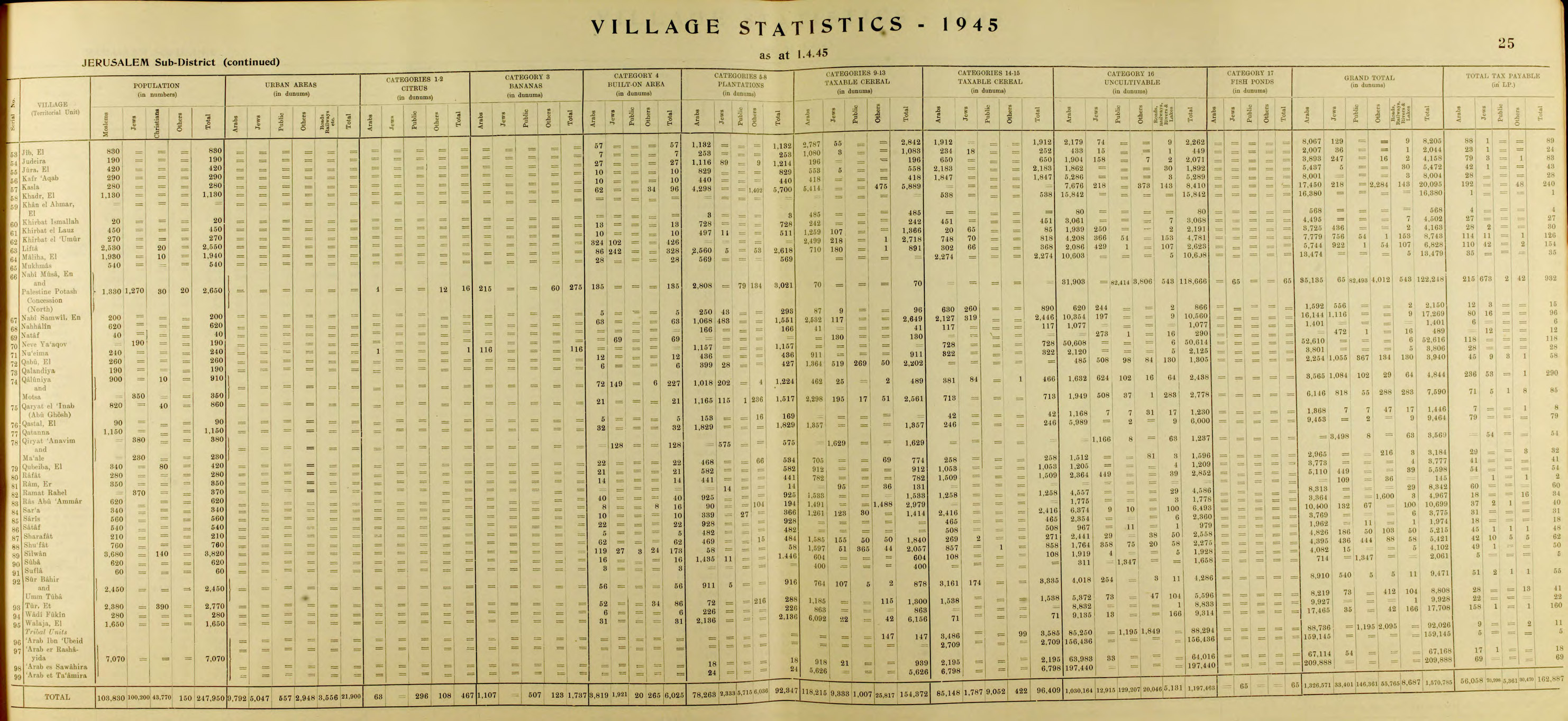
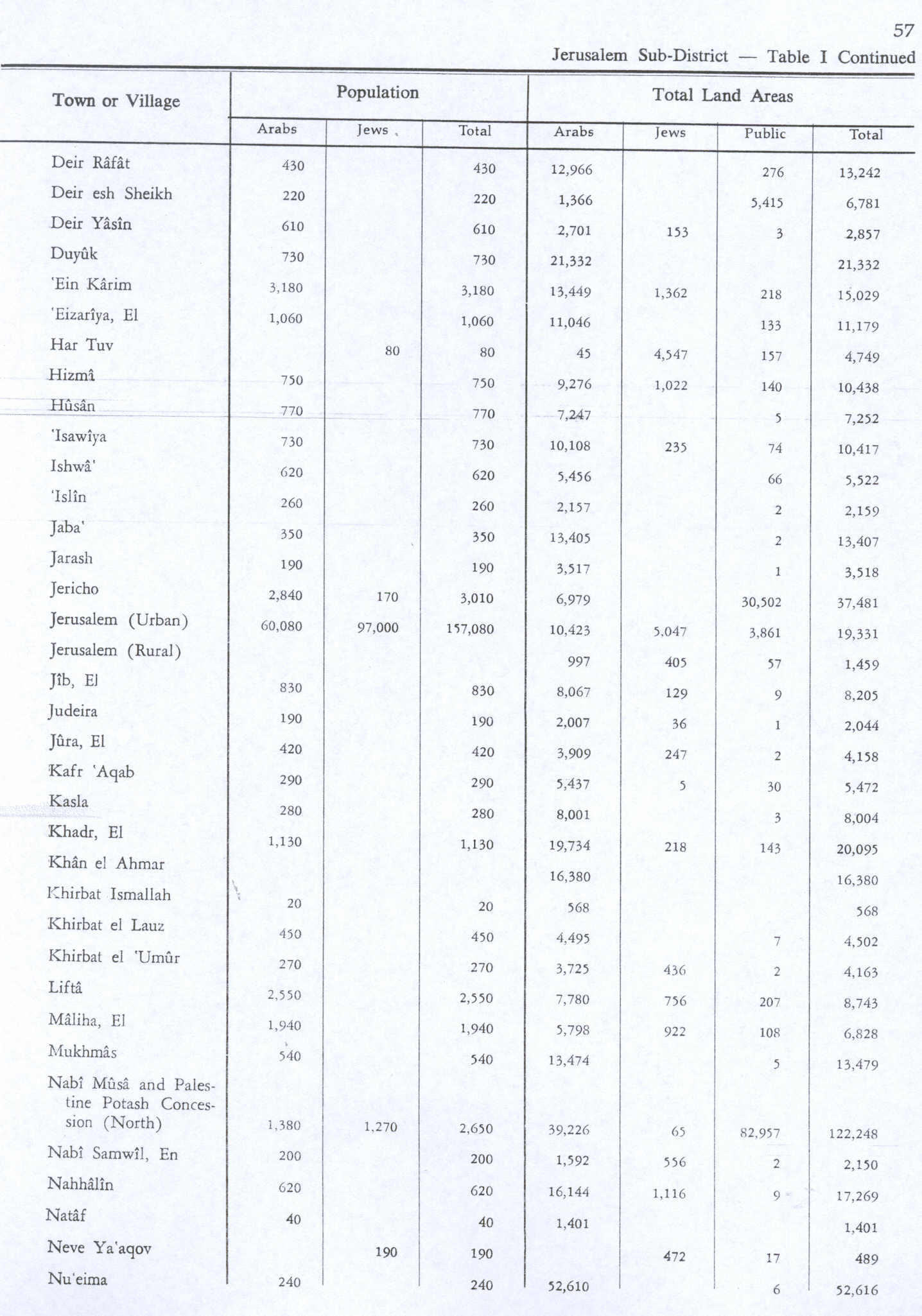
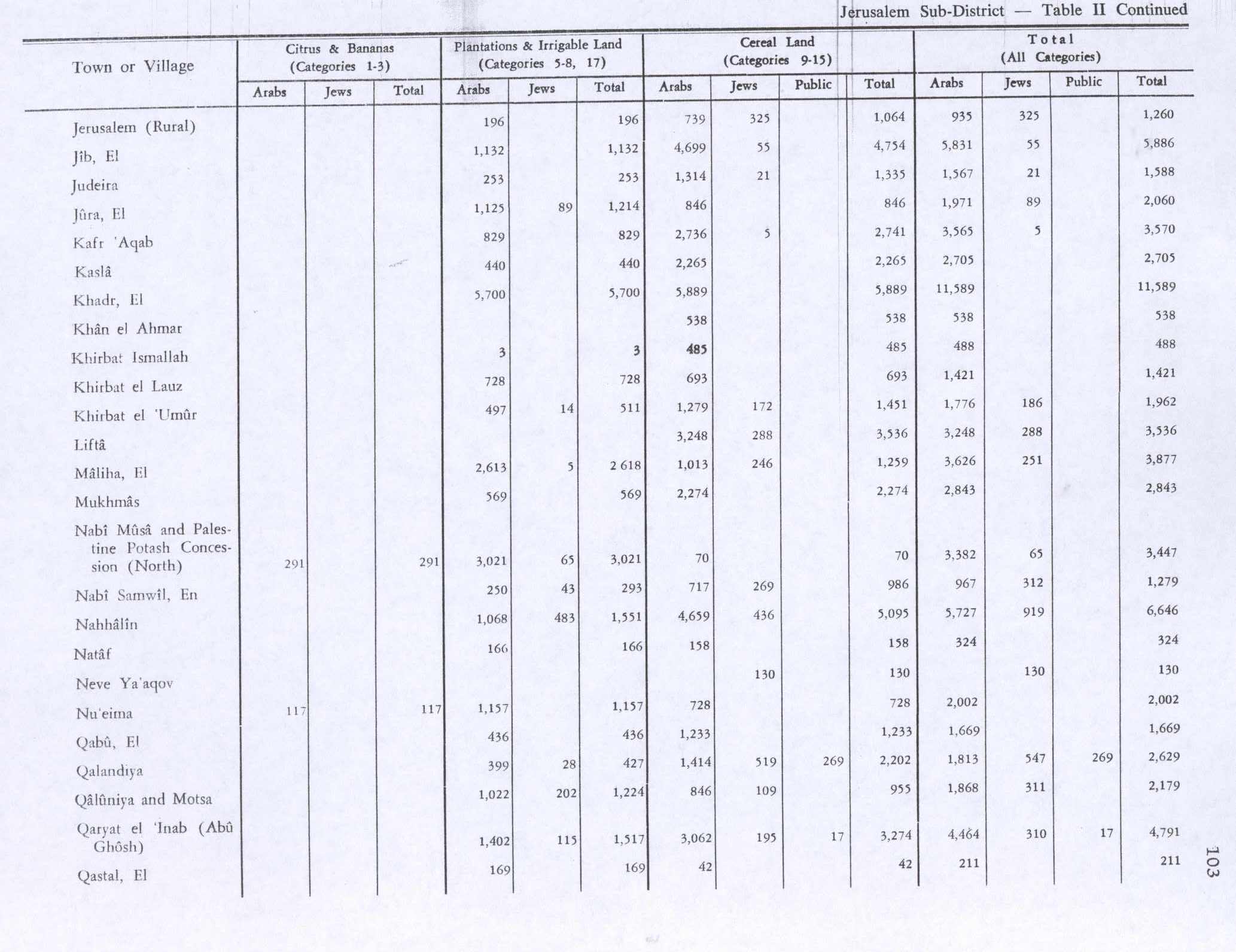
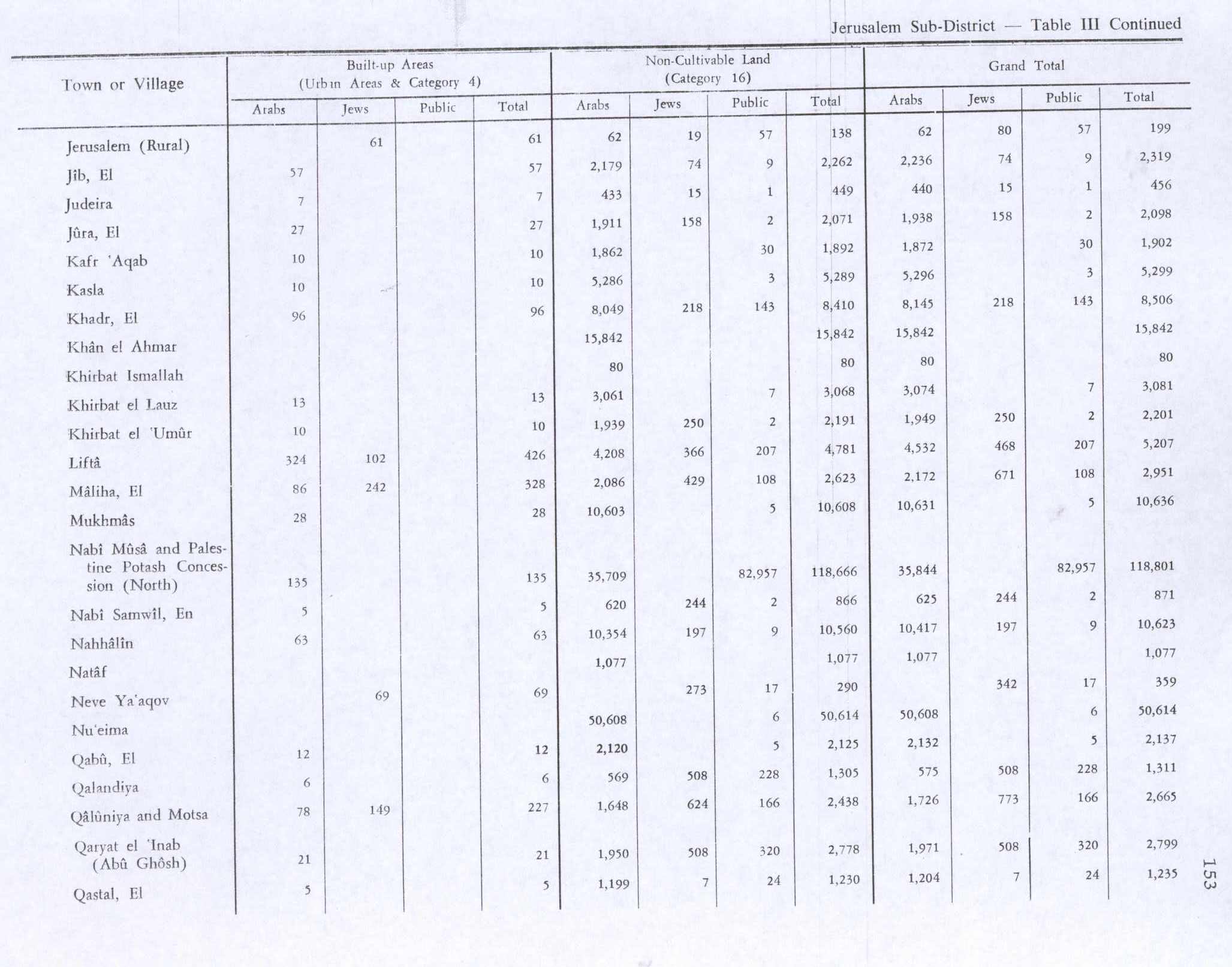
In the 1945 statistics the population of Lifta was 2,250; 2,230 Muslims and 20 Christians,[4] and the total land area was 8,743 dunams, according to an official land and population survey.[33] 3,248 dunams were for cereals,[34] while 324 dunams were built-up (urban) land.[35]
.jpg)
Prior to 1948, the village, with a population of some 2,500 people, had orchards, several olive presses, a winepress, in addition to a modern clinic, two coffeehouses, two carpentry shops, barbershops, a butcher, and a mosque.[2][3] A small number of Jews resided in the village, and one former Jewish inhabitant described the relationship her family and the Palestinian majority as 'excellent'.[3]
1948 war and depopulation
Script error: No such module "labelled list hatnote". Script error: No such module "Sidebar". In the 1947–48 Civil War in Mandatory Palestine Lifta, Romema, and Shaykh Badr which were strategically located on the road leaving Jerusalem to Tel-Aviv, were an operational priority for Jewish forces. Some families had already left the village after a decision had been made somewhat earlier on 4 December, to evacuate its women and children, in order to host a military company, and on 4 December 1947 some Arab families left.[36] By mid-December irregular Arab militia took up positions in Lifta to defend the site. Hagannah patrols engaged in firefights with the village militiamen while Irgun and Lehi were even more aggressive. On 28 December 1947, the village suffered from what survivors called the “Lifta massacre” when a Jewish militia launched a machine-gun and grenade assault on the café of Salah Eisa. In order to warn residents that they should evacuate, the mukhtar's home was incinerated, and 20 buildings blown up as the village was put under siege.[5]Template:Efn The attack left seven dead, and more women and children left the village. The village was suffering from food shortages in the beginning of January. Subsequently, a number of the villagers returned home, with Benny Morris reporting "some, or most" doing so. Subsequently, Abd al-Qadir al-Husayni, while visiting the village, ordered the women, children and elderly to evacuate and the men to stay put. On 29 January, a Lehi raid blew up 3 houses in the village. By early February the village was abandoned by the irregular militia. Benny Morris lists the cause of the depopulation of the village as being a military assault on the settlement.[37]
According to one resident, interviewed in 2021, there were are around 40,000 descendants of the original refugee population, dispersed in East Jerusalem, the West Bank, Jordan and the Palestinian diaspora.[5] Several families still retain their Ottoman period property deeds, attesting to their ownership of parts of Lifta.[5]
State of Israel
After the expulsion of its Palestinian villagers, of Lifta's 410 homes, 60 stone houses, some three stories high, remained, together with its mosque, an olive press, and a tiled pathway to a spring.[5] It is listed by Unesco as a potential World Heritage Site, and in 2018, the World Heritage Fund registered the village among a list of 24 heritage sites that were endangered.[5]
Lifta was used for Jewish refugee housing during the war, and following the war the Jewish Agency and the state of Israel settled Jewish immigrants from Yemen and Kurdistan in the village, totaling 300 families. However ownership of the houses was not registered in their name. Living conditions in Lifta were difficult, the buildings were in poor repair, poor roads and transport, and lack of electricity, water, and sanitation infrastructure.[9][2][38][39] In 1969-71 most of the Jewish inhabitants of Lifta chose to leave as part of a compensation program by Amidar. Holes were drilled in the roofs of the evacuated buildings to make them less inhabitable, so that squatters wouldn't take up residence. 13 families, who lived in the portion of the village close to Highway 1 and didn't suffer from transportation issues chose to remain.[40]
In the 1980s, Lifta was declared a municipal nature reserve under the auspices of the Israel Nature and Parks Authority.[41][42]
In 1984, one of the abandoned buildings in the village was occupied by the "Lifta gang", a Jewish group plotting the blow up the mosques on the Temple Mount, who were stopped at the gates of the site with 250 pounds of explosives, hand grenades, and other armaments.[43][44]
.jpg)
Following the departure of the Jewish residents, some of the buildings in the village were used for Lifta drug abuse rehabilitation center for adolescents, which was closed in 2014,[45] and from 1971 for the Lifta high school, an open education school, which relocated to German Colony, Jerusalem in 2001.[46]

In 2011, plans were announced to demolish the village and build a luxury development consisting of 212 luxury housing units and a hotel.[47] Former residents brought a legal petition to preserve the village as a historic site.[48] Lifta was the last remaining Arab village that was depopulated to have not been either completely destroyed or re-inhabited.[47] In 2012, the plans to rebuild the village as an upscale neighborhood were rejected by the Jerusalem District Court.[49][3]
By 2011, three books about the Palestinian village history had been published.[50]
In June 2017 the last Jewish residents left the village following a settlement with the government who acknowledged they were not squatters but rather resettled in Lifta by the appropriate authorities.[51] In July 2017 Mei Neftoach was declared a national nature reserve.[6] 55 out of 450 pre-1948 stone houses are still standing.[52][2]
In 2021, the Israel Land Administration, without informing beforehand the Jerusalem Municipality authorities, announced on Jerusalem Day that it was reported to be preparing a tender for the construction of a luxury neighborhood on the village's ruins, projected to consist of 259 villas, a hotel, and a mall.[3] On 11 August 2022, the plan to demolish Lifta and build luxury housing was shelved, with new Jerusalem mayor Moshe Lion seeking to preserve the village of Lifta and transform it into a UNESCO World Heritage Site. The previous Mayor of Jerusalem, Israeli businessman and politician Nir Barkat, had initially approved the plan for Lifta's demolition before changing his mind, opposing the development plans after visiting the site. Currently, Lifta is still on the list of UNESCO's tentative World Heritage Sites.[53]
Archaeology
In 2010, an archaeological survey was conducted at Lifta by Mordechai Heiman on behalf of the Israel Antiquities Authority (IAA).[54]
Arab traditional dress
Script error: No such module "Labelled list hatnote". Lifta was among the wealthiest communities in the Jerusalem area, and the women were known for their fine embroidery[55]Script error: No such module "Unsubst". Thob Ghabani bridal dresses were sewn in Lifta. They were made of ghabani, a natural cotton covered with gold color silk floral embroidery produced in Aleppo, and were narrower than other dresses. The sleeves were also more tapered. The sides, sleeves and chest panel of the dress were adorned with silk insets. The dresses were ordered by brides in Bethlehem.[56] The married women of Lifta wore a distinctive conical shaṭweh head-dress, that was also worn in Bethlehem, Ayn Karim, Beit Jala and Beit Sahour.[57]Script error: No such module "Unsubst".
Notable people
See also
References
<templatestyles src="Reflist/styles.css" />
- ↑ a b Barron, 1923, Table VII, Sub-district of Jerusalem, p. 14
- ↑ a b c d e f Lifta and the Regime of Forgetting: Memory Work and Conservation, Daphna Golan, Zvika Orr, Sami Ershied, Jerusalem Quarterly, 2013, Vol. 54, pp 69-81
- ↑ a b c d e f Stefanie Glinski, '‘We will return’: the battle to save an ancient Palestinian village from demolition,' The Guardian 29 July 2021
- ↑ a b Government of Palestine, Department of Statistics, 1945, p. 25
- ↑ a b c d e f Gideon Levy, Alex Levac, 'The Saddest Village in Israel,' Haaretz 23 July 2021:’Each floor of the buildings, fashioned from stone and graced with arches, tells the story of a different period and a different style of construction. Lifta is a rare architectural gem, a monument to what was once here in this country, mute testimony to a way of life that was abruptly cut off. A mosque, olive presses and a flour mill, remains of picturesque balconies, a tiled path leading to the spring, which was one the village’s throbbing heart and whose waters are now in use by yeshiva students and “hilltop youth” in the “between the times” vacation that follows Tisha B’Av.’
- ↑ a b According to the law of nature: four new reserves in Israel, Yisrael Hayom, 4 July 2017
- ↑ Palestinian ‘Pompeii’ in Jerusalem could face demolition
- ↑ Script error: No such module "Citation/CS1".
- ↑ a b Lifta Documentation and Initial Survey (in Hebrew), 2013, Israeli Antiquities Authority]
- ↑ Lifta, Archaeological Annex to Development plan, 2003 Israeli Antiquities Authority
- ↑ Script error: No such module "Citation/CS1".
- ↑ Nephtoah Bible Dictionary
- ↑ Script error: No such module "Citation/CS1".
- ↑ Conder and Kitchener, 1881, SWP III, p. 18, 47
- ↑ Heritage conservation in Israel: Lifta
- ↑ Pringle, 1997, p. 66
- ↑ Hütteroth and Abdulfattah, 1977, p. 115. Quoted in Khalidi, 1992, p. 301
- ↑ Khalidi, 1992, p. 301
- ↑ Robinson and Smith, 1841, vol 3, Appendix 2, p. 123
- ↑ Robinson and Smith, 1841, vol 2, p. 140
- ↑ Robinson and Smith, 1841, vol 2, p. 321
- ↑ Guérin, 1868, pp. 252-256
- ↑ Socin, 1879, p. 157
- ↑ Hartmann, 1883, p. 118, also noted 117 houses
- ↑ Conder and Kitchener, 1883, III:18. Quoted in Khalidi, 1992, p. 301
- ↑ Schick, 1896, p. 126
- ↑ Rothstein, 1914, pp. 102 -123
- ↑ Gilbert, 1936, pp. 157-68
- ↑ Mills, 1932, p. 41
- ↑ Script error: No such module "citation/CS1".
- ↑ Script error: No such module "citation/CS1".
- ↑ Script error: No such module "citation/CS1".
- ↑ Government of Palestine, Department of Statistics. Village Statistics, April, 1945. Quoted in Hadawi, 1970, p. 57
- ↑ Government of Palestine, Department of Statistics. Village Statistics, April, 1945. Quoted in Hadawi, 1970, p. 103
- ↑ Government of Palestine, Department of Statistics. Village Statistics, April, 1945. Quoted in Hadawi, 1970, p. 153
- ↑ Morris, 2004, pp. 119-120
- ↑ Cite error: Script error: No such module "Namespace detect".Script error: No such module "Namespace detect".
- ↑ Jerusalem 'Squatter' Discovers That His Home Is Rightfully His, Ha'aretz, 10 February 2012
- ↑ The Kenesset discusses eviction of Lifta residents: "the immigrants from Arab countries were called squatters and the Kibutniks - settlers" (in Hebrew), TheMarker, 25 January 2016
- ↑ from Settlers to squatters - the classification of residents in absentee property as squatters is injust, Lifta as an example (in Hebrew), Black Labor, Yoni Yochanan, 11 September 2016
- ↑ INPA Raises Lifta Security to Prevent Willow Theft, Jerusalem Post, September 19, 2011
- ↑ Mei Neftoach (Lifta) (in Hebrew Script error: No such module "webarchive"., Mapa, encyclopedia entry
- ↑ Discourse and Palestine: Power, Text and Context, Annelies Moors, page 133
- ↑ Ground Zero: Jerusalem, Holy War, and Collective Insanity, Jerry Kroth, page 131
- ↑ Despite the economic improvement, Drug rehabilitation center for adolescents in Lifta to close (in Hebrew), Haaretz, 22 May 2014
- ↑ Lifta High School: History Script error: No such module "webarchive"., Lifta High School
- ↑ a b "Israel moves to turn deserted Palestinian village into luxury housing project", Haaretz.com, 21 January 2011.
- ↑ Script error: No such module "citation/CS1".
- ↑ Court rules against demolition of empty Lifta homes
- ↑ Davis, 2011, p.30 30
- ↑ Defeated in Court, Lifta's Last Families to Leave Their Jerusalem-area Homes, Ha'aretz, 22 June 2017
- ↑ Esther Zandberg,Unofficial monument to a decisive time in history, Haaretz.com, 25 November 2004; accessed 2 September 2015.
- ↑ Script error: No such module "citation/CS1".
- ↑ Israel Antiquities Authority, Excavators and Excavations Permit for Year 2010, Survey Permit # A-5974
- ↑ Woven legacy, woven language Script error: No such module "webarchive"., Saudi Aramco World, Volume 42, Number 1.
- ↑ Stillman, 1979, pp. 42, 44 (ill.)
- ↑ Stillman, 1979, p. 37
Script error: No such module "Check for unknown parameters".
Bibliography
<templatestyles src="Refbegin/styles.css" />
- Script error: No such module "Citation/CS1".
- Script error: No such module "citation/CS1". (p. 544)
- Script error: No such module "citation/CS1".
- Script error: No such module "citation/CS1". (no. 293, pp. 436−437)
- Script error: No such module "citation/CS1". (plate LVIII)
- Script error: No such module "citation/CS1".
- Script error: No such module "Citation/CS1".
- Script error: No such module "citation/CS1". (p. 900)
- Gilbert, Major Vivian (1936): The Romance of the last Crusade, London, UK
- Script error: No such module "citation/CS1".
- Script error: No such module "citation/CS1".
- Script error: No such module "citation/CS1".
- Script error: No such module "Citation/CS1".
- Script error: No such module "Citation/CS1".
- Script error: No such module "citation/CS1".
- Script error: No such module "citation/CS1".
- Script error: No such module "citation/CS1".
- Script error: No such module "citation/CS1".
- Script error: No such module "citation/CS1".
- Script error: No such module "citation/CS1".
- Script error: No such module "citation/CS1".
- Script error: No such module "citation/CS1".
- Script error: No such module "Citation/CS1".
- Script error: No such module "Citation/CS1".
- Script error: No such module "citation/CS1".
- Script error: No such module "Citation/CS1".
- Script error: No such module "citation/CS1". (A catalog of the MOIFA (Museum of International Folk Art at Santa Fe's) collection of Palestinian clothing and jewellery.)
- Script error: No such module "citation/CS1". (pp. 758-60; cited in Pringle, 1997, p. 66)
- Script error: No such module "Citation/CS1".
External links
Script error: No such module "Side box".
- Welcome to Lifta, palestineremembered.com; accessed 2 September 2015.
- Lifta, Zochrot
- [1], The Ruins of Lifta (2016)
- Israel Antiquities Authority, Jerusalem, Lifta, Survey (2010)
- Survey of Western Palestine, Map 17: IAA, Wikimedia commons
- Lifta in Antiquity Archaeological Survey of Israel
- F.A.S.T.-Lifta Preservation Joint project on the reconstruction of memory and the preservation of Lifta, archive.org, 14 May 2006.
- Lifta photos by Dr Moslih KanaanehScript error: No such module "Category handler".[<span title="Script error: No such module "string".">usurped]Script error: No such module "Check for unknown parameters"., jalili48.com; accessed 2 September 2015.
- Lifta, by Rami Nashashibi (1996), Center for Research and Documentation of Palestinian Society.
- Lifta, zochrot.org
- Return to Lifta, 13 May 2006, zochrot.org
- Lifta Society website, liftasociety.org
- Lifta website, schulen.eduhi.at
- 3D models of different houses in Lifta, sketchfab.com; accessed 2 September 2015.

Template:Nature reserves of Israel Template:Palestinian Arab villages depopulated during the 1948 Palestine War Script error: No such module "Navbox". Script error: No such module "Authority control".