Kord machine gun
Script error: No such module "Infobox".Script error: No such module "Check for unknown parameters".
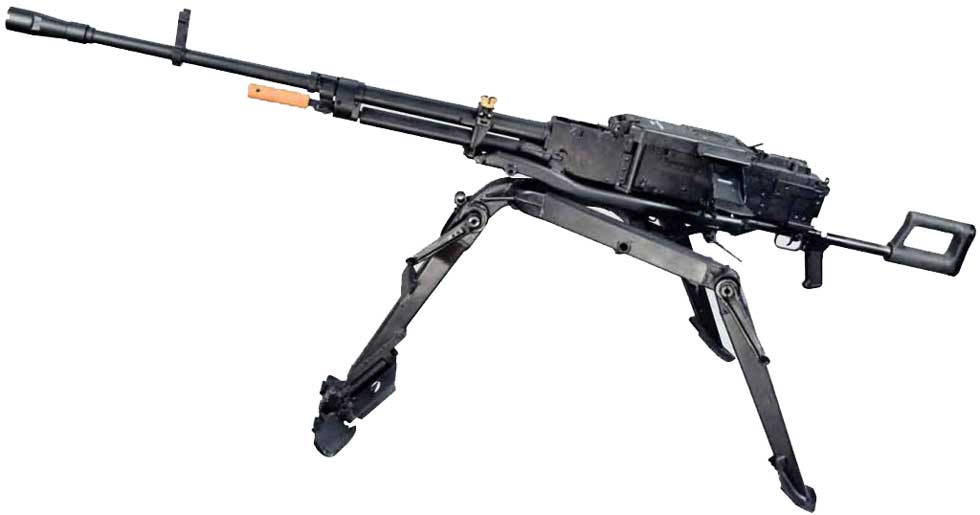
The Kord-12.7 mm heavy machine gun is a Russian design that entered service in 1998[1] replacing the older NSV machine gun. Externally the weapon resembles the NSV; however, the internal mechanism has been extensively reworked, changing from a horizontally pivoting breech block to a rotating bolt design.[1] Additionally the gas system has been changed and the muzzle baffle redesigned. These changes give the weapon reduced recoil compared with the NSV, allowing greater accuracy during sustained fire.
Development
The catalyst for the development of the weapon was a complete lack of any heavy machine guns in construction at that time in the Russian Federation. Prior to the dissolution of the Soviet Union, the weapon that had functioned as the heavy machine gun was the NSV, or "Utyos" ("утёс", meaning one lonely cliff in Russian, this name was its designation during development)[2] machine gun. The main production centre for the NSV was located in what is now Kazakhstan.[1]
The Russian Degtyarev bureau was given the job of producing an updated version of the weapon chambered in the 12.7×108mm cartridge, which could be used for support, mounted on vehicles or in an anti-aircraft capacity. All variants of the weapon are also available chambered in the .50 BMG (12.7×99mm NATO) cartridge for export sales.[3]
.jpg)
The weapon employs new construction, and consequently is significantly lighter than its predecessor. The firing mechanism is very rugged, and is capable of a greater rate of fire and significantly less recoil. Because a new barrel made of a high-tech alloy minimizes distortion and drop, accuracy has increased tremendously over previous Soviet machine guns. Unlike its predecessor, it may be fired from a bipod; a rather unusual feature for 12.7 mm/.50 caliber heavy machine guns. Its relatively light weight and lesser recoil allows stronger soldiers to move the gun around without assistance.[4]
Variants
- 6P49: Baseline variant for vehicle mounting.[1]
- 6P50: Basic infantry version.[1]
- 6P50-1 (6P57): 6T19 Bipod-mounted infantry version. Bipod provides ±15° range of traverse.[1]
- 6P50-2 (6P58): Infantry variant.[1]
- 6P50-3 (6P59): Mounted on boats, sea-going ships, and stationary objects on a 6U16 multipurpose mount. Casing ejection is to the right side.[1]
- 6P51: Co-axial version with left-hand feed system and forward casing ejection.[1]
Remote weapon stations
- 6C21 is a Russian remote weapon station using Kord machine gun or PKMT machine gun.[5]
Combat history
The Kord machine gun was used by the Russian forces in 1999–2000 during the Second Chechen war and in 2008 during the Russo-Georgian War.[6] It later saw action in the Russo-Ukrainian War[6] and in the Syrian Civil War.[7] 6P67, 6P68, 6P69 versions entered service in 2019.[8]
Users
- File:Flag of Finland.svg Finland: for purposes of NSV replacement testing.[9]
- File:Flag of Namibia.svg Namibia[10]
- Script error: No such module "flag".[11]
- Script error: No such module "flag".[7]
- File:Flag of Vietnam.svg Vietnam: on T-90S tank
- File:Flag of Ukraine.svg Ukraine: Multiple rifles were captured by the Ukrainian armed forces and pressed into service as a complement to the PKM and M249 machine gun.Script error: No such module "Unsubst".


Gallery
-
6P49
-
6P57
-
6P60


See also
- List of Russian weaponry
- STK 50MG
- Rheinmetall RMG.50
- HMG PK-16
- Zastava M87
- Type 77 heavy machine gun
- W85 heavy machine gun
- QJZ-89
- QJZ-171
References
<templatestyles src="Reflist/styles.css" />
- ↑ a b c d e f g h i Script error: No such module "citation/CS1".
- ↑ Modern Firearms - NSV-12.7 machine gun Script error: No such module "webarchive".
- ↑ Cite error: Script error: No such module "Namespace detect".Script error: No such module "Namespace detect".
- ↑ Russian Udarnaya Sila TV show, excerpt showing Russian officer firing Kord from the hip while moving [1] Script error: No such module "webarchive".
- ↑ Script error: No such module "citation/CS1".
- ↑ a b Script error: No such module "citation/CS1".Template:Better source needed
- ↑ a b Script error: No such module "citation/CS1".
- ↑ Script error: No such module "citation/CS1".
- ↑ Finnish Army HQ Materiel Department decision MI37585/27.12.2012 (Script error: No such module "Lang".)
- ↑ Script error: No such module "citation/CS1".
- ↑ Script error: No such module "citation/CS1".
Script error: No such module "Check for unknown parameters".
- Script error: No such module "citation/CS1".
External links
Script error: No such module "Side box".
- V.A. Degtyarev Plant – official site
- Modern Firearms
- Image of Kord on Tripod
- «KORD» large caliber machine gun
Script error: No such module "Unsubst".