Kafr Abbush
Template:Pp-extended Script error: No such module "Settlement short description".Script error: No such module "Infobox".Template:Template otherScript error: No such module "Check for unknown parameters".Script error: No such module "Check for conflicting parameters".Expression error: Unexpected < operator. Kafr 'Abbush (Template:Langx) is a Palestinian town in the Tulkarm Governorate in the northwestern West Bank. According to the Palestinian Central Bureau of Statistics, Kafr 'Abbush had a population of approximately 1,488 inhabitants in mid-year 2006 and 1,739 by 2017.[1][2] 24.8% of the population of Kafr 'Abbush were refugees in 1997.[3] The healthcare facilities for Kafr 'Abbush are based in Kafr 'Abbush, where the facilities are designated as MOH level 2.[4]
History
Archeological findings from Kafr 'Abbush include potsherds from the Byzantine era[5] and two menorahs carved in stone.[6]
Ottoman era
Kafr 'Abbush was incorporated into the Ottoman Empire in 1517 with all of Palestine, and in 1596 it appeared under the name of Abbush in the tax registers as being in the Nahiya of Bani Sa'b, part of Nablus Sanjak. It had a population of 19 Muslim households. The villagers paid a fixed tax rate of 33.3% on various agricultural products, such as wheat, barley, summer crops, olive trees, goats and/or beehives, in addition to "occasional revenues" and a press for olive oil or grape syrup; a total of 4,974 akçe.[7]
In 1838, Robinson noted Kefr 'Abush as a village in Beni Sa'ab district, west of Nablus.[8] In 1870/1871 (1288 AH), an Ottoman census listed the village in the nahiya (sub-district) of Bani Sa'b.[9]
In the 1860s, the Ottoman authorities granted the village an agricultural plot of land called Ghabat Kafr 'Abbush in the former confines of the Forest of Arsur (Ar. Al-Ghaba) in the coastal plain, west of the village.[10][11]
In 1882, the PEF's Survey of Western Palestine (SWP) described Kafr Abbush as: "a stone village of moderate size, on steep round hill, with a few olives. It is supplied by cisterns. The ground is very rugged near it."[12]
British Mandate era
In the 1922 census of Palestine conducted by the British Mandate authorities, Kafr Abbush had a population of 263 Muslims,[13] increasing in the 1931 census to 360 Muslims, in 63 houses.[14]
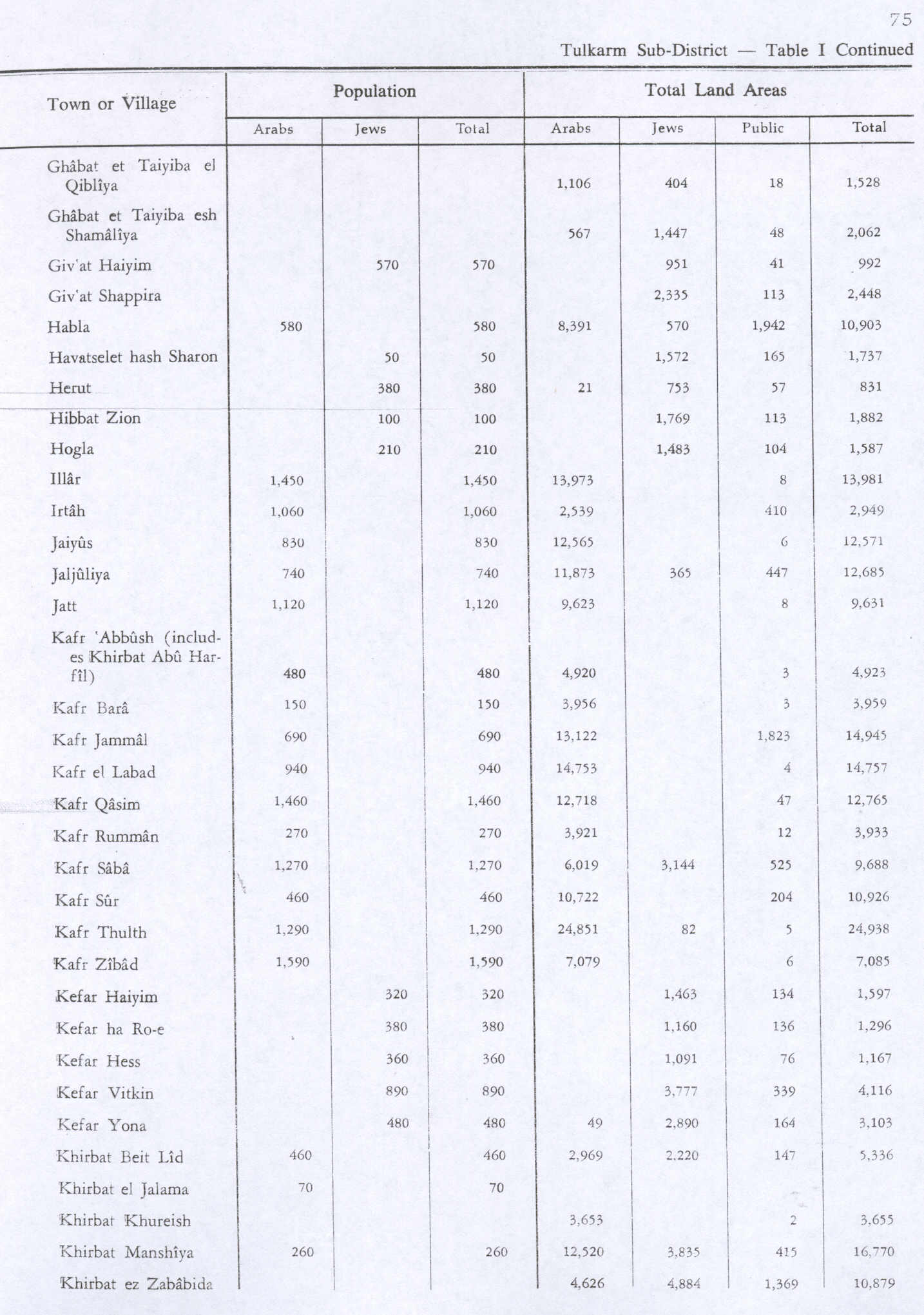
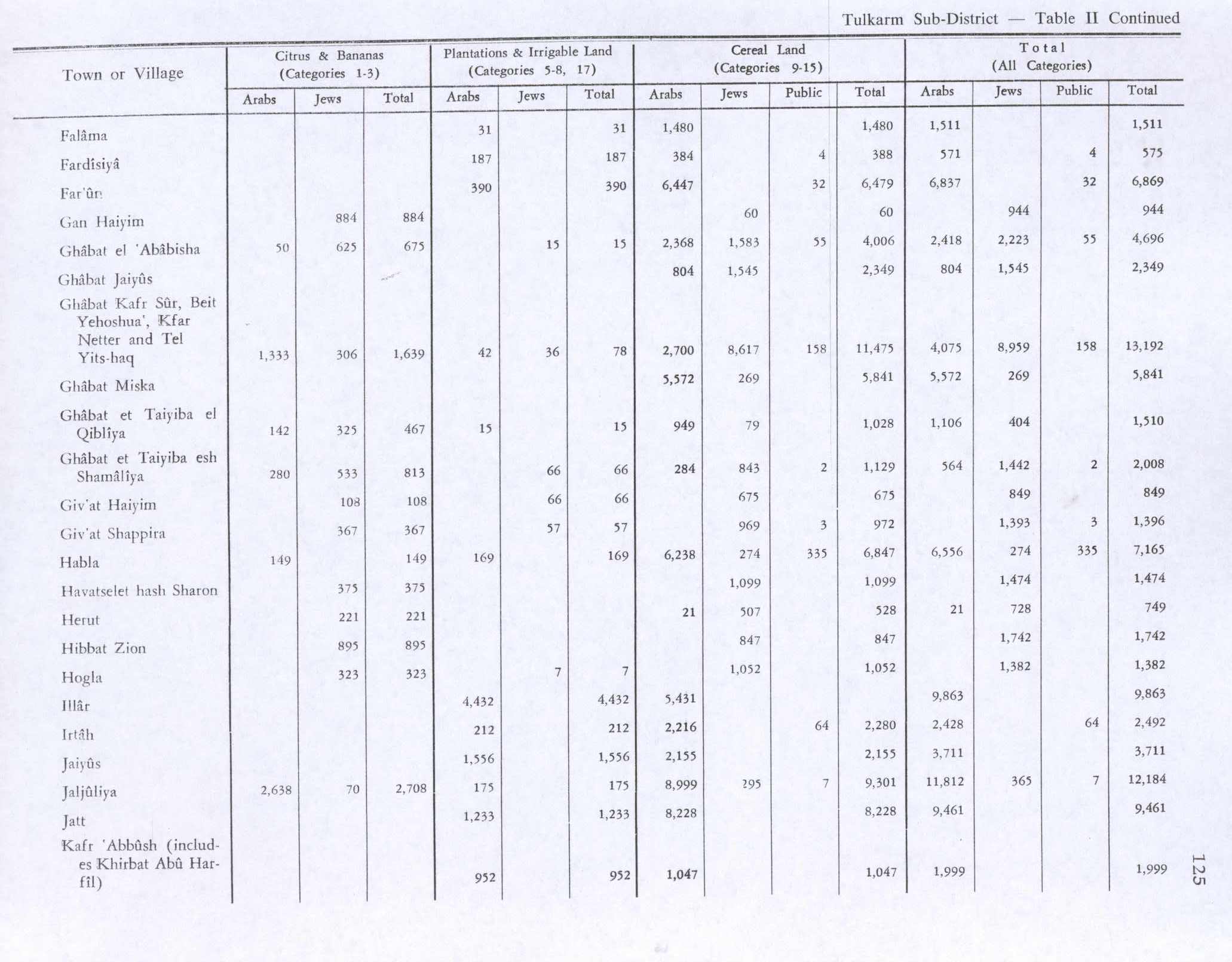
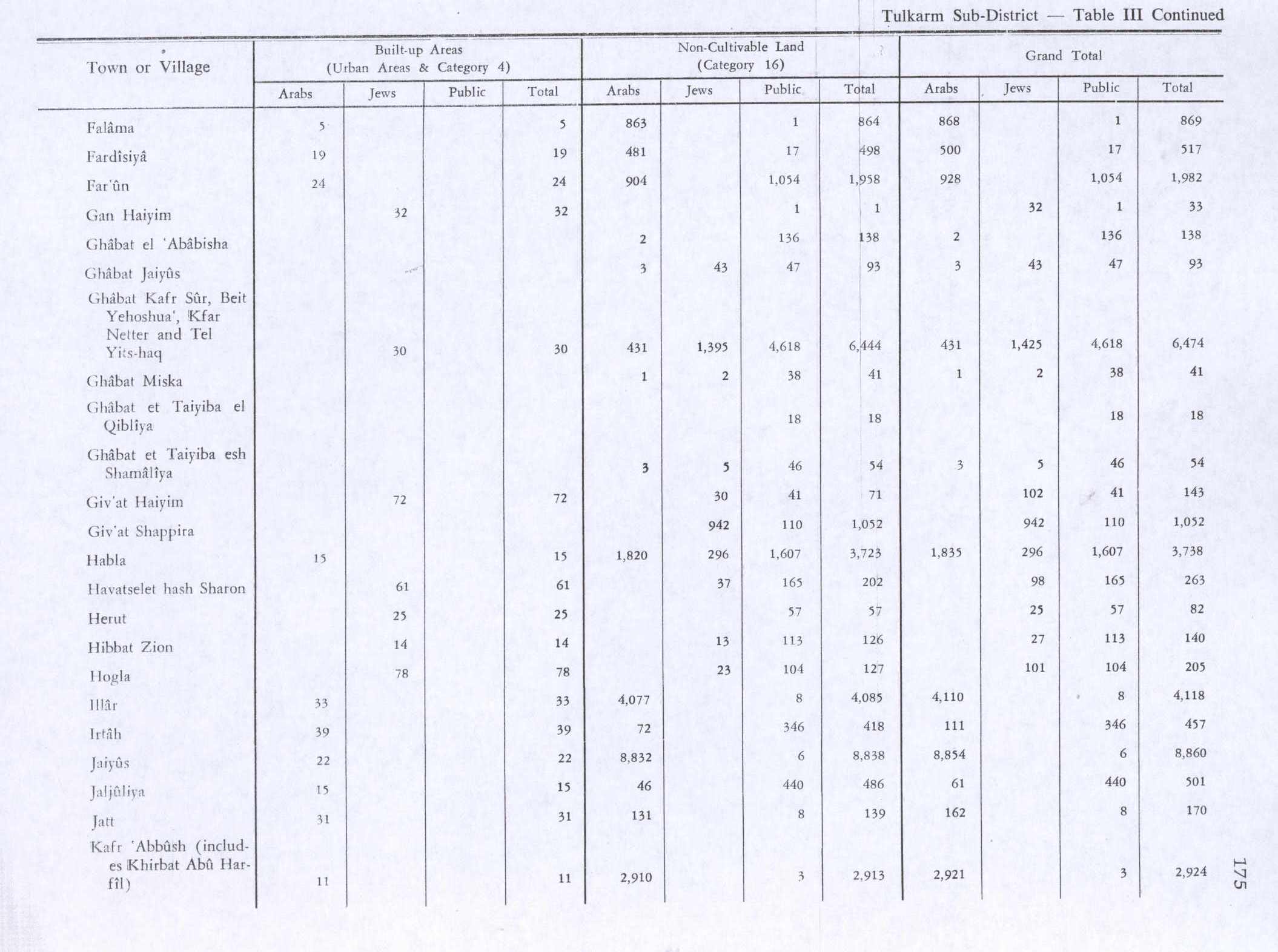
In the 1945 statistics the population of Kafr Abbush was 480 Muslims,[15] with 4,923 dunams of land according to an official land and population survey.[16] Of this, 952 dunams were plantations and irrigable land, 1,047 were used for cereals,[17] while 11 dunams were built-up (urban) land.[18]
-
Kafr Abbush 1942 1:20,000
-
Kafr Abbush 1945 1:250,000


Jordanian era
In the wake of the 1948 Arab–Israeli War, and after the 1949 Armistice Agreements, Kafr Abbush came under Jordanian rule.
In 1961, the population of Kafr Abbush was 704.[19]
Post 1967
Since the Six-Day War in 1967, Kafr Abbush has been under Israeli occupation.
Demography
Local origins
Residents of Kafr Abbush originally came from Egypt and Kafr Majdal (one village near Taybeh) in the 16th century.[20]
Footnotes
<templatestyles src="Reflist/styles.css" />
- ↑ Cite error: Script error: No such module "Namespace detect".Script error: No such module "Namespace detect".
- ↑ Projected Mid -Year Population for Tulkarm Governorate by Locality 2004- 2006 Template:Webarchive Palestinian Central Bureau of Statistics.
- ↑ Palestinian Population by Locality and Refugee Status Template:Webarchive Palestinian Central Bureau of Statistics
- ↑ Health care Facilities Tulkarm Governorate
- ↑ Dauphin, 1998, p. 772
- ↑ Script error: No such module "Citation/CS1".
- ↑ Hütteroth and Abdulfattah, 1977, p. 140
- ↑ Robinson and Smith, 1841, vol 3, Appendix 2, p. 127
- ↑ Script error: No such module "citation/CS1".
- ↑ Marom, Roy, "The Contribution of Conder's Tent Work in Palestine for the Understanding of Shifting Geographical, Social and Legal Realities in the Sharon during the Late Ottoman Period", in Gurevich D. and Kidron, A. (eds.), Exploring the Holy Land: 150 Years of the Palestine Exploration Fund, Sheffield, UK, Equinox (2019), pp. 212-231
- ↑ Script error: No such module "citation/CS1".
- ↑ Conder and Kitchener, 1882, SWP II, p. 165
- ↑ Barron, 1923, Table XI, Sub-district of Tulkarm, p. 27
- ↑ Mills, 1932, p.53
- ↑ Government of Palestine, Department of Statistics, 1945, p. 21
- ↑ Government of Palestine, Department of Statistics. Village Statistics, April, 1945. Quoted in Hadawi, 1970, p. 75
- ↑ Government of Palestine, Department of Statistics. Village Statistics, April, 1945. Quoted in Hadawi, 1970, p. 125
- ↑ Government of Palestine, Department of Statistics. Village Statistics, April, 1945. Quoted in Hadawi, 1970, p. 175
- ↑ Government of Jordan, 1964, p. 27
- ↑ Grossman, D. (1986). "Oscillations in the Rural Settlement of Samaria and Judaea in the Ottoman Period". in Shomron studies. Dar, S., Safrai, S., (eds). Tel Aviv: Hakibbutz Hameuchad Publishing House. p. 345

Script error: No such module "Check for unknown parameters".
Bibliography
<templatestyles src="Refbegin/styles.css" />
- Script error: No such module "citation/CS1".
- Script error: No such module "citation/CS1".
- Script error: No such module "citation/CS1".
- Script error: No such module "citation/CS1".
- Script error: No such module "citation/CS1".
- Script error: No such module "citation/CS1".
- Script error: No such module "citation/CS1".
- Script error: No such module "citation/CS1".
- Script error: No such module "citation/CS1".
- Script error: No such module "citation/CS1".
External links
- Welcome To Kafr Abbush
- Survey of Western Palestine, Map 11: IAA, Wikimedia commons

Script error: No such module "Navbox".