Immatain
Template:Short description Template:Protection padlock Script error: No such module "Settlement short description".Script error: No such module "Infobox".Script error: No such module "Check for unknown parameters".Script error: No such module "Check for conflicting parameters".Expression error: Unexpected < operator
Immatin (Template:Langx) is a Palestinian village located in the northwestern West Bank, in the Qalqilya Governorate of the State of Palestine, about seventeen kilometers southwest of Nablus.
Since 2012, the village of Farratin is included in Immatin.
Location
Elmatan (including the Far’ata locality) is located Script error: No such module "convert". west of Qalqiliya. It is bordered by Tell to the east, Deir Istiya to the south, Jinsafut, Al Funduq and Hajja to the west, and Kafr Qaddum and Jit to the north.[1]
History

Immatin has been identified with the Israelite village of Elmatan, which was mentioned in one of the Samaria Ostraca.[2]
Ceramics dating from the Byzantine period have been found in the village.[3]
According to a tradition recalled by a Samaritan High Priest in the 20th century, two hundred Samaritans in Immatin were reportedly forced to convert to Islam by Saladin; however, written sources make no further reference to this event.[4]
Ottoman era
Immatin was incorporated into the Ottoman Empire in 1517 with all of Palestine, and in 1596 Immatin appeared in the tax registers as Matin, being in the Nahiya of Jabal Qubal of the Liwa of Nablus. It had a population of 20 households and 1 bachelor, all Muslim. The villagers paid a fixed tax rate of 33.3% on a number of crops, including wheat, barley, summer crops, olives, goats and beehives; a total of 3,000 akçe.[5]
In 1838, Amatin was noted as located in Jurat Amra, south of Nablus.[6]
In 1870/1871 (1288 AH), an Ottoman census listed the village with a population of 33 households in the nahiya (sub-district) of Jamma'in al-Awwal, subordinate to Nablus.[7]
In 1882, the PEF's Survey of Western Palestine Immatin was described as "a village of moderates size on the slope of the hill, with a few olives."[8]
British Mandate era
In the 1922 census of Palestine conducted by the British Mandate authorities, Immatin had a population of 234, all Muslim,[9] increasing in the 1931 census to 334 Muslims in 67 houses.[10]
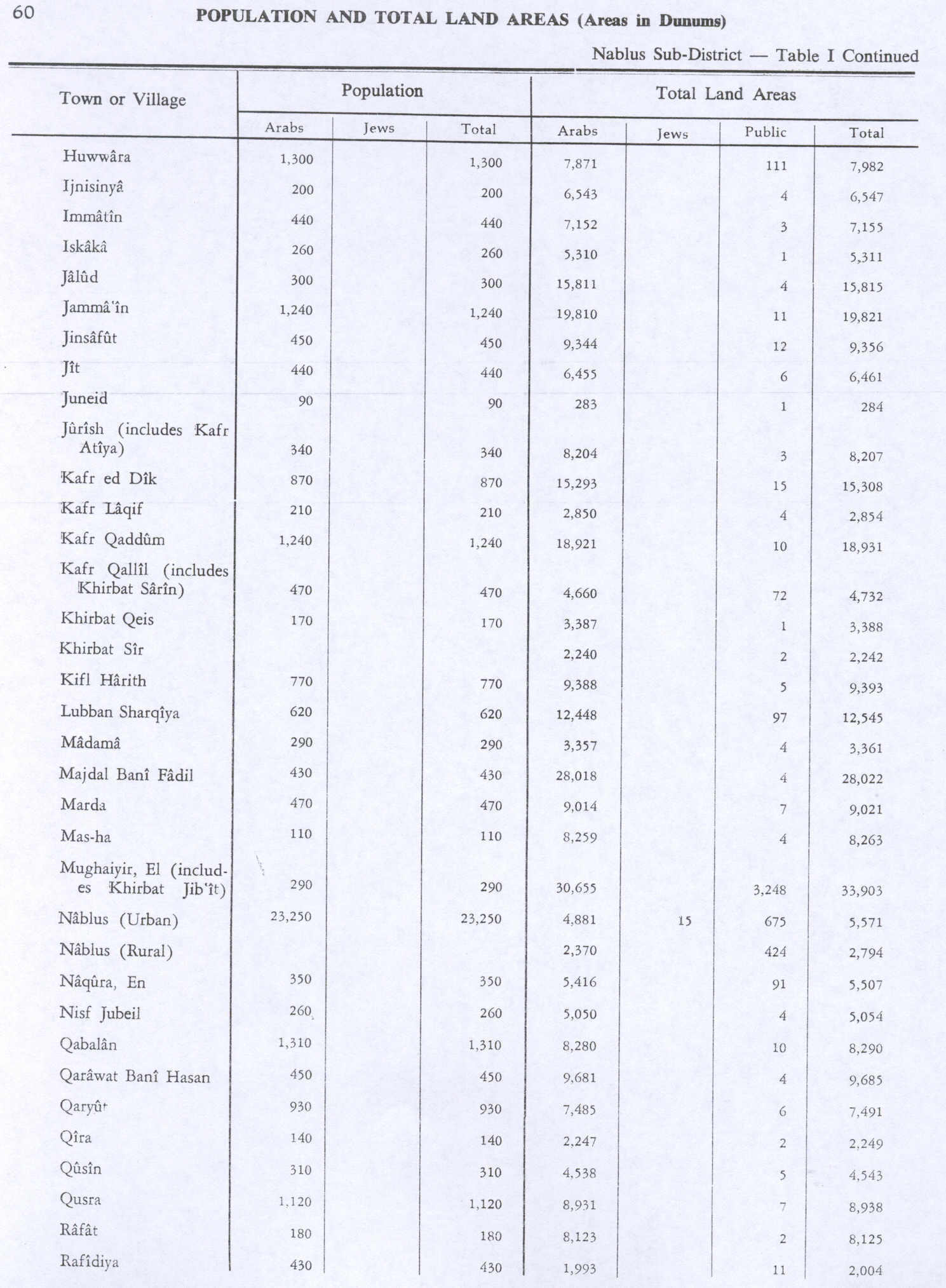
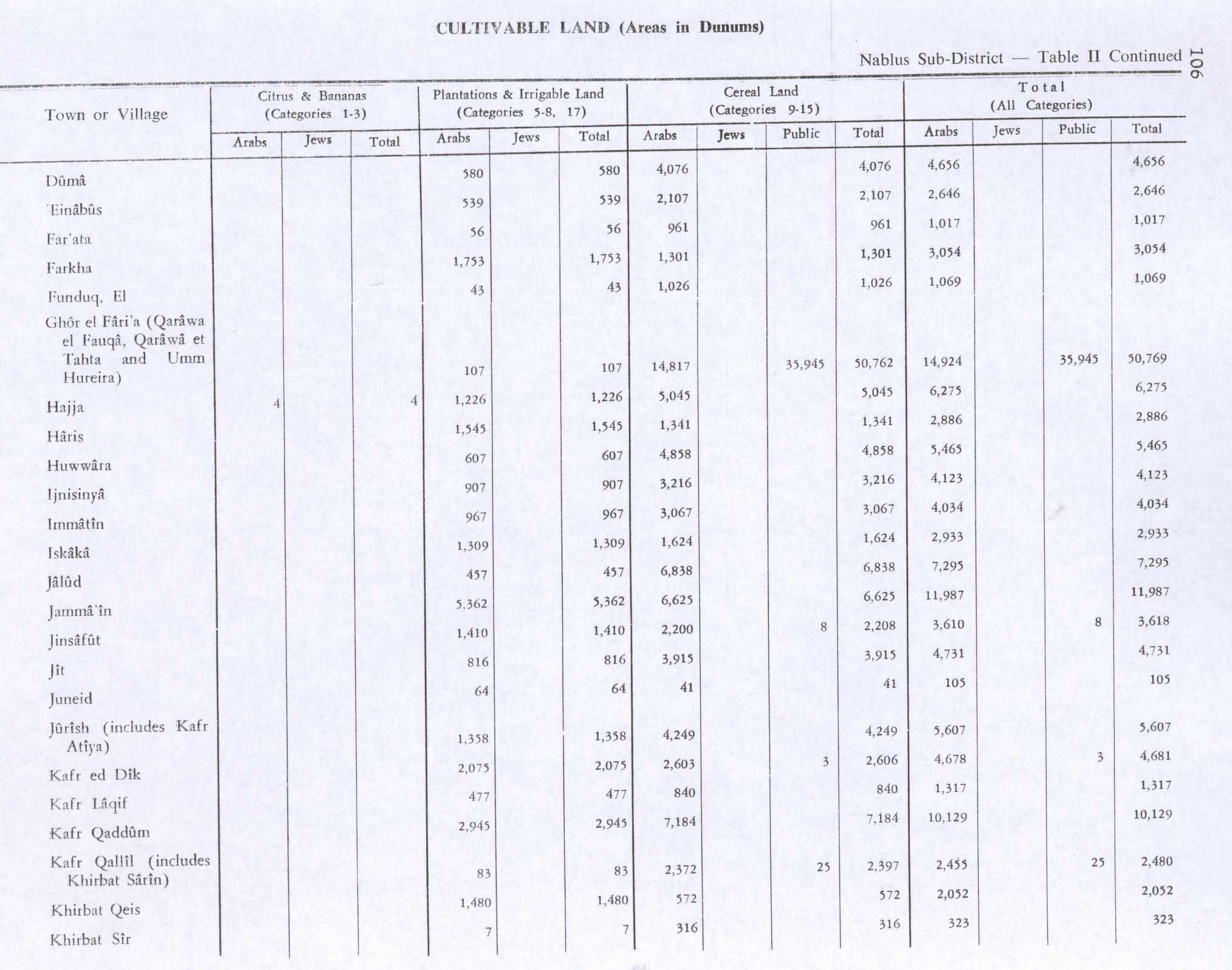
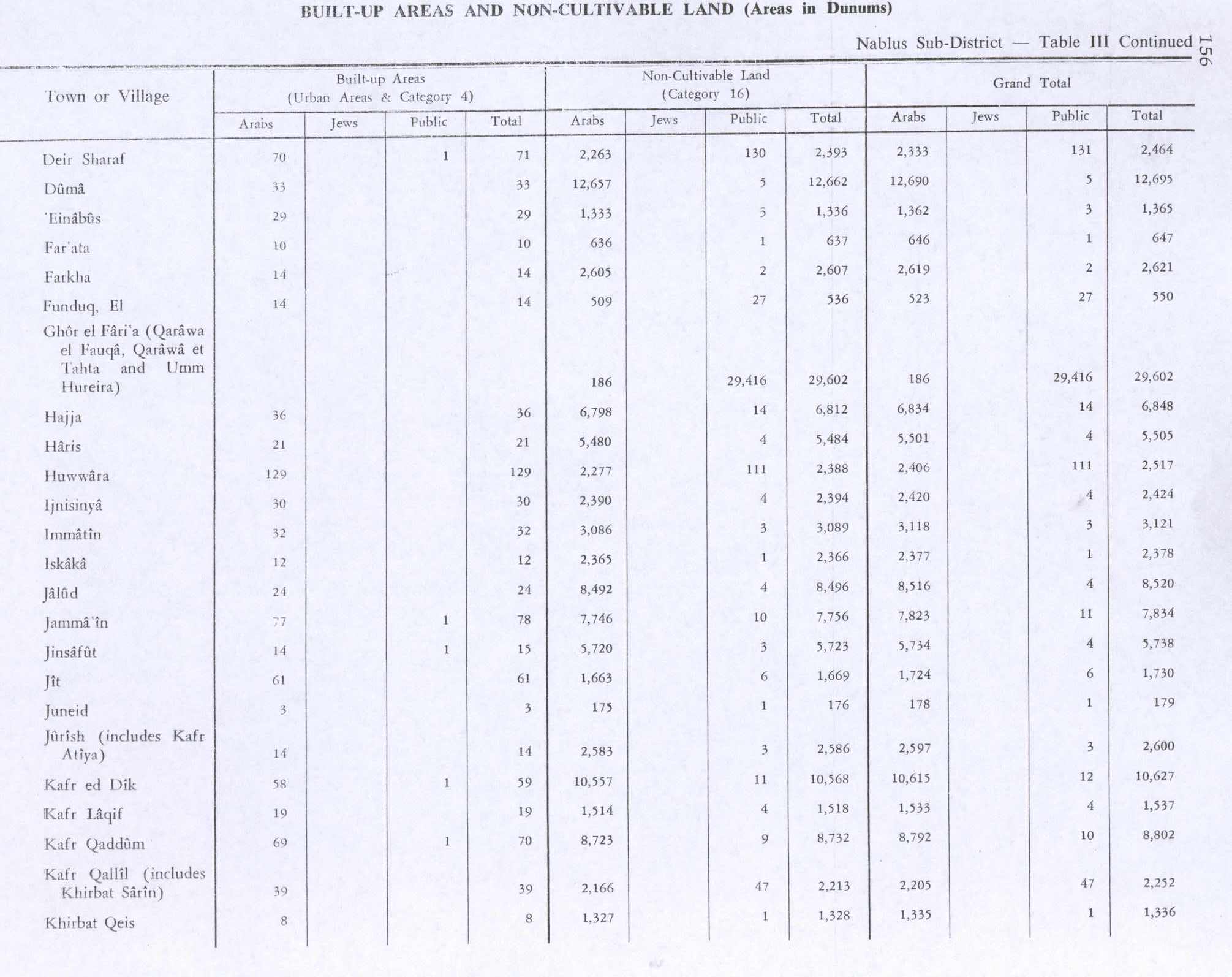
In the 1945 statistics the population of Immatin was 440, all Muslims,[11] while the total land area was 7,155 dunams, according to an official land and population survey.[12] Of this, 967 were allocated for plantations and irrigable land, 3,067 for cereals,[13] while 32 dunams were classified as built-up (urban) areas.[14]
Land ownership of Immatin in 1945
The following is a breakdown of land ownership in 1945.[12][11]
| Ethnic group | Land ownership (dunams) | Land ownership (%) |
|---|---|---|
| Arab | 7,152 | 99.9% |
| Jewish | 0 | 0% |
| Christian | 0 | 0% |
| Public | 3 | 0.0004% |
Land usage of Immatin in 1945
The following is a breakdown of the land usage during 1945 in the dunams.[13][11]
| Land usage type | Arab dunams | Percentage |
|---|---|---|
| Irrigated and plantation | 967 | 8% |
| Area planted with olives | 1,042 | 9% |
| Area planted with cereal | 3,067 | 25% |
| Built-up | 32 | 0.3% |
| Cultivable | 4,034 | 33% |
| Non-cultivable | 3,089 | 24.7% |
| Total | 12,240 | 100% |
Jordanian era
In the wake of the 1948 Arab–Israeli War, and after the 1949 Armistice Agreements, Immatin came under Jordanian rule. It was annexed by Jordan in 1950.
The Jordanian census of 1961 found 782 inhabitants in Immatin.[15]
Post-1967
Since the Six-Day War in 1967, Immatin has been held under Israeli occupation.
In 1992, the 19- year-old Bilal Ahmed Ghanan from Immatain was killed by Israeli soldiers. A "shocking picture" of Ghanan's stitched-up body accompanied a Aftonbladet 2009 news article about illegal organ removal allegations in the Israeli Abu Kabir Forensic Institute.[16]
After the 1995 accords, 58.3% of the total village land of Immatin/Far'ata was classified as Area B, while the remaining 41.7% was classified as Area C.[17] Israel has expropriated 163 dunams of land from Immatin for the construction of the Israeli settlement of ‘Sha’ar Emmanuel’, part of the Immanuel settlement.[18]
In 2013 complaint were made over "training exercises" which the Israeli army held in the village. “The troops spread out through the village for several hours, withdrawing just before midnight." According to the Israeli army, the exercise was a "navigating run … whose purpose was to acquaint the forces more closely with the relevant sector, as well as demonstrating IDF presence in the area".[19]
Population
According to the Palestinian Central Bureau of Statistics, Immatain had a population of approximately 2,450 inhabitants in mid-year 2006 and 2,755 by 2017.[20][21] Almost double the amount live abroad for political and economical reasons.Script error: No such module "Unsubst". Each year, on average two family units emigrate from Immatin.Script error: No such module "Unsubst". Immatin has four families. They are Sawwan, Ghanim, Albarree, and Matanee.
| Family name | Population est. | Percent of the population |
|---|---|---|
| Sawan | 1220 | 49.8% |
| Ghanim | 850 | 34.7% |
| Albaree | 255 | 10.4% |
| Matanee | 125 | 5.1% |
Population growth (1922 - 2007)
Source:[22]
Footnotes
<templatestyles src="Reflist/styles.css" />
- ↑ Cite error: Script error: No such module "Namespace detect".Script error: No such module "Namespace detect".
- ↑ Script error: No such module "Citation/CS1".
- ↑ Dauphin, 1998, p. 800
- ↑ Script error: No such module "citation/CS1".
- ↑ Hütteroth and Abdulfattah, 1977, p. 136
- ↑ Robinson and Smith, 1841, vol 3, Appendix 2, p. 127
- ↑ Script error: No such module "citation/CS1".
- ↑ Conder and Kitchener, 1882, SWP II, p. 162
- ↑ Barron, 1923, Table IX, Sub-district of Nablus, p. 25
- ↑ Mills, 1932, p. 62
- ↑ a b c Government of Palestine, Department of Statistics, 1945, p. 18
- ↑ a b Government of Palestine, Department of Statistics. Village Statistics, April, 1945. Quoted in Hadawi, 1970, p. 60
- ↑ a b Government of Palestine, Department of Statistics. Village Statistics, April, 1945. Quoted in Hadawi, 1970, p. 106
- ↑ Government of Palestine, Department of Statistics. Village Statistics, April, 1945. Quoted in Hadawi, 1970, p. 156
- ↑ Government of Jordan, Department of Statistics, 1964, p. 25
- ↑ Script error: No such module "citation/CS1".
- ↑ Immatin Village Profile (including Far’ata Locality), ARIJ, p. 16
- ↑ Immatin Village Profile (including Far’ata Locality), ARIJ, p. 17
- ↑ Palestinian villages subject to Israeli mock raids not told they are exercises, Harriet Sherwood, 12 Nov 2013, The Guardian
- ↑ Cite error: Script error: No such module "Namespace detect".Script error: No such module "Namespace detect".
- ↑ Projected Mid -Year Population Script error: No such module "webarchive". for Qalqilya Governorate by Locality 2004- 2006 Palestinian Central Bureau of Statistics.
- ↑ Script error: No such module "citation/CS1".

Script error: No such module "Check for unknown parameters".
Bibliography
<templatestyles src="Refbegin/styles.css" />
- Script error: No such module "citation/CS1".
- Script error: No such module "citation/CS1".
- Script error: No such module "citation/CS1".
- Script error: No such module "citation/CS1".
- Script error: No such module "citation/CS1".
- Script error: No such module "citation/CS1".
- Script error: No such module "citation/CS1".
- Script error: No such module "citation/CS1".
- Script error: No such module "citation/CS1".
- Script error: No such module "citation/CS1".
- Script error: No such module "citation/CS1".
External links
- Welcome To Immatin
- Survey of Western Palestine, Map 11: IAA, Wikimedia commons
- Immatin Village (including Far’ata Locality) (Fact Sheet), Applied Research Institute–Jerusalem (ARIJ)
- Immatin Village Profile (including Far’ata Locality), ARIJ
- Immatin, aerial photo, ARIJ
- Development Priorities and Needs in Imatin (including Far’ata Locality), ARIJ
- Israeli Hoax of Barriers removal 22, June, 2004
- New Palestinian Enclaves created by the Israeli updated wall map around Ariel Settlement Bloc. 14, June, 2006, POICA
- Testimony: Settlers attack Palestinian farmers on their land, Jan. '09, B'Tselem
- Gilad Zoher colony: a source of continuous aggression against Palestinian farmers, 20, May, 2009, POICA
- Harvest under Fire, This week in Palestine


Script error: No such module "Navbox". Script error: No such module "Authority control".