Idna
Script error: No such module "about". Template:Pp-extended Script error: No such module "Settlement short description".Script error: No such module "Infobox".Script error: No such module "Check for unknown parameters".Script error: No such module "Check for conflicting parameters".Expression error: Unexpected < operator
Idna or Idhna (Template:Langx) is a Palestinian town in the southern West Bank, located in the Hebron Governorate of the State of Palestine, 13 kilometers west of Hebron and about one kilometer east of the Green Line. According to the Palestinian Central Bureau of Statistics, the town had a population of 26,009 inhabitants in 2017.[1]
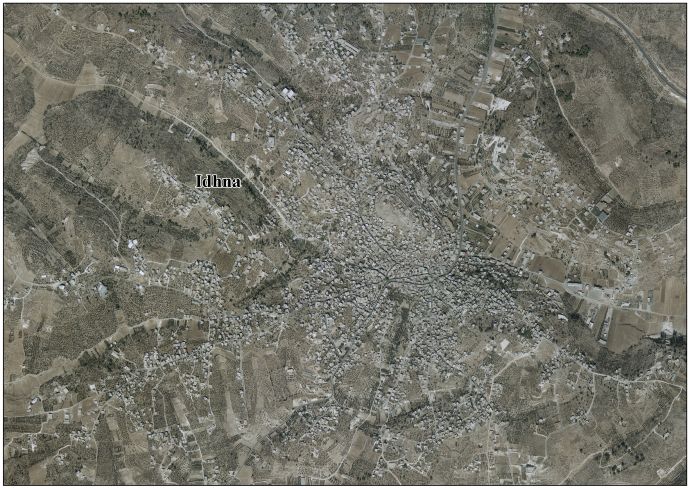
Idna is physically divided into southern and northern parts by the Wadi al-Feranj.[2] Idna's primary source of income is agriculture and the town's total land area is 21,526 dunams (Template:Cvt), of which 2,809 dunams (Template:Cvt) are built up area.[3] Idna is governed by a municipal council of thirteen members and six departments.[4]
History
Idna's site was inhabited since Canaanite times (the Bronze Age), evident from ancient remains found in the town. The town has been suggested being identified with the biblical city of Dannah, mentioned in the Book of Joshua (15:49) as a town of Judah.[5][6]
Hebrews, Romans, Byzantines and Arabs succeeded in gaining control of the town and coins, statues, tombs and pottery dating from these various rulers were found in the town.[7]
Writing in the early 4th century, Eusebius mentioned a village named Iedna as being six miles from Eleutheropolis on the road to Hebron.[8]
In 2018, a set of Roman-era tombs from the first century CE, when the region was part of Roman-controlled Judaea, was found in Idna.[9]
In February 1262, Baybars’ endowed Idhna, than an inhabited village, to the Mosque of the Cave of the Patriarchs.[10]
Ottoman era
Idna was incorporated into the Ottoman Empire in 1517 with all of Palestine. An Ottoman fiscal source from c. 1525 - 28 mentions Idhna among the villages whose residents had scattered.[10]
By 1596 it appeared in the tax registers as being in the nahiya of Halil in the liwa of Quds. It had a population of 68 households, all Muslim. They paid a fixed tax rate of 33,3% on agricultural products, including wheat, barley, olives, vineyards, fruit trees, goats and/or beehives; a total of 19,000 akçe. All of the revenue went to a waqf.[11]
Edward Robinson, who visited Idna in 1838, recorded that the town's two parts were led by a sheikh and the inhabitants of each part followed and backed their respective sheikh in internal quarrels. Adjacent to Idna are the ruins of the original village which is totally covered by cultivable fields. Tesserae (mosaic stones) were found on the site.[2][12] Idna was further noted as a Muslim village located between the mountains and the plain of Gaza, but subject to the government of el-Khuhlil.[13]
Victor Guérin visited Idna in June 1863 and described a village with almost 500 inhabitants, divided into two districts, each ruled by a sheikh. Many houses, especially a small Bordj, had substructures of stone, which, to all appearances, were dating back to antiquity.[14]
An Ottoman village list of about 1870 showed that Idna had 22 houses and a population of 108, though the population count included only men.[15][16]
According to Marom,
By the second half of the nineteenth century, in tandem with the Ottoman Land code reforms which allocated abandoned lands to inhabited villages, Idhna absorbed Bayt ‘Alām, Bayt al-Bān, Tayyibat al-Ism, Umm al-Jamājim and other sites, covering 34 km2 of land. Idhna’s residents held possession of the miri (state owned) lands [...] in common [...]. Cultivation of each plot was rotated between Idhna’s six main clans on a bi-annual basis. Because of the distance of the lands from Idhna, residents established seasonal quarters among Idhna’s khirab (ruined/temporary sites). [....] Negev nomads from the Jubārāt, Ramādīn, and Wuhaydī tribes also frequented the area in times of drought.[10]
In 1883 the PEF's Survey of Western Palestine (SWP) described Idna as "a small village on the south slope of a hill [ ] divided by a small depression into two."[17] SWP further found that near the town were several large caves with niches for lamps or skulls.[18]
British Mandate era

In the 1922 census of Palestine, conducted by the British Mandate authorities, Idna had a population of 1,300, all Muslim,[19] increasing in the 1931 census to 1,719, still all Muslim, in 317 houses.[20] Idhna’s inscreasing population reflects the demographic transition resulting from improved health care and food security.[10]
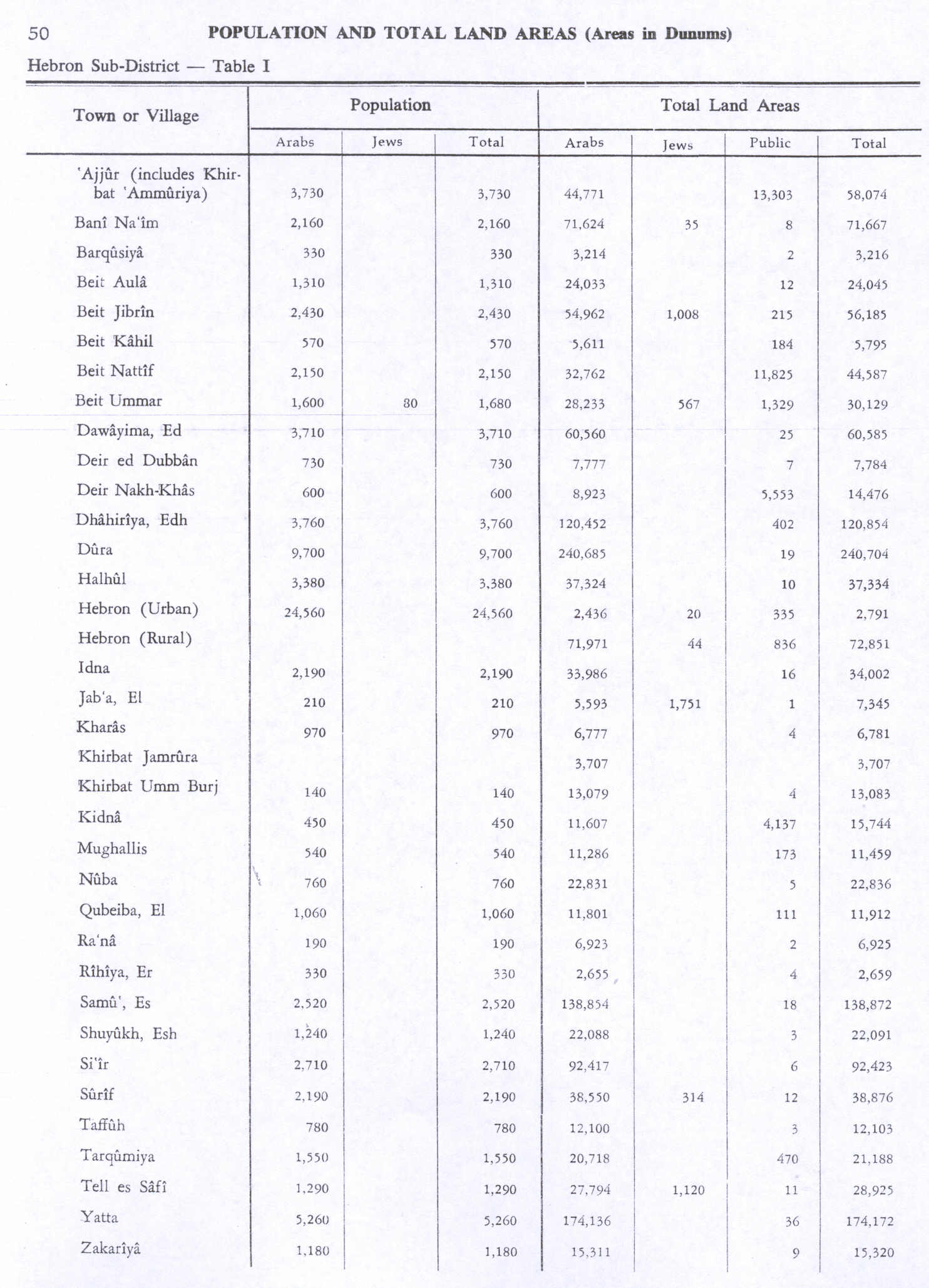
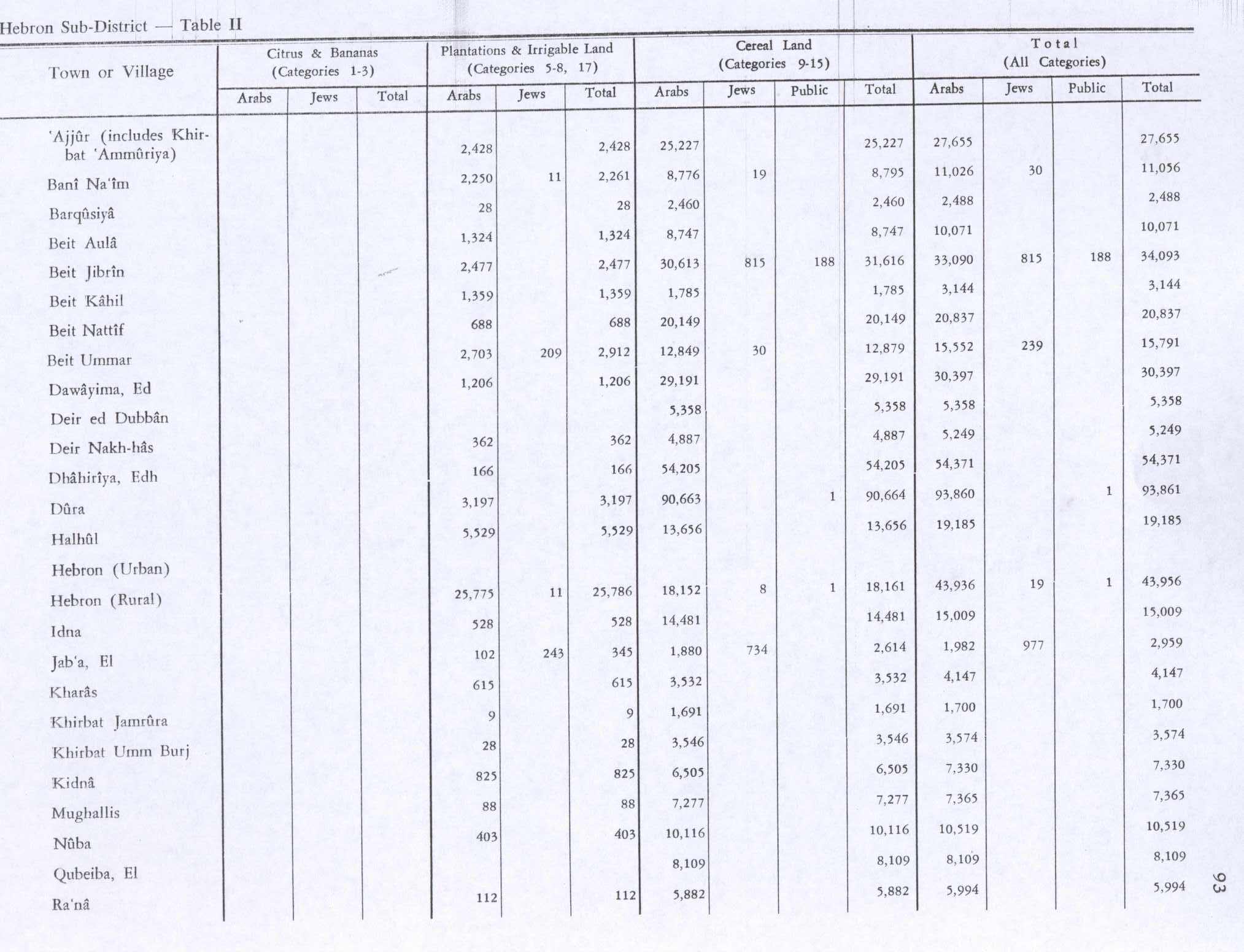
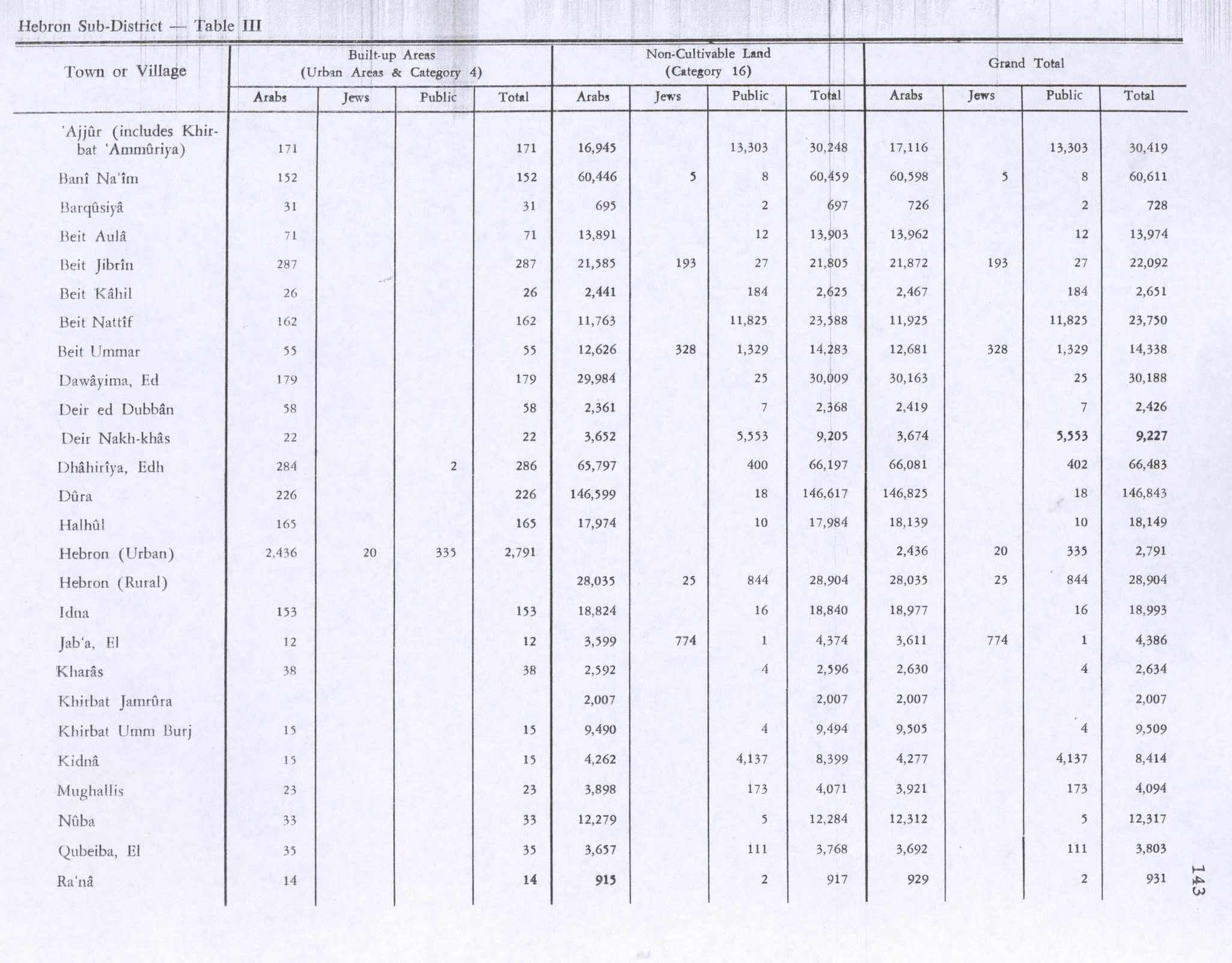
In the 1945 statistics the population of Idna was 2,190, all Muslims,[21] who owned 34,002 dunams of land according to an official land and population survey.[22] 528 dunams were plantations and irrigable land, 14,481 for cereals,[23] while 153 dunams were built-up (urban) land.[24]

Jordanian era
In the wake of the 1948 Arab–Israeli War, and after the 1949 Armistice Agreements, Idna came under Jordanian rule.
The Jordanian census of 1961 recorded 3,568 inhabitants in Idna.[25]
1967, aftermath
Since the Six-Day War in 1967, Idna has been under Israeli occupation. The population in the 1967 census conducted by the Israeli authorities was 3,713.[26]
Since 1995, Idna has been governed by the Palestinian National Authority as part of Area B of the West Bank. Today, the population is wholly Muslim.
On 14 April 2014, Baruch Mizrahi, 47-year-old Israeli police officer, was shot dead near Tarqumiyah by a Hamas-affiliated gunman from Idna.[27][28]
On 25 April 2015, Mahmoud Abu Jheisha, 20 years old, from Idna was shot dead in Hebron after he had been accused of stabbing an Israeli soldier.[29][30]
References
<templatestyles src="Reflist/styles.css" />
- ↑ Cite error: Script error: No such module "Namespace detect".Script error: No such module "Namespace detect".
- ↑ a b Robinson and Smith, 1856, pp. 69-70
- ↑ Demolitions, threats of demolitions and evictions in Idhna town - Hebron Governorate Script error: No such module "webarchive". Land Research Center. 24 February 2007
- ↑ Municipality of Idna Script error: No such module "webarchive". Idna Municipality.
- ↑ Conder and Kitchener, 1881, SWP III, p. 305
- ↑ Bromiley, 1979, pp. 319, 866
- ↑ History of Idna Script error: No such module "webarchive". Idna Municipality.
- ↑ Script error: No such module "citation/CS1".
- ↑ Script error: No such module "citation/CS1".
- ↑ a b c d Script error: No such module "Citation/CS1".
- ↑ Hütteroth and Abdulfattah, 1977, p. 124.
- ↑ Robinson and Smith, 1841, vol 2, p. 425
- ↑ Robinson and Smith, 1841, vol 3, Appendix 2, p. 117
- ↑ Guérin, 1869, pp. 364-5
- ↑ Socin, 1879, p. 155
- ↑ Hartmann, 1883, p. 142, noted 60 houses
- ↑ Conder and Kitchener, 1883, SWP III, p. 305
- ↑ Conder and Kitchener, 1883, SWP III, p. 330
- ↑ Barron, 1923, Table V, Sub-district of Hebron, p. 10
- ↑ Mills, 1932, p. 32.
- ↑ Government of Palestine, Department of Statistics, 1945, p. 23
- ↑ Government of Palestine, Department of Statistics. Village Statistics, April, 1945. Quoted in Hadawi, 1970, p. 50
- ↑ Government of Palestine, Department of Statistics. Village Statistics, April, 1945. Quoted in Hadawi, 1970, p. 93
- ↑ Government of Palestine, Department of Statistics. Village Statistics, April, 1945. Quoted in Hadawi, 1970, p. 143
- ↑ Government of Jordan, Department of Statistics, 1964, p. 13
- ↑ Script error: No such module "citation/CS1".
- ↑ Script error: No such module "citation/CS1".
- ↑ Script error: No such module "citation/CS1".
- ↑ [1] Ma'an 25/4/2015
- ↑ Script error: No such module "citation/CS1".

Script error: No such module "Check for unknown parameters".
Bibliography
<templatestyles src="Refbegin/styles.css" />
- Script error: No such module "citation/CS1".
- Script error: No such module "citation/CS1".
- Script error: No such module "citation/CS1".
- Script error: No such module "citation/CS1".
- Script error: No such module "citation/CS1".
- Script error: No such module "citation/CS1".
- Script error: No such module "citation/CS1".
- Script error: No such module "Citation/CS1".
- Script error: No such module "citation/CS1".
- Script error: No such module "citation/CS1".
- Script error: No such module "citation/CS1".
- Script error: No such module "citation/CS1".
- Script error: No such module "citation/CS1".
- Script error: No such module "citation/CS1".
- Script error: No such module "Citation/CS1".
External links
Script error: No such module "Side box".
- Welcome To Idna
- Idna, Welcome to Palestine
- Survey of Western Palestine, Map 21: IAA, Wikimedia commons
- Script error: No such module "citation/CS1".
- Idna Town (Fact Sheet), Applied Research Institute–Jerusalem (ARIJ)
- Idna Town Profile, ARIJ
- Idna aerial photo, ARIJ
- The priorities and needs for development in Idna town based on the community and local authorities’ assessment, ARIJ
- Idhna, Idna

Template:Cities in Palestinian National Authority areas Script error: No such module "Navbox". Script error: No such module "Authority control".