Hylonomus
Template:Short description Template:Speciesbox
Hylonomus (Script error: No such module "IPAc-en".; hylo- "forest" + nomos "dweller")[1] is an extinct genus of reptile that lived 318 million years ago during the Bashkirian stage of the Late Carboniferous. It is the earliest known crown group amniote and the oldest known unquestionable reptile, with the only known species being Hylonomus lyelli.[2][3] Despite being amongst the oldest known reptiles, it is not the most primitive member of the group, being a eureptile more derived than either parareptiles or captorhinids.
Discovery and naming
Hylonomus lyelli was first described by John William Dawson in 1860.[4] The species' name was given in honor of Dawson's teacher, the geologist Sir Charles Lyell. While it has traditionally been included in the group Protorothyrididae, it has since been recovered outside this group.[5][6]
Formerly assigned species
Dawson also attributed two other species H. aciedentatus and H. wymani when he described H. lyelli in 1860, and later described two more species H. multidens and H. latidens in 1882. In 1966, Robert L. Carroll suggested that H. latidens is synonymous with the type species H. lyelli and that H. multidens belongs to a different genus of 'microsaur' which he named as Novascoticus. Both H. aciedentatus (also known as Smilerpeton aciedentatum) and H. wymani (RM 3061-9) are later reclassified as specimens of Dendrerpeton acadianum.[7][8]
Description


Hylonomus was Script error: No such module "convert". long (including the tail). Most of them are 20 cm long and probably would have looked rather similar to modern lizards. It had small sharp teeth and it likely ate small invertebrates such as millipedes or early insects.[9] Specimens of Hylonomus indicate that their bodies are covered with horny scales.[10] They are also described as having slender and lightweight leg and arm bones, long and slim hands and feet, a narrow and tongue-shaped part in the roof of the mouth, a deep groove on a certain bone in the skull, a bumpy structure on the back bones, changes in the height of certain back bone parts, a hole in a specific place on the skull, arm and leg bones that are the same length, a short fourth toe bone compared to the shin bone, a short fifth toe bone compared to the fourth toe bone, long neck bones, and a well-developed opening below the eye.[11]

Fossils of the basal pelycosaur Archaeothyris and the basal diapsid Petrolacosaurus are also found in the same region of Nova Scotia, although from a higher stratum, dated approximately 6 million years later.[12]
Fossilized footprints found in New Brunswick have been attributed to Hylonomus, at an estimated age of 315 million years.[13]
Paleoecology
Fossils of Hylonomus have been found in the remains of fossilized club moss stumps in the Joggins Formation, Joggins, Nova Scotia, Canada. It is supposed that, after harsh weather, the club mosses would crash down, with the stumps eventually rotting and hollowing out. Small animals such as Hylonomus, seeking shelter, would enter and become trapped, starving to death. An alternative hypothesis is that the animals made their nests in the hollow tree stumps.[14]
In popular culture
Hylonomus lyelli was named the Provincial Fossil of Nova Scotia in 2002.[15]
References
<templatestyles src="Reflist/styles.css" />
- ↑ Genus Hylonomus Etymology
- ↑ Script error: No such module "Citation/CS1".
- ↑ Script error: No such module "Citation/CS1".
- ↑ Script error: No such module "Citation/CS1".
- ↑ Script error: No such module "Citation/CS1".
- ↑ Script error: No such module "Citation/CS1".
- ↑ Script error: No such module "Citation/CS1".
- ↑ Script error: No such module "Citation/CS1".
- ↑ Script error: No such module "citation/CS1".
- ↑ Script error: No such module "Citation/CS1".
- ↑ Muller, J.; Reisz, R. R. (2006). "The phylogeny of early eureptiles: Comparing parsimony and Bayesian approaches in the investigation of a basal fossil clade". Systematic Biology. 55 (3): 503–511. doi:10.1080/10635150600755396. PMID 16861212.
- ↑ Script error: No such module "Citation/CS1".
- ↑ Falcon-Lang, H.J., Benton, M.J. & Stimson, M. (2007): Ecology of early reptiles inferred from Lower Pennsylvanian trackways. Journal of the Geological Society, London, 164; no. 6; pp 1113-1118. article
- ↑ Script error: No such module "citation/CS1".
- ↑ Script error: No such module "citation/CS1".
Script error: No such module "Check for unknown parameters".
External links
- Fossils of Nova Scotia - The Tree Stump Animals
- Transitional Vertebrate Fossils FAQ Part 1B
- Early Researchers & Finds of the Joggins Fossil Cliffs
- The Science of the Joggins Fossil Cliffs
- Hylonomus: Provincial Fossil of Nova Scotia Script error: No such module "webarchive".
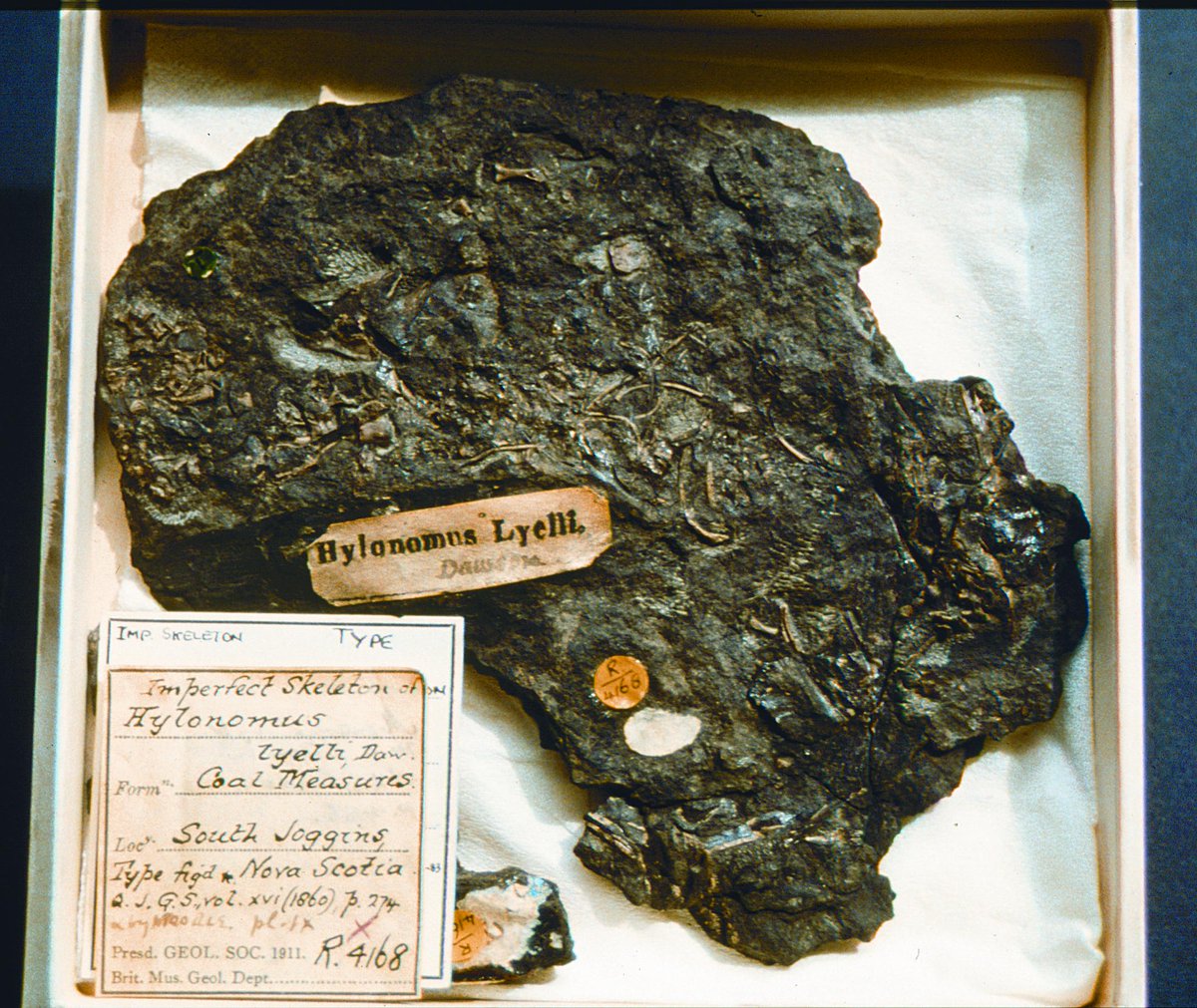
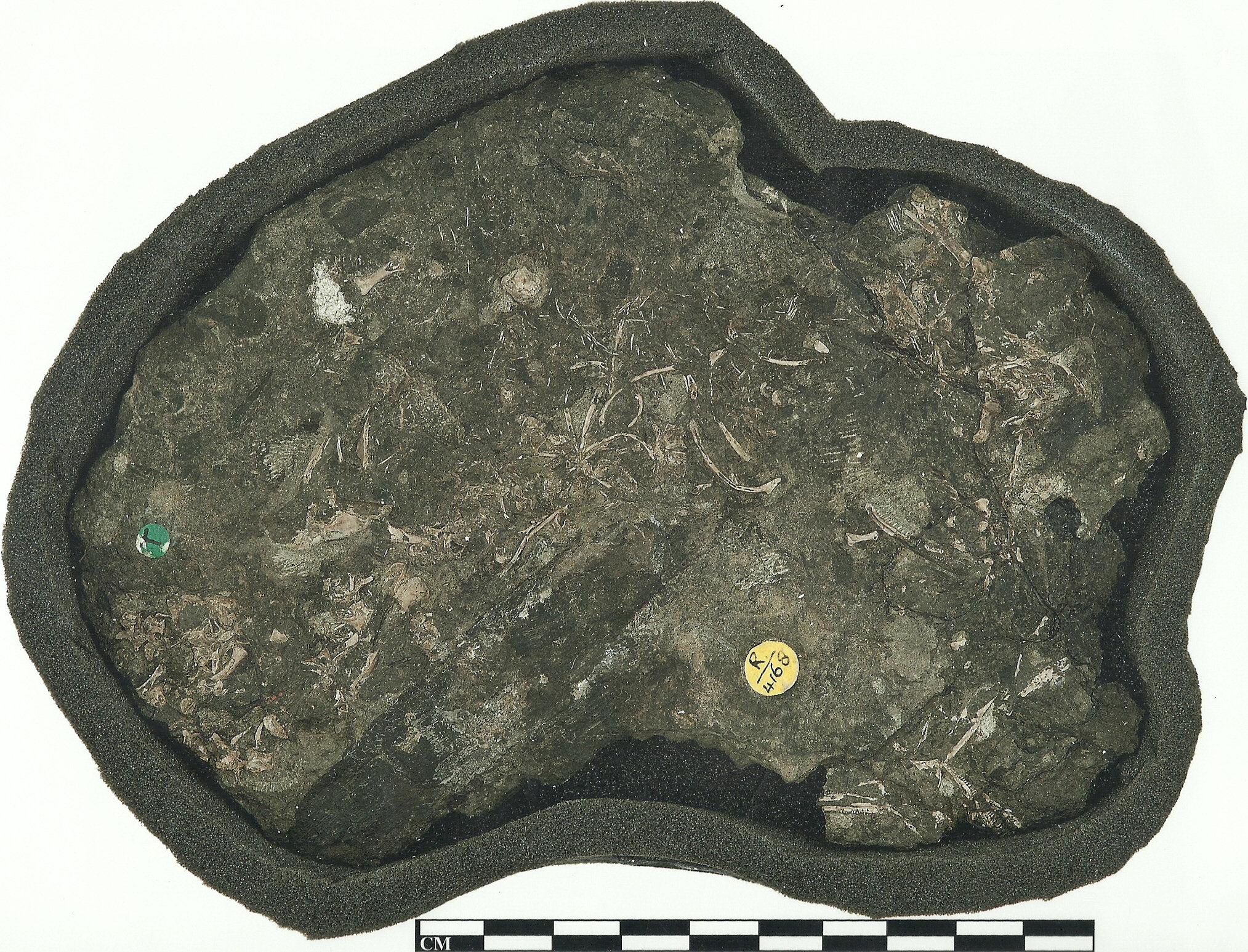
- A photograph of the disarticulated skeleton, credited to J. Calder
- Another photo of the specimen, from Dr. Melissa Grey's twitter account
Script error: No such module "Portal". Template:Early tetrapods Template:Taxonbar