Ghijak
Template:Short description Script error: No such module "Unsubst".
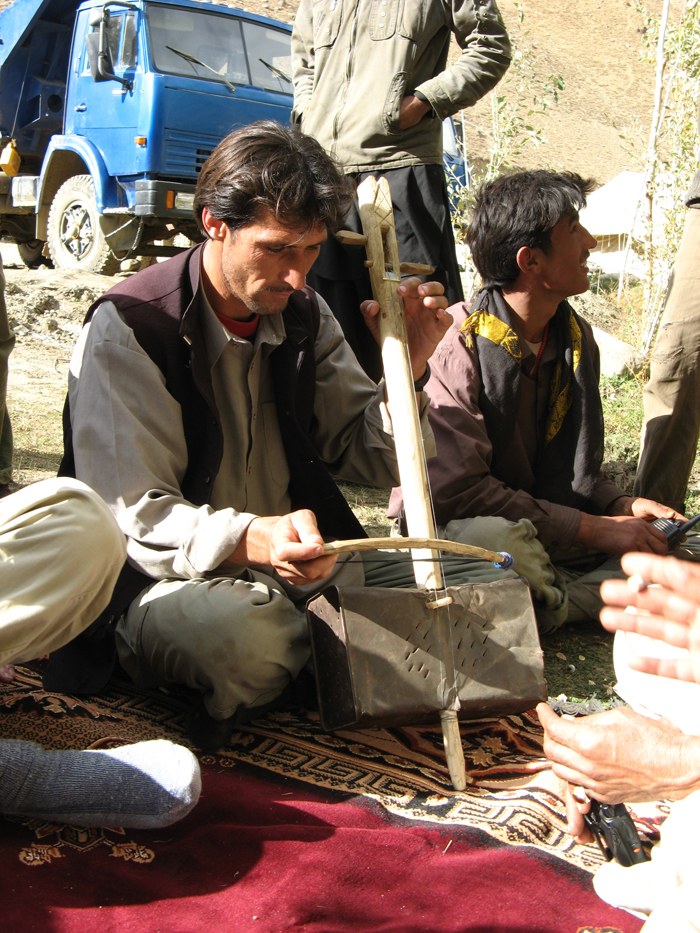
Script error: No such module "Infobox".Script error: No such module "Check for unknown parameters". The ghijak (also spelled ghidjak, ghichak, gidzhak, gijak, g'ijjak,[1] Template:Langx, or ghijek (Template:Langx, or occasionally Template:Langx; Chinese: 艾捷克 aijieke or 吉孜哈克 jizihake; Template:Langx), is a group of related spike fiddles, used by Afghans, Uzbeks, Uyghurs, Tajiks, Turkmens, Qaraqalpaks[2] and in the Xinjiang province of western China. Despite the similarity of the name, it is more closely related to the Persian kamancheh than the ghaychak.
History

The instrument name appears in 10th-century manuscripts, which indicate that the bridge (harrak) was made of almond shells. The ghidjak as depicted in 15th-century Persian miniatures resembles the modern instrument in its construction.[1]
Xinjiang
The ghijek as it is used in Xinjiang has four strings, either with a bowl soundbox (similar to the kamancheh), or with a box soundbox often made from a tin can.[3] One of Xinjiang's most prominent ghijek players is Akram Omar (艾克热木·吾买尔 / ئەكرەم ئۆمەر / Акрам Омар), from Kashgar.video
See also
References
<templatestyles src="Reflist/styles.css" />
Script error: No such module "Check for unknown parameters".
External links
- Afghan ghaychak (box lute)
- Tajik ghijak (box lute Script error: No such module "webarchive".
Script error: No such module "Navbox". Script error: No such module "Authority control".
- Pages with script errors
- Wikipedia articles incorporating the Cite Grove template
- Wikipedia articles incorporating the Cite Grove template with a doi parameter
- Pages with broken file links
- Chinese musical instruments
- Culture in Xinjiang
- Uyghur musical instruments
- Kazakhstani musical instruments
- Kyrgyz musical instruments
- Afghan musical instruments
- Uzbekistani musical instruments
- Tajik musical instruments
- Turkmen musical instruments