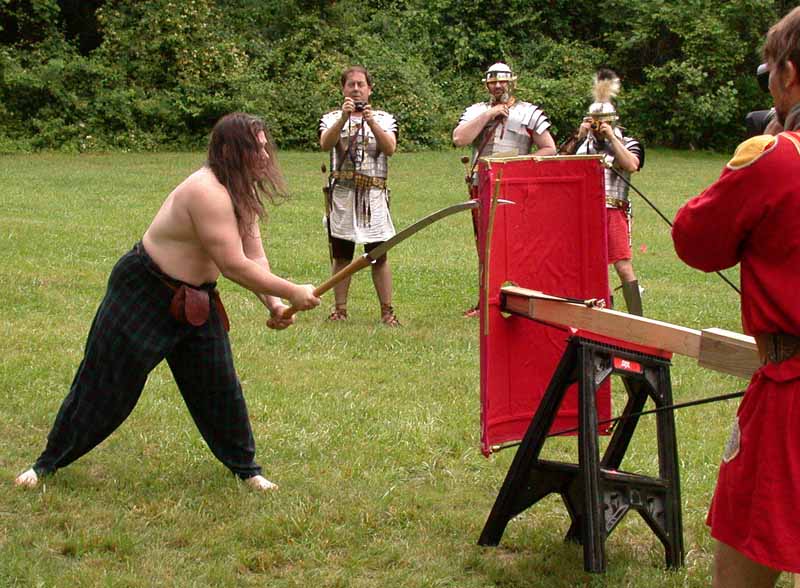
Falx
Template:Short description Script error: No such module "Italic title". Script error: No such module "other uses".

The Script error: No such module "Lang". was a weapon with a curved blade that was sharp on the inside edge used by the Thracians and Dacians. The name was later applied to a siege hook used by the Romans.
Etymology
Script error: No such module "Lang". is a Latin word originally meaning 'sickle' but was later used to mean any of a number of tools that had a curved blade that was sharp on the inside edge like a sickle. Script error: No such module "Lang". was thus also used to mean the weapon of the Thracians and Dacians, and the Roman siege hook.
Dacian falx

In Latin texts, the weapon was described as an Script error: No such module "Lang". (whence Script error: No such module "Lang".) by Ovid in Script error: No such module "Lang". and as a Script error: No such module "Lang". by Juvenal in Script error: No such module "Lang"..
The Dacian Script error: No such module "Lang". came in two sizes: one-handed and two-handed. The shorter variant was called Script error: No such module "Lang".[2] (sickle) in the Dacian language (Valerius Maximus, III, 2.12) with a blade length that varied but was usually around Script error: No such module "convert". long with a handle one-third longer than the blade. The two-handed Script error: No such module "Lang". was a polearm. It consisted of a Script error: No such module "convert". wooden shaft with a long curved iron blade of nearly-equal length attached to the end. Archaeological evidence indicates that the one-handed Script error: No such module "Lang". was also used two-handed.[3]
The blade was sharpened only on the inside and was reputed to be devastatingly effective. However, it left its user vulnerable because, being a two-handed weapon, the warrior could not also make use of a shield. It may be imagined that the length of the two-handed Script error: No such module "Lang". allowed it to be wielded with great force, the point piercing helmets and the blade splitting shields – it was said to be capable of splitting a shield in two at a single blow. Alternatively, it might have been used as a hook, pulling away shields and cutting at vulnerable limbs, or striking the edge of a strong shield. The inward curving point was still able to pierce the armour or flesh of the target behind the shield, rendering even the most reinforced shields much less effective against a Script error: No such module "Lang". wielder.
Trajan's column is a monument to the emperor's conquest of Dacia. The massive base is covered with reliefs of trophies of Dacian weapons and includes several illustrations of the two-handed Script error: No such module "Lang".. The column itself has a helical frieze that tells the story of the Dacian wars. On the frieze, almost all the Dacians that are armed have shields and therefore cannot be using two-handed Script error: No such module "Lang".. The exact weapon of those few shown without shields cannot be determined with certainty. The frieze of Trajan's column also shows Dacians using smaller, sword-sized Script error: No such module "Lang".. However, this column is also largely stylized, with the sculptor believed to have worked from Trajan's now lost commentary and unlikely to have witnessed the events himself. A further problem is that most of the weapons on the monument were made of metal, which have since disappeared.[4]
The Adamclisi monument, built by Trajan to commemorate the Romans who lost their lives in the Dacian counterattack in Moesia, is thought to have been constructed by the soldiers who fought there, so it may be more accurate. This column shows four distinct types of Script error: No such module "Lang"., whereas Trajan's shows only one type that does not resemble any on the Adamclisi monument. Because of this, historians disagree on which depiction is correct, but it has been pointed out that if the Trajan's column Script error: No such module "Lang". are correct, then there would have been no need to modify Roman armour.[5] Both columns show the Dacians fighting with no armour apart from a shield, although some on the Adamclisi are wearing helmets. Some historians believe that armour was not depicted to differentiate Dacians from Romans, as both used the same style of shield. Other sources indicate that Dacians by this time had undergone Romanisation, used Roman military tactics, and sometimes wore Roman style scale armour. It is likely that the nobles at least wore armour and, combined with the Script error: No such module "Lang"., the Dacians would have been a formidable threat.[6]
Effectiveness
Marcus Cornelius Fronto described the large gaping wounds that a Script error: No such module "Lang". inflicted, and experiments have shown that a blow from a Script error: No such module "Lang". easily penetrated the Romans' Script error: No such module "Lang"., enough to incapacitate or kill a majority of opponents. These experiments also show that the Script error: No such module "Lang". was most efficient when targeting the head, shoulders, legs and especially the right (sword) arm, which was generally exposed. A legionary who had lost the use of his right arm became a serious liability to his unit in battle.[3]
During the conquest of Dacia by Trajan the Roman army adapted personal equipment while on campaign, and it seems likely that this was a response to this deadly weapon. Roman legionaries had transverse reinforcing iron straps applied to their helmets - it is clear that these are late modifications because they are roughly applied across existing embossed decoration. The legions also reintroduced the wearing of Script error: No such module "Lang". and Script error: No such module "Lang". for the Dacia campaign as both were more flexible than the newer Script error: No such module "Lang". armour which was able to distribute damage more widely. In addition, both these older armour styles had unique modifications, a row of Script error: No such module "Lang". was added to the sleeves, a double row of Script error: No such module "Lang". was added to the skirt and a heavily padded vestment was worn underneath them. Roman armour of the time left limbs unprotected; Trajan introduced the use of greaves and an arm protector (Script error: No such module "Lang".) for the right arm, which had previously been used only by gladiators, and which was never used again by soldiers once the Dacia campaign concluded.[7]Script error: No such module "Unsubst".
Thracian Script error: No such module "Lang".
The Thracians also made use of the Script error: No such module "Lang".. They also used the Script error: No such module "Lang"., a weapon very similar to the two-handed Script error: No such module "Lang". but less curved.
Development

The two-handed Script error: No such module "Lang". is clearly related to the Thracian Script error: No such module "Lang".. It is a derivative of both the sword and the spear, having evolved from a spear to a polearm before becoming more dramatically curved to facilitate a superior cutting action.Script error: No such module "Unsubst". This drastic curve rendered the Script error: No such module "Lang". a purely offensive weapon to be used against a broken or routing force.Script error: No such module "Unsubst". Typically, an enemy would be broken by a sustained hail of missile fire from javelin, dart, bow, sling, and stone throwing troops before being chased down and cut to pieces by the Script error: No such module "Lang". wielders.Script error: No such module "Unsubst".
The ancestor of the two-handed Script error: No such module "Lang". may have been a farming implement used as an improvised weapon, in a manner analogous to the bill-guisarme.Script error: No such module "Unsubst". The single-handed Script error: No such module "Lang". might have been inspired by the sickle, although agricultural sickles of the time were typically quite small – no more than 30 cm or so in length.Script error: No such module "Unsubst".
At the time of the Dacian wars, producing a long, sharp blade was technically challenging.Script error: No such module "Unsubst". As such, it might be that the larger two-handed Script error: No such module "Lang". was a high-status weapon and used only by the best warriors.Script error: No such module "Unsubst".
Other variations
Similarly, there are the Script error: No such module "Lang". and the Script error: No such module "Lang".. The Script error: No such module "Lang". is a much smaller variation, some with very dramatic curves or bends. The Script error: No such module "Lang". is often larger and used with two hands, though there were some one handed ones.
Gallery
-
A Script error: No such module "Lang". (Script error: No such module "Lang".) wielded on the Tropaeum Traiani
-
Another image from the Tropaeum Traiani
-
Falx with personification of a Roman province, possibly Thrace, from the Hadrianeum
-
The shorter sica as the weapon of the Thraex gladiator (Gallo-Roman mosaic, 1st century)


_from_the_Hadrianeum_(Temple_of_the_Divine_Hadrian)_145_AD,_Palazzo_Massimo_alle_Terme,_Rome_(8508913059).jpg)

See also
Script error: No such module "Template wrapper".Script error: No such module "Check for unknown parameters".
References
<templatestyles src="Reflist/styles.css" />
- ↑ Script error: No such module "citation/CS1".
- ↑ Rome's Enemies, Vol. 1: Germanics and Dacians (Men at Arms Series, 129) by Peter Wilcox and Gerry Embleton, 1982, p. 35
- ↑ a b Michael Schmitz The Dacian threat, 101-106 AD Caeros 2005, p. 31 Template:ISBN
- ↑ Michael Schmitz The Dacian threat, 101-106 AD, p. 4
- ↑ Michael Schmitz The Dacian threat, 101-106 AD, p. 30
- ↑ Michael Schmitz The Dacian threat, 101-106 AD, pp. 32–33
- ↑ Michael Schmitz The Dacian threat, 101-106 AD, pp. 33–36
Script error: No such module "Check for unknown parameters".
External links
Script error: No such module "Side box".
- Borangic C. - Incursiune in Arsenalul Armelor Curbe Tracice. Falx Dacica. Sebus, I, 2009 Template:In lang.
- Demonstration of a reconstructed falx in use.
- The curved sword of the Dacians.
- Falx as a tool.
- Dacian wielding single handed falx, Trajan's column Script error: No such module "webarchive"..
- Dacians wielding single handed falxes, Trajan's column Script error: No such module "webarchive"..
- Images of historical re-enactor with falx (referring to images in row F).
- Trajan's Column: Besieged Dacians sally forth Script error: No such module "webarchive"..