Eriophyllum lanatum
Template:Short description Template:Speciesbox
Eriophyllum lanatum, with the common names common woolly sunflower, Oregon sunshine and golden yarrow,[1] is a common, widespread, North American plant in the family Asteraceae.[2][3][4]
Description
Eriophyllum lanatum is a perennial herb growing from Script error: No such module "convert". in height, in well-branched clumps. Both the stems and leaves may be covered with a woolly gray hair, but some plants lack this. The leaves are Script error: No such module "convert". long,[1] linear on the upper stems, and slender and pinnately lobed on the lower stems.[4] The hairs conserve water by reflecting heat and reducing air movement across the leaf's surface.[4][1]
The flowers are yellow and composite, looking much like true sunflowers, and sometimes grow to about Script error: No such module "convert". wide.[1] Both the (8–12) ray and disk flowers are yellow,[1] with one flower head on each flowering stalk.[4][5] The flower heads have 6–14 rays, which are darker towards the base, and several disk flowers.[6] They bloom from May to August.[2][3] The seeds have scales at the tip.[1]
Script error: No such module "Gallery".
Taxonomy
The Lewis and Clark Expedition reportedly saw this plant growing above their camp on the Clearwater River (near present-day Kamiah, Idaho), and collected two specimens on 6 June 1806.Script error: No such module "Unsubst". Botanist Frederick Traugott Pursh studied the plants collected on the expedition; his first classification and naming of the species, as Actinella lanata, was published in 1813.[7]
The common name "woolly sunflower" is often used to describe any member of the genus Eriophyllum.
Varieties
- Eriophyllum lanatum var. achillioides (DC.) Jeps. — California, Nevada, Oregon.[8]
- Eriophyllum lanatum var. arachnoideum (Fisch. & Avé-Lall.) Jeps. — Spiderweb sunflower; endemic to the California Coast Ranges from Del Norte County to Monterey County in California.[9]
- Eriophyllum lanatum var. croceum (Greene) Jeps. — Sierra woolly sunflower; endemic to the Sierra Nevada in California.[10]
- Eriophyllum lanatum var. grandiflorum (A.Gray) Jeps. — Large flowered woolly sunflower; northern California, Oregon.[11]
- Eriophyllum lanatum var. hallii Constance — Fort Tejon woolly sunflower, Hall's woolly sunflower; endemic to the Tehachapi Mountains in Kern County, and Sierra Madre Mountains in Santa Barbara County, in southern California.[12]
- Eriophyllum lanatum var. integrifolium (Hook.) Smiley — Oregon sunshine; California, Idaho, Montana, Nevada, Oregon, Utah, Washington, Wyoming.[13]
- Eriophyllum lanatum var. lanatum — Idaho, Montana, Oregon, Washington.
- Eriophyllum lanatum var. lanceolatum (Howell) Jeps. — endemic to the Klamath Mountains, in NW California and SW Oregon.[14]
- Eriophyllum lanatum var. leucophyllum (DC.) W.R.Carter — British Columbia, Oregon, Washington.
- Eriophyllum lanatum var. obovatum (Greene) H.M.Hall — Southern Sierra woolly sunflower; endemic to the western Sierra Nevada and the San Bernardino Mountains in California.[15]
Distribution and habitat
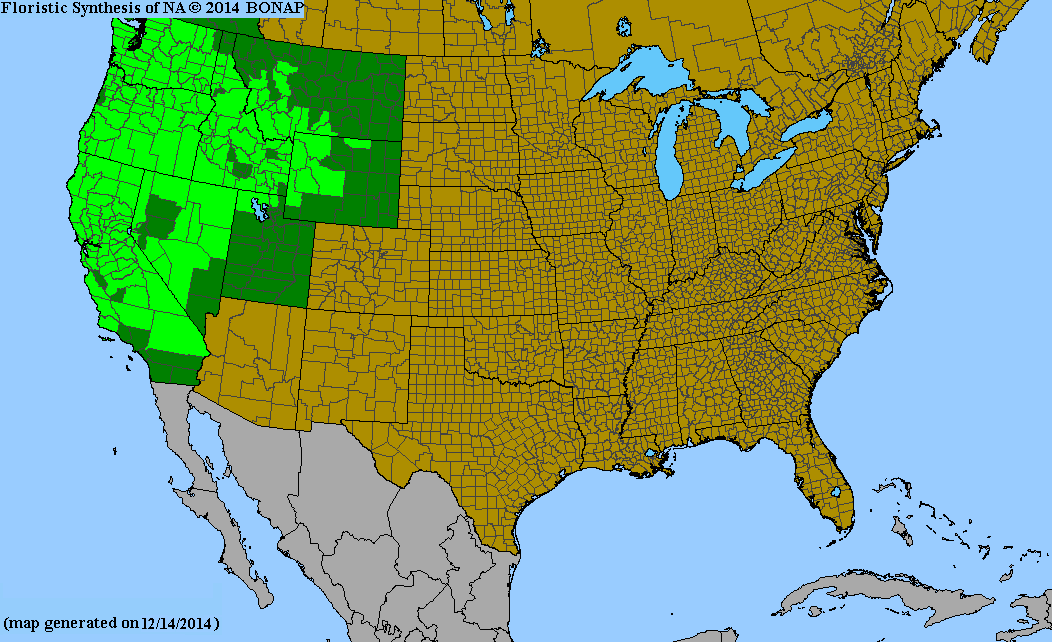
Eriophyllum lanatum is native to western North America. It is most common across California,[2] also growing north through Oregon into British Columbia and east through Idaho into Wyoming, and through Nevada into Utah.[2][16] This species has only been collected from Mexico once, on Guadalupe Island, and it is most likely extirpated there.[17]
It can be found (for instance in California) in chaparral, oak woodland, mixed evergreen forest, and yellow pine forest and other conifer forests, grassland, and sagebrush scrub habitats.[2] It commonly grows in dry, open places[1] below Script error: No such module "convert". in elevation. It prefers full sun and well-drained soil, but it also grows on rocky slopes and bluffs.[6]
References
<templatestyles src="Reflist/styles.css" />
- ↑ a b c d e f g Script error: No such module "citation/CS1".
- ↑ a b c d e f University of California, Calflora taxon report: Eriophyllum lanatum (Pursh) James Forbes
- ↑ a b Sierra Nevada Wildflowers, Karen Wiese, 2nd Ed. 2013, p. 116
- ↑ a b c d e Cite error: Script error: No such module "Namespace detect".Script error: No such module "Namespace detect".
- ↑ a b Flora of North America, Eriophyllum lanatum (Pursh) J. Forbes, 1833. Common woolly sunflower
- ↑ a b Script error: No such module "citation/CS1".
- ↑ Pursh, Frederick Traugott (1813). A Systematic Arrangement and Description of The Plants of North America.
- ↑ Calflora: Eriophyllum lanatum var. achilleoides
- ↑ Calflora: Eriophyllum lanatum var. arachnoideum
- ↑ Calflora: Eriophyllum lanatum var. croceum
- ↑ Calflora: Eriophyllum lanatum var. grandiflorum
- ↑ Calflora: Eriophyllum lanatum var. hallii
- ↑ Calflora: Eriophyllum lanatum var. integrifolium
- ↑ Calflora: Eriophyllum lanatum var. lanceolatum
- ↑ Calflora: Eriophyllum lanatum var. obovatum
- ↑ Biota of North America Program 2014 county distribution map
- ↑ Script error: No such module "Citation/CS1".
Script error: No such module "Check for unknown parameters".
Further reading
- Script error: No such module "citation/CS1".
External links
- Calflora Database: Eriophyllum lanatum (Common woolly sunflower, Wooly sunflower)
- Jepson Manual eFlora (TJM2) treatment of Eriophyllum lanatum
- USDA Plants Profile for Eriophyllum lanatum (common woolly sunflower)
- U.C. Calphotos gallery: Eriophyllum lanatum images
- Wildflowers of the Pacific Northwest: Eriophyllum lanatum — photos, description, Northwest distribution map.
- Lady Bird Johnson Wildflower Center, University of Texas: Eriophyllum lanatum
- Pages with script errors
- Pages with reference errors
- Eriophyllum
- Flora of British Columbia
- Flora of California
- Flora of Guadalupe Island
- Flora of Nevada
- Flora of Utah
- Flora of the Cascade Range
- Flora of the Great Basin
- Flora of the Klamath Mountains
- Flora of the Sierra Nevada (United States)
- Flora of the Northwestern United States
- Flora without expected TNC conservation status
- Natural history of the California chaparral and woodlands
- Plants described in 1813
- Taxa named by Frederick Traugott Pursh