Erigeron strigosus
Template:Short description Template:Speciesbox

Erigeron strigosus is a species of flowering plant in the family Asteraceae known by the common names prairie fleabane,[1] common eastern fleabane,[2] and daisy fleabane.[3]
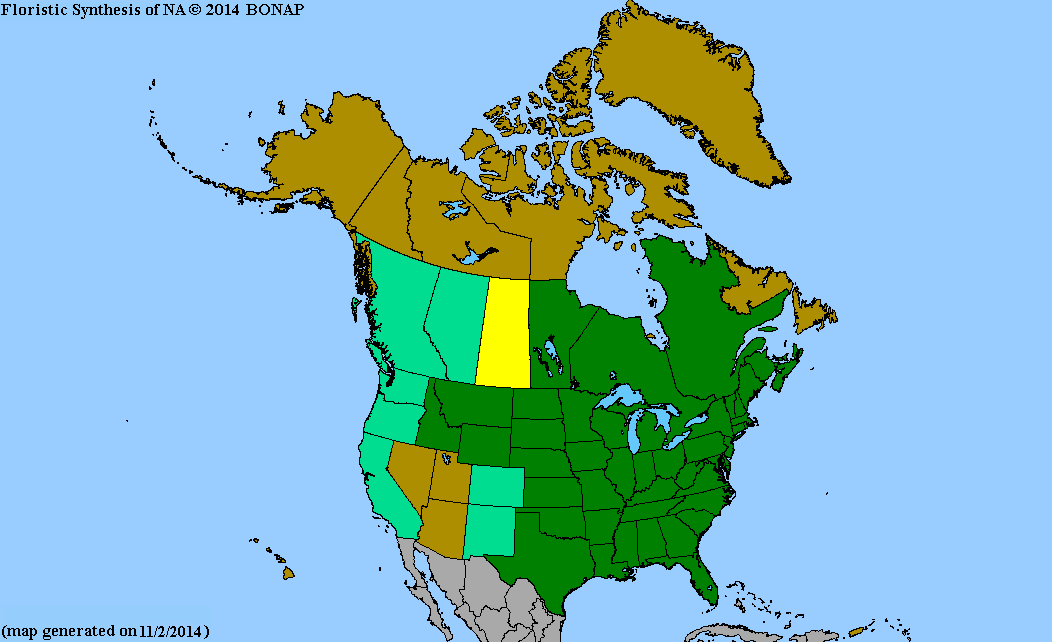
Erigeron strigosus is native to eastern and central North America as far west as Manitoba, Idaho and Texas. It has also become naturalized in western North America as well as in Europe and China as a somewhat weedy naturalized species.[4][5][6]
Erigeron strigosus is an annual or biennial herb reaching heights of up to 80 cm (32 inches). It has hairy, petioled, non-clasping, oval-shaped leaves a few centimeters long mostly on the lower part of the plant. One plant can produce as many as 200 flower heads in a spindly array of branching stems. Each head is less than a centimeter (0.4 inches) wide, containing 50–100 white, pink, or blue ray florets surrounding numerous yellow disc florets.[2]
- Varieties[2]
- Erigeron strigosus var. calcicola J. R. Allison - Alabama, Georgia, Tennessee
- Erigeron strigosus var. dolomiticola J. R. Allison - Alabama
- Erigeron strigosus var. strigosus - much of North America; introduced in China
- Erigeron strigosus var. septentrionalis (Fernald & Wiegand) Fernald - much of North America; introduced in Europe
Pollen
Erigeron strigosus repoduces asexually and sexually in the southeastern United States.[7] Pollen of Erigeron strigosus has been studied, larger higher quality pollen grains are typically sexual and smaller lower quality pollen grains are apomictic. Large pollen grains of Erigeron strigosus are have more variable size which implies more sexual than asexual reproduction.[8]
Invasive
This species is native to eastern and central North America but has become invasive in parts of Asia and Europe. Erigeron strigosus was falsely identified as E. annuus in China because as foreign species they were not well known.[9] It was also observed as a common invasive in Poland and forms hybrids with Erigeron annuus, two cytotypes of Erigeron strigosus were reported, a triploid (3n=27 and 4n=36) and hexaploid form. [10] It is able to easily adapt to new regions and cross with closely related species. The family and genus Erigeron was found to have high taxonomic diversity within Russia and Europe, novel hybrids, contributes to the invasiveness of the species.[11]
Fire Ecology
In part of its range Erigeron strigosus is found in tall grass prairie where wildfire is a regular part of the ecosystem. The cycle of fire initially causes a reduction of Erigeron strigosus, but it increases two to three years after fire.[12] The cycle of fire also reduces the incidence of infections on Erigeron strigosus such as rust fungus Puccinia dioicae.[13]
References
<templatestyles src="Reflist/styles.css" />
- ↑ Template:Cite PLANTS
- ↑ a b c Template:EFloras
- ↑ Template:Illinois Wildflowers
- ↑ Biota of North America Program 2014 state-level distribution map.
- ↑ Template:EFloras
- ↑ Tela Botanica, Asteraceae, Erigeron strigosus Mühl. ex Willd., Vergerette maigre in French with French distribution map and other information.
- ↑ Script error: No such module "citation/CS1".
- ↑ Script error: No such module "Citation/CS1".
- ↑ Script error: No such module "citation/CS1".
- ↑ Script error: No such module "Citation/CS1".
- ↑ Script error: No such module "Citation/CS1".
- ↑ Script error: No such module "Citation/CS1".
- ↑ Script error: No such module "Citation/CS1".
Script error: No such module "Check for unknown parameters".