Dibang Valley district
Script error: No such module "Distinguish". Template:Use British English Script error: No such module "Unsubst". Script error: No such module "Settlement short description".Script error: No such module "Infobox".Script error: No such module "Check for unknown parameters".Script error: No such module "Check for conflicting parameters".Expression error: Unexpected < operator
Dibang Valley district (Script error: No such module "IPAc-en". Script error: No such module "Respell".) is a district of the Indian state of Arunachal Pradesh[1] named after the Dibang River[2] or the Talon as the Mishmis call it. It is the least populated district in India and has an area of Script error: No such module "convert"..[3]
History
In June 1980, Dibang Valley district was created out of part of Lohit district.[4] On 16 December 2001, Dibang Valley district was bifurcated into Dibang Valley district and Lower Dibang Valley district.[4]
Geography

The Dibang River originates in the mountains of Arunachal Pradesh and flows through the length of the valley which is named after it. The Dibang has multiple tributaries and only once it debouches into the plains is it called by its name. Some of the major rivers of Dibang Valley District are the Ahui, Emra, Mathun, Dri, Tangon, Ithun, and Ange. The capital of this district, Anini, is the northernmost district capital in Northeast India. This district contains the northernmost point of Northeast India.Script error: No such module "Unsubst".
Transport
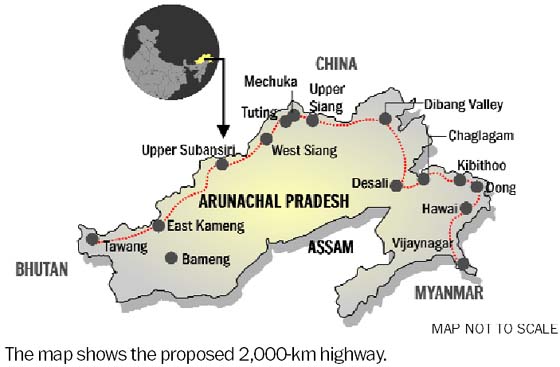
The Script error: No such module "convert". proposed Mago-Thingbu to Vijaynagar Arunachal Pradesh Frontier Highway along the McMahon Line,[5][6][7][8] (will intersect with the proposed East-West Industrial Corridor Highway) will pass through this district, alignment map of which can be seen here and here.[9]

Divisions
There is only one Arunachal Pradesh Legislative Assembly constituency in this district- the Anini constituency. It is part of Arunachal East Lok Sabha constituency.[10]
Demographics
<templatestyles src="Module:Historical populations/styles.css"/>Script error: No such module "Historical populations".According to the 2011 census, Dibang Valley district has a population of 7,948,[3] roughly equal to the nation of Nauru.[11] This gives it a ranking of 640th in India (out of a total of 640).[3] The district has a population density of Script error: No such module "convert". .With this, it is also the most sparsely populated district in India.[3] Its population growth rate over the decade 2001–2011 was 9.3%.[3] Dibang Valley has a sex ratio of 808 females for every 1000 males,[3] and a literacy rate of 64.8%.[3]
The major population of this district consists of Mishmi (Idu).
The Mishmis have a story narrating the first journeys undertaken in course of migration. The story conveys the names and location of the Cheethu-Huluni or the twelve rivers that the Mishmi (Idu) people came over in the region and settled around. The first accounts of the Mishmi (Idus) are found in the narrations given by the neighboring Ahoms. The Mishmis inhabited the deep jungles of what is now the Dibang valley.
Religion
About 40% of the district's population follows Hinduism.[12] The Mishmi(Idu) people here believes that Rukmini-Chief Consort of Lord Krishna belonged to their tribe.[13] The plays and dances on ‘Rukmini haran’ are common. There is a legend that
Lord Krishna asked the Mishmi people to cut their hair as a form of punishment for not allowing him to marry Rukmini. Due to this Idu-Mishmi people are also called "chulikata" (chuli-hair, kata- cut).[14]
Languages
Languages spoken include Idu Mishmi with approximately 25,000 speakers, written in both Latin and Devanagric scripts.
Flora and fauna
The district is rich in wildlife. Rare mammals such as Mishmi takin, red goral and Gongshan muntjac occur, while among birds there is the rare Sclater's monal.[15] A flying squirrel new to science was discovered from this district in the 2000s. It has been named as Mishmi giant flying squirrel, Petaurista mishmiensis.[16]
In 1991, Dibang Valley district became home to the Dibang Wildlife Sanctuary, which has an area of Script error: No such module "convert"..[17]
Map

References
<templatestyles src="Reflist/styles.css" />
- ↑ National Portal of India : Know India : Districts of India. India.gov.in.
- ↑ History : Lower Dibang Valley. Roing.nic.in (16 December 2001).
- ↑ a b c d e f g Cite error: Script error: No such module "Namespace detect".Script error: No such module "Namespace detect".
- ↑ a b Script error: No such module "citation/CS1".
- ↑ Script error: No such module "citation/CS1".
- ↑ Script error: No such module "citation/CS1".
- ↑ Script error: No such module "citation/CS1".
- ↑ Script error: No such module "citation/CS1".
- ↑ Script error: No such module "citation/CS1".
- ↑ Script error: No such module "citation/CS1".
- ↑ Script error: No such module "citation/CS1".
- ↑ a b Script error: No such module "citation/CS1".
- ↑ Script error: No such module "citation/CS1".
- ↑ Script error: No such module "citation/CS1".
- ↑ Choudhury, Anwaruddin(2008) Survey of mammals and birds in Dihang-Dibang biosphere reserve, Arunachal Pradesh. Final report to Ministry of Environment & Forests, Government of India. The Rhino Foundation for nature in NE India, Guwahati, India. 70pp.
- ↑ Choudhury, Anwaruddin (2009).One more new flying squirrel of the genus Petaurista Link, 1795 from Arunachal Pradesh in north-east India. The Newsletter and Journal of the RhinoFoundation for nat. in NE India 8: 26–34, plates.
- ↑ Script error: No such module "citation/CS1".
Script error: No such module "Check for unknown parameters".
External links
Script error: No such module "Navbox".
Script error: No such module "Authority control".
- Pages with script errors
- Pages with broken file links
- Pages with reference errors
- Pages using infobox settlement with image map1 but not image map
- ParserFunction errors
- Pages using bar box without float left or float right
- Districts of Arunachal Pradesh
- Dibang Valley district
- 1980 establishments in Arunachal Pradesh