Deir Ibzi
Template:Pp-extended Template:Use dmy dates Script error: No such module "Settlement short description".Script error: No such module "Infobox".Template:Template otherScript error: No such module "Check for unknown parameters".Script error: No such module "Check for conflicting parameters".Expression error: Unexpected < operator.
Deir Ibzi (Template:Langx) is a Palestinian town in the Ramallah and al-Bireh Governorate, located west of Ramallah in the northern West Bank. According to the Palestinian Central Bureau of Statistics, the town had a population of 2,590 inhabitants in 2017.[1]
Location
Deir Ibzi is located Script error: No such module "convert". (horizontally) west of Ramallah. It is bordered by Ein 'Arik to the south and east, Ein Qiniya to the east and north, Al-Janiya to the north, Kafr Ni'ma and Saffa to the west, and Beit Ur al-Tahta, Beit Ur al-Fauqa and Beitunia to the south.[2]
History
It has been suggested that this was the place mentioned in Crusader sources as Zibi,[3] but this is not supported by archeological evidence, as the earliest potsherds found here date back to the Ottoman period.[4]
Ottoman era
In 1517, the village came under Ottoman rule with the rest of Palestine and in the 1596 tax-records it was in the Nahiya of Jabal Quds of the Liwa of Al-Quds. The population was 25 households, all Muslim. They paid a fixed tax rate of 33.3% on agricultural products, which included wheat, barley, olive trees, vineyards, fruit trees, goats and beehives in addition to "occasional revenues"; a total of 3,290 akçe.[5] Sherds from the early Ottoman era have been found here.[4]
In 1838 it was noted as Deir Bezi'a, a Muslim village, located in the Beni Harith region, north of Jerusalem.[6][7]
In 1870, Victor Guérin described the village, which he called Deir Ebzieh, as being: "situated on a summit of very difficult access and contains four hundred inhabitants, all Moslems; some houses are large and fairly well built. I notice with the medhafeh (guest house) a fragment of carved stone which carries the debris of a mutilated rosette."[8] An Ottoman village list of about the same year, 1870, showed that der bezei had 239 inhabitants with 51 houses, though the population count included only the men. It further noted that the village was north of Bethoron, that is, north of Beit Ur al-Fauqa and Beit Ur al-Tahta.[9][10]
In 1882, the PEF's Survey of Western Palestine described Deir Ibzia as: "a village of moderate size on a ridge, with a well to the west, and surrounded by olives".[11]
In 1896 the population of Der bezei was estimated to be about 279 persons.[12]
British Mandate era
In the 1922 census of Palestine, conducted by the British Mandate of Palestine authorities, the village, named Dair Ibzie, had a population of 262, all Muslim,[13] increasing in the 1931 census to 360, still all Muslim, in 90 inhabited houses.[14]
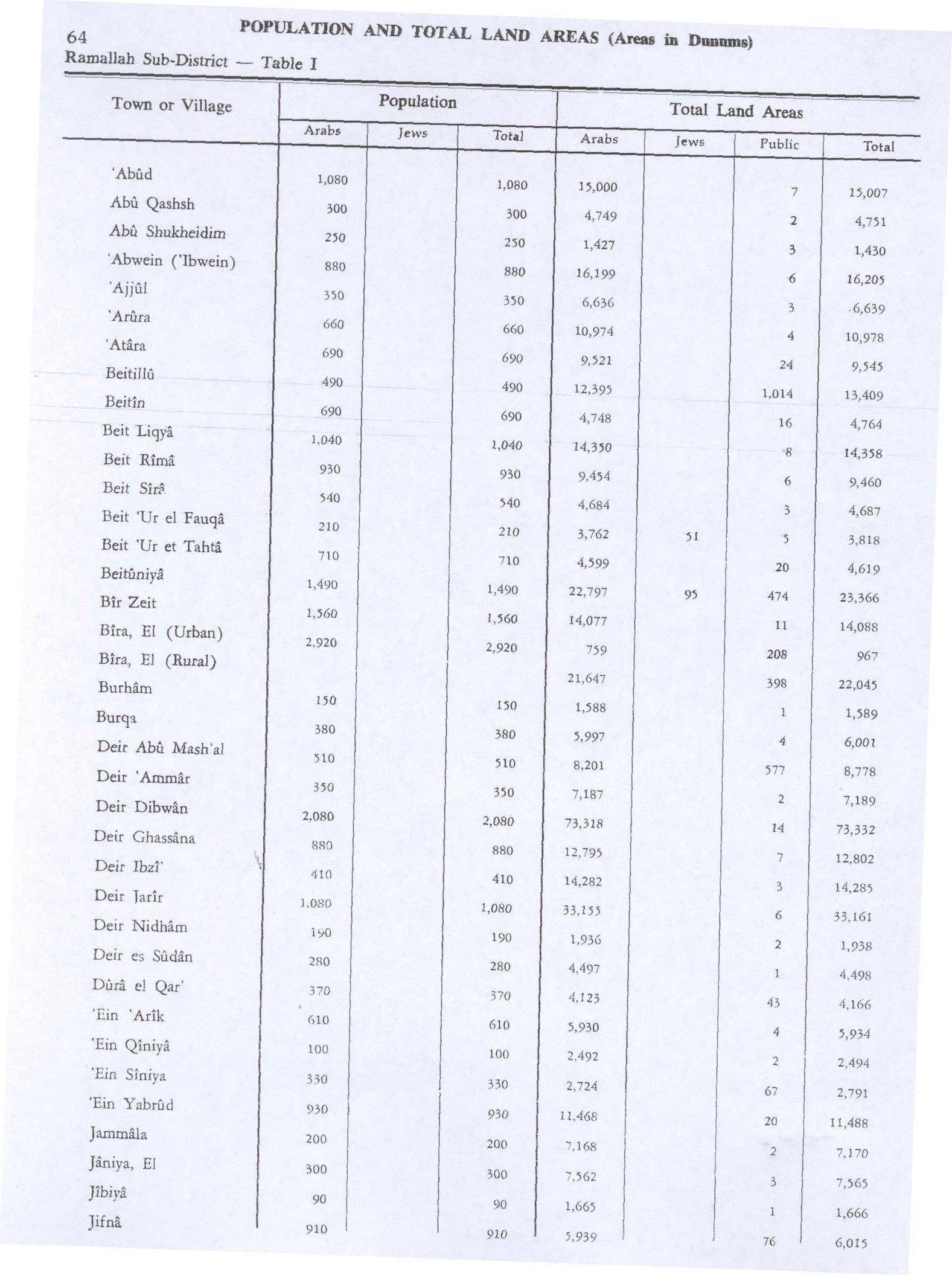
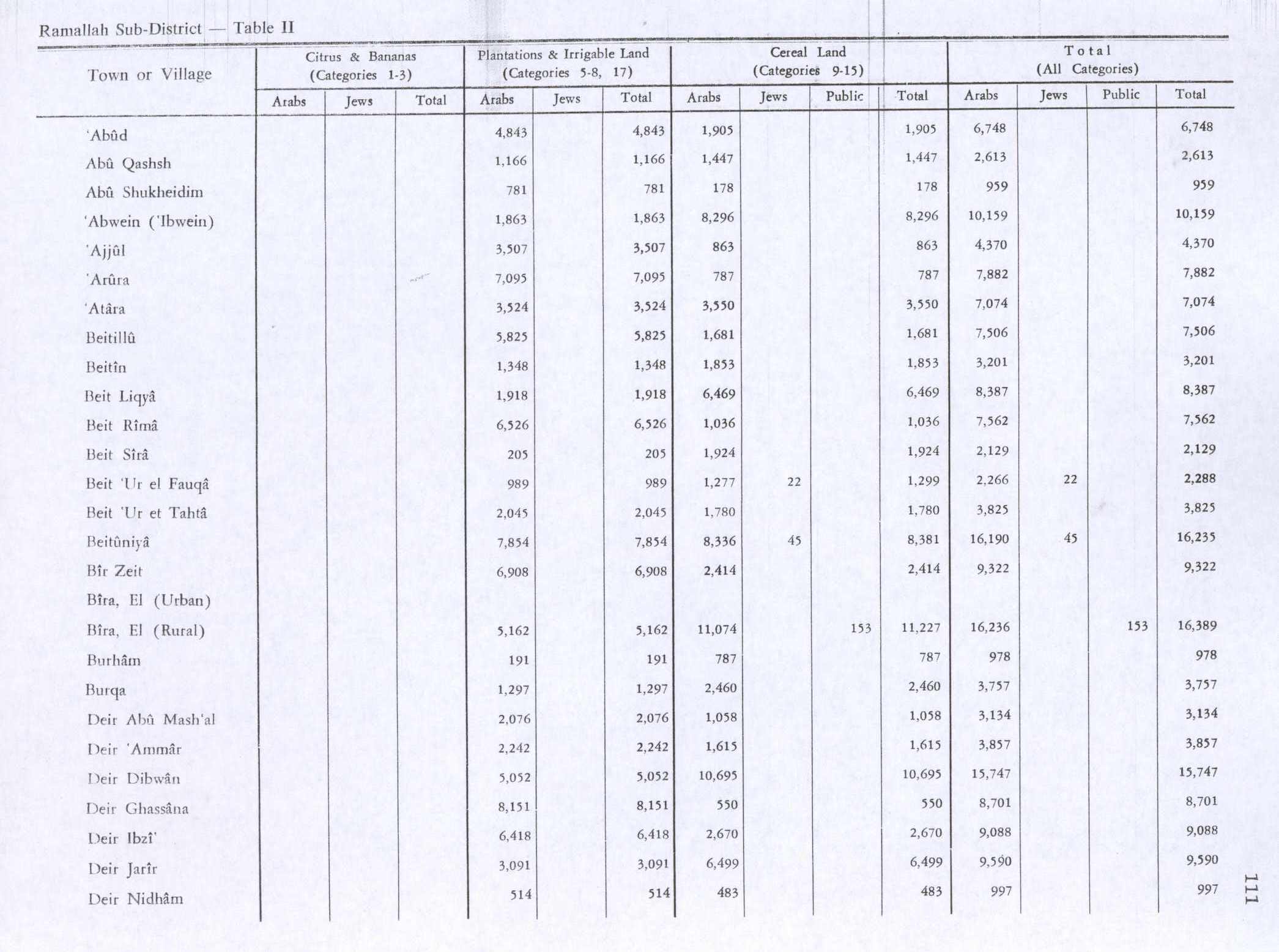
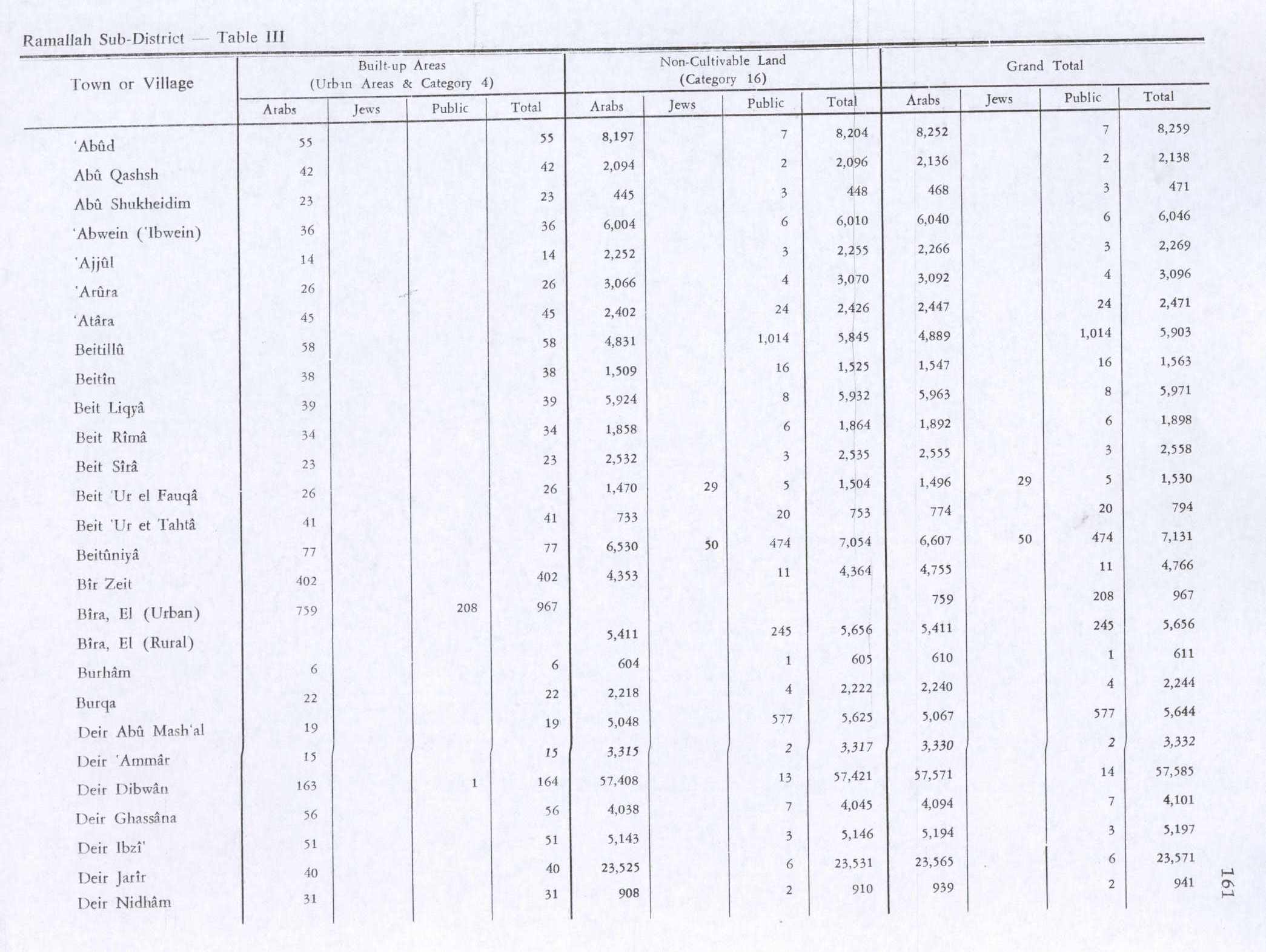
In the 1945 statistics, the population of Deir Ibzi was 410 Muslims,[15] with Script error: No such module "convert". of land under their jurisdiction, according to an official land and population survey.[16] Of this, 6,418 dunams were plantations and irrigable land, 2,670 were for cereals,[17] while Script error: No such module "convert". were built-up (urban) land.[18]
Jordanian era
In the wake of the 1948 Arab–Israeli War, and after the 1949 Armistice Agreements, Deir Ibzi came under Jordanian rule.
The Jordanian census of 1961 found 542 inhabitants in Deir Ibzi.[19]
1967-present

Since the Six-Day War in 1967, Deir Ibzi has been under Israeli occupation. The population in the 1967 census conducted by the Israeli authorities was 536, 34 of whom originated from the Israeli territory.[20]
After the 1995 accords, 27% of village land was classified as Area B, the remaining 73% as Area C. Israel has confiscated land from Deir Ibzi for bypass roads, in addition to 22 dunams taken for the Israeli settlement of Dolev.[21] This included spring Ein Bubin, now used by the Israeli settlers in Dolev for their own irrigation projects.[22][23]
References
<templatestyles src="Reflist/styles.css" />
- ↑ Cite error: Script error: No such module "Namespace detect".Script error: No such module "Namespace detect".
- ↑ Cite error: Script error: No such module "Namespace detect".Script error: No such module "Namespace detect".
- ↑ Prawer and Benvenisti, 1970, cited in Finkelstein et al, 1998, p. 312
- ↑ a b Finkelstein et al, 1998, p. 312
- ↑ Hütteroth and Abdulfattah, 1977, p. 118
- ↑ Robinson and Smith, 1841, vol 3, Appendix 2, p. 124
- ↑ Robinson and Smith, 1841, vol. 3, p. 66
- ↑ Guérin, 1875, pp. 47-48
- ↑ Socin, 1879, p. 151 also noted it was located in the Beni Harit district
- ↑ Hartmann, 1883, p. 125, also noted 51 houses
- ↑ Conder and Kitchener, 1882, SWP II, p. 295
- ↑ Schick, 1896, p. 121
- ↑ Barron, 1923, Table VII, Sub-district of Ramallah, p. 16
- ↑ Mills, 1932, p. 48
- ↑ Government of Palestine, Department of Statistics, 1945, p. 26
- ↑ Government of Palestine, Department of Statistics. Village Statistics, April, 1945. Quoted in Hadawi, 1970, p. 64
- ↑ Government of Palestine, Department of Statistics. Village Statistics, April, 1945. Quoted in Hadawi, 1970, p. 111
- ↑ Government of Palestine, Department of Statistics. Village Statistics, April, 1945. Quoted in Hadawi, 1970, p. 161
- ↑ Government of Jordan, Department of Statistics, 1964, p. 24
- ↑ Script error: No such module "citation/CS1".
- ↑ Deir Ibzi village profile, ARIJ, pp. 17-18
- ↑ How dispossession happens. The humanitarian impact of the takeover of Palestinian springs by Israeli settlers Template:Webarchive, March 2012, United Nations Office for the Coordination of Humanitarian Affairs occupied Palestinian territory, p. 25
- ↑ 'This Place Is Only for Jews': The West Bank's Apartheid Springs, by Gideon Levy and Alex Levac, 29 August 2019, Haaretz

Script error: No such module "Check for unknown parameters".
Bibliography
<templatestyles src="Refbegin/styles.css" />
- Script error: No such module "citation/CS1".
- Script error: No such module "citation/CS1".
- Script error: No such module "citation/CS1".
- Script error: No such module "citation/CS1".
- Script error: No such module "citation/CS1".
- Script error: No such module "citation/CS1".
- Script error: No such module "citation/CS1".
- Script error: No such module "Citation/CS1".
- Script error: No such module "citation/CS1".
- Script error: No such module "citation/CS1".
- Script error: No such module "citation/CS1".
- Script error: No such module "citation/CS1".
- Script error: No such module "Citation/CS1".
- Script error: No such module "Citation/CS1".
External links
- Deir Ibzi home siteTemplate:Category handler[<span title="Script error: No such module "string".">usurped]Script error: No such module "Check for unknown parameters".
- Welcome to Dayr Ibzi
- Deir Ibzi, Welcome to Palestine
- Survey of Western Palestine, Map 14: IAA, Wikimedia commons
- Deir Ibzi village (fact sheet), Applied Research Institute–Jerusalem
- Deir Ibzi village profile, ARIJ
- Deir Ibzi aerial photo, ARIJ
- Locality Development Priorities and Needs in Deir Ibzi Village, ARIJ
- Civil Administration nixes order to take land for settlement road, 14 June 2012, The Times of Israel


Script error: No such module "Navbox". Template:Authority control