Dark wave
Template:Short description Script error: No such module "For". Script error: No such module "Unsubst". Script error: No such module "Infobox".Script error: No such module "Check for unknown parameters". Dark wave (also known as darkwave) is a music genre that emerged from the new wave and post-punk movement of the late 1970s.[1][2] Dark wave compositions are largely based on minor key tonality and introspective lyrics and have been perceived as being dark, romantic and bleak, with an undertone of sorrow.[1][3] Common features include the use of chordophones such as electric and acoustic guitar, violin and piano, as well as electronic instruments such as synthesizer, sampler and drum machine. Like new wave, dark wave is not a "unified genre but rather an umbrella term"[4] that encompasses a variety of musical styles, including cold wave,[5] ethereal wave,[6] gothic rock,[5][7][2] neoclassical dark wave[8] and neofolk.[7]
In the 1980s, a subculture developed primarily in Europe alongside dark wave music, whose followers were called "wavers"[9][10] or "dark wavers".[11][12] In some countries, most notably Germany, the movement also included fans of gothic rock[13] (so-called "trad-goths").[14]
History
1980s: Origins in Europe

Since the 1980s,[15][16][17] the term "dark wave" has been used in Europe by the music press[18] to describe the gloomy and melancholy variant of new wave and post-punk music.[1][19] At that time, the term "goth" was inseparably connected with gothic rock,[20] whereas "dark wave" acquired a broader meaning, embracing bands and solo artists that were associated with gothic rock[19] and synthesizer-based new wave music,[2][21] such as Bauhaus,[22] Joy Division,[17][23][24] the Cure,[23][25] Siouxsie and the Banshees,[23] the Sisters of Mercy,[23] Anne Clark,[26] Depeche Mode,[25][21] Gary Numan[21] and the Chameleons.[23]
<templatestyles src="Template:Blockquote/styles.css" />
The term darkwave originated in the 1980s as an indicator of the dark counterpart of new wave. Bands such as Cocteau Twins, Soft Cell, and Depeche Mode are exponents of this first generation of darkwave. Darkwave... employs relatively slower tempos, lower pitches, and more minor keys in its musical settings of melancholy texts than new wave.[27]
Script error: No such module "Check for unknown parameters".
The movement spread internationally, developing such strands as ethereal wave, with bands such as Cocteau Twins, and neoclassical dark wave, initiated by the music of Dead Can Dance and In the Nursery.[28][29] French cold wave groups such as Clair Obscur[30] and Opera Multi Steel[31] have also been associated with the dark wave scene;[4] Rémy Lozowski, guitarist of French cold wave band Excès Nocturne, described his music as Script error: No such module "Lang". ("dark new wave").[32]
Simultaneously, different substyles associated with the new wave and dark wave movements started to merge and influence each other, e.g. synth-wave[33] (a kind of new wave with synthesizers, also referred to as "electro-wave"[34][35]) with gothic rock, or began to borrow elements of post-industrial music. Attrition,[36] Die Form (France), Pink Industry (UK), Psyche (Canada), Kirlian Camera (Italy) and Clan of Xymox (Netherlands)[37] performed this music in the 1980s. Other bands such as Malaria! and the Vyllies added elements of chanson and cabaret music. This sort of dark wave music became known as cabaret noir (or "dark cabaret", a term popularized by U.S. dark wave label Projekt Records).[19][38]
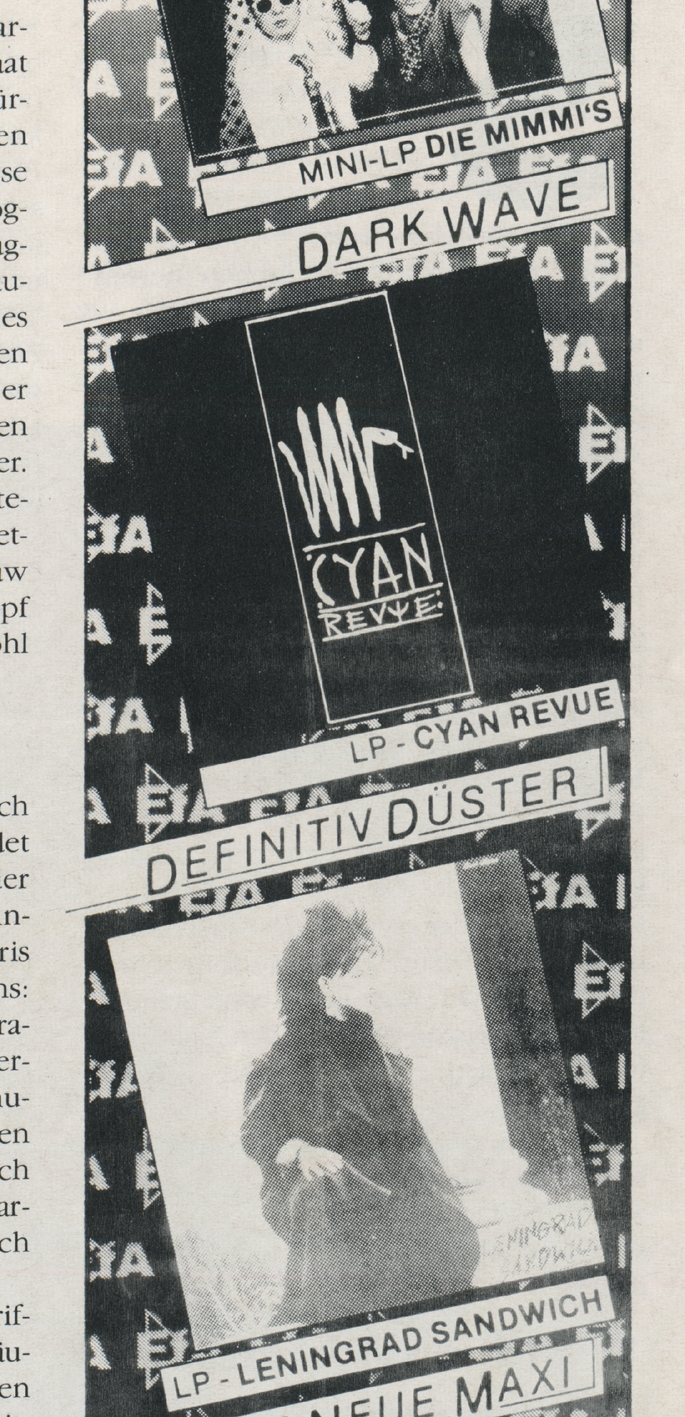
German dark wave bands were partially associated with the Neue Deutsche Welle (i.e. German new wave),[39] and included Xmal Deutschland,[40] Mask For, Asmodi Bizarr,[4] II. Invasion,[4] Unlimited Systems, Moloko †, Maerchenbraut,[41][4] Cyan Revue,[15] Leningrad Sandwich,[15] Stimmen der Stille, Belfegore,[42] and Pink Turns Blue.[43][4]
1990s: Second generation

After the new wave and post-punk movements faded in the mid-1980s,[44] dark wave was renewed as an underground movement[45][41][46] by German bands such as Girls Under Glass, Deine Lakaien,[41] Love Like Blood,[23] Love Is Colder Than Death,[47] Diary of Dreams,[48][26] the Eternal Afflict,[49] and Wolfsheim, as well as Project Pitchfork and its offshoot Aurora Sutra.[45][41] Ataraxia and the Frozen Autumn from Italy, and the French Corpus Delicti also evolved from this movement and became the leading artists of the west Romanesque dark wave scene.[50] These bands followed a path based on the new wave and post-punk music of the 1980s.[23][27]
<templatestyles src="Template:Blockquote/styles.css" />
In the 1990s, a second generation of darkwave bands became popular, including Diary of Dreams, Deine Lakaien, and the Frozen Autumn... The German band Deine Lakaien ... is audibly influenced by the dark synthesizer sounds of Depeche Mode.[27]
Script error: No such module "Check for unknown parameters".
At the same time, a number of German artists, including Das Ich,[51] Goethes Erben,[51] Relatives Menschsein,[51] and Endraum,[51] developed a more theatrical style, interspersed with German poetic, metaphorical lyrics, called Neue Deutsche Todeskunst (literally New German Death Art).[51][52] Other bands, such as Silke Bischoff, In My Rosary,[53] Engelsstaub,[54] and Impressions of Winter[55] combined synthesizers with elements of neofolk and neoclassical dark wave.[54]
United States
After 1993, in the United States the term dark wave (as the one-word variant "darkwave") became associated with the Projekt Records label,[21] because it was adopted by label founder Sam Rosenthal after leafing through the pages of German music magazines such as Zillo, and has been used to promote and market artists from German label Hyperium Records in the U.S., e.g. Chandeen and Love Is Colder Than Death.[56]
<templatestyles src="Template:Blockquote/styles.css" />
I first became aware of the term "Dark Wave" back in 1992. It appeared in German magazines – such as Zillo – describing a style of European music that followed other "waves" such as New Wave ... I found those two words ("dark" and "wave") quite interesting. This was something underground, submerged, obscure... which swept over you, immersed you, surrounded you. It was a poetic phrase that could describe many different sounds. At the time, I was looking for a name for my little mail-order company. I wanted something that would encompass the variety of music available in my catalog.[57]
Script error: No such module "Check for unknown parameters".

Projekt featured bands such as Lycia, Black Tape for a Blue Girl, and Love Spirals Downwards, some of these characterized by atmospheric guitar and synth-sounds and female vocals.[58] This style took cues from 1980s bands like Cocteau Twins[54] and is often referred to as ethereal dark wave.[59][54] Projekt Records has also had a long association with Attrition, who appeared on the label's earliest compilations.[60] Another American record label in this vein was Tess Records, which featured This Ascension, Faith and the Muse,[61] and the reunited Clan of Xymox.[62]
Joshua Gunn, a professor of communication studies at Louisiana University, described the U.S. type of dark wave music as:
<templatestyles src="Template:Blockquote/styles.css" />
...an expansion of the rather limited gothic repertoire into electronica and, in a way, the US answer to the "ethereal" subgenre that developed in Europe (e.g. Dead Can Dance). Anchored by Sam Rosenthal's now New York-based label Projekt, dark wave music is less rock and more roll, supporting bands who tend to emphasize folk songcraft, hushed vocals, ambient experimentation, and synthesized sounds [...] Projekt bands like Love Spirals Downwards and Lycia are the most popular of this subgenre.[61]
Script error: No such module "Check for unknown parameters".
2000s–2020s: Revival
During the 2000s, as part of the post-punk revival,[63] a new generation of bands rekindled several sonic characteristics of early dark wave music for a new generation of fans which proliferated into the early 2010s. Some prominent acts include She Wants Revenge,[63] the Soft Moon,[63] She Past Away,[63] Drab Majesty,[63] Twin Tribes, Selofan[63] and Boy Harsher.[64][65] Alongside Belarusian band Molchat Doma.[66]
Substance is an annual darkwave and industrial music festival occurring in Los Angeles which began in the 2010s.[67] Meanwhile, Verboden is an annual Darkwave festival in Vancouver, British Columbia.[68] The Wave-Gotik-Treffen festival in Leipzig, Germany, established in 1992, is considered one of the world's largest festivals for "dark" music and culture, taking place at Pentecost annually throughout the city. It attracts around 20,000 visitors from all over the world.
Related genres
Neoclassical dark wave

Neoclassical dark wave is a subgenre of dark wave music[69][8] that is characterized by incorporating elements of classical music[54] to create an ethereal, dramatic or melancholy atmosphere.[70][71] Neoclassical dark wave makes extensive use of orchestral components; many bands utilize modern production equipment (orchestra-derived synthesizer samples),[70] while others make use of chamber orchestras and acoustic instruments (e.g. string and brass instruments and orchestral percussion).[28] Vocals in the subgenre can vary; female voices predominate.[70][28]
In the second half of the 1980s, former post-punk bands such as Dead Can Dance (Within the Realm of a Dying Sun, 1987[72]) and In the Nursery (Stormhorse, 1987[71]) released influential albums which essentially laid the foundations of the genre.[70][54]
Other artists include Arcana,[28] Ataraxia,[70] Autumn Tears,[73] Camerata Mediolanense,[74] Dargaard,[75] Dark Sanctuary[28] Impressions of Winter,[76] Les Secrets de Morphée,[54] Lingua Ignota,[77] Love Is Colder Than Death,[78] Ophelia's Dream,[79] Stoa,[71] and WeltenBrand.[70]
References
<templatestyles src="Reflist/styles.css" />
- ↑ a b c Script error: No such module "citation/CS1".
- ↑ a b c Script error: No such module "citation/CS1".
- ↑ Schmidt, Axel; Neumann-Braun, Klaus: Die Welt der Gothics. Spielräume düster konnotierter Transzendenz., Wiesbaden: VS Verlag für Sozialwissenschaften 2004, Template:ISBN, p. 270
"Textlich und musikalisch ergibt sich für Dark Wave ein Stimmungsbild, das sich gezähmt zwischen Härte und Romantik bewegt, sehnsuchtsvoll und melancholisch, Wut kommt kaum aggressiv zum Ausdruck, alles wirkt ausgewogen und reflektiert." - ↑ a b c d e f Script error: No such module "citation/CS1".
- ↑ a b Schilz, Andrea: Flyer der Schwarzen Szene Deutschlands: Visualisierungen, Strukturen, Mentalitäten. Waxmann Verlag, 2010, Template:ISBN, p. 84.
"Dark Wave ist ein ... Oberbegriff für düstere Spielarten des Wave, der auch Gothic darunter subsumiert. Cold Wave bezeichnet eine Untergattung experimenteller, minimalistischer Elektronikmusik aus Frankreich." - ↑ Script error: No such module "Citation/CS1"..
- ↑ a b Uecker, Susann: Mit High-Heels im Stechschritt, Hirnkost Verlag, 2014, Template:ISBN
"Die Dark-Wave-Szene unterteilt sich unter anderem in den klassischen Dark Wave, den Gothic-Rock, elektronische Gruppen oder auch den Neofolk." - ↑ a b Carstens, Olaf; Thalhofer, Frank: Duden - Das Fremdwörterbuch, Bibliographisches Institut, Auflage 11, 2015, Template:ISBN, p. 726
"Genre der Dark-Wave-Musik, das durch verschiedene Stilmittel und Komponisten der Romantik, der Alten Musik oder der Neuen Musik inspiriert ist." - ↑ Script error: No such module "citation/CS1".
- ↑ Script error: No such module "citation/CS1".
- ↑ Haumann, Melanie: Fetisch Weiblichkeit. Der Mythos der schönen Frau?, Verlag für Wissenschaft und Forschung, 2001, Template:ISBN, p. 2
"Die Dark Waver, Waver – oder belächelnd auch "Grufties" genannt – sind eine Jugendkultur, die in den 80er Jahren aus der Punk-Bewegung entstanden ist." - ↑ Farin, Klaus: Jugend, Gesellschaft und Recht im neuen Jahrtausend, Forum Verlag Godesberg, 2003, Template:ISBN, p. 66
- ↑ Script error: No such module "citation/CS1".
"The subculture of the Goths (in Germany called "Grufties") started in Britain in the early 1980s and derives from the gloomy, resigned side of punk and new wave, in the field of music called 'dark wave' or 'doom.'" - ↑ Hodkinson, Paul: Goth. Identity, Style and Subculture, Bloomsbury Academic, 2002, Template:ISBN, p. 50
- ↑ a b c SPEX. Musik zur Zeit: Classified Ad by German distribution company EFA – Spots 5/85, issue 5/85, p. 17, May 1985, online picture
- ↑ Bobby Vox: Gorgonen, Hydras & Chimären – Interview with Marquee Moon, E.B. music magazine, issue 3/86, p. 18, May 1986
- ↑ a b New Life Soundmagazine, issue 38, description of the single "Love Will Tear Us Apart“ by Joy Division, p. 10, November 1988
- ↑ Script error: No such module "citation/CS1".
- ↑ a b c Issitt, Micah: Goths: A Guide to an American Subculture, Greenwood Publishing Group, 2011, Template:ISBN, p. 111
- ↑ Schmidt, Axel; Neumann-Braun, Klaus: Die Welt der Gothics. Spielräume düster konnotierter Transzendenz., Wiesbaden: VS Verlag für Sozialwissenschaften 2004, Template:ISBN, p. 261.
- ↑ a b c d Script error: No such module "citation/CS1".
"The term 'darkwave' came from back in the 1980s, and was one of the terms used to describe the Golden Age bands, as well as dark electronica acts like Gary Numan and Depeche Mode." - ↑ Matzke, Peter; Seeliger, Tobias: Das Gothic- und Dark-Wave-Lexikon, p. 39, 2002, Template:ISBN
- ↑ a b c d e f g Script error: No such module "citation/CS1".
- ↑ Peter Jandreus, The Encyclopedia of Swedish Punk 1977–1987, Stockholm: Premium Publishing, 2008, p. 11.
- ↑ a b Script error: No such module "citation/CS1".
- ↑ a b Script error: No such module "citation/CS1".
- ↑ a b c Isabella van Elferen, Jeffrey Andrew Weinstock: Goth Music: From Sound to Subculture. Routledge Studies in Popular Music, 2015, p. 25, Template:ISBN
- ↑ a b c d e Matzke, Peter; Seeliger, Tobias: Das Gothic- und Dark-Wave-Lexikon, p. 400–401, 2003, Template:ISBN
- ↑ Nym, Alexander: Schillerndes Dunkel. Geschichte, Entwicklung und Themen der Gothic-Szene, Plöttner Verlag 2010, Template:ISBN, p. 169
- ↑ SPEX. Musik zur Zeit: Classified Ad by German distribution company EFA, issue 12/88, p. 58, December 1988
- ↑ Opera Multi Steel - Official band biography
- ↑ Illusions Perdues magazine: Interview with Excès Nocturne, issue 1, p. 18, January 1989
- ↑ Cite error: Script error: No such module "Namespace detect".Script error: No such module "Namespace detect".
- ↑ Matzke, Peter; Seeliger, Tobias: Das Gothic- und Dark-Wave-Lexikon, p. 222, 2003, Template:ISBN
- ↑ Script error: No such module "citation/CS1".
- ↑ Script error: No such module "citation/CS1".
- ↑ DeBord, Jason: Clan of Xymox at DNA Lounge, Rock Subculture Journal, March 21, 2015
"A pioneer of Darkwave music, the mix of Synth Wave, Post-Punk, and Gothic Rock had its golden age in the '80s among contemporaries like Bauhaus, Joy Division, the Cure, Sisters of Mercy, Siouxsie and the Banshees, Cocteau Twins, and Depeche Mode." - ↑ Stücker, Bianca: Die Funktionalisierung von Technik innerhalb des subkulturellen Kontexts, Europäischer Hochschulverlag, 2013, Template:ISBN, p. 74
- ↑ Schmidt, Axel; Neumann-Braun, Klaus: Die Welt der Gothics. Spielräume düster konnotierter Transzendenz., Wiesbaden: VS Verlag für Sozialwissenschaften 2004, Template:ISBN, p. 256
- ↑ Schmidt, Axel; Neumann-Braun, Klaus: Die Welt der Gothics. Spielräume düster konnotierter Transzendenz., Wiesbaden: VS Verlag für Sozialwissenschaften 2004, Template:ISBN, p. 257
- ↑ a b c d Kilpatrick, Nancy. The Goth Bible: A Compendium for the Darkly Inclined. New York: St. Martin's Griffin, 2004, Template:ISBN, pp. 84/85.
- ↑ Esch, Rüdiger: Electri_city, Berlin: Suhrkamp Verlag, 3rd edition, 2015, Template:ISBN, p. 356
- ↑ Oliver Sheppard: Pink Turns Blue – An interview with German darkwave pioneers. CVLT Nation magazine, 9 September 2016
- ↑ Schilz, Andrea: Flyer der Schwarzen Szene Deutschlands: Visualisierungen, Strukturen, Mentalitäten. Waxmann Verlag, 2010, Template:ISBN, p. 92
- ↑ a b Schmidt, Axel; Neumann-Braun, Klaus: Die Welt der Gothics. Spielräume düster konnotierter Transzendenz., Wiesbaden: VS Verlag für Sozialwissenschaften 2004, Template:ISBN, pp. 258/259
- ↑ Köble, Oliver: Editorial, Glasnost magazine, issue 28, p. 3, July/August 1991
"Der Trend ist eindeutig: Die großen Star-Bands verschwinden immer mehr aus dem Rampenlicht, während eine Vielzahl junger Nachwuchsbands sich stetig wachsenden Interesses seitens des Szene-Publikums erfreut. Und ohne unangenehmes Gefühl darf gesagt werden, dass Deutschland momentan das absolute Zentrum der Wave-Musik ist." - ↑ Matzke, Peter; Seeliger, Tobias: Das Gothic- und Dark-Wave-Lexikon, p. 266, 2002, Template:ISBN
- ↑ Matzke, Peter; Seeliger, Tobias: Das Gothic- und Dark-Wave-Lexikon, p. 111, 2002, Template:ISBN
- ↑ Script error: No such module "citation/CS1".
- ↑ Stableford, Brian: News of the Black Feast and Other Random Reviews, Wildside Press 31 March 2009, Template:ISBN, p. 24
- ↑ a b c d e Matzke, Peter; Seeliger, Tobias: Das Gothic- und Dark-Wave-Lexikon, p. 311, 2002, Template:ISBN
- ↑ Schmidt, Axel; Neumann-Braun, Klaus: Die Welt der Gothics. Spielräume düster konnotierter Transzendenz., Wiesbaden: VS Verlag für Sozialwissenschaften 2004, Template:ISBN, pp. 280/281.
- ↑ Matzke, Peter; Seeliger, Tobias: Das Gothic- und Dark-Wave-Lexikon, pp. 221/222, 2002, Template:ISBN
- ↑ a b c d e f g Script error: No such module "citation/CS1".
- ↑ Matzke, Peter; Seeliger, Tobias: Das Gothic- und Dark-Wave-Lexikon, p. 219, 2002, Template:ISBN
- ↑ Script error: No such module "citation/CS1".
- ↑ Various Artists: Darkwave: Music of the Shadows, K-Tel International Inc., Liner Notes, Februar 2000
- ↑ Dave Thompson, Kirsten Borchardt: Schattenwelt – Helden und Legenden des Gothic Rock., Hannibal Verlag 2003, Template:ISBN, p. 362
- ↑ Glasnost Wave-Magazin, issue 42, Description of the bands Trance to the Sun, This Ascension, p. 32/34, April 1994
- ↑ Various Artists: From Across this Gray Land, first appearance of Attrition on Projekt Records, 1986
- ↑ a b Kilpatrick, Nancy. The Goth Bible: A Compendium for the Darkly Inclined. New York: St. Martin's Griffin, 2004, Template:ISBN, p. 90.
- ↑ Script error: No such module "citation/CS1".
- ↑ a b c d e f Script error: No such module "citation/CS1".
- ↑ Script error: No such module "citation/CS1".
- ↑ Script error: No such module "citation/CS1".
- ↑ Script error: No such module "citation/CS1".
- ↑ Los Angeles Post-Punk Festival Substance Reveals its 2022 Lineup
- ↑ Script error: No such module "citation/CS1".
- ↑ Script error: No such module "citation/CS1".
- ↑ a b c d e f Script error: No such module "citation/CS1".
- ↑ a b c Script error: No such module "citation/CS1".
- ↑ Script error: No such module "citation/CS1".
- ↑ Matzke, Peter; Seeliger, Tobias: Autumn Tears In: Das Gothic- und Dark-Wave-Lexikon, p. 44, 2003, Template:ISBN
- ↑ Matzke, Peter; Seeliger, Tobias: Camerata Mediolanense. In: Das Gothic- und Dark-Wave-Lexikon, p. 82, 2003, Template:ISBN
- ↑ Matzke, Peter; Seeliger, Tobias: Dargaard. In: Das Gothic- und Dark-Wave-Lexikon, p. 139, 2003, Template:ISBN
- ↑ Matzke, Peter; Seeliger, Tobias: Impressions of Winter. In: Das Gothic- und Dark-Wave-Lexikon, p. 287, 2003, Template:ISBN
- ↑ Script error: No such module "citation/CS1".
- ↑ Script error: No such module "citation/CS1".
- ↑ Matzke, Peter; Seeliger, Tobias: Ophelia's Dream. In: Das Gothic- und Dark-Wave-Lexikon, p. 421, 2003, Template:ISBN
Script error: No such module "Check for unknown parameters".
Bibliography
- Farin, Klaus; Wallraff, Kirsten: Die Gothics. Bad Tölz: Verlag Thomas Tilsner, 1999, Template:ISBN.
- Mercer, Mick. Hex Files: The Goth Bible. New York: The Overlook Press, 1997, Template:ISBN.
- Steinberg, Shirley; Parmar, Priya; Richard, Birgit: Contemporary Youth Culture. An International Encyclopedia. Volume II., Greenwood Publishing Group, 2005, Template:ISBN.
- van Elferen, Isabella; Weinstock, Jeffrey Andrew: Goth Music: From Sound to Subculture. Routledge Studies in Popular Music, 2015, Template:ISBN.
- Hecken, Thomas; Kleiner, Marcus: Handbuch Popkultur, J. B. Metzler Verlag, 2017, Template:ISBN.
- Sturman, Janet: The SAGE International Encyclopedia of Music and Culture. SAGE Publications, 2019, Template:ISBN.
External links
Template:New wave music Script error: No such module "Navbox". Script error: No such module "Authority control".
- Pages with script errors
- Pages with reference errors
- Pages with broken file links
- Dark wave
- New wave music
- Post-punk
- Rock music genres
- Electronic music genres
- Fusion music genres
- British styles of music
- 1980s in music
- 1990s in music
- 20th-century music genres
- Music scenes
- 1980s fads and trends
- 1980s neologisms
- Goth subculture
- Underground music
- Western culture