Champlain Canal
Template:Short description Template:Use American English Script error: No such module "Unsubst". Script error: No such module "Infobox".Script error: No such module "Check for unknown parameters". Template:Short descriptionScript error: No such module "Infobox".Script error: No such module "Check for unknown parameters".
The Champlain Canal is a Script error: No such module "convert". canal in New York that connects the Hudson River to the south end of Lake Champlain. It was simultaneously constructed with the Erie Canal for use by commercial vessels, fully opening in 1823. Today, it is mostly used by recreational boaters as part of the New York State Canal System and Lakes to Locks Passage.
Water for the highest portion comes from the Hudson River via the Glens Falls Feeder Canal, from above the drop at Glens Falls, New York.
History
An early proposal made in the 1790s by Marc Isambard Brunel for a Hudson River–Lake Champlain canal was not approved. Another proposal for the canal was made in 1812 and construction authorized in 1817. By 1818, Script error: No such module "convert". were completed, and in 1819 the canal was opened from Fort Edward to Lake Champlain. The canal was officially opened on September 10, 1823.[1] It was an immediate financial success, and carried substantial commercial traffic until the 1970s.Script error: No such module "Unsubst".
In 1903, New York authorized the expansion of the Champlain Canal—along with the Erie, Oswego, and Cayuga–Seneca Canals—into the "New York State Barge Canal."[2] The project broke ground in 1905 and was completed in 1918.[3] The "Barge Canal" name fell out of use in 1992.
The abandoned Lake Champlain Seaway proposal would have upgraded the Champlain Canal into a ship canal, easing marine transport between New York City and Montreal.
Route

The Champlain Canal's southern end is about Script error: No such module "convert". north of the locks at the Troy Federal Dam, at the point where the Erie Canal splits from the Hudson River. The Hudson River is designated as part of the canal proceeding north for approximately Script error: No such module "convert"., with six locks providing navigation around dams, until it reaches lock C-7 in Fort Edward, New York. At this point, the canal diverges from the river and follows a constructed channel for approximately Script error: No such module "convert"., with five additional locks, bringing the canal to the southern end of Lake Champlain at Whitehall, New York.
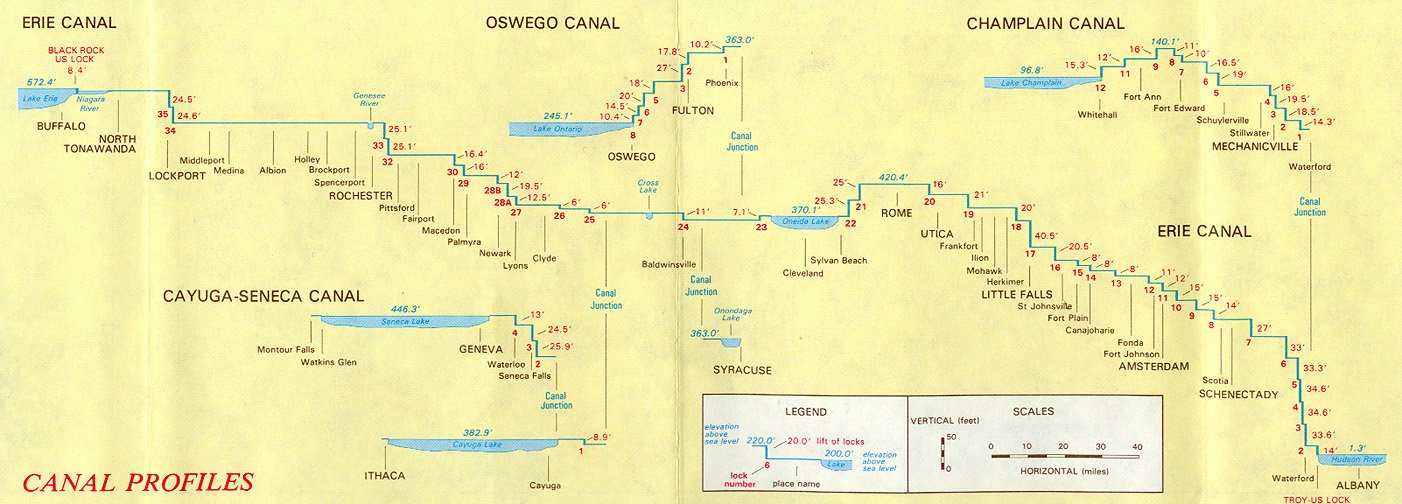
The elevation on the Hudson River portion increases from Script error: No such module "convert". above sea level at the southern end, on the northern end of the locks at the Troy Federal Dam, to about Script error: No such module "convert". above sea level at lock C-7, where the canal leaves the Hudson River. The elevation of the constructed portion reaches a peak of Script error: No such module "convert". above sea level between locks C-9 and C-11, then declines to the level of Lake Champlain, between Script error: No such module "convert". above sea level, at Whitehall.[4] By traveling the length of Lake Champlain, boaters can access the Richelieu River and Chambly Canal, which connect Lake Champlain to the Saint Lawrence River.
Locks

The following list of locks is provided for the current canal, from south to north. There are a total of 11 locks on the Champlain Canal.
All locks on the New York State Canal System are single-chamber; the dimensions are Script error: No such module "convert". long and Script error: No such module "convert". wide with a minimum Script error: No such module "convert". depth of water over the miter sills at the upstream gates upon lift. They can accommodate a vessel up to Script error: No such module "convert". long and Script error: No such module "convert". wide.[5][6][7] Overall sidewall height will vary by lock, ranging between Script error: No such module "convert". depending on the lift and navigable stages.[8]
There is no Lock C10 on the Champlain Canal. The Troy Federal Lock, located just north of Troy, New York, is not part of the New York State Canal System proper; it is operated by the United States Army Corps of Engineers.[5] The Champlain Canal officially begins at the confluence of the Hudson and Mohawk rivers at Waterford, New York.
Distance is based on position markers from an interactive canal map provided online by the New York State Canal Corporation and may not exactly match specifications on signs posted along the canal. Mean surface elevations are comprised from a combination of older canal profiles and history books as well as specifications on signs posted along the canal.[5][9][10] The margin of error should normally be within Script error: No such module "convert"..
| Lock No. | Location | Elevation
(upstream/north) |
Elevation
(downstream/south) |
Lift or Drop | Distance to Next Lock
(upstream/north) |
HAER No. |
|---|---|---|---|---|---|---|
| Troy Federal Lock * | Troy | Script error: No such module "convert". | Script error: No such module "convert". | Script error: No such module "convert". | C1, Script error: No such module "convert". | |
| C1 | Waterford | Script error: No such module "convert". | Script error: No such module "convert". | Script error: No such module "convert". | C2, Script error: No such module "convert". | Template:HAER |
| C2 | Halfmoon | Script error: No such module "convert". | Script error: No such module "convert". | Script error: No such module "convert". | C3, Script error: No such module "convert". | Template:HAER |
| C3 | Mechanicville | Script error: No such module "convert". | Script error: No such module "convert". | Script error: No such module "convert". | C4, Script error: No such module "convert". | Template:HAER |
| C4 | Stillwater | Script error: No such module "convert". | Script error: No such module "convert". | Script error: No such module "convert". | C5, Script error: No such module "convert". | Template:HAER |
| C5 | Northumberland | Script error: No such module "convert". | Script error: No such module "convert". | Script error: No such module "convert". | C6, Script error: No such module "convert". | Template:HAER |
| C6 | Fort Miller | Script error: No such module "convert". | Script error: No such module "convert". | Script error: No such module "convert". | C7, Script error: No such module "convert". | Template:HAER |
| C7 | Fort Edward | Script error: No such module "convert". | Script error: No such module "convert". | Script error: No such module "convert". | C8, Script error: No such module "convert". | Template:HAER |
| C8 | Fort Edward | Script error: No such module "convert". | Script error: No such module "convert". | Script error: No such module "convert". | C9, Script error: No such module "convert". | Template:HAER |
| C9 | Smiths Basin | Script error: No such module "convert". | Script error: No such module "convert". | Script error: No such module "convert". | C11, Script error: No such module "convert". | Template:HAER |
| C11 | Comstock | Script error: No such module "convert". | Script error: No such module "convert". | Script error: No such module "convert". | C12, Script error: No such module "convert". | Template:HAER |
| C12 | Whitehall | Script error: No such module "convert". | Script error: No such module "convert". | Script error: No such module "convert". | Lake Champlain | Template:HAER |
All surface elevations are approximate.
* Denotes Federal managed locks.
Lake Champlain has a mean surface elevation ranging between Script error: No such module "convert"..
References
<templatestyles src="Reflist/styles.css" />
- ↑ Script error: No such module "citation/CS1".
- ↑ Script error: No such module "citation/CS1".
- ↑ Script error: No such module "citation/CS1".
- ↑ Script error: No such module "citation/CS1".
- ↑ a b c New York State Canal Corporation - Canal Map, New York State Canals, Retrieved Jan. 26, 2015.
- ↑ New York State Canal Corporation - Frequently Asked Questions, Retrieved Jan. 26, 2015.
- ↑ The Erie Canal - Locks, Retrieved Jan, 26, 2015.
- ↑ The Erie Canal, History of the Barge Canal of New York State by Noble E. Whitford, 1921, Chapter 23, Retrieved Jan. 28, 2015.
- ↑ Wilfred H. Schoff, The New York State Barge Canal, 1915, American Geographical Society, Vol. 47, No. 7, page 498, Retrieved Jan. 26, 2015.
- ↑ The Erie Canal - Canal Profiles, Retrieved Jan. 6, 2015.
Script error: No such module "Check for unknown parameters".
External links
Script error: No such module "Side box".
- Information and Boater's Guide to the New York State Canal System
- History of the Canal System of the State of New York—Champlain Canal
- New York State Canals—Map of the Champlain Canal
- Champlain Canal Net—History and PhotographsScript error: No such module "Category handler".[<span title="Script error: No such module "string".">usurped]Script error: No such module "Check for unknown parameters".
- Historic Glens Falls Feeder Canal
- Historic American Buildings Survey (HABS) No. NY-6121, "Champlain and Hudson Canal"
- Historic American Engineering Record (HAER) documentation:
- Template:HAER
- Template:HAER (replaced)
- Template:HAER
- Template:HAER
Template:New York State Canal System Script error: No such module "Navbox". Template:Hudson River Script error: No such module "Authority control".
- Pages with script errors
- NRHP infobox with nocat
- Pages with broken file links
- Canals on the National Register of Historic Places in New York (state)
- Canals in New York (state)
- Historic American Buildings Survey in New York (state)
- Historic American Engineering Record in New York (state)
- Historic districts on the National Register of Historic Places in New York (state)
- Bridges in Rensselaer County, New York
- Transportation buildings and structures in Saratoga County, New York
- Transportation buildings and structures in Washington County, New York
- Tributaries of the Hudson River
- Canals opened in 1823
- National Register of Historic Places in Rensselaer County, New York
- National Register of Historic Places in Saratoga County, New York
- National Register of Historic Places in Washington County, New York
- 1823 establishments in New York (state)