Cancún International Airport
Template:Short description Template:Pp-semi-indef Script error: No such module "For". Template:Use mdy dates Template:Infobox airport
Cancún International Airport (Template:Langx) (Template:Comma separated entries) is Mexico’s second busiest airport and the largest in the country and Latin America for international passengers. Located in the Cancún Metropolitan Area in Quintana Roo, it serves as the primary gateway to the Mexican Caribbean, Riviera Maya, and Yucatán Peninsula, offering flights to over 100 cities across the Americas and Europe.
While it serves as a hub for Viva and a focus city for Volaris and Magnicharters, Cancún Airport primarily functions as a major destination for most U.S. and Canadian mainline airlines from all their hubs and focus cities, making it the airport outside the U.S. with the most destinations served in the United States.[1]
Operated by Grupo Aeroportuario del Sureste (ASUR), the airport also handles general and executive aviation, flight training, and international charter services. It is the easternmost airport in Mexico, with Cozumel and Tulum airports serving as alternative options in the Cancún area. In 2023, the airport handled approximately 32.75 million passengers, with a slight decrease to 30.6 million in 2024, of which 20.1 million were international passengers.[2][3]
History
Early operations
Cancún's initial airport was established in 1942 as a strategic move to support the region's primary industry at the time: the chewing gum industry. This early airport operated on a rudimentary runway, featuring a control tower constructed from wood and reeds, which remained in operation until 1973. To commemorate its history, a replica stands near the city's entrance, close to its original location.[4]
In the early 1970s, Cancun emerged as a major tourist destination following a deliberate effort by the Mexican government, in collaboration with the National Tourism Development Fund (Template:Langx). Recognizing its strategic location near pristine beaches, natural landscapes, and archaeological sites, the comprehensive plan aimed to transform Cancun from a sparsely inhabited area into a world-class tourist hub. Substantial investments in infrastructure were made, including the construction of the new Cancun International Airport, executed by Henro y Asociados in collaboration with the Department of Infrastructure. The airport's inaugural commercial flight occurred on May 12, 1975, drawing swift attention from international tourists.
Throughout its history, Cancun Airport has hosted a variety of airlines. It served as a hub for Mexicana, Interjet, and Aladia in their operational years, facilitating connections for both domestic and international flights. The defunct charter airline Aerocancun, based in Cancun, also provided flights to U.S., Canadian, European, and South American destinations. MAYAir, established in 1994 initially as a charter airline, expanded its routes from Cancun to various destinations in the Yucatán Peninsula.
Privatization and expansion
In 1995, Mexico embarked on a significant airport privatization initiative through the 'Ley de Aeropuertos' (Airports Law) introduced by the Department of Infrastructure. This marked a pivotal moment for Cancun Airport, integrating it into the Grupo Aeroportuario del Sureste ASUR.
Until the early 2000s, Cancun Airport operated with two terminals. A major transformation began in 2005 when ASUR invested US$150 million in constructing Terminal 3, officially inaugurated in 2007.[5] Key additions, including a new runway and Latin America's tallest control tower at 97 meters, were unveiled in October 2009, effectively doubling the airport's passenger handling capacity.[6] On November 27, 2013, Cancun Airport achieved another milestone, becoming the first in Mexico to welcome the Airbus A380, commemorating the 80th anniversary of Air France and the 15th anniversary of ASUR.
The expansion continued with Terminal 2 in 2014 and a significant Template:Convert expansion of Terminal 3 in 2016, introducing six gates and additional commercial areas.[7] This expansion aimed at accommodating the growing annual capacity, raising capacity from 6 million to 10 million. In response to the overcrowding and surging demand, Terminal 4 was inaugurated in October 2017.
Despite challenges from the COVID-19 pandemic, Mexican authorities kept borders open for tourism, making Cancún one of the few international destinations to remain accessible.
Facilities
.jpg)
The airport is located in the Cancún urban area, less than Template:Convert southwest of the tourist complex, at an elevation of Template:Convert above sea level. With the capability to accommodate large aircraft such as Boeing 747 and Airbus A380, the airport boasts two parallel operative runways that can be used simultaneously: Runway 12R/30L, which is Template:Convert in length, and Runway 12L/30R, which spans Template:Convert.
Cancún Airport comprises three terminals dedicated to scheduled flights (Terminals 2, 3, and 4), one terminal specifically for charter flights (Terminal 1), and an FBO terminal. This gives it the highest number of passenger terminals in Mexico. Beyond the terminals, the airport offers long-term and short-term parking facilities, on-site hotels, a variety of restaurants, and rental car services. It also accommodates facilities for the Mexican Air Navigation Services (Template:Langx).
Terminals

Terminal 1 (only charter)
Exclusively dedicated to charter or private flights, Terminal 1 features 7 gates numbered 1 to 7, 3 helicopter stands, and a VIP lounge, offering comprehensive services for private air travel. Temporarily closed for reconstruction after Hurricane Wilma, the terminal resumed operations exclusively for charter flights upon reopening in November 2013.
Terminal 2


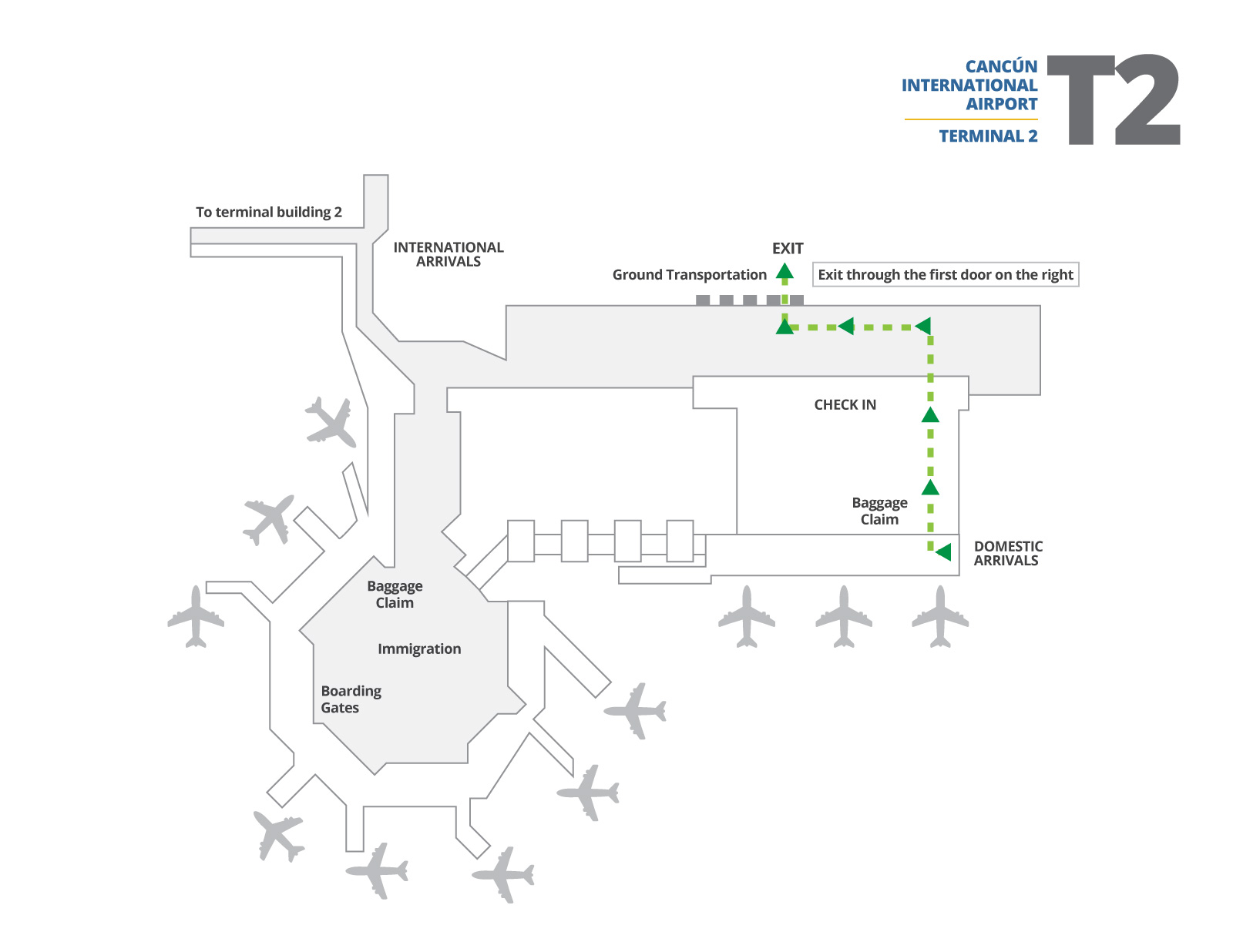
As the oldest terminal, Terminal 2 handles arrivals and departures for domestic and international flights. With 22 gates—A1 through A11 (in a satellite building) and B12 through B22 (at the main building)—it serves most domestic airlines, along with all international flights to Central and South America and select long-haul flights to Europe. The check-in area houses a bank and food outlets, while the boarding area features several restaurants and shops, along with immigration/customs services. Two lounges, the MERA Business Lounge and The Lounge by Global Lounge Network cater to both domestic and international travelers.
The primary tenants at the terminal are Viva, which operates a hub at this location, and Volaris and Magnicharters, operating focus city services along with Volaris Costa Rica and Volaris El Salvador. Other airlines serving Terminal 2 include Aerolíneas Argentinas, Aerus, Alaska Airlines, Arajet, Avianca, Avianca El Salvador, Conviasa, Copa Airlines, GOL Linhas Aéreas, LATAM Chile, LATAM Perú, LOT Polish Airlines, Neos, Sky Airline Peru, Sunwing Airlines, TAG Airlines, TUI Airways, TUI fly Netherlands, TUI fly Belgium, and Wingo.
Terminal 3


.jpg)
Dedicated exclusively to international flights, Terminal 3 features 21 gates (C4 through C24). Primarily used by major U.S. carriers and some Canadian and European carriers, the terminal provides amenities such as shops, including duty-free options, cafés, restaurants, and immigration and customs facilities. Terminal 3 is home to the MERA Business Lounge. The ground transportation facility is situated outside the arrivals hall.
Airlines operating from Terminal 3 include Air Canada, Air Canada Rouge, Air Caraïbes, American Airlines, Avelo, British Airways, Delta Air Lines, Iberojet, Spirit Airlines, United Airlines, and World2fly.
Terminal 4

Terminal 4 serves both domestic and international flights. Opened in October 2017, it made Cancún Airport the first in Mexico with four terminals. It features 14 gates equipped with jet bridges and a capacity of 9 million passengers per year.[8] A parking structure and an on-site hotel are also planned. The terminal has three lounges: the MERA Business Lounge (domestic), MERA Business Lounge (international), and The Lounge in Partnership with Air Transat.[9]
Airlines operating from Terminal 4 include Aeroméxico, Air Europa, Air France, Air Transat, Austrian Airlines, Condor, Discover Airlines, Edelweiss Air, Flair Airlines, Frontier Airlines, JetBlue, KLM, Lufthansa, Southwest Airlines, Sun Country Airlines, TAP Air Portugal, Turkish Airlines, and WestJet.
FBO terminal
The FBO terminal caters to general aviation from Mexico, the United States, and Latin America. It is positioned south of the passenger terminal complex, near the main airport entrance. It offers various services, including ground support, fuel coordination, ground transportation, car rental, catering, and airport lounges. Additionally, the FBO accommodates commercial services from the Belizean airline Tropic Air.
Inter-terminal transportation
Inter-terminal transportation is provided by a shuttle service, with buses departing from each terminal every 10 minutes.
Airlines and destinations
.jpg)
Passenger
Template:Airport destination list
Cargo
Template:Airport destination list
Destination maps
| Template:Location map+ |
| Template:Location map+ |
| Template:Location map+ |
| Template:Location map+ |
| Template:Location map+ |
| Template:Location map+ |
Traffic statistics
.jpg)
Passengers
| Year | Total passengers | % change |
|---|---|---|
| 1999 | 6,969,733 | – |
| 2000 | 7,745,317 | Increase 11.1% |
| 2001 | 7,639,021 | Decrease 1.4% |
| 2002 | 7,717,144 | Increase 1.0% |
| 2003 | 8,683,950 | Increase 12.5% |
| 2004 | 10,010,526 | Increase 15.3% |
| 2005 | 9,301,240 | Decrease 7.1% |
| 2006 | 9,728,149 | Increase 4.6% |
| 2007 | 11,340,027 | Increase 16.6% |
| 2008 | 12,646,451 | Increase 11.5% |
| 2009 | 11,174,908 | Decrease 11.6% |
| 2010 | 12,439,266 | Increase 11.3% |
| 2011 | 13,022,481 | Increase 4.7% |
| 2012 | 14,463,435 | Increase 11.1% |
| 2013 | 15,962,162 | Increase 10.4% |
| 2014 | 17,455,353 | Increase 9.4% |
| 2015 | 19,596,485 | Increase 12.3% |
| 2016 | 21,415,795 | Increase 9.3% |
| 2017 | 23,601,509 | Increase 10.2% |
| 2018 | 25,202,016 | Increase 6.8% |
| 2019 | 25,481,989 | Increase 1.1% |
| 2020 | 12,259,148 | Decrease 51.89% |
| 2021 | 22,318,467 | Increase 82.1% |
| 2022 | 30,342,961 | Increase 36.0% |
| 2023 | 32,750,411 | Increase 7.9% |
| 2024 | 30,411,520 | Decrease 7.1% |


Busiest routes

.jpg)
| Rank | City | Passengers | YoY % change | Ranking | Airlines |
|---|---|---|---|---|---|
| 1 | Mexico City | 1,728,758 | Decrease 21.74% | Steady | Aeroméxico, Aeroméxico Connect, Magnicharters, Viva, Volaris |
| 2 | Monterrey | 783,343 | Decrease 15.70% | Steady | Magnicharters, Viva, Volaris |
| 3 | Mexico City–AIFA | 560,061 | Increase 56.98% | Increase 1 | Aeroméxico, Viva, Volaris |
| 4 | Guadalajara | 443,422 | Decrease 20.65% | Decrease 1 | Magnicharters, Viva, Volaris |
| 5 | Toluca | 242,833 | Increase 8.64% | Increase 1 | Viva, Volaris |
| 6 | Tijuana | 171,820 | Decrease 44.18% | Decrease 1 | Viva, Volaris |
| 7 | León/El Bajío | 169,656 | Decrease 21.41% | Steady | Magnicharters, Viva, Volaris |
| 8 | Puebla | 166,848 | Decrease 3.75% | Steady | Magnicharters, Viva, Volaris |
| 9 | Querétaro | 150,568 | Decrease 4.54% | Steady | Magnicharters, Viva, Volaris |
| 10 | Tuxtla Gutiérrez | 125,448 | Increase 2.51% | Increase 1 | Viva, Volaris |

.jpg)

| Rank | City | Passengers | YoY % change | Ranking | Airlines |
|---|---|---|---|---|---|
| 1 | Dallas/Fort Worth | 577,104 | Decrease 0.43% | Steady | American Airlines, Frontier, Spirit, Sun Country |
| 2 | Houston (Intercontinental and Hobby)Template:Efn | 511,975 | Decrease 9.83% | Steady | Frontier, Southwest, Spirit, United Airlines |
| 3 | Chicago (O'Hare and Midway)Template:Efn | 508,835 | Increase 1.17% | Steady | American Airlines, Frontier, Southwest, Spirit, United Airlines |
| 4 | Toronto–Pearson | 506,847 | Increase 29.24% | Increase 1 | Air Canada, Air Canada Rouge, Air Transat, Flair Air, Sunwing Airlines, WestJet |
| 5 | Atlanta | 401,756 | Decrease 9.07% | Decrease 1 | Delta Air Lines, Frontier, Southwest |
| 6 | New York–JFK | 367,689 | Increase 2.50% | Steady | American Airlines, Delta Air Lines, JetBlue |
| 7 | Denver | 306,465 | Decrease 3.94% | Increase 1 | Frontier, Southwest, United Airlines |
| 8 | Panama City–Tocumen | 300,923 | Decrease 9.11% | Decrease 1 | Copa Airlines |
| 9 | Montréal–Trudeau | 294,851 | Increase 36.84% | Increase 8 | Air Canada, Air Canada Rouge, Air Transat, Flair Air |
| 10 | Los Angeles | 280,815 | Decrease 11.07% | Steady | Alaska, American Airlines, Delta Air Lines, United Airlines |
- Notes
Ground transportation

The primary mode of transportation to and from the airport is by road. Travelers to Cancun often arrange ground transportation in advance due to its convenience. Official airport taxis, known for their higher costs, are generally discouraged, and local taxis are not permitted for pickups at the airport. Large short- and long-term parking facilities are available at all terminals.
Local shuttles

Each terminal features extensive ground transportation facilities with numbered boarding platforms, and nearby snack stands. These facilities are serviced by various companies offering transportation to and from hotels, many of which allow online pre-booking.

Long-distance bus
ADO, the primary long-distance bus carrier in southeastern Mexico, serves various destinations, including Cancun, Playa del Carmen, Tulum, and Mérida (with stops at Altabrisa station and Paseo 60 station). Additionally, ADO provides transportation to Cozumel (via Bus + Ferry) and Chiquilá (via Bus + Ferry).
ADO buses stop at all terminals and travel directly to the ADO Bus stations in the specified towns without stopping at hotels or along the route. Coaches accommodate 44 passengers and feature air conditioning and high-definition entertainment screens.
At Terminal 4, ADO bus tickets are available for a price approximately five times higher than the standard rate. It is advisable to either purchase the ticket online or consider walking to Terminal 1 or Terminal 2 to potentially save around 400 Mexican pesos (M$110) or 25 US dollars (USD 25) as of 2023. The bus stop is located past the ground transportation facility.
Train
Cancún Airport railway station is located across Federal Highway 180 from Cancún International Airport. The station features nine platforms situated on the opposite side of the runway from the main terminal buildings. It handles services along both the west route, connecting to destinations such as Chichén Itzá railway station, Teya Mérida railway station, and San Francisco de Campeche railway station, and the south route, serving Tulum railway station, Tulum Airport railway station, and Chetumal Airport railway station. Trains are scheduled to operate at least every 2 hours along these routes.
The Conexión Intermodal Tren Maya is a shuttle bus connection that will connect the four terminals of the airport with the railway station.[11]
Accidents and incidents
- On December 26, 1980, a British Aerospace 125 operated by Servicios Aereos Regiomontanos (SARSA) descended into trees on climbout and crashed one kilometer from the airport. All three occupants were killed.[12]
- On March 15, 1984, Aerocozumel Flight 261 crashed soon after takeoff. No one died in the crash, but one passenger died of a heart attack while evacuating the swampy crash scene.[13]
- On September 9, 2009, Mexico City-bound Aeroméxico Flight 576 was hijacked after take off. The hijackers were Bolivians who wanted to speak to the President. The plane landed safely in Mexico City, all hostages were released, and the hijackers were arrested.[14]
Accolades
- 2011 – Best Airport in Latin America – Caribbean of the Airport Service Quality Awards by Airports Council International[15] and 2nd Best Airport by Size in the 5 to 15 million passenger category[16]
See also
- List of the busiest airports in Mexico
- Busiest airports in North America
- Busiest airports in Latin America
- Lists of airports
- Airports in Mexico
- Airfields in Baja California
- Airfields in Baja California Sur
- Small airstrips
- Airports by ICAO code: M
- Military bases
- Air Force bases
- Naval Air bases
- Airlines of Mexico
- Airline destinations: Mexico
- Transportation in Mexico
- Tourism in Mexico
- Federal Civil Aviation Agency
- Grupo Aeroportuario del Sureste
- List of busiest airports by passenger traffic
- List of international airports by country
- List of beaches in Mexico
- List of cities by international visitors
- Riviera Maya
- Caribbean Sea
References
External links
- Template:Commons category-inline
- Template:Wikivoyage inline
- Template:Official website
- Aeronautical chart and airport information for MMUN at SkyVector
- Template:NWS-current
- Template:ASN
- Cancun Airport travel data at Airportsdata.net (in English)
- Cancun Airport Terminal 2 Map at Transcun.com (in English)
- Airport Cancun Arrivals and Departures at Cancun Airport (in English)
Template:Airports in Mexico Template:Cancún
Template:Portal bar Template:Authority control
- ↑ Script error: No such module "citation/CS1".
- ↑ Script error: No such module "citation/CS1".
- ↑ a b Cite error: Invalid
<ref>tag; no text was provided for refs namedasur - ↑ Script error: No such module "citation/CS1".
- ↑ Script error: No such module "citation/CS1".
- ↑ Script error: No such module "citation/CS1".
- ↑ Script error: No such module "citation/CS1".
- ↑ Script error: No such module "citation/CS1".
- ↑ Script error: No such module "citation/CS1".
- ↑ a b Script error: No such module "citation/CS1".
- ↑ Script error: No such module "citation/CS1".
- ↑ Script error: No such module "citation/CS1".
- ↑ Script error: No such module "citation/CS1".
- ↑ https://www.nytimes.com/aponline/2009/09/09/world/AP-LT-Mexico-Hijacking.html Template:Dead link
- ↑ "ASQ Award for Best Airport in Latin America – Caribbean" Template:Webarchive Airports Council International. 14 February 2012. Retrieved 2012-04-13
- ↑ "ASQ Award for Best Airport by Size (5-15m)" Template:Webarchive Airports Council International. 14 February 2012. Retrieved 2012-04-13