Beitin
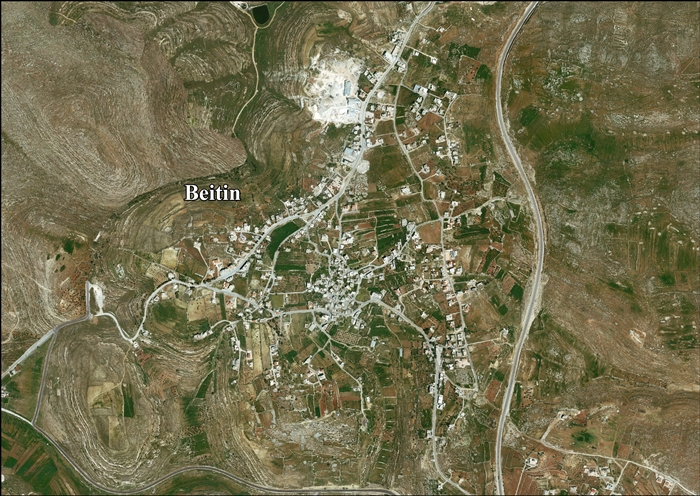
Script error: No such module "about". Template:Pp-extended Script error: No such module "Settlement short description".Script error: No such module "Infobox".Script error: No such module "Check for unknown parameters".Script error: No such module "Check for conflicting parameters".Expression error: Unexpected < operator Beitin (Template:Langx) is a Palestinian village in the Ramallah and al-Bireh Governorate in the central West Bank, located Script error: No such module "convert". northeast of Ramallah along the Ramallah-Nablus road. The Palestinian village of Dura al-Qar' and Ein Yabrud lie to the north, Rammun to the east, Deir Dibwan to the southeast and al-Bireh to the southwest. The Israeli settlement of Beit El is northwest of Beitin.
Beitin was established in the mid-19th century by settlers from the nearby Burqa.[1] It stands on the site of the ancient town and biblical sanctuary of Bethel,[1][2][3] which was left abandoned after the Crusader period. The area remained uninhabited until the late Ottoman period, when modern Beitin was founded.[1]
Geography
There are several springs around Beitin, which is known for its olive, almond, fig and plum groves.[4]
History
Early history and archaeology
Script error: No such module "Labelled list hatnote". Beitin is identified with the ancient settlement of Bethel, and preserves its ancient name.[3][2][1] The site was first settled during the Chalcolithic period. Sherds from the Early, Intermediate, Middle and Late Bronze Age, as well as the Iron Age I and II, the Persian, Hellenistic, Roman,[5] the Byzantine[5][6] and Crusader/Ayyubid periods have been found.[5] At the ruins of the Crusader watchtower (al-Burj), residential remains from the Mamluk period were discovered.[7]
In the Hellenistic and Roman periods, Bethel was mentioned in 1 Maccabees, Josephus' writings, and in several patristic texts.[2] The town was garrisoned by Bacchides (during the Maccabean revolt) and later by Vespasian (during the First Jewish–Roman War).[2] In Byzantine times, Bethel held annual festivals on October 18. The population was Eastern Orthodox Christian and monks from the Sinai Peninsula, particularly Zosimas of Palestine, were known to have visited the town.[8] A church dating from the fifth century CE was found at the site.[2]
Bethel was abandoned after the 1187 defeat of the Crusaders at the hands of Saladin and the ensuing destruction of Christian sites. It remained obscure and unmentioned by various sources from the 13th to the 19th century, including Yaqut, Mujir al-Din, and European travelers, likely indicating a state of ruin since the fall of the Crusader kingdom.[1]
Ottoman period

Beitin was absent from Ottoman censuses of the 16th century. When visited by Robinson in 1838 and Schwartz before 1845, it still lay in ruins. However, by Guérin's visit in 1863, it had become inhabited, with its residents originating from the nearby Burqa.[1]
After Beitin was reestablished, the village came under the administration of the Mutasarrif ("Governorate") of Jerusalem.[9] In the early 19th century, people from Transjordan and other places migrated to Beitin[8][10] and built a mosque near the site of the old church.[11]
In 1838 Edward Robinson noted Beitin as a place "in ruins or deserted," located immediately north of Jerusalem.[3][12]
In 1863 Victor Guérin found the village to have 400 inhabitants,[13] while an Ottoman village list from around 1870 showed that Beitin had an adult male population of 140, in a total of 55 houses (thus excluding women and children).[14][15]
In 1882 the PEF's Survey of Western Palestine described Beitin as a village "built on the side of a flat spur which rises slightly on the north. On the south-east is a flat dell, with good fig and pomegranate gardens, and there are other fig-trees round the village and among the houses. The cottages have a ruinous appearance, with rough stone walls. There is one square white house in two stories, which is visible from a great distance. The ground is very open, and the slopes gentle; the village slopes down gradually south-east. The surrounding ground is quite bare of trees, of white chalk, very barren and stony on the south; of hard limestone cropping up on the north; the fields divided off by low drystone walls. The contrast of the grey rocks, the red ploughland and the dark green figs is very striking. The remains of a good-sized tower exist towards the north, and on the south the walls of a church of Crusading date, once dedicated to St. Joseph. The population is stated at 400. The place is supplied from a fine spring on the south, which wells up in a circular basin. The spring is double, and was surrounded with a large reservoir, 314 feet long north-west and south-east, by 217 feet; of massive stones. The eastern and southern walls are standing about 10 feet high. The spring is perennial..."[16]
In 1896 the population of Betin was estimated to be about 360 persons.[17]
In 1907, small gardens and a few old tombs were found in the vicinity, and the Muslim population was known for its strength and fearlessness.[18]
British Mandate period

In the 1922 census of Palestine conducted by the British Mandate authorities, Baitin had a population of 446; all Muslims,[19] increasing at the time of the 1931 census to 566, still all Muslim, in 135 houses.[20]
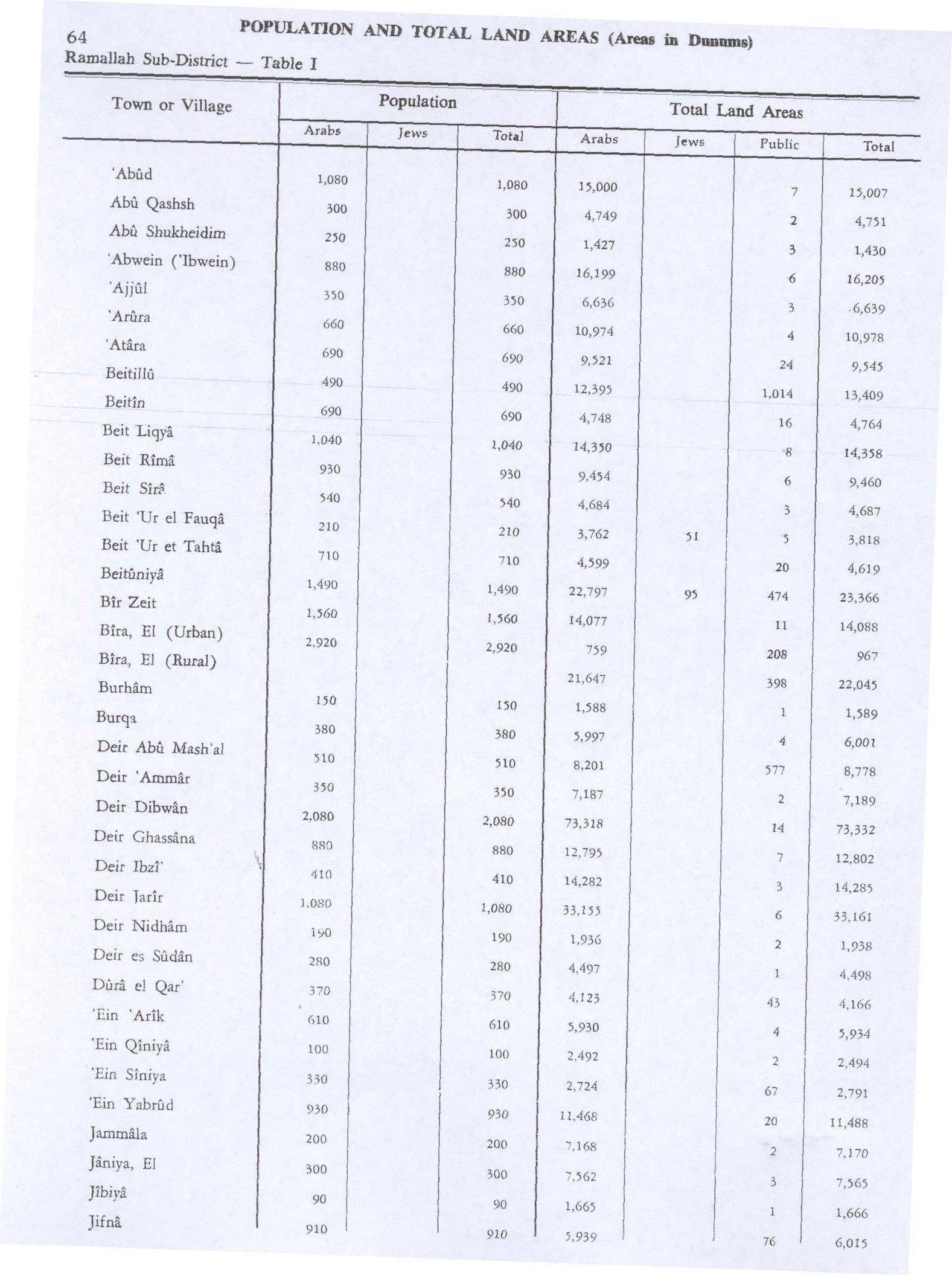
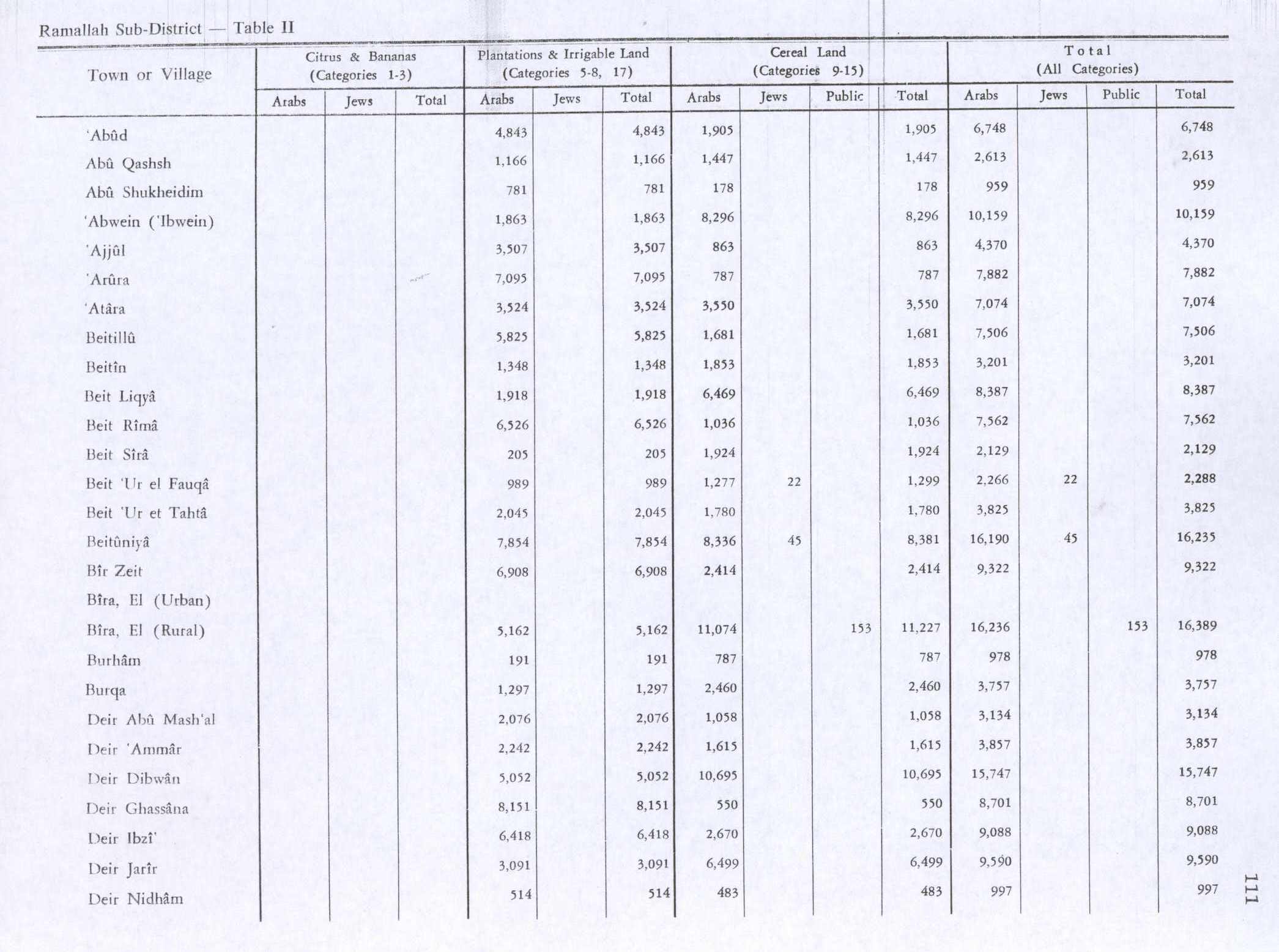
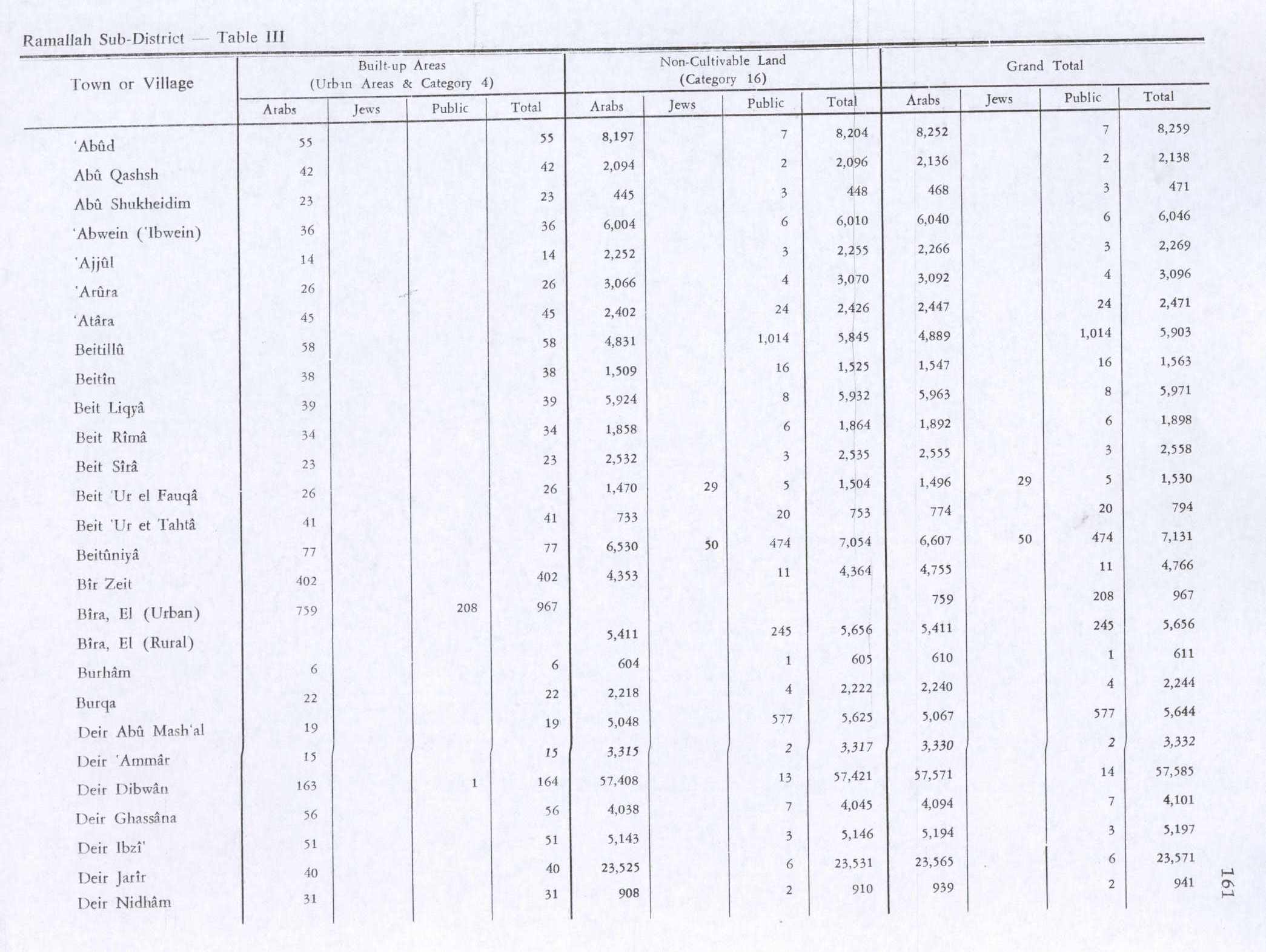
In the 1945 statistics the population was 690 Muslims,[21] while the total land area was 4,764 dunams, according to an official land and population survey.[22] Of this, 1,348 were allocated for plantations and irrigable land, 1,853 for cereals,[23] while 38 dunams were classified as built-up areas.[24]
Jordanian period
In the wake of the 1948 Arab–Israeli War, and after the 1949 Armistice Agreements, Beitin came under Jordanian rule.
In 1961, a Jordanian census found the population to be 1,017.[25]
Post-1967
After the Six-Day War in 1967, Beitin has, with the rest of the West Bank, been held under Israeli occupation. The population in the 1967 census conducted by the Israeli authorities was 958, of whom 134 originated from the Israeli territory.[26]
After the 1995 accords, 19,1% of the village land is classified as Area B, while the remaining 80.9% is defined as Area C land (full Israeli control). Beitin village land has also been taken in order to construct the illegal Israeli outpost Givat Asaf.[27][28]
On 19 December 2011, Israeli settlers were accused of carrying out a second price tag attack in only four days, in which five Palestinian-owned cars were burnt and the walls of several houses were sprayed with graffiti.[29] During the first incident (15 December 2011), the assailants not only vandalized a mosque, but also attacked an IDF military base in the West Bank, injuring a top Israeli commander.[30] According to witnesses of the second incident, the Israeli army dispersed the settlers without arresting any of them,[29] presumably also those who attacked the Israeli commander, although four days earlier the incident had prompted Israeli Prime-Minister, Benjamin Netanyahu, to say: "We won't let them attack our soldiers. We won't let them ignite a religious war with our neighbors. We won't let them desecrate mosques. We won't let them harm Jews or Arabs."[30]
Landmarks
Church ruins
The ruins of the Byzantine church are known in Arabic as "al-Muqater" or "Khirbet al-Kenise" ("Ruins of the Church").[8][31] According to Röhricht, when the Crusaders arrived, they found a ruined church. They built another and placed it first under the Abbey of St. Joseph of Arimathea, later under the Canons of the Holy Sepulcher.[8][32] The ruins of the church were drawn in the 1880s.[33][34]
Tower ruins ("al-Burj")

Another ruin, called "al-Burj Beitin" ("the Tower of Beitin") or simply al-Burj is located in the western part of the village.[8] They were also drawn in the 1880s.[35] The ruins of the Burj are about 1 meter tall, and apparently built on the older ruins of a Byzantine monastery.[36] Some have believed that it was constructed on the site where Abraham built an altar.[11][37] According to biblical scholar Edward Robinson who visited Palestine in the 19th century, al-Burj Beitin consisted of dilapidated stones that used to form part of a fortress and a Greek church.[3] Al-Burj was used as a watch tower by the Crusaders.[8]
Demographics

In 1997, Palestinian refugees accounted for exactly 30% of the population, which was 1,510 at the time.[38]
According to the Palestinian Central Bureau of Statistics (PCBS), Beitin had a population of over 3,050 inhabitants in 2006.[39] In 2007, a PCBS census recorded a population of 2,143 (1,128 men and 1,015 women). There were 717 homes in the village and the average household size consisted of 4.9 family members.[40]
References
<templatestyles src="Reflist/styles.css" />
- ↑ a b c d e f Script error: No such module "citation/CS1".
- ↑ a b c d e Script error: No such module "Citation/CS1".
- ↑ a b c d Robinson and Smith, 1841, vol. 2, pp. 125-130.
- ↑ Script error: No such module "citation/CS1".
- ↑ a b c Finkelstein and Lederman, 1997, p. 518
- ↑ Dauphin, 1998, p. 835
- ↑ Keio University, Archaeological Excavations and Development of Resources for Tourism at Beitin (Bethel), website of the Japan Consortium for International Cooperation in Cultural Heritage Independent Administrative Instituti. Accessed 15 April 2019.
- ↑ a b c d e f Luza, also Bethel - (Beitin) Script error: No such module "webarchive". Studium Biblicum Franciscanum - Jerusalem. 2000-12-19.
- ↑ Script error: No such module "citation/CS1".
- ↑ Lutfiyya, 1966, p. 36
- ↑ a b Visit Palestine: Bittin Visit Palestine.
- ↑ Robinson and Smith, 1841, vol 3, Appendix 2, p. 122
- ↑ Guérin, 1869, pp. 14-26
- ↑ Socin, 1879, p. 148. It was noted in the Bire District
- ↑ Hartmann, 1883, p. 127 also noted 55 houses
- ↑ Conder and Kitchener, 1882, SWP II, pp. 295-296
- ↑ Schick, 1896, p. 121
- ↑ Grant, 1907, p. 218
- ↑ Barron, 1923, Table VII, Sub-district of Ramallah, p. 16
- ↑ Mills, 1932, p. 47
- ↑ Government of Palestine, Department of Statistics, 1945, p. 26
- ↑ Government of Palestine, Department of Statistics. Village Statistics, April, 1945. Quoted in Hadawi, 1970, p. 64
- ↑ Government of Palestine, Department of Statistics. Village Statistics, April, 1945. Quoted in Hadawi, 1970, p. 111
- ↑ Government of Palestine, Department of Statistics. Village Statistics, April, 1945. Quoted in Hadawi, 1970, p. 161
- ↑ Government of Jordan, Department of Statistics, 1964, p. 24 It was further noted (note 2) that it was governed by a mukhtar.
- ↑ Script error: No such module "citation/CS1".
- ↑ Beitin (village profile), ARIJ, pp. 17-19
- ↑ Nahum Barnea, 'Beitunian nights: The IDF in the West Bank', Ynet 18 March 2016.
- ↑ a b Script error: No such module "citation/CS1".
- ↑ a b Script error: No such module "citation/CS1".
- ↑ Conder and Kitchener, 1882, SWP II, p. 305
- ↑ Röhricht, 1887, ZDPV 10, pp. 207, 292
- ↑ Wilson, c1881, vol 1, pp. 219 (ill.), 221
- ↑ Pringle, 1993, pp. 104 -105
- ↑ Wilson, c1881, vol 1, p. 217 (ill.)
- ↑ Finkelstein and Lederman, 1997, p. 522
- ↑ Conder and Kitchener, 1882, SWP II, p. 307
- ↑ Palestinian Population by Locality and Refugee Status Script error: No such module "webarchive". Palestinian Central Bureau of Statistics.
- ↑ Projected Mid -Year Population for Ramallah & Al Bireh Governorate by Locality 2004- 2006 Palestinian Central Bureau of Statistics (PCBS)
- ↑ 2007 PCBS Census. Palestinian Central Bureau of Statistics. p.114.

Script error: No such module "Check for unknown parameters".
Bibliography
<templatestyles src="Refbegin/styles.css" />
- Script error: No such module "citation/CS1".
- Script error: No such module "citation/CS1". (p. 284)
- Script error: No such module "citation/CS1".
- Script error: No such module "citation/CS1".
- Script error: No such module "citation/CS1".
- Script error: No such module "citation/CS1".
- Script error: No such module "citation/CS1".
- Script error: No such module "citation/CS1".
- Script error: No such module "citation/CS1".
- Script error: No such module "citation/CS1".
- Script error: No such module "citation/CS1". (pp. 205-206)
- Script error: No such module "citation/CS1".
- Script error: No such module "citation/CS1".
- Script error: No such module "Citation/CS1".
- Script error: No such module "citation/CS1".
- Script error: No such module "citation/CS1".
- Script error: No such module "citation/CS1".
- Script error: No such module "citation/CS1".
- Script error: No such module "citation/CS1".
- Script error: No such module "citation/CS1".
- Script error: No such module "Citation/CS1".
- Script error: No such module "Citation/CS1".
- Script error: No such module "Citation/CS1".
- Script error: No such module "citation/CS1".
- Script error: No such module "citation/CS1".
External links
- Welcome To Beitin
- Survey of Western Palestine, Map 14: IAA, Wikimedia commons
- Beitin (fact sheet), Applied Research Institute–Jerusalem (ARIJ)
- Beitin (village profile), ARIJ
- Beitin (aerial photo), ARIJ

Script error: No such module "Navbox".