Bayt Daras
Template:Short description Template:Pp-extended Script error: No such module "Settlement short description".Script error: No such module "Infobox".Template:Template otherScript error: No such module "Check for unknown parameters".Script error: No such module "Check for conflicting parameters".Expression error: Unexpected < operator.
Bayt Daras (Template:Langx) was a Palestinian Arab town located Script error: No such module "convert". northeast of GazaTemplate:SfnTemplate:Sfn and approximately Script error: No such module "convert". above sea level. The village was depopulated and destroyed during the 1948 Palestine war, as part of the 1948 Palestinian expulsion and the Nakba.[1]
History
A grave, dating to the Hellenistic era, probably from the first half of the third century BCE, have been found and excavated at the site.[2]
Bayt Daras was an archaeological site that contained stone foundations and vaulted rooms. The Crusaders built a castle on the hill that overlooked the village.[1][3][4] Church endowments and land deeds mention it as Betheras.[5] During the Mamluk rule in Palestine, (1205-1517), Bayt Daras formed part of a mail route from Cairo to Damascus. In this period, in 1325, a khan, or caravanserai, was built in the village.[6][1]
Bayt Daras was one of twin villages carrying this name, inhabited in the 15th century. In 1459, Mamluk records mention Bayt Daras al-Surgha (Lesser Bayt Daras)'s endowment as a waqf.[5]
Ottoman Empire
In 1517, Bayt Daras was incorporated into the Ottoman Empire with the rest of Palestine. In first Ottoman tax register of 1526/7 the village had a population of 22 Muslim households, and it belonged to the nahiya (subdistrict) of Gaza (Gaza Sanjak).[7] In 1596 the village also appeared as being in the nahiya of Gaza under the Liwa of Gaza, with a population of 58 Muslim households; an estimated 319 persons. It paid a fixed tax rate of 33,3% on a number of crops, including wheat and barley, as well as on goats, beehives and vineyards; a total of 7,900 akçe. 1/24 of the revenue went to a waqf.[8]
During the 17th and 18th centuries, the area of Bayt Daras experienced a significant process of settlement decline due to nomadic pressures on local communities. The residents of abandoned villages moved to surviving settlements, but the land continued to be cultivated by neighboring villages.[9]
In 1838, Beit Daras was noted as a Muslim village in the Gaza district.[10][11]
French explorer Victor Guérin visited the village in 1863, and found it to have 700 inhabitants.[12] In the 1882 PEF's Survey of Western Palestine (SWP), the village of Bayt Daras was described as being surrounded by gardens and olive groves, and it was bordered to the north by a pond.[13]
British Mandate

In the 1922 census of Palestine, conducted by the British Mandate authorities, Bait Daras had a population of 1,670 Muslims,[14] increasing in the 1931 census of Palestine, to 1,804, still all Muslim, in 401 inhabited houses.[15]

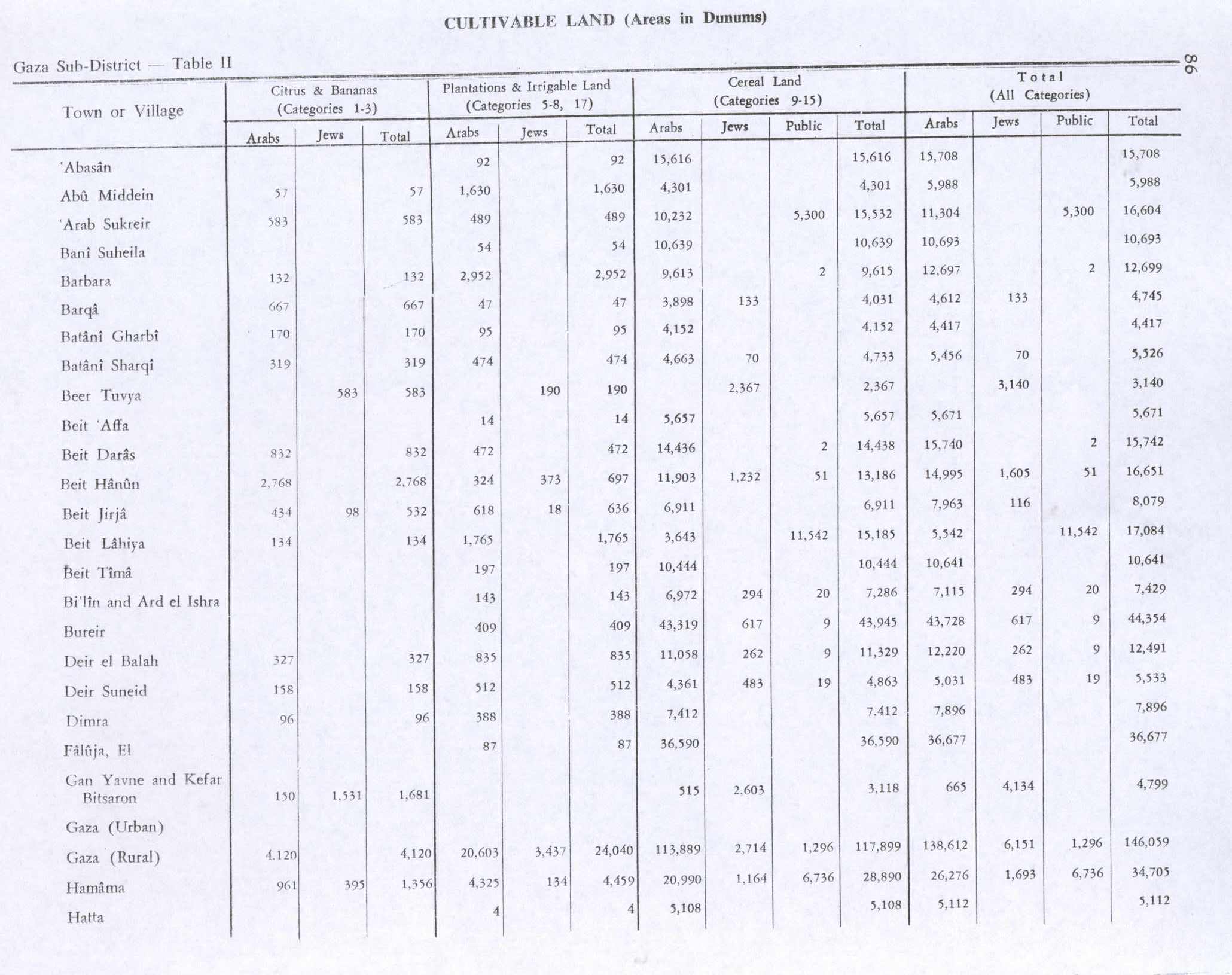
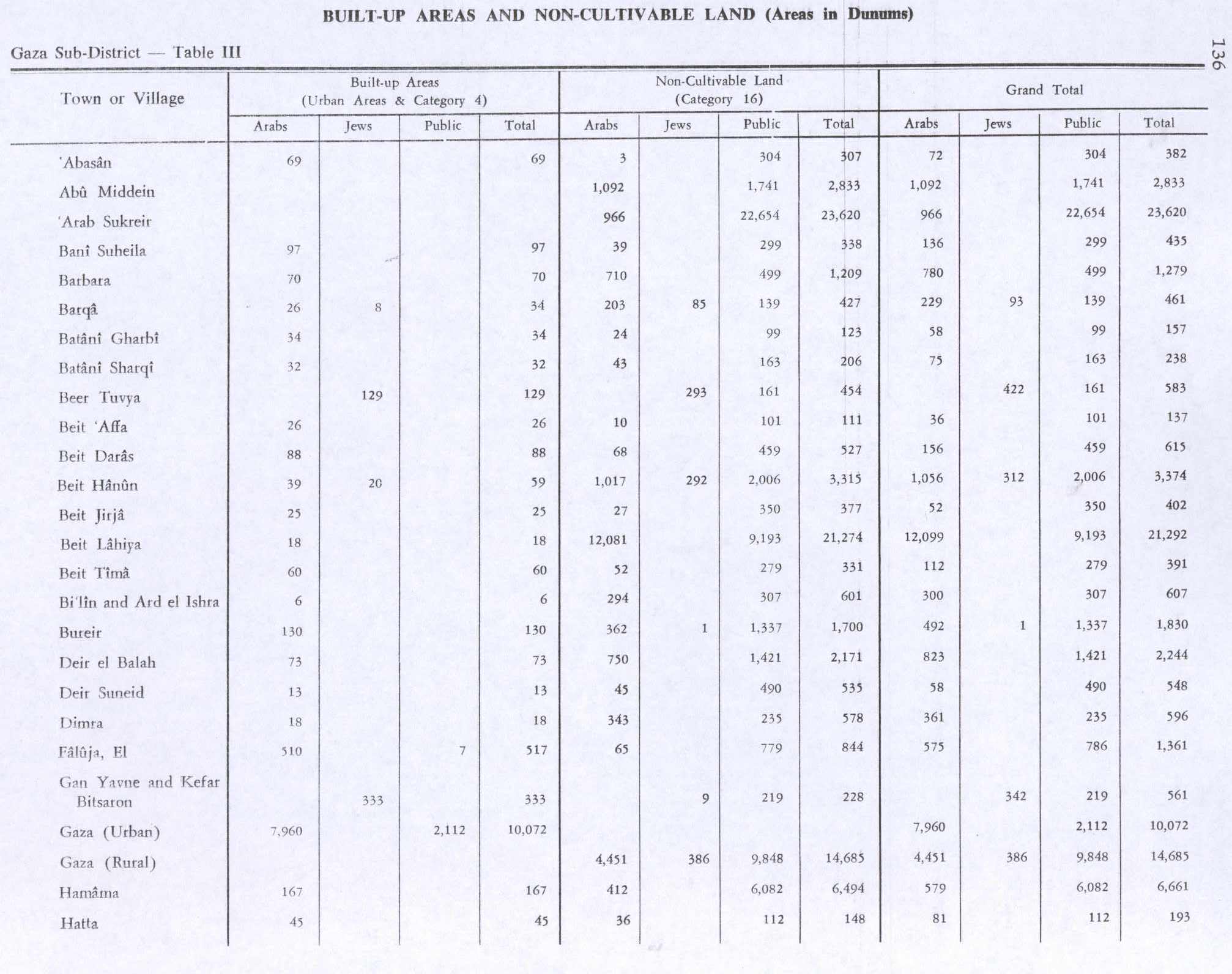
In the 1945 statistics Beit Daras had a population of 2,750 Muslims,[16] with 16,357 dunams of land, according to an official land and population survey.[17] Of this, 832 dunams were allocated to citrus and banana plants, 472 plantations and irrigable land, 14,436 used for cereals,[18] while 88 dunams were built-up land.[19] One quarter of the land was owned by a single family, one of whose survivors still has their title deeds in her keeping in a Khan Younis refugee camp.Template:SfnTemplate:Sfn A school was established there in 1921 and in its first year had 234 students enrolled, taught by 5 teachers in six classes.Template:Sfn
In addition to agriculture, residents practiced animal husbandry which formed was an important source of income for the town. In 1943, they owned 653 heads of cattle, 489 sheep over a year old, 103 goats over a year old, 35 camels, 10 horses, 18 mules, 299 donkeys, 6307 fowls, 2454 pigeons, and 23 pigs.[20]
1948 war and destruction
Script error: No such module "labelled list hatnote".
Template:Nakba According to Palestinian accounts, Beit Daras villagers lived peacefully with residents of Tabiyya, a walled kubaniya (Jewish colony) on its borders. Jews brought their produce, spoke the dialect fluently and their local doctor, Tsemeh, would care for Beit Daras' sick people when called on for assistance. The only anomaly was the occasional sound of gunfire practice in Tabiyya which soldiers from the British army appeared to be training their neighbours in the use of arms. Occasionally British soldiers on horseback made harassing forays into Beit Daras. Template:Sfn
According to Ramzy Baroud, Beit Daras began to be subjected to heavy shelling on March 27–28, 1948, during which nine villagers died and much of the crops were destroyed.Template:SfnTemplate:Sfn
The village was subject to an Israeli offensive military assault four times.[21] It was defended by the Sudanese Army and a number of local militiamen and, The objective of the Palmach's operational plan, 'Operation Lightning' (Mivtza Barak) was to compel the Arab inhabitants of the area to 'move' and by striking one or more population centres to cause an exodus, which was foreseen given the wave of panic that was sweeping Arab communities after the Deir Yassin massacre. Template:Sfn Bayt Daras was targeted to be surrounded, to have the villagers surrender and hand over their arms, and if this order was resisted, it was to be mortared, stormed and 'dealt with in the manner of scorched earth'.
The village was attacked and captured on May 11, 1948 by the Givati Brigade during Operation Barak, just prior to the outbreak of the 1948 Arab–Israeli War.[22] The village suffered some 50 casualties, and many houses were then blown up, and wells and granaries sabotaged.[23] Bayt Daras had a population of 3,190 living in 709 houses in 1948. In Baroud's account, a massacre took place as people fled the village.Template:Sfn

According to the memoirs of Gamal Abdel Nasser, the empty village was reoccupied by Sudanese forces in June, but they left after a signaling error caused them to be shelled by their own side.[24]
Structures in the village were made of stone foundations with vaulted rooms. There were also two elementary schools and two mosques, all of which were demolished after its capture.
Following the war the area was incorporated into the State of Israel. In 1950 the moshav of Giv'ati was built on the site of the village, with two other moshavim, Azrikam, Emunim, established on land that had belonged to Bayt Daras.[1] Later in the 1950s a farm called Zemorot was built on Khirbat Awda, which had also belonged to Bayt Daras.[25]
In 1992 the village site was described: "The only remain of village buildings are the foundations of one house and some scattered rubble. The site is overgrown with wild vegetation interspersed by cactuses and eucalyptus trees. At least one of the streets is clearly recognisable. The surrounding fields are cultivated by the settlements."[25]
Culture
A woman's thob (loose fitting robe with sleeves) dated to about 1930 from the village of Beit Daras is part of the Museum of International Folk Art (MOIFA) collection at Santa Fe. The dress fabric is called abu hizz ahmar (black cotton ground with purple, orange and green stipes of cotton and silk), from Majdal. The only embroidery on the front is below the neck opening. The back panel has three horizontal bands of embroidery, and a local version of the khem-el-basha ("the pashas tent") motif along the hem.[26]
Notable Palestinians with roots in Bayt Daras
- Ramzy Baroud
- Abdallah Tayeh, a Palestinian writer and novelist, author of Moon in Beit Daras (2001).Template:Sfn
See also
References
<templatestyles src="Reflist/styles.css" />
- ↑ a b c d Khalidi, 1992, p. 87
- ↑ Eisenberg-Degen et al., 2019, ‘Azriqam, Giv‘ati Pumping Station
- ↑ 545, 546 in 1177 CE, in Röhricht, 1893, p. 145
- ↑ Ellenblum, 2003, p. 202
- ↑ a b Script error: No such module "Citation/CS1".
- ↑ Cite error: Script error: No such module "Namespace detect".Script error: No such module "Namespace detect".
- ↑ Script error: No such module "Citation/CS1".
- ↑ Hütteroth and Abdulfattah, 1977, p. 146. Quoted and estimated in Khalidi, 1992, p. 87
- ↑ Script error: No such module "Citation/CS1".
- ↑ Robinson and Smith, 1841, vol 2, p. 369
- ↑ Robinson and Smith, 1841, vol 3, 2nd appendix, p. 118
- ↑ Guérin, 1869, p. 81
- ↑ Conder and Kitchener, 1882, II:409. Also quoted in Khalidi, 1992, p.87
- ↑ Barron, 1923, Table V, Sub-district of Gaza, p. 8
- ↑ Mills, 1932, p. 2
- ↑ Cite error: Script error: No such module "Namespace detect".Script error: No such module "Namespace detect".
- ↑ Cite error: Script error: No such module "Namespace detect".Script error: No such module "Namespace detect".
- ↑ Government of Palestine, Department of Statistics. Village Statistics, April, 1945. Quoted in Hadawi, 1970, p. 86
- ↑ Government of Palestine, Department of Statistics. Village Statistics, April, 1945. Quoted in Hadawi, 1970, p. 136
- ↑ Script error: No such module "Citation/CS1".
- ↑ S.A. Jawad, 'Zionist Massacres: the creation of the Palestine Refugee Problem,' in Eyal Benvenisti, Chaim Gans, Sari Hanafi (eds.) Israel and the Palestinian Refugees, Springer 2007 pp.59-127 p.81 n.60.
- ↑ Morris, 2004, pp. 256-257
- ↑ Morris, 2004, p. 256
- ↑ Script error: No such module "Citation/CS1".
- ↑ a b Khalidi, 1992, p. 88
- ↑ Stillman, 1979, p. 76
Script error: No such module "Check for unknown parameters".
Bibliography
<templatestyles src="Refbegin/styles.css" />
- Script error: No such module "citation/CS1".
- Script error: No such module "citation/CS1".
- Script error: No such module "citation/CS1".
- Script error: No such module "citation/CS1".
- Script error: No such module "citation/CS1".
- Script error: No such module "citation/CS1".
- Script error: No such module "Citation/CS1".
- Script error: No such module "citation/CS1".
- Script error: No such module "citation/CS1".
- Script error: No such module "citation/CS1".
- Script error: No such module "citation/CS1".
- Script error: No such module "citation/CS1".
- Script error: No such module "citation/CS1".
- Script error: No such module "citation/CS1".
- Script error: No such module "citation/CS1".
- Nasser, G.A. (1955/1973): "Memoirs" in Journal of Palestine Studies
- “Nasser's Memoirs of the First Palestine War” in 2, no. 2 (Win. 73): 3-32, pdf-file, downloadable
- Script error: No such module "citation/CS1".
- Script error: No such module "citation/CS1".
- Script error: No such module "citation/CS1".
- Script error: No such module "citation/CS1".
- Script error: No such module "citation/CS1".
- Stillman, Yedida Kalfon (1979): Palestinian costume and jewelry, Albuquerque: University of New Mexico Press, Template:ISBN (A catalog of the Museum of International Folk Art (MOIFA) at Santa Fe's [1] collection of Palestinian clothing and jewelry.)
External links
- Welcome to Bayt Daras Palestine Remembered
- Bayt Daras, Zochrot
- Survey of Western Palestine, Map 16: IAA, Wikimedia commons
- Dome structure in ‘Azrikam
- Bayt Daras from the Khalil Sakakini Cultural Center

Template:Palestinian Arab villages depopulated during the 1948 Palestine War Template:Massacres against Palestinians Template:Authority control